How to Remember What You Study in Only 15 Minutes
A practical 15-minute study session design: one topic, active recall, and a 3-minute end-of-session recall that makes short windows count for retention.
Table of Contents
- Why 15 Minutes Can Be Enough
- What 15 minutes can and cannot do
- Designing a 15-Minute Session for Maximum Retention
- The 15-minute template
- Why this order works
- Quick versions for different situations
- The Single-Topic Rule for Short Study Windows
- Why single-topic matters
- How to choose the topic
- Shrink the topic until it fits
- End-of-Session Recall: The Most Important 3 Minutes
- How to do it
- Why it works so well
- A quick self-rating
- Stacking 15-Minute Sessions Across a Week
- A simple weekly pattern
- Let a system schedule it
- Common Mistakes in Short Sessions
- A 15-Minute Session You Can Start Right Now
- Frequently Asked Questions
- Is 15 minutes of studying actually effective?
- What is the best way to memorize something in 15 minutes?
- How many 15-minute sessions should I do per day?
- Can I learn new material in 15 minutes?
- What if I only have 15 minutes before an exam?
- The Bottom Line
You can remember a surprising amount in 15 minutes if you study one topic only, spend most of the time retrieving instead of rereading, and finish with 3 minutes of free recall. A short session is not a weaker version of a long one. Used well, it can be more effective per minute.
Maybe you have a meeting in an hour, a commute, a lunch break, or just one of those days where “a proper study session” is not going to happen. Fifteen minutes feels too short to matter. It is not. This guide shows you exactly how to design a 15-minute block so that it leaves something in your long-term memory, not just a feeling of having looked at the material. To turn these sessions into a routine that keeps material for months, pair them with the methods in how to memorize fast and not forget.
Why 15 Minutes Can Be Enough
Short sessions work because memory depends more on how you study than on how long you study. A focused 15 minutes with retrieval beats an unfocused hour of rereading.
Three findings explain why:
- Retrieval practice is stronger than review. In the well-known Karpicke and Roediger (2008) study published in Science, students who practiced retrieving word translations recalled roughly 80% a week later, compared with about a third for students who simply restudied. Same material, very different results.
- Attention fades quickly. Most people can sustain intense focus for only a limited stretch before quality drops. A short, bounded session makes it easier to stay fully on task.
- Spacing beats cramming. Studies on the spacing effect, such as the large review by Cepeda and colleagues (2006), show that distributing practice across days produces better long-term retention than the same time in one block. Three 15-minute sessions across a week often beat one 45-minute session.
What 15 minutes can and cannot do
| 15 minutes is good for | 15 minutes is not enough for |
|---|---|
| Reviewing a deck of flashcards | Learning a brand-new complex chapter from zero |
| Retrieving a single topic or section | Writing a full essay or lab report |
| Fixing the gaps from yesterday | Working through a long problem set |
| Preparing a small set of facts for tomorrow | Deep conceptual understanding of a hard subject |
Use short sessions for retention and consolidation. Use longer blocks for first-time understanding.
Designing a 15-Minute Session for Maximum Retention
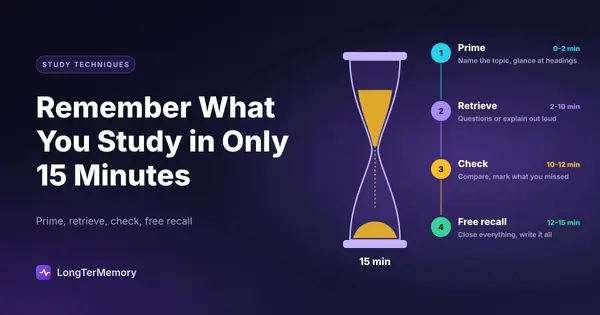
The best 15-minute structure is: prime for 2 minutes, retrieve for 8, check for 2, and recall freely for 3. Every minute has a job, and none of them is passive reading.
The 15-minute template
| Minutes | Phase | What you do |
|---|---|---|
| 0 to 2 | Prime | Name the topic. Look at the headings or your notes only, then write down three things you already know about it |
| 2 to 10 | Retrieve | Answer questions or flashcards, or explain the topic out loud without notes |
| 10 to 12 | Check | Compare with the source, mark what you missed, and read only the missed parts |
| 12 to 15 | Free recall | Close everything and write or say everything you remember |
Why this order works
- Priming warms up what you already know, so new information has something to attach to.
- Retrieval is the main event. Struggling to remember is the signal that you are strengthening the memory.
- Checking corrects errors immediately, which prevents you from reinforcing the wrong answer.
- Free recall consolidates the session and gives you an honest picture of what stuck.
Quick versions for different situations
| Situation | Adapt the template like this |
|---|---|
| You have flashcards | Skip the prime. Do 8 to 10 minutes of cards, then 2 minutes on the cards you failed, then 3 minutes of recall |
| You only have a textbook | Read one page in 3 minutes, close it, then retrieve for 8 minutes |
| You’re on a bus | Do silent retrieval: ask yourself questions and answer in your head, then jot down the gaps |
| You’re before an exam | Spend the retrieval block on your weakest topic, not your favorite |
The Single-Topic Rule for Short Study Windows
In a short window, study exactly one topic. Switching between subjects costs time and attention, and in 15 minutes you cannot afford either.
Why single-topic matters
Every time you change topics, your brain has to reload context. In a long session this overhead is small. In 15 minutes it can eat a third of your time. Researchers describe this as a switch cost, and it shows up as slower responses and more errors after changing tasks.
There is a time to mix topics, which is interleaving, and it is powerful for long-term learning. But interleaving works best over a longer study block. For a 15-minute window, depth beats variety.
How to choose the topic
Use one of these simple rules:
- The weakest first. Choose the topic you missed most in your last practice test.
- The nearest deadline. What do you need to know soonest?
- The oldest memory. Which topic did you last review longest ago?
- The smallest unit. A “topic” should fit on one or two pages, such as “the stages of cell division” and not “biology”.
Shrink the topic until it fits
If you find yourself thinking “I can’t cover this in 15 minutes,” the topic is too large. Break it down:
| Too big | Right size |
|---|---|
| The French Revolution | Causes of the 1789 revolution |
| Contract law | The elements of a valid contract |
| Pharmacology | Beta blockers: mechanism and side effects |
| Python | List comprehensions and how to write them |
A good test: can you write 5 to 10 questions about it? If yes, it fits.
End-of-Session Recall: The Most Important 3 Minutes
The last 3 minutes of a session, in which you close everything and write down what you remember, are the most valuable part. They convert a study session into a retrieval event, and they show you exactly what to fix next time.
How to do it
- Close the book and notes. Put away your phone as well.
- Set a 3-minute timer.
- Write or say everything you can remember about the topic: terms, steps, examples, numbers, connections. Do not stop when it gets hard.
- Look at the source for 30 to 60 seconds and mark what you missed.
- Write down one next action, such as “make cards for the three missed items.”
Why it works so well
- It’s retrieval without cues, the hardest and most effective form.
- It gives you feedback about the gap between what you thought you knew and what you really know.
- It creates a plan for your next 15 minutes, so you never waste time deciding what to study.
If you want a deeper look at the technique, our guide to the blurting method uses exactly this kind of free recall.
A quick self-rating
After your recall, rate yourself from 1 to 5:
| Score | Meaning | Next step |
|---|---|---|
| 1 to 2 | Most of it didn’t stick | Re-study the basics, then schedule another session tomorrow |
| 3 | About half | Review the missed items and test again in two days |
| 4 to 5 | Most of it recalled | Move on, and schedule a review for later in the week |
Stacking 15-Minute Sessions Across a Week
One 15-minute session helps. Several, spaced over days, create long-term memory. The point is to return to the topic just as you’re about to forget it.
A simple weekly pattern
| Day | Session | Purpose |
|---|---|---|
| Day 1 | 15 min on Topic A | First retrieval pass |
| Day 2 | 15 min on Topic A (gaps only) | Fix what you missed |
| Day 4 | 15 min on Topic A | Spaced review |
| Day 8 | 15 min on Topic A | Longer-gap review |
| Day 15 to 21 | 15 min on Topic A | Consolidation |
Each time, the retrieval will feel a bit harder, and that’s how you know it’s working. The expanding gaps are the idea behind spaced repetition. If you want to know more, read about the science of spaced repetition.
Let a system schedule it
Tracking what to review and when is the part that gets lost. A tool like LongTerMemory can generate question and answer cards from your study material and schedule the reviews automatically, so your 15 minutes begins with exactly what is due. That removes the “what should I study now?” friction, which is often the biggest obstacle to using short windows. If you prefer a pure planning approach, our post on studying in 15-minute intervals covers how to structure a longer day around short blocks.
Common Mistakes in Short Sessions
- Using the time to reread. It feels productive but produces little memory.
- Starting without a topic. You waste the first five minutes deciding.
- Trying to cover too much. Better to learn 10 facts well than to skim 50.
- Skipping the final recall. It is the part that consolidates the session.
- Checking your phone “just once”. In 15 minutes, a single distraction can cost a third of the session. Put the phone in another room.
- Never returning to the topic. One short session without a review is likely to fade.
A 15-Minute Session You Can Start Right Now
Try this today:
- Pick one small topic that you can write 5 questions about.
- Set a timer for 15 minutes and put your phone away.
- Spend 2 minutes writing down what you already know.
- Spend 8 minutes answering questions about it without looking.
- Spend 2 minutes checking only what you missed.
- Spend 3 minutes writing everything you remember.
- Write the date you’ll review this again (tomorrow or in two days).
That’s it. Even if you do nothing else today, you’ve just done something that measurably improves memory.
Frequently Asked Questions
Is 15 minutes of studying actually effective?
Yes, if the minutes are spent on retrieval and the topic is small. Research on retrieval practice and spacing suggests that short, focused, repeated sessions can produce better retention than long, passive ones.
What is the best way to memorize something in 15 minutes?
Study a single small topic, test yourself repeatedly instead of rereading, check your errors, and finish with 3 minutes of free recall.
How many 15-minute sessions should I do per day?
Two to four is a reasonable range for most people, with a different topic or a different phase (new versus review) in each. Quality matters more than count.
Can I learn new material in 15 minutes?
You can start it, and you can memorize small sets of facts. For complex new material, use longer blocks for understanding and short sessions for review.
What if I only have 15 minutes before an exam?
Pick your weakest high-value topic, do a retrieval round, check your errors, and finish with a quick recall. Do not try to read new material.
The Bottom Line
Fifteen minutes is enough to build real memory when you use one topic, retrieve actively, check errors, and close with 3 minutes of free recall. Stack those sessions across days and the gaps between them will do the rest of the work.
Don’t wait for the perfect two-hour block. Set a timer, choose a small topic, and start. Your future self, sitting in the exam hall, will be glad you did.