
How to Build Mental Models for Complex Topics
Learn how to build powerful mental models that make complex topics understandable. Discover techniques using analogies, examples, and cross-domain transfer.
Table of Contents
- What Mental Models Are and Why They Outperform Isolated Facts
- Building Mental Models Through Examples, Analogies, and Application
- Phase One: Concrete Examples
- Phase Two: Explicit Abstraction
- Phase Three: Application and Prediction
- How Mental Models From One Domain Transfer to Another
- Teaching as a Mental Model Diagnostic
- Using Visual Tools to Build and Strengthen Models
- Refining Mental Models Over Time
- Mental Models and Exam Performance
- The Payoff of Model-Based Learning
Complex topics feel overwhelming because they contain too many moving parts to hold in your mind at once. Whether you are learning quantum mechanics, corporate finance, or immunology, the individual facts are not the problem. The problem is seeing how they fit together. Mental models are the solution.
A mental model is a simplified representation of how something works. It is not a memory of every detail. It is a functional map that lets you predict, explain, and navigate a domain without memorizing every possible scenario. The best learners are not necessarily the ones with the best memories. They are the ones with the best mental models.
This article explains what mental models are, why they outperform isolated facts, and how to build them deliberately using examples, analogies, and application.
What Mental Models Are and Why They Outperform Isolated Facts
Isolated facts are fragile. You memorize them for a test, and they decay within weeks. Mental models are durable because they are networked. Each fact connects to others through causal relationships, which means retrieving one fact automatically activates the others.
Consider the difference between memorizing a list of symptoms and understanding a disease process. A student with isolated facts knows that heart failure causes dyspnea, edema, and fatigue. A student with a mental model understands that pump dysfunction leads to backward congestion, which raises pulmonary pressures and causes dyspnea, while forward hypoperfusion reduces oxygen delivery to muscles and causes fatigue. The second student can predict symptoms they have not memorized because they understand the mechanism.
Cognitive scientists call this schema construction. When you organize information into a coherent framework, your brain stores it more efficiently and retrieves it more flexibly. A 2018 study in npj Science of Learning found that students who learned physics through causal models outperformed students who learned through fact memorization by 35 percent on novel problem-solving tasks. The advantage was not on recall. It was on application, which is what real exams and real work require.
Mental models also reduce cognitive load. Working memory can hold roughly four independent chunks of information at once. A mental model compresses many facts into a single chunk. Instead of holding twenty isolated facts about cardiac electrophysiology, you hold one model of the action potential cycle. That frees mental space for reasoning, calculation, and creative problem-solving.
Building Mental Models Through Examples, Analogies, and Application
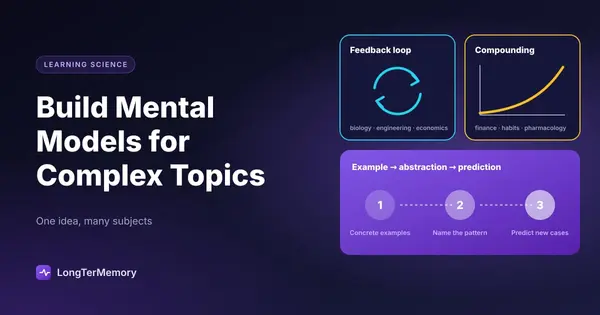
Mental models do not emerge from reading definitions. They emerge from repeated exposure to patterns across multiple examples, coupled with explicit abstraction. Here is a three-phase process for building them deliberately.
Phase One: Concrete Examples
Start with specific cases before general rules. If you are learning about supply and demand, do not begin with the abstract curves. Begin with a concrete story: a drought reduces the coffee bean harvest, so Starbucks raises prices. Work through the details. What happens to quantity supplied? What happens to consumer behavior? How do substitutes enter the picture?
Work through five to ten concrete examples before you try to state the general principle. Each example adds a data point to your unconscious pattern recognition system. By the time you encounter the formal model, your brain already has a felt sense of how it behaves.
For technical subjects, worked examples are the fastest route to mental model construction. A worked example shows every step of a solution, including the reasoning behind each step. Research by Sweller and colleagues shows that studying worked examples produces better learning than solving problems blindly, especially in the early stages of skill acquisition. The examples build the model. Problem-solving tests it.
Phase Two: Explicit Abstraction
After you have seen enough examples, extract the general pattern. Write it in your own words. Draw it as a diagram. The format matters less than the act of explicit abstraction. You are forcing your brain to distill the common structure from the specific instances.
A useful technique is the analogy bridge. Ask yourself: what does this remind me of? What other system behaves similarly? For example, the flow of electricity through a wire is analogous to water flowing through a pipe. Voltage is like pressure. Current is like flow rate. Resistance is like pipe narrowness. The analogy is not perfect, but it creates an initial scaffold that you can refine over time.
Be careful not to treat the analogy as the final truth. Analogies are training wheels. Once you understand the target concept, you should notice where the analogy breaks down. The fact that electricity does not literally flow like water is itself a learning opportunity. It forces you to identify the precise mechanisms that make the target system unique.
Phase Three: Application and Prediction
A mental model is only real when you use it to make predictions. Find problems that require you to apply the model in a slightly new context. If you learned supply and demand using coffee, test yourself with housing markets or labor markets. If the model is robust, it will transfer. If it breaks, you have discovered a boundary condition that refines your understanding.
Prediction exercises are especially powerful. Before reading the next chapter or watching the next lecture, pause and predict what will happen. If you are learning about immune responses, predict how the body would handle a novel pathogen based on what you have learned so far. Then check your prediction against the source material. The gap between your prediction and reality is exactly where your model needs refinement.
How Mental Models From One Domain Transfer to Another
One of the most powerful features of mental models is cross-domain transfer. A model built in one subject can accelerate learning in another. The mental model of feedback loops that you learn in engineering applies directly to endocrinology. The model of competitive advantage that you learn in business strategy applies to evolutionary biology.
The key to transfer is explicit comparison. Do not wait for similarities to occur to you accidentally. Actively ask: where else have I seen this pattern? Charlie Munger, the vice chairman of Berkshire Hathaway, famously built his investment approach by collecting mental models from physics, psychology, and mathematics and applying them to finance. His success is evidence that transfer is not a side effect of deep learning. It is a skill you can cultivate deliberately.
Here are some universal mental models that appear across multiple disciplines.
| Mental Model | Core Idea | Appears In |
|---|---|---|
| Feedback loops | Outputs of a system influence its future inputs | Engineering, biology, economics, psychology |
| Compounding | Small consistent changes produce exponential results | Finance, pharmacology, habit formation |
| Bottlenecks | The slowest step limits the entire system | Manufacturing, physiology, project management |
| Diminishing returns | Benefits decrease as investment increases | Economics, nutrition, study time allocation |
| Incentives | Behavior follows rewards and punishments | Economics, education, organizational design |
When you encounter a new subject, scan for these universal patterns first. If you recognize a feedback loop in a biological system, you already have a head start. You know to look for amplifiers, dampeners, delays, and equilibrium points. The specific molecules are new, but the architecture is familiar.
Teaching as a Mental Model Diagnostic
The fastest way to test whether you have a mental model or just a collection of facts is to teach the concept to someone else. If you truly understand the underlying structure, you can adapt your explanation to any audience. If you only know isolated facts, your explanation will be a list that falls apart under questioning.
Use the Feynman technique as a structured teaching exercise. Choose a concept. Explain it in plain language as if to a smart twelve-year-old. Identify the points where your explanation becomes vague or relies on jargon. Those are the gaps in your mental model. Go back to the source material, fill the gaps, and try again.
Teaching reveals whether your model is generative. A generative model produces new insights. A non-generative model only reproduces what you have seen. When you teach, pay attention to whether you can answer questions you have never explicitly studied. If a student asks “What would happen if X changed?” and you can reason through the answer, your model is working. If you are stumped, your model needs more examples and more abstraction.
Using Visual Tools to Build and Strengthen Models
Mental models are not just verbal. They are often spatial and visual. Drawing the model forces you to make relationships explicit in a way that prose does not.
Concept maps are the most flexible visual tool. Start with the central concept in the middle of the page. Draw branches to related concepts. Label each branch with the nature of the relationship: causes, inhibits, depends on, produces. The act of drawing reveals connections you did not notice while reading.
Flowcharts work well for process-based models. If you are learning a multi-step procedure like the coagulation cascade or the citric acid cycle, a flowchart makes the sequence and branching points visually obvious.
Comparison tables work well for models that involve categories or types. If you are learning about different market structures in economics, a table comparing perfect competition, monopolistic competition, oligopoly, and monopoly on dimensions like price control, entry barriers, and product differentiation builds a comparative mental model.
The best visual tool is the one that makes the structure of the system visible. If your diagram is just a list in picture form, it is not helping. If it shows causality, sequence, or hierarchy, it is building your model.
Refining Mental Models Over Time
Mental models are not static. They evolve as you encounter edge cases, exceptions, and deeper layers of a subject. A beginner’s model of evolution might be “survival of the fittest.” An advanced model includes genetic drift, gene flow, sexual selection, and the role of neutral mutations. Both are correct at their level of resolution. The advanced model is more precise and more predictive.
Expect your models to break. In fact, seek out the breaking points. Read advanced texts that contradict your current understanding. Work on problems that seem to violate the rules you have learned. The moments of confusion are where your model upgrades. A model that never breaks is either trivial or wrong.
Keep a model journal. For each major concept, write down your current model in one paragraph. Date the entry. When your understanding shifts, write a new paragraph and compare it to the old one. Over time, you will see your thinking become more nuanced, more connected, and more powerful.
Mental Models and Exam Performance
Exams, especially high-stakes professional exams, rarely test isolated facts. They test whether you can apply principles to novel scenarios. A student with strong mental models recognizes the underlying pattern in a question even when the surface details are unfamiliar.
For example, a board exam might describe a patient with a rare syndrome you have never studied. But if your mental model of endocrine feedback loops is solid, you can reason backward from the hormone levels to the likely glandular failure. The specific syndrome is new, but the architecture is not.
To prepare for this style of testing, prioritize principle-based practice questions over memorization drills. When you review an answer, do not just note whether you got it right. Ask: what mental model would have led me to the correct answer? How does this question map onto the framework I am building? This meta-level review is what converts practice into model refinement.
If you want to accelerate the process of building mental models from your study materials, LongTerMemory can help. The system does not just generate flashcards. It generates questions that test conceptual relationships and causal reasoning, the exact skills that mental models produce. By reviewing these relationship-based cards on an optimal spaced schedule, you strengthen the connections that make complex topics feel simple. You can start building your models today with a free trial.
The Payoff of Model-Based Learning
Learning through mental models is slower at first. Building a model takes more time than memorizing a list. But the payoff is enormous. A student with isolated facts knows what happened yesterday. A student with mental models knows what will happen tomorrow.
The durability is the real advantage. Facts fade. Models endure. Ten years after your exam, you will not remember the specific pharmacokinetic parameters you memorized. But if you built a mental model of how drugs interact with receptors, you will be able to learn new medications in minutes instead of hours.
Start with examples. Abstract the pattern. Test it with predictions. Teach it to someone else. Draw it. Refine it when it breaks. Do this consistently, and complex topics will stop feeling like walls of information. They will start feeling like landscapes you can navigate.