Preparing for Bar Exams, Medical Boards, and Civil Service Tests: Strategies for High-Volume Study
Bar exam prep, medical board study, or civil service exam? Learn how to organize massive volumes of material and study smarter under pressure.
Table of Contents
- The High-Volume Study Problem
- How to Organize Thousands of Pages Without Losing Your Mind
- Step 1: Inventory Before You Dive
- Step 2: Build a Subject Prioritization Matrix
- Step 3: Break Material into Reviewable Units
- Step 4: Use a Master Tracker
- Spaced Repetition Systems for Legal and Medical Subject Matter
- Why Standard Flashcards Aren't Enough for Professional Exams
- Building the System
- AI Tools for Legal and Medical Material
- Time Management: Balancing Work Commitments with Exam Preparation
- The Minimum Viable Study Window
- Protecting Study Time Like a Professional Appointment
- Avoiding Burnout Without Losing Momentum
- The Week Before the Exam
- The Bottom Line
There’s a particular kind of exam pressure that most people never experience , the kind that comes when years of training, licensing, and professional identity are riding on a single test. The bar exam. USMLE Step 1 or 2. The CPA exam. A civil service promotion test. These aren’t the college exams where a bad result means retaking the course. These are the gatekeeping assessments that determine whether you practice in your field at all.
The volume of material alone is staggering. Bar exam candidates are typically expected to know the rules of evidence, constitutional law, civil procedure, torts, contracts, property, criminal law, and several state-specific subjects. Medical board candidates face thousands of clinical vignettes spanning every major system of the body. Civil service exams for specialized roles can require mastery of entire regulatory frameworks.
The question isn’t whether you can learn it all , it’s whether you can learn it in a way that stays accessible when you need it most.
This guide is about exactly that.
The High-Volume Study Problem
The first challenge is simply psychological: opening a prep book for a major professional exam and seeing 2,000 pages of content that you’re somehow supposed to internalize can produce a kind of paralysis. Where do you even start? How do you know what matters? How do you make sure nothing falls through the cracks?
Most people respond to this overwhelm in one of two ways. Some over-plan , they spend a week creating elaborate color-coded schedules and never feel ready to actually start. Others dive in and read linearly, accumulating notes that grow faster than their understanding, until they realize two months in that they remember nothing from the beginning.
Neither approach works. What does work is a systematic, retrieval-first strategy built around the specific demands of high-stakes, high-volume exams. Everything in this guide is built around that principle.
How to Organize Thousands of Pages Without Losing Your Mind
The organizing problem is real, and it has to be solved before anything else. You cannot study effectively from a pile of material you don’t understand structurally.
Step 1: Inventory Before You Dive
Start by mapping the territory, not learning it. Spend your first two to three days doing nothing but answering these questions:
- What subjects or domains does the exam test?
- What’s the approximate weight of each subject? (Most licensing bodies publish this or you can infer it from practice exams)
- What study materials do you have, and do they cover everything?
- What’s your honest baseline in each subject? (Take a diagnostic practice test before you do a single hour of studying)
This sounds like it delays “real” studying, but it doesn’t. Without a map, every hour you study is less efficient than it would be with one. The diagnostic test alone is invaluable , it tells you where you actually stand, not where you assume you stand.
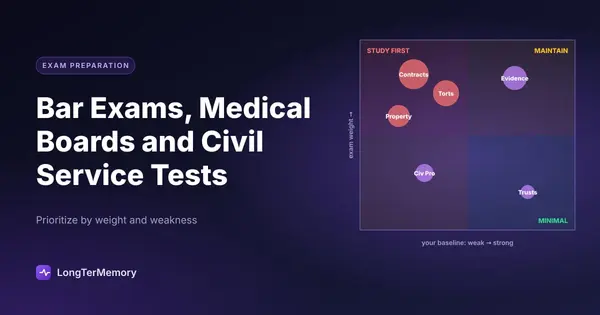
Step 2: Build a Subject Prioritization Matrix
Once you know the landscape, prioritize ruthlessly. A simple framework:
| Priority | Criteria | Action |
|---|---|---|
| High | High weight + weak baseline | Study first, review most often |
| Medium | High weight + strong baseline | Maintain, don’t neglect |
| Medium | Low weight + weak baseline | Study, but don’t over-invest |
| Low | Low weight + strong baseline | Minimal review only |
This is not permission to ignore anything. It’s a framework for allocating more time to what will move your score most. A high-weight subject where you’re currently at 40% correct answers deserves dramatically more attention than a low-weight subject where you’re already at 75%.
Step 3: Break Material into Reviewable Units
The worst thing you can do with a 500-page prep book is treat it as a monolithic object. Break every subject into topic clusters of manageable size , 15 to 30 testable concepts each. These become the atomic units of your study plan.
For the bar exam, this might mean: “Hearsay Exceptions” is one cluster. “Constitutional Equal Protection” is another. “Landlord-Tenant Law” is another. Each cluster gets its own set of flashcards, its own review schedule, and its own checkmark when you’ve reached a passing threshold of mastery.
For medical boards, it might be: “MI presentation and management,” “Hepatitis differentials,” “Pediatric developmental milestones.” Clinical vignettes, not abstract facts.
For civil service exams: “Procurement regulations,” “Personnel management principles,” “Budget formulation procedures.”
The clusters give you visible progress markers, which is important psychologically during long preparation windows. You can see yourself moving through them. You can see the gaps closing.
Step 4: Use a Master Tracker
Create a simple spreadsheet or document with every cluster listed, and track:
- Date first studied
- Current mastery level (not ready / approaching / passing / solid)
- Next review date
- Notes on weak sub-areas
Update it weekly. This becomes your source of truth for what needs attention and what doesn’t. Without it, you’ll unconsciously spend time on material you already know (because it feels good) and neglect the harder clusters.
Spaced Repetition Systems for Legal and Medical Subject Matter
Spaced repetition is the most evidence-backed approach to long-term retention available, and it’s uniquely well-suited to high-volume professional exams where you need to retain enormous amounts of material over months.
The core principle: review information at increasing intervals based on how well you know it. Material you’re struggling with gets reviewed frequently. Material you’ve mastered gets reviewed rarely. This concentrates your effort where it’s needed and prevents over-studying what you already know.
Why Standard Flashcards Aren’t Enough for Professional Exams
Basic fact-recall flashcards work well for definitions, rules, and formulas. They don’t work as well for the kind of applied reasoning that professional licensing exams require.
The bar exam doesn’t ask “define hearsay.” It presents a complex trial scenario and asks you to identify whether three different statements are admissible and why. USMLE presents a clinical vignette and expects you to diagnose, order appropriate tests, and select treatment , often while ruling out plausible alternatives. These aren’t recall tasks. They’re reasoning tasks.
This means your flashcard system needs two levels:
Level 1 , Rule recall: Can you state the rule, definition, or principle accurately? This is traditional flashcard territory.
Level 2 , Application: Given a scenario, can you correctly apply the rule? This requires practice questions, not just flashcard review.
A spaced repetition system handles Level 1 efficiently. Level 2 requires practice with exam-format questions , past exams, commercial question banks, or AI-generated application scenarios.
Building the System
The most effective approach for most candidates:
- After studying each topic cluster, create flashcards for all Level 1 content (rules, definitions, exceptions, elements)
- Immediately do 10–15 practice questions on that cluster from your question bank
- For every question you get wrong, identify whether the failure was at Level 1 (you didn’t know the rule) or Level 2 (you knew the rule but misapplied it)
- Level 1 failures get added to your spaced repetition deck with a note
- Level 2 failures get flagged for re-analysis , you need to understand the reasoning pattern, not just the rule
This dual-track approach is more work upfront but produces dramatically better results than either flashcards or question banks alone.
AI Tools for Legal and Medical Material
The newest generation of AI-powered study tools can meaningfully help with high-volume professional exam prep in ways that weren’t possible a few years ago.
What they’re good at:
- Converting your own notes and commercial outlines into flashcard decks automatically
- Generating application-level questions from source material
- Scheduling reviews automatically based on performance
- Surfacing your weakest areas across a large deck
What to be careful about:
- AI-generated medical content should always be verified against authoritative clinical sources , the stakes are too high for uncorrected errors
- Legal AI tools may reference outdated case law or jurisdiction-specific rules incorrectly , always cross-reference against your bar prep materials
- No AI tool replaces the question bank for learning exam format and reasoning patterns
According to peer-reviewed research on spaced repetition in medical education, students using systematic spaced practice significantly outperform those using passive review , with retention gains most pronounced for complex clinical material studied over longer periods. The evidence is clear; the question is only how to implement it effectively.
Time Management: Balancing Work Commitments with Exam Preparation
Here’s the reality most guides don’t state plainly: the majority of people preparing for bar exams, medical boards, and civil service tests are not studying full-time. Bar exam candidates have often just finished law school and may be working. Medical residents preparing for boards are working 60–80 hour weeks. Civil service candidates are current employees.
You are probably not in a study bubble. You have a life.
This makes time management not a nice-to-have but the central constraint of your preparation. Every hour of study time is precious in a way it simply isn’t when studying is your full-time job.
The Minimum Viable Study Window
Research on skill acquisition and memory consolidation suggests that consistency matters more than volume in any single session. Three hours of focused studying five days a week produces better retention than seven hours on Saturday and nothing else. This is because sleep plays a critical role in memory consolidation , the processing that happens between study sessions is not dead time.
For candidates with demanding work schedules, a sustainable structure often looks like:
| Time slot | Duration | Activity |
|---|---|---|
| Morning (before work) | 45–60 min | New material or review |
| Lunch break | 20–30 min | Flashcard review only |
| Evening (after work) | 60–90 min | Practice questions + analysis |
| Weekend mornings | 3–4 hours | Deep dive on weak subjects |
This isn’t a universal prescription , it’s a template to adapt. The important principle is daily contact with the material, even on days when that contact is brief.
Protecting Study Time Like a Professional Appointment
The single most consistent behavior among successful high-volume exam candidates is that they treat study blocks as non-negotiable appointments. Not “I’ll study if I have time tonight.” Study from 7–8:30 PM is in the calendar, it gets the same protection as a meeting with a senior partner or attending, and it takes active external force to cancel it.
This sounds simple. It’s harder than it sounds, especially when exhaustion is real and the exam still feels distant. The candidates who fail to protect their study time early in the preparation window almost always find themselves in crisis in the final weeks.
Avoiding Burnout Without Losing Momentum
Long preparation windows (3–6 months for most major licensing exams) create their own psychological challenge. Motivation is high at the start and high in the final weeks. The dangerous period is the middle , weeks 6 through 14 of a 20-week program , when the exam feels neither close enough to produce urgency nor far enough to feel comfortable.
Strategies that help:
- Set intermediate milestones. “By week 8 I will have completed all flashcards for constitutional law and scored 65%+ on three timed practice sections” is more motivating than “pass the bar.”
- Build in deliberate rest. One full day off per week is not laziness , it’s recovery. Sustained cognitive performance requires it.
- Track your progress visibly. Seeing your question bank score go from 42% to 58% over six weeks is genuinely motivating. Use your tracker.
- Connect with others preparing for the same exam. Study groups, online forums, and professional communities provide both accountability and perspective on shared struggle.
The Week Before the Exam
After months of preparation, the final week has a specific and counterintuitive purpose: it is not a week for learning new material. Everything you haven’t learned by seven days before the exam will not be reliably learned in seven more days. Trying will only produce anxiety and sleep disruption, both of which hurt performance.
What the final week is for:
- Light review of your highest-confidence material , reinforcing, not learning
- Reviewing your “mistakes” log , the practice questions you consistently got wrong and understand why now
- Simulating exam conditions , one timed practice session under real conditions to calibrate pacing
- Sleep. Every. Night. This is not optional. Memory consolidation happens during sleep. The studies on sleep deprivation and cognitive performance are unambiguous.
The candidates who perform best on exam day are not the ones who studied for 14 hours the night before. They’re the ones who maintained a consistent system for months and trusted it at the end.
With this much material, creating cards by hand can become a second full time job. LongTerMemory generates question and answer flashcards directly from your outlines, review books, and lecture PDFs, then schedules them with spaced repetition, so your limited hours go into reviewing instead of formatting.
The Bottom Line
High-volume professional exams are different from most academic tests in two key ways: the stakes are higher, and the material volume is genuinely extreme. These two facts make good study strategy not just helpful but determinative.
Organize the material structurally before you start studying. Use spaced repetition for retention and practice questions for applied reasoning. Protect your study time aggressively while also protecting your sleep and recovery. Build a system you can sustain for months, not one that requires heroic effort.
The lawyers, doctors, engineers, and civil servants who pass these exams aren’t necessarily the ones who worked the hardest. They’re often the ones who worked the most systematically. And there’s every reason to believe that with the right structure, you can be in that group.