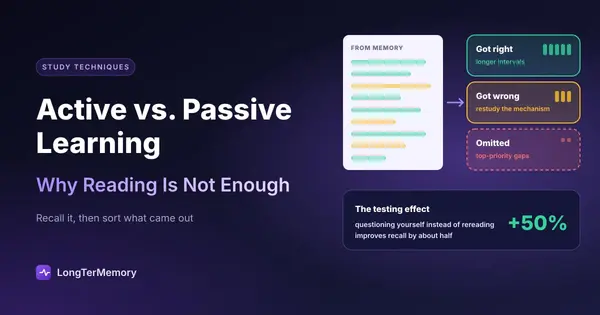
Active vs. Passive Learning: Why Reading Is Not Enough
Discover why passive study methods fail and how active learning techniques like the testing effect can improve recall by up to 50%.
Table of Contents
- What Passive Learning Actually Is (And Why It Feels Productive)
- The Testing Effect: Why Self-Questioning Improves Recall by 50%
- How to Transform Reading into Deep Comprehension
- The Question-Before-Answer Rule
- Pause and Recall After Every Section
- Generate Your Own Questions
- Interleave, Don't Block
- Practical Exercises to Verify True Understanding (Not Just Familiarity)
- The Blank Page Test
- The Teaching Test
- The Novel Application Test
- The Most Common Active Learning Mistakes
- Building a Sustainable Active Learning Habit
- The Bottom Line
Let’s be honest about something. When most people say they’ve been studying, what they’ve actually been doing is reading. Maybe with a highlighter. Maybe while listening to a playlist. Occasionally pausing to re-read a paragraph that didn’t land the first time. Then closing the book, feeling like something productive happened, and moving on.
This is passive learning. And the uncomfortable truth is that it barely works.
This isn’t a personal failing , it’s a design flaw in how most of us were taught to study. Nobody sat us down and explained that the feeling of understanding something and actually retaining it are two completely different cognitive events. Nobody told us that the methods that feel most comfortable , re-reading, highlighting, summarizing , consistently rank among the least effective in controlled studies.
The good news is that once you understand the difference between active and passive learning, switching to better methods is not particularly hard. It just requires doing something that feels a little more uncomfortable in the short term.
What Passive Learning Actually Is (And Why It Feels Productive)
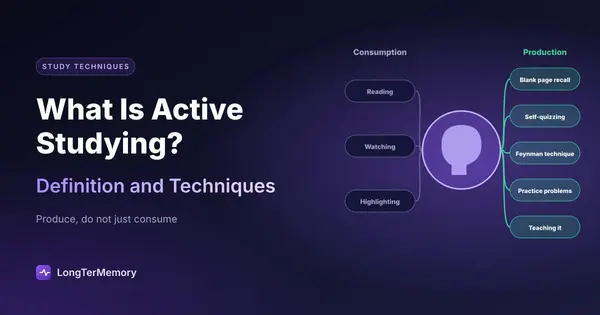
Passive learning is any study activity where you receive information without actively processing or retrieving it. The defining feature: your brain is in consumption mode, not production mode.
Common passive learning activities:
- Re-reading notes or textbook chapters
- Highlighting or underlining text
- Watching lecture recordings without pausing to test yourself
- Listening to recorded content
- Copying notes by hand without generating questions
The reason these methods feel productive is real and well-documented. When you re-read material, it starts to feel familiar. That familiarity registers in your brain as a positive signal , “yes, I recognize this, I know this.” Psychologists call this the fluency illusion: you mistake the ease of recognition for the depth of understanding.
The problem surfaces on the exam. The exam doesn’t show you information and ask if you recognize it. It gives you a blank page and asks you to retrieve it. And retrieval , pulling something from memory without a prompt , is a completely different cognitive skill than recognition. You can ace recognition and fail retrieval on the same material.
This is the gap that passive learning doesn’t close, and that active learning specifically targets.
The Testing Effect: Why Self-Questioning Improves Recall by 50%
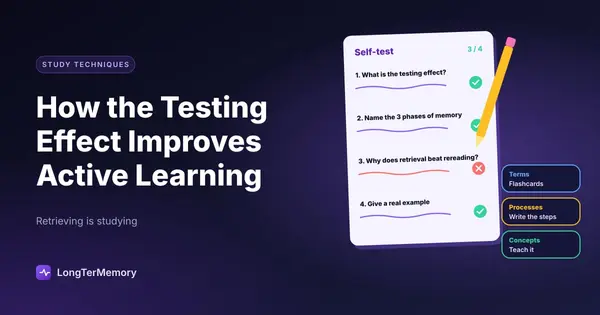
The most robust finding in educational psychology is something researchers call the testing effect (also called retrieval practice or the testing effect). The core finding: the act of retrieving information from memory strengthens that memory more than additional study does.
This has been demonstrated in hundreds of studies over more than a century of research. A landmark 2006 study by Roediger and Karpicke , two of the most cited researchers in this area , showed that students who studied material once and then took three practice tests retained about 80% of the material a week later. Students who re-studied the same material four times retained about 36%.
Same material. Same total time. Dramatically different outcomes.
According to a comprehensive review of learning techniques published in Psychological Science in the Public Interest, retrieval practice receives the highest utility rating of any study method , above elaborative interrogation, self-explanation, interleaved practice, and all passive methods. The evidence base is simply stronger than for any other approach.
What makes retrieval practice so effective? A few mechanisms:
Desirable difficulty. Struggling to retrieve something , the effortful feeling of reaching for an answer before you check , is cognitively demanding in exactly the right way. The effort itself signals to your brain that this information is important and worth holding onto. Easy review doesn’t produce this signal.
Error correction. When you try to recall something and get it wrong, then check the correct answer, you remember the correction better than if you’d simply read the correct answer cold. The contrast between what you believed and what’s true creates a more durable memory.
Metacognitive accuracy. Testing yourself gives you honest feedback about what you actually know versus what you think you know. Passive review gives you confidence. Active retrieval gives you data.
How to Transform Reading into Deep Comprehension
The shift from passive to active learning doesn’t require buying new materials or spending more time studying. It requires changing what you do with the time you already have. Here are the concrete methods that move information from surface familiarity to real understanding.
The Question-Before-Answer Rule
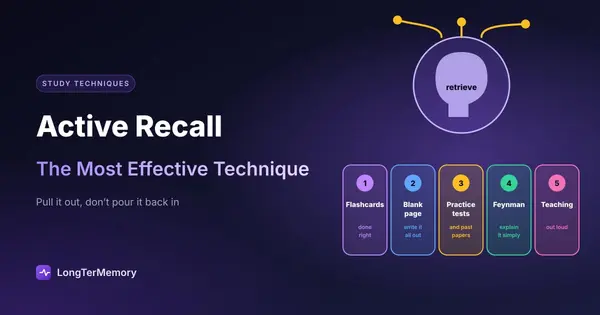
The simplest change with the biggest impact: never look at an answer before attempting it. This applies to flashcards, practice problems, and even re-reading your own notes.
When you open your notes to review, cover the answers or explanations. Try to reconstruct them from memory first. Then check. The attempt , even if unsuccessful , dramatically improves how well you remember the correct answer when you see it.
Most students do this backwards. They look at the question and answer together, confirm they recognize it, and call that studying. They’re essentially bypassing the entire mechanism that makes retrieval practice work.
Pause and Recall After Every Section
After reading any section of material , a chapter, a lecture unit, a set of notes , close everything and spend two to three minutes writing down everything you can remember.
Not a summary. Not a neat outline. Everything you can pull up: key concepts, examples, the specific phrasing of an important definition, anything. Then open the material and check what you got right, what you got wrong, and what you missed entirely.
The gaps you find are not failures. They’re your study agenda. They tell you exactly what to focus on in the next session, with far more precision than re-reading would.
Generate Your Own Questions
As you read, stop periodically and write a question that would test the content you just covered. Not “what did I just read?” but a question that could plausibly appear on an exam: “What are the three conditions under which X occurs?” or “Why does Y lead to Z rather than the reverse?”
This technique accomplishes two things simultaneously. First, it forces you to think about the material from the examiner’s perspective , what’s actually testable, what’s core versus peripheral. Second, the questions become your review deck for later sessions.
Interleave, Don’t Block
Interleaved practice is closely related to active learning and consistently outperforms blocked practice. Blocked practice means finishing all of Topic A before moving to Topic B. Interleaved practice means mixing problems or topics , A, B, C, B, A, C.
Blocked practice feels more productive because you build momentum and get into a groove. Interleaved practice feels harder because you constantly have to switch context. But that switching forces your brain to actively retrieve the right approach for each problem rather than riding on the momentum of repetition. On tests, where context-switching is mandatory, this advantage is decisive.
Practical Exercises to Verify True Understanding (Not Just Familiarity)
Here’s a set of self-tests you can run on any topic to determine whether you genuinely understand it or just recognize it:
The Blank Page Test
Take a piece of paper. Write the name of the concept or topic at the top. Now explain it , completely, from memory, in your own words. Include definitions, mechanisms, examples, exceptions, and connections to related ideas. Don’t look anything up until you’re done.
When you check against the source material, pay attention to three categories:
| Category | What it means | What to do |
|---|---|---|
| Things you got right | Solid understanding | Move to longer review intervals |
| Things you got wrong | Surface familiarity without depth | Re-study the mechanism, not just the fact |
| Things you omitted | Blind spots | These are your highest-priority gaps |
The Teaching Test
Explain the concept out loud to someone , a friend, a study partner, your cat. If nobody’s available, explain it to a phone camera. You don’t need a real audience; you need the cognitive constraint of having to make your explanation coherent to another mind.
The moment you get fuzzy, stumble over an explanation, or realize you can’t produce a clear example , that’s the gap. That’s where you don’t actually understand it yet, even if you thought you did. Honest teaching forces intellectual precision that private review lets you avoid.
The Novel Application Test
Find a scenario, case study, or problem involving the concept that you’ve never seen before. Can you correctly apply what you know?
This is the highest-level test, and it’s the most predictive of exam performance. It’s also the one that passive study most consistently fails to prepare you for. You can recognize the concept in familiar contexts all day and still fail to apply it when it’s framed differently. Only active practice with varied examples builds this kind of flexible understanding.
The Most Common Active Learning Mistakes
Knowing the methods isn’t enough if you undermine them in practice. Here are the errors to watch for.
Peeking too soon. You flip a flashcard, nothing comes immediately, and you check the answer after five seconds. You’ve just turned active recall into passive review. Give yourself at least 30 seconds of genuine effort before checking. The struggle is the mechanism , shortcutting it removes the benefit.
Comfort zone drilling. It feels good to test yourself on material you already know. You get everything right, you feel competent, you feel like you’re studying. But you’re maintaining what’s already solid and neglecting what isn’t. The hard cards , the ones you consistently get wrong , are exactly the ones that deserve the most time.
Passive elaboration. Writing detailed, beautiful notes about a topic is not the same as testing yourself on it. Note-taking can be a form of active learning if you’re generating questions or connections. But if you’re copying information into a prettier format, you’re still in passive mode.
Testing only at the end. Many students treat practice tests as diagnostic tools to be used once they feel “ready.” The research inverts this completely: testing yourself early and often , before you feel ready , is how you build the readiness. Test at the beginning of review sessions, not just the end.
Building a Sustainable Active Learning Habit
The methods above work , the evidence is unambiguous on this. The challenge is consistency. Here’s what makes the difference between people who briefly try active recall and people who integrate it permanently.
Start small. Don’t overhaul your entire study routine on day one. Pick one subject. After each study session, spend 10 minutes on a blank-page recall. Do that for two weeks. Once it’s habitual, extend it.
Pair it with existing habits. If you already make flashcards, change how you use them , commit to answers before flipping rather than reading both sides. If you already do practice problems, start doing them with the worked examples hidden rather than alongside them.
Track the evidence. Keep a simple log of your practice test scores over time. Watching your score move from 45% to 68% over six weeks is more motivating than any productivity tip. The data makes the method feel real in a way that abstract advice can’t.
Expect it to feel harder. Active learning is more cognitively demanding than passive review. Study sessions will feel more taxing, and you’ll likely feel less confident after them than after re-reading sessions. This is a feature, not a bug , what researchers call desirable difficulty. The discomfort is the evidence that your brain is doing the right work.
If you want to make active learning the default, LongTerMemory removes the biggest barrier. Upload the material you would normally just reread, and it generates question and answer flashcards automatically, then schedules them with spaced repetition so every session is active retrieval.
The Bottom Line
Passive learning , re-reading, highlighting, reviewing , feels like studying and produces the sensation of progress. Active learning , retrieval practice, self-testing, teaching , feels harder and produces actual learning.
The testing effect alone, applied consistently, can improve retention by 50% or more compared to re-study with the same time investment. That’s not a marginal optimization. That’s a fundamental change in what studying can do for you.
You don’t need more study time. You need better study time. And the shift from passive to active is the single highest-leverage change available to anyone trying to learn and remember more.
Close the notes. Ask yourself the question. Do the hard thing first. That’s where learning actually happens.