How to Study for Data Analytics Certification Exams
A practical guide to preparing for data analytics certification exams, covering top certs, study strategies, and tools that actually work.
Table of Contents
- Why Data Analytics Certifications Matter
- Step One: Choose the Right Certification for Your Goal
- Entry-Level Certifications
- Mid-Level and Advanced Certifications
- Step Two: Understand the Exam Blueprint
- Step Three: Build a Structured Study Schedule
- Step Four: Hands-On Practice Is Non-Negotiable
- Step Five: Use Practice Tests the Right Way
- Step Six: Handle the Conceptual + Vocabulary Load
- The Week Before Your Exam
- Mindset for Exam Day
- After You Pass
Data analytics is one of the hottest career moves of the decade, and the certification market knows it. Whether you’re eyeing the Google Data Analytics Certificate, the IBM Data Analyst Professional Certificate, the Microsoft Certified: Data Analyst Associate (Power BI), or something more advanced like the Certified Analytics Professional (CAP), one thing is true across all of them: passing requires more than watching a few tutorial videos. It takes a real study plan.
This guide is for people who are serious about earning their data analytics certification and want to know exactly how to prepare, what to focus on, and how to make the time they invest actually count.
Why Data Analytics Certifications Matter
Before we get into the how, a quick word on the why. In a field where almost anyone can claim to “know Excel” or “be familiar with SQL,” a recognized certification signals something verifiable. It tells employers that you have sat down, demonstrated competency under test conditions, and passed a standardized benchmark.
Certifications like the Google Data Analytics Certificate are especially valued for career changers because they create a credible entry point into the field without requiring a four-year degree in statistics or computer science. More advanced credentials like the CAP or the AWS Certified Data Analytics Specialty signal depth of expertise to employers in larger organizations or technical roles.
The market for data professionals keeps growing. Getting certified now, before the competition thickens further, is a smart move. But only if you pass. And passing requires strategy.
Step One: Choose the Right Certification for Your Goal
Not all data analytics certifications are created equal. Before you register for anything, get clear on what outcome you actually want.
Entry-Level Certifications
If you’re new to the field, start here:
- Google Data Analytics Professional Certificate (Coursera): Covers spreadsheets, SQL, R, Tableau, and data cleaning. Designed for beginners. Takes roughly six months at ten hours per week.
- IBM Data Analyst Professional Certificate (Coursera): Similar scope, adds Python and IBM Cognos. Also beginner-friendly.
- Microsoft Certified: Power BI Data Analyst Associate (PL-300): Focused on Power BI specifically. Ideal if you’re already in a Microsoft-heavy workplace.
Mid-Level and Advanced Certifications
Once you have foundational experience:
- Certified Analytics Professional (CAP): Vendor-neutral, experience-required, broad coverage of the analytics lifecycle.
- AWS Certified Data Analytics Specialty: Deep AWS-specific content, suitable for cloud-focused data engineers and analysts.
- Databricks Certified Data Analyst Associate: Emerging certification for SQL analysts using the Databricks platform.
Picking the right one before you study matters a lot. Your study materials, your practice tests, and your daily routine all depend on which exam you’re actually targeting. Trying to study for everything at once is a guaranteed way to pass nothing.
Step Two: Understand the Exam Blueprint
Every major certification publishes an exam guide or content outline. This document tells you exactly which domains are covered and, crucially, how heavily each one is weighted.
Find this document. Print it. Pin it to your wall.
Most candidates skip this step and end up spending equal time on every topic regardless of importance. That’s a massive inefficiency. If the exam weights data preparation at 30% and data modeling at 20%, those two domains deserve roughly half your total study hours before you touch anything else.
For example, the PL-300 Power BI exam is structured around four domains:
- Prepare the data (approximately 25%)
- Model the data (approximately 30%)
- Visualize and analyze the data (approximately 25%)
- Deploy and maintain assets (approximately 20%)
That breakdown tells you exactly where to focus. Model the data gets the most weight, so it gets the most time. It sounds obvious, but most people don’t study this way.
Step Three: Build a Structured Study Schedule
Once you know what the exam covers and how it’s weighted, you can build a study schedule that respects those proportions.
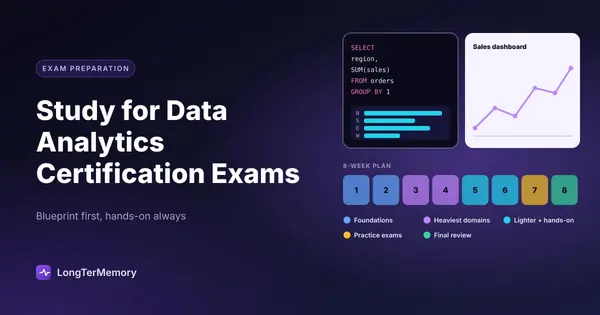
A good schedule for most data analytics certifications looks something like this:
| Week | Focus |
|---|---|
| 1-2 | Foundations and core concepts |
| 3-4 | Heaviest exam domains (highest weighted) |
| 5-6 | Lighter domains + hands-on practice |
| 7 | Full practice exams and review of weak areas |
| 8 | Final review, sleep, and exam day |
A few rules that make this work:
Study daily, not in marathon sessions. Sixty minutes per day beats seven hours on Sunday in terms of actual retention. Your brain consolidates learning during sleep, so spreading sessions out gives it time to do that consolidation work.
Block time on your calendar. If it’s not scheduled, it won’t happen. Treat your study sessions like meetings you cannot reschedule.
Don’t ignore weekends completely. A light 30-40 minute review session on Saturday keeps you from losing the week’s progress before Monday comes around.
Step Four: Hands-On Practice Is Non-Negotiable
This is where data analytics certification prep differs from most knowledge-based exams. You can know every definition of a DAX function cold, but if you’ve never actually written one in Power BI, you’ll freeze in scenario-based questions.
Every serious data analytics certification includes applied questions where you have to think through real scenarios. That means your study time must include actual tool practice, not just reading.
Here’s what hands-on practice looks like in this context:
- SQL: Use free databases (PostgreSQL on your machine, SQLite, or cloud tools like BigQuery Sandbox) to write real queries. Don’t just read SQL, write it. Debug it. Break it and fix it.
- Python or R: Work through actual datasets from Kaggle or the UCI Machine Learning Repository. Build cleaning pipelines, run basic analyses, and visualize your outputs.
- Power BI or Tableau: Build real dashboards from raw data. Follow along with Microsoft Learn modules for Power BI or Tableau’s own training paths, but always apply what you learn immediately.
- Cloud platforms (AWS, GCP, Azure): Use free tiers to actually touch the services covered by cloud-based certifications. Reading about S3 buckets is not the same as creating one and loading data into it.
A solid ratio is roughly 60% conceptual study and 40% hands-on practice for entry-level certifications, shifting to closer to 50/50 for more advanced ones.
Step Five: Use Practice Tests the Right Way
Practice exams are your most valuable study tool, but only if you use them correctly. Most people treat practice tests as a final checkup before exam day. That’s the wrong approach.
Start doing practice questions from week two. Not to pass them, but to identify gaps early so you have time to close them.
When you get a question wrong, don’t just note the correct answer and move on. Ask yourself three things:
- Why did I choose the wrong answer?
- What concept was this question actually testing?
- Where in my study materials can I reinforce this?
This process, often called error analysis, is one of the most powerful study techniques available. It’s slow, it’s uncomfortable, and it dramatically accelerates your learning.
Resources for practice questions:
- Whizlabs and MeasureUp for Microsoft certifications
- Udemy practice test courses (especially for Google and AWS certifications)
- The official sample questions published by exam providers themselves
- ExamTopics for community-contributed practice questions (use with caution, quality varies)
Aim to complete at least 300-400 unique practice questions before your exam. If you’re consistently scoring above 80% in your practice environment, you’re in good shape for most certification exams.
Step Six: Handle the Conceptual + Vocabulary Load
Data analytics certifications expect you to know a lot of terminology precisely. The difference between a dimension table and a fact table, the exact definition of data governance, what ETL means versus ELT, the specific use cases for various statistical methods. These aren’t just buzzwords, they’re tested directly.
Active recall is your best friend here. Instead of passively re-reading definitions, create question-and-answer pairs for every key term and concept. Test yourself on them daily using the spacing effect: review new terms more frequently, and space out review of terms you already know well.
A tool like LongTerMemory can help a lot here. You can upload your study notes, past practice questions, or even sections of the exam guide as a PDF, and the platform automatically generates Q&A flashcards from your material. It then schedules reviews using spaced repetition, so you’re automatically spending more time on the concepts you’re shaky on and less time on the ones you’ve already locked in. For vocabulary-heavy certifications, that kind of automated review scheduling saves a significant amount of prep time.
The Week Before Your Exam
The week before your exam is for review and confidence-building, not for learning new material. If you try to cram new concepts in the final week, you’ll just create interference with everything you’ve already learned.
Your final week should look like:
- Days 1-4: Work through practice exams in timed, exam-like conditions. Review every wrong answer carefully.
- Day 5: Light review of your weakest domain only. No new material.
- Day 6: Rest, light physical activity, a walk outside. Give your brain a recovery day.
- Day 7 (exam day): Sleep well the night before. Eat a proper meal. Arrive or log in early. Trust your preparation.
One thing that catches people off guard: the difficulty of simulating real exam conditions at home. If you’re taking an online-proctored exam, do a full mock run where you clear your desk, close all other applications, set a timer, and sit with the practice test without breaks. The first time you do this should not be on exam day.
Mindset for Exam Day
Certification exams are designed to be challenging. They will include questions that seem ambiguous, scenarios with two plausible-looking answers, and problems that test judgment more than memorization. This is intentional.
When you hit a question you’re unsure about, don’t panic. Eliminate the clearly wrong answers first. Read the remaining options against the specific wording of the question. Most of the time, one option aligns more precisely with what the question is actually asking.
Flag difficult questions and move on. Come back to them once you’ve answered everything you can. Running out of time because you fixated on one hard question is one of the most avoidable exam failures there is.
After You Pass
Once you earn your certification, the real work begins. Certifications have renewal cycles. The Google Data Analytics Certificate doesn’t expire, but credentials like the AWS Certified Data Analytics Specialty and the Microsoft PL-300 require renewal every two to three years. Mark those dates now, before you forget.
More importantly, start applying what you learned immediately. The skills become real when you use them on actual projects, even personal ones. Find datasets that interest you, build something, and document what you made. That portfolio work will matter as much as the certification itself in most hiring conversations.
Data analytics certifications are very much achievable if you approach them with a plan. Understand the exam structure, weight your study time appropriately, practice with real tools, use active recall for vocabulary, and simulate exam conditions before the real thing. With that foundation in place, the only variable left is showing up and doing the work.
You’ve got this.