How to Eat and Hydrate Optimally Before an Exam
What you eat and drink before an exam directly affects your focus and memory. Here's the science-based guide to exam day nutrition and hydration.
Table of Contents
- Why Pre-Exam Nutrition Actually Matters
- The Optimal Pre-Exam Meal: Timing, Composition, and Portion
- Timing
- Composition
- Practical Pre-Exam Meal Examples
- What to Avoid Before an Exam
- Simple Sugars and High-Glycemic Foods
- A Very Large or Heavy Meal
- Foods That Cause You Personal Digestive Issues
- Excessive Caffeine
- The Hydration Strategy for Exam Day
- Why Dehydration Hits Cognitive Function Hard
- How to Hydrate Without Creating Bathroom Anxiety
- What to Drink
- The Morning-of Routine That Sets You Up Well
You’ve studied. You’ve done practice tests. You’ve reviewed your weakest areas and slept (hopefully) a full night before the big day. And then, an hour before the exam, you grab a gas station energy drink and a bag of chips because you’re running late and didn’t think about breakfast.
That’s a problem, and not just in a “healthy eating” kind of way. What you put into your body in the hours before a high-stakes cognitive task directly affects how well that brain of yours actually performs. We’re talking measurable differences in working memory, sustained attention, reaction time, and the ability to manage stress.
This guide covers the nutritional and hydration science that applies specifically to exam performance, what to eat, what to avoid, when to eat it, and how to handle hydration without creating other problems.
Why Pre-Exam Nutrition Actually Matters
Your brain is an energy-intensive organ. It accounts for roughly 2% of your body weight but consumes about 20% of your total energy expenditure. During cognitively demanding tasks like a written exam, that metabolic demand increases. Giving your brain the right fuel before that demand peaks is not optional, it’s a performance input.
The key mechanisms at play:
Blood glucose stability. Your brain runs primarily on glucose. But it’s not just about having glucose available, it’s about having it available steadily. Spikes and crashes in blood sugar create corresponding spikes and crashes in alertness and focus. A rapid-rise, rapid-fall glucose pattern (the kind you get from sugary foods on an empty stomach) can produce a slump right in the middle of your exam window.
Neurotransmitter precursors. Several cognitive functions depend on neurotransmitters that are synthesized from dietary precursors. Dopamine, serotonin, and acetylcholine all depend on amino acids and other compounds that come from food. What you eat influences the raw materials your brain has available for these systems.
Hydration and cognitive function. Dehydration of as little as 1-2% of body weight produces measurable declines in short-term memory, attention, and processing speed. Many people arrive at exams mildly dehydrated without realizing it, especially if they’ve been anxious and not drinking normally, or if they’ve avoided fluids in the morning to prevent bathroom urgency during the exam.
The Optimal Pre-Exam Meal: Timing, Composition, and Portion
Timing
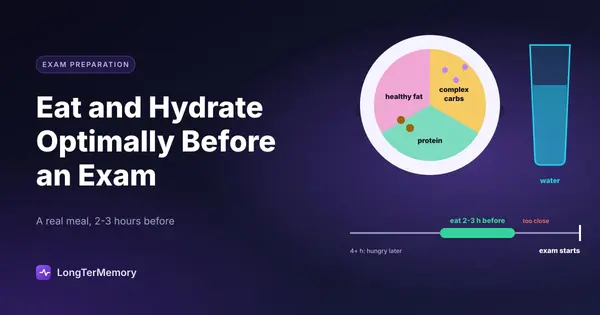
The research consensus is that a substantial meal eaten 2-3 hours before a cognitive task allows optimal digestion and blood sugar stabilization before peak demand. Eating too close to the exam (within 30-45 minutes) can direct blood flow toward digestion and away from the brain, produce slight drowsiness as your parasympathetic system activates, and create unpredictable blood sugar behavior before you’ve reached the exam room.
Eating too far in advance (more than four hours before) can leave you genuinely hungry during the exam, which is itself a cognitive distraction. Hunger activates the stress response and competes with your ability to focus.
The target window is 2-3 hours before your exam start time. If your exam is at 9 AM, eat at around 6:30-7 AM. If it’s at 2 PM, have lunch around 11 AM.
Composition
The ideal pre-exam meal has three components working together:
Complex carbohydrates for sustained energy. Unlike simple sugars, complex carbohydrates (oats, whole grain bread, sweet potato, brown rice, legumes) release glucose gradually into the bloodstream. This produces a steady, sustained energy supply rather than a spike and crash. Aim to make complex carbohydrates the largest portion of your pre-exam meal.
Protein for neurotransmitter support and satiety. Protein provides amino acids that serve as precursors to several cognitive neurotransmitters. It also slows gastric emptying, which moderates the blood glucose curve from your carbohydrates and extends satiety. Good options include eggs, Greek yogurt, cottage cheese, nuts, nut butter, or lean meat.
Moderate healthy fat for sustained energy and anti-inflammatory support. Omega-3 fatty acids (found in fish, walnuts, flaxseed, and chia seeds) have well-documented cognitive benefits. Moderate dietary fat also extends the satiety effect and provides a longer-burning energy source than carbohydrates alone.
Practical Pre-Exam Meal Examples
| Meal | Why It Works |
|---|---|
| Oatmeal with nuts, berries, and a boiled egg | Complex carbs + protein + antioxidants |
| Whole grain toast with avocado and eggs | Healthy fat + protein + complex carbs |
| Greek yogurt with granola and banana | Protein + complex carbs + potassium |
| Brown rice, grilled chicken, and vegetables | Balanced macros, nothing too heavy |
| Nut butter on whole grain bread with a small fruit | Portable, practical, effective |
These meals are not remarkable. They’re regular food. The point is that they deliver what your brain needs without the downsides that come from skipping breakfast or eating the wrong things.
What to Avoid Before an Exam
This section might be more immediately useful than the “what to eat” advice, because the mistakes here are common and their effects are real.
Simple Sugars and High-Glycemic Foods
Sugary cereals, pastries, white bread, candy, fruit juice in large quantities, and energy drinks with high sugar content all cause a rapid spike in blood glucose followed by a corresponding dip. If that dip lands during your exam window, you will notice it as a loss of focus, reduced mental sharpness, and sometimes mild irritability or anxiety.
The energy drink problem deserves specific mention. Many high-caffeine, high-sugar energy drinks produce an initial alertness boost that candidates mistake for a reliable cognitive enhancer. The problem is that the sugar crash often arrives 60-90 minutes after consumption, directly in the middle of most exam windows. If you’re going to use caffeine before an exam (more on that below), get it from a lower-sugar source.
A Very Large or Heavy Meal
Even nutritionally excellent food can become a problem if consumed in excessive quantities close to exam time. A very large meal diverts significant blood flow and metabolic resources toward digestion. It can produce drowsiness (the post-meal somnolence is a real physiological response) that hits exactly when you need to be alert.
Eat enough to be fueled and satiated. Don’t overeat. The cognitive ideal is not the same as the comfort food ideal.
Foods That Cause You Personal Digestive Issues
This one is obvious but worth saying explicitly: exam day is not the day to try a new food. Stick to things your digestive system handles well and reliably. If a certain food gives you gas, bloating, or stomach discomfort even occasionally, remove it from your pre-exam menu regardless of its nutritional profile.
Eat foods you know. Predictability matters more than optimization on exam day.
Excessive Caffeine
Caffeine is a legitimate cognitive tool. It blocks adenosine receptors, which reduces feelings of tiredness and improves alertness. Moderate caffeine use (roughly 100-200 mg, the equivalent of one to two cups of coffee) is well-tolerated by most people and produces measurable improvements in alertness and sustained attention.
The problem is excessive caffeine. High doses produce anxiety, jitteriness, elevated heart rate, and difficulty concentrating, all of which are counterproductive when you need to think clearly under pressure. Exam anxiety and high caffeine together make a particularly unpleasant combination.
The other caffeine problem is timing. Taking caffeine on an empty stomach amplifies both its effects and its side effects. Pair caffeine with food. If you’ve never had caffeine before an exam, exam day is not the day to start or experiment with higher doses.
The Hydration Strategy for Exam Day
Why Dehydration Hits Cognitive Function Hard
Research consistently shows that mild dehydration impairs several cognitive functions relevant to exams. Studies published in journals like Nutrients and Frontiers in Human Neuroscience have documented declines in working memory, attention, processing speed, and psychomotor speed at dehydration levels of just 1-2% of body weight. That’s a level many people reach through normal morning activity without feeling significantly thirsty.
The problem is that thirst is a lagging indicator of dehydration. By the time you feel thirsty, you may already be mildly impaired. Waiting until you’re thirsty before drinking on exam day is poor hydration strategy.
How to Hydrate Without Creating Bathroom Anxiety
The reasonable concern most exam candidates have about hydration is this: if I drink a lot of water before a long exam, I’ll need to use the bathroom in the middle of it. And depending on the exam format (proctored in-person, strict time limits, limited break opportunities), that’s a legitimate concern.
Here’s how to balance this:
Start hydrating the evening before. This is the most underused hydration strategy. If you’re well-hydrated going into the night before your exam, you need less acute hydration on the morning of the exam. Drink water consistently throughout the day before.
Drink water steadily in the morning, not in large quantities all at once. One or two glasses with your meal 2-3 hours before the exam is appropriate. Sipping water in the hour before is fine. Drinking a full liter right before you walk in is what causes urgent bathroom needs mid-exam.
Calibrate your intake to the exam length and format. A 90-minute online exam with limited bathroom access warrants different hydration behavior than a 4-hour in-person exam where you can raise your hand and step out. Know the format and plan accordingly.
Check the exam rules in advance. Many in-person professional exams allow a clear water bottle at your testing station. If this is allowed, bring one. Having water available to sip during the exam lets you maintain hydration without front-loading everything beforehand.
What to Drink
Water is your primary hydration source. Nothing beats it, and nothing is more consistently available.
For candidates who want a cognitive edge beyond plain water:
Low-sugar electrolyte drinks can be useful for longer exams (three or more hours) where electrolyte depletion becomes a factor, particularly if you’re stressed and sweating. Avoid high-sugar sports drinks for the same reasons as sugary foods generally.
Green tea offers a moderate caffeine dose alongside L-theanine, an amino acid that promotes calm alertness and may moderate the more anxious edge of caffeine’s stimulant effect. Many people find the caffeine from green tea feels smoother and more focus-supporting than coffee. This is a popular choice among candidates who want cognitive support without jitteriness.
Avoid alcohol the night before and the morning of. This should be obvious but it’s worth saying. Alcohol disrupts sleep architecture, reduces REM sleep (which is critical for memory consolidation), and produces morning-after cognitive impairment even without a full hangover. The night before a big exam is not the night to decompress with drinks.
Good food and hydration help your brain retrieve what you have learned, but they cannot replace the learning itself. In the weeks before the exam, LongTerMemory turns your notes and PDFs into question and answer flashcards and schedules them with spaced repetition, so exam morning is about staying fresh, not cramming.
The Morning-of Routine That Sets You Up Well
Here’s a simple practical sequence that works well for most candidates:
Evening before: Drink 1.5-2 liters of water throughout the day. Eat a normal, balanced dinner, nothing too heavy. Avoid alcohol.
Morning of: Wake up with enough time to avoid rushing. Rushing elevates cortisol and activates stress responses that compete with optimal cognition. Drink one to two glasses of water within 30 minutes of waking.
2-3 hours before the exam: Eat your pre-exam meal as described above. Include complex carbohydrates, protein, and moderate fat. Eat a normal portion, not a large one.
1 hour before: Light activity if it helps you feel calm (a short walk, light stretching). Sip water as needed. Avoid large quantities. If you use caffeine, this is an appropriate window for a moderate dose paired with food.
Right before you start: Use the bathroom if needed. Bring your water bottle if permitted. Take a few slow breaths. Trust what you’ve put in.
Exam day nutrition is one of the most underappreciated aspects of test preparation. Candidates spend weeks or months on content knowledge and almost zero time thinking about the physiological inputs that affect how well they can retrieve and apply that knowledge under pressure.
You’ve done the work. Don’t undermine it with a poor breakfast and a large energy drink. Give your brain what it needs to perform, and then let it do its job.