How to Find a Study Buddy or Accountability Partner Online
Where to find study partners online, how to structure productive sessions, and what makes a good accountability partner for long-term success.
Table of Contents
- Platforms and Communities for Finding Study Partners Remotely
- Discord Servers
- Reddit Communities
- Focused Online Study Platforms
- Professional and Certification Forums
- Language Exchange Apps
- How to Structure a Productive Online Study Partnership
- Establish Clear Expectations Early
- Session Structures That Work
- Dealing With Inconsistency
- What to Look for in a Compatible Study Buddy
- Similar Work Pace and Intensity
- Compatible Schedules
- Shared Accountability Preferences
- Long-Term vs. Short-Term Goals
- When to Look for More Than One Partner
- Pairing Partnership With Good Tools
- The Bottom Line
There is a version of studying that most people default to: alone, in silence, trying to hold yourself accountable through sheer willpower. And for some people, in some situations, that works. But for a lot of people, a lot of the time, it is unnecessarily hard. Not because they lack discipline, but because humans are fundamentally social learners, and trying to strip all the social context out of learning often makes it both less effective and less sustainable.
This is where study buddies and accountability partners come in. The research on this is pretty consistent: people who study with partners or in accountable structures tend to be more consistent, stay on task longer, and perform better on assessments. The question is how to actually find the right person, especially now that “online” opens up the pool to millions of potential study partners around the world.
Platforms and Communities for Finding Study Partners Remotely
The good news is that you do not need to rely on whoever happens to be in your physical classroom. The internet has produced a surprisingly rich ecosystem of spaces where people looking for study partners can find each other.
Discord Servers
Discord has become one of the primary hubs for online study communities. There are thousands of servers dedicated to specific subjects (organic chemistry, bar exam prep, coding, language learning) as well as general study servers where people from many different fields come together to study in parallel.
Some of the most active general study servers include:
- The Study Hall (formerly known as StudyTogether) is one of the largest Discord study communities, with tens of thousands of members, study rooms organized by topic, Pomodoro timers, and accountability channels.
- Study Together also has a companion website where you can find study rooms and partners organized by subject.
- r/StudyBuddy on Reddit has a Discord attached to it where you can match with someone studying the same material.
For subject-specific communities, searching “[your subject] Discord” will almost always surface active servers. Medical students congregate on servers dedicated to USMLE prep. Law students have bar exam servers. Language learners have language-pair specific servers for conversation practice.
Reddit Communities
Reddit remains one of the best places to post “looking for study partner” requests, especially for niche subjects. The communities worth knowing:
- r/FindAStudyBuddy: specifically designed for this, with posts organized by subject, timezone, and study goals.
- r/StudyBuddy: slightly smaller but active, often with more specific certification and professional exam matching.
- Subject-specific subreddits: r/MCAT, r/barexam, r/CPA, r/learnprogramming, and hundreds more often have weekly or pinned threads for study partner matching.
The Reddit approach works well when you need someone who is studying exactly what you are studying, because the specificity of subreddits means you can find a very close match.
Focused Online Study Platforms
Several platforms are built specifically around group study and accountability:
Focusmate is one of the most interesting: you book a 25- or 50-minute video co-working session with a random matched partner. You both say what you will work on at the start, work in silence (cameras on), and briefly check in at the end. The accountability comes from the social presence rather than from discussing material together. It works remarkably well for students who need someone else “in the room” to stay focused but do not necessarily need a subject-matter peer.
StudyStream is a platform where you study on camera in a virtual library environment. You can see other people studying, which creates ambient social pressure to stay on task.
Cram Fighter is more specialized toward medical licensing exam prep and helps with study planning and partner matching in that community.
Professional and Certification Forums
For professional certification exams (CFA, PMP, AWS, bar exam, CPA, and similar), the most motivated and aligned study partners are usually found in the dedicated forums and communities for those exams. These are people studying the exact same material under the same time pressure, which makes coordination much easier.
Some examples:
- AnalystForum (CFA candidates)
- Reddit’s r/CFA, r/CPA, r/PMP
- LinkedIn Groups for specific certifications
- Facebook Groups organized by exam and test date
For time-sensitive certifications, matching with someone who has the same exam date as you creates natural, deadline-driven accountability.
Language Exchange Apps
If you are learning a language, the study partner dynamic works slightly differently. Apps like Tandem and HelloTalk connect you with native speakers of your target language who are learning your language, creating a mutual exchange. You help them with your language for half the session, they help you with theirs for the other half. This is remarkably effective and builds the conversational fluency that self-study simply cannot replicate.
How to Structure a Productive Online Study Partnership
Finding a study partner is the easy part. Making the partnership actually work long-term requires some deliberate structure from the start. Most study partnerships fail not because of incompatibility but because of vague expectations and inconsistent communication.
Establish Clear Expectations Early
Before your first real session, have a conversation about the basics:
Schedule: What days and times will you meet? How long will sessions be? How much notice is expected for cancellations? Even fifteen minutes of upfront conversation about this prevents months of scheduling friction.
Format: Will you study the same material in parallel, quiz each other, work through problems together, or just use each other for accountability while working independently? There is no single right answer, but you both need to be on the same page.
Communication: Will you check in between sessions? Via WhatsApp, Discord, or email? Knowing where to reach each other and what is expected keeps the partnership from going silent.
Goals: What are you each working toward? Knowing each other’s goals creates genuine investment in each other’s success rather than a transactional relationship.
Session Structures That Work
The Parallel Work Session is the simplest and most scalable: you both show up, announce what you will work on, set a timer (usually 25-50 minutes), work independently with cameras on, and then briefly check in at the end. This is essentially Focusmate with someone you already know. The accountability is social presence, not subject matter discussion.
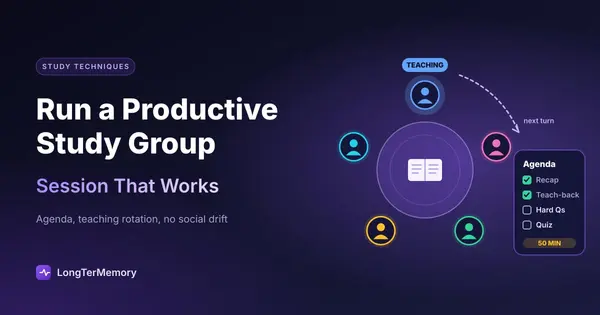
The Teaching Session is more intensive but highly effective: one person explains a concept to the other, who then asks questions. This forces the “teacher” to fully articulate their understanding (which reveals gaps) and gives the “learner” a different framing from their own notes. Alternate roles regularly.
The Quiz Swap works especially well for fact-heavy subjects: each person prepares practice questions from the material they have studied, and you quiz each other. This builds two sets of active recall practice into one session.
The Problem-Solving Session is best for quantitative subjects: work through practice problems independently for twenty minutes, then compare approaches and explain your reasoning to each other. Disagreements are gold, as they force you to articulate and defend your reasoning, which deepens understanding.
Dealing With Inconsistency
Every partnership will hit periods of inconsistency. Life happens. Exams, travel, illness, overwhelming weeks. The partnerships that survive these stretches are the ones with explicit rather than implicit norms.
A simple practice: if you need to cancel, give as much notice as possible and suggest a replacement time in the same message. “I need to move our Thursday session. Can you do Friday at the same time?” This keeps the rhythm going rather than letting the partnership quietly fade.
If a partner consistently misses sessions without communication, it is completely reasonable to have a direct conversation about it. Most people appreciate clarity over ambiguity.
What to Look for in a Compatible Study Buddy
Not everyone makes a good study partner, and matching on subject alone is not enough. The partnerships that last are built on a few key compatibility factors.
Similar Work Pace and Intensity
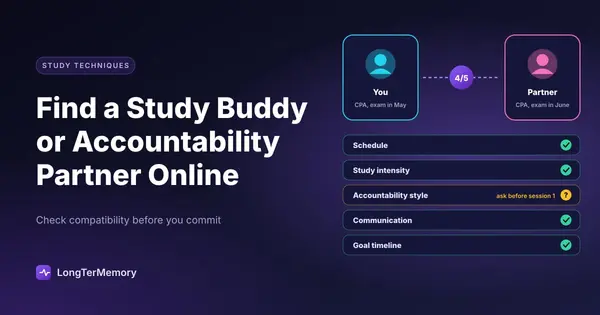
If one person treats study sessions like leisurely reading and the other is trying to cover forty pages of dense material in an hour, the mismatch will create friction quickly. In your initial conversation, get specific about study pace. How much material do you typically cover in a session? What does “productive” look like for you?
Compatible Schedules
This sounds obvious, but time zone alignment and schedule compatibility are genuinely the most common reasons study partnerships fail. If your optimal study time is early morning and your partner is a night owl in a time zone six hours different, even strong motivation will struggle against the logistical friction.
Be realistic about your actual schedule, not your aspirational one. If you say you can meet three times a week but your honest schedule only allows once, the partnership starts with a mismatch between expectation and reality.
Shared Accountability Preferences
Some people want a cheerleader who celebrates their wins and encourages them when they miss goals. Others want someone who will call them out directly if they skip sessions or fall behind. Neither is wrong, but mismatching on this dimension creates awkwardness.
Ask directly: “What kind of accountability style works best for you?” and share your own preference. Knowing upfront that your partner appreciates direct feedback saves both of you from misread signals later.
Long-Term vs. Short-Term Goals
A study partner for a three-month certification push has a very different dynamic from a long-term academic partner for a multi-year program. Short-term partnerships can afford to be more intense and narrowly focused. Long-term ones need more flexibility and resilience to life changes.
Match on time horizon as well as subject matter. “I am studying for the CFA Level 1 exam in June” is more useful than “I want to learn finance.”
| Compatibility Factor | Why It Matters | How to Assess |
|---|---|---|
| Schedule alignment | Logistics friction kills partnerships | Compare calendars before committing |
| Study intensity | Pace mismatch creates resentment | Ask specifically: pages/hour, session length |
| Accountability style | Mismatched expectations cause awkwardness | Ask directly before first session |
| Communication style | Response time expectations vary widely | Discuss preferred channels upfront |
| Goal timeline | Short-term vs. long-term needs differ | State your exam date or end goal clearly |
When to Look for More Than One Partner
One study buddy is great. But for certain subjects and goals, a small study group of three to five people can be even more effective, because you get multiple perspectives, different explanations of the same concept, and group dynamics that reduce the load on any single relationship.
The ideal study group size is three to four. Beyond five, coordination overhead increases and free-rider dynamics tend to emerge. Below three, you lose the diversity of perspective.
For group matching, Reddit’s r/FindAStudyBuddy often has people looking to form groups rather than pairs. Discord servers frequently have channels specifically for forming study groups around specific exams or courses.
Pairing Partnership With Good Tools
The social accountability of a study partner works best when it sits on top of a solid individual study system. If you are using spaced repetition (through LongTerMemory or similar platforms), your daily card review provides the consistent retrieval practice that builds memory, and your study partner sessions add the active recall through discussion, teaching, and quizzing that makes the material stick even deeper.
Think of it this way: your spaced repetition system is the foundation. Your study partner is the structure built on top of it. Both serve different functions, and together they create something more robust than either alone.
The Bottom Line
Finding a study partner online is genuinely not hard. There are communities full of people looking for exactly what you are looking for, and the coordination tools available now make remote study partnerships more seamless than in-person ones were for previous generations.
What is harder is building a partnership that lasts, because that requires upfront honesty about expectations, consistent communication, and genuine investment in each other’s success.
Start by finding someone in one of the communities above. Have an honest conversation about pace, schedule, and accountability style. Run a few sessions and see how the dynamic feels. Adjust as needed.
The right study partner is out there. The only thing left is to go find them.