
How to Prepare for the GRE Quantitative Reasoning Section
Master GRE Quantitative Reasoning with targeted strategies. Learn what's tested, how to prepare efficiently, and how to maximize your score.
Table of Contents
- What the GRE Quantitative Section Tests and How It's Weighted
- Question Types
- The High-Frequency Topics Worth the Most Preparation Time
- Arithmetic: Number Properties and Fractions
- Algebra: Linear Equations, Inequalities, and Word Problems
- Geometry: What to Know and What to Skip
- Data Analysis: Statistics, Probability, and Graphs
- Practice Problem Strategy: How to Use Practice Questions Effectively
- Wrong Answer Analysis Is More Valuable Than Right Answer Volume
- Work Backward from Answer Choices
- Pick Numbers for Abstract Problems
- Calculator Use on GRE Quant
- Building Your Study Plan
- Pacing and Test Day Strategy
- The Bottom Line
The GRE Quantitative Reasoning section has a reputation that’s both accurate and misleading at the same time. It’s accurate in that the math is genuinely challenging if you haven’t engaged with it in a while. It’s misleading in that many test-takers assume they need to be math-savvy at an advanced level to do well. They don’t.
The GRE Quant section tests math through roughly the 10th or 11th grade level, but it tests it in ways that are specifically designed to be tricky. The questions reward careful reading, strategic thinking, and efficient problem-solving as much as they reward raw math ability. Which means that targeted preparation matters enormously, perhaps more for Quant than for any other section of the GRE.
This guide breaks down exactly what the section tests, which topics deserve the most preparation time, and how to build a study approach that actually produces score improvements.
What the GRE Quantitative Section Tests and How It’s Weighted
First, the basics. The GRE Quantitative Reasoning section tests your ability to understand and work with quantitative information, interpret and analyze quantitative data, and solve problems using mathematical models.
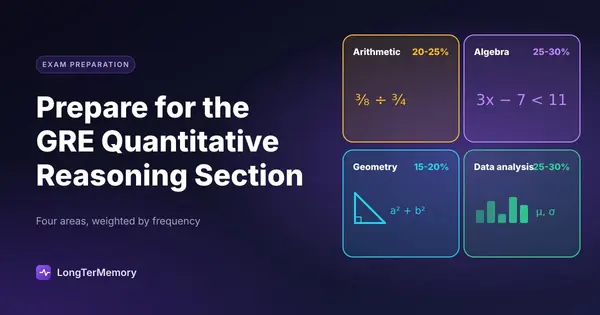
The content is organized into four broad mathematical areas:
| Content Area | Approximate Percentage |
|---|---|
| Arithmetic | 20-25% |
| Algebra | 25-30% |
| Geometry | 15-20% |
| Data Analysis | 25-30% |
The scoring scale runs from 130 to 170, in one-point increments. The mean score is around 153. Scores above 160 are generally considered competitive for quantitative-heavy graduate programs. Scores above 165 put you in the top tier.
The section appears twice in the standard GRE, with 27 questions per section and 47 minutes per section. That’s roughly 1 minute and 45 seconds per question on average, which feels tight but is manageable with practice.
Question Types
Understanding the four question types is critical because they require different strategies:
Quantitative Comparison (QC): These questions give you two quantities (Quantity A and Quantity B) and ask you to compare them. The answer choices are always the same: A is greater, B is greater, they’re equal, or the relationship cannot be determined. These questions reward algebraic manipulation and picking smart numbers more than calculation.
Multiple Choice (one answer): Standard multiple choice with five options. Plugging in answer choices (working backward from the answers) is often faster than solving algebraically.
Multiple Choice (one or more answers): These require you to select all correct choices, which can be one, several, or all. There’s no partial credit. This question type rewards thoroughness and careful verification.
Numeric Entry: No multiple choice. You calculate and enter the answer. These require exact computation, so estimation tricks are less useful here.
Knowing the question type before diving into a problem changes your strategy. Get familiar with all four.
The High-Frequency Topics Worth the Most Preparation Time
Not all GRE math topics are created equal. Some appear constantly. Others appear rarely. Concentrating your preparation on high-frequency topics produces disproportionate score improvements.
Arithmetic: Number Properties and Fractions
GRE arithmetic questions lean heavily on number properties: divisibility, prime factorization, factors, multiples, and the behavior of odd and even integers. Questions in this area are often disguised as “what is the remainder when X is divided by Y” or “which of the following is always true when N is a positive integer.”
Fractions, decimals, and percentages are also heavily tested, particularly percentage increase and decrease, which show up in data analysis and word problems.
Ratios and proportions appear in both arithmetic and word problem contexts. Being comfortable with direct and inverse proportions saves time significantly.
Algebra: Linear Equations, Inequalities, and Word Problems
The algebra content that appears most frequently on the GRE involves:
- Linear equations in one or two variables
- Inequalities (including absolute value inequalities, which many people find tricky)
- Word problems that translate verbal descriptions into algebraic expressions
- Sequences and patterns
- Exponent rules, particularly with negative and fractional exponents
- Functions (basic function notation and plugging in values)
Quadratic equations appear but are less central than many people expect. When they do appear, factoring is usually the fastest approach, so having solid factoring skills matters.
Geometry: What to Know and What to Skip
Geometry on the GRE focuses on a relatively narrow set of topics:
- Lines and angles (especially with parallel lines and transversals)
- Triangles: properties of right triangles (Pythagorean theorem), the 30-60-90 and 45-45-90 special triangles, area formulas, and similarity
- Quadrilaterals: rectangles, squares, parallelograms, areas and perimeters
- Circles: circumference, area, arc length, central angles
- Coordinate geometry: slope, distance between points, midpoints
Three-dimensional geometry (volumes of boxes, cylinders, spheres) appears occasionally. The formulas are provided in the GRE reference sheet at the start of each Quantitative section, so you don’t need to memorize them, but you do need to know how to apply them correctly.
What the GRE does NOT test: trigonometry, calculus, proofs, or complex three-dimensional figures. If you’re spending time on these, you’re studying the wrong things.
Data Analysis: Statistics, Probability, and Graphs
Data analysis has grown as a component of the GRE Quant section in recent years. The key areas are:
- Descriptive statistics: mean, median, mode, range, standard deviation (conceptually, not computational)
- Data interpretation: reading bar graphs, line graphs, pie charts, scatterplots, and tables accurately
- Probability: basic probability, independent events, conditional probability
- Combinations and permutations (appear less frequently but enough to be worth reviewing)
- Normal distributions (conceptually: what it means for data to be within one or two standard deviations)
The data interpretation questions are often presented as sets where multiple questions reference the same graph or table. These question sets reward careful, accurate reading more than calculation. Misreading the y-axis scale is a common mistake that costs points on otherwise straightforward questions.
Practice Problem Strategy: How to Use Practice Questions Effectively
Most GRE Quant preparation involves a lot of practice problems. How you use them determines how much your score improves.
Wrong Answer Analysis Is More Valuable Than Right Answer Volume
The biggest mistake in GRE prep is treating practice questions as a test of current ability rather than a tool for improvement. Every wrong answer is information about a specific gap, and that information is only useful if you actually investigate it.
After completing a practice set, don’t just check which answers were right and which were wrong. For every wrong answer:
- Identify why you got it wrong (conceptual misunderstanding, calculation error, misread the question, ran out of time, or made an unjustified assumption).
- Work through the correct solution method until you genuinely understand it, not just until you see how to get the right answer.
- Write down the concept or technique involved and add it to your review list.
This process is slower than blasting through problem sets, but it’s also dramatically more effective. A student who does 50 questions with deep analysis of every wrong answer will improve more than a student who does 200 questions checking only right/wrong.
LongTerMemory is useful here because you can upload your error analysis notes or summary sheets and convert them into spaced-repetition flashcards, ensuring that the concepts you’ve identified as weak spots get reviewed at the right intervals automatically, rather than relying on you to remember to revisit them.
Work Backward from Answer Choices
On multiple-choice Quant questions, backsolving (plugging the answer choices into the problem to see which one works) is often faster than solving algebraically. This is especially true for word problems where the algebra would take several steps.
The standard approach is to start with the middle value answer choice, since the choices are usually ordered numerically, and see if it works. If it’s too big, you know you need a smaller value. If it’s too small, you need a larger one. This eliminates answer choices efficiently.
Pick Numbers for Abstract Problems
When a question involves variables without specific values, picking smart numbers often reduces the problem to straightforward arithmetic. The numbers you pick need to satisfy any constraints given in the problem (odd, prime, positive integer, etc.), but within those constraints, choose numbers that make the arithmetic easy.
For proportion and percentage problems, 100 is usually the easiest number to work with. For odd/even problems, pick 1, 2, and 3. For fraction problems, pick numbers that produce clean results.
This technique is also powerful for Quantitative Comparison questions where the relationship between two quantities is unclear with variables in play.
Calculator Use on GRE Quant
The GRE provides an on-screen calculator for the Quantitative section. This is genuinely useful, but there’s a trap: the calculator is slower than mental math for simple operations, and over-relying on it wastes time.
Use the calculator for: multi-digit multiplication, long division, converting fractions to decimals, and square roots you can’t do mentally.
Don’t use the calculator for: basic arithmetic with small numbers, fraction operations, or anything you can estimate. Developing mental math fluency for these operations will save meaningful time on test day.
Building Your Study Plan
How you structure your preparation depends on your starting point, your target score, and how much time you have.
If you have 3+ months: Start with a diagnostic practice test to identify your baseline and weakest areas. Spend the first month on content review for your identified weak areas using a structured resource (Manhattan Prep’s GRE strategy guides or the Official GRE books are both solid). Spend the second month on mixed practice question sets with deep error analysis. Spend the final month on full practice tests, timed sections, and fine-tuning strategy.
If you have 4-8 weeks: Skip comprehensive content review and focus immediately on your highest-leverage weak spots based on a diagnostic test. Do intensive practice question work with error analysis daily. Take at least three full practice tests in the final two weeks.
If you have less than 4 weeks: Focus exclusively on your weakest content areas and strategy techniques (backsolving, picking numbers). Take two full practice tests, one at the beginning and one at the end, to calibrate your score and identify the most impactful remaining gaps.
Regardless of timeline, consistency matters more than volume. Fifty minutes of focused daily practice with error analysis beats three-hour weekend sessions with passive review in between.
Pacing and Test Day Strategy
GRE Quant pacing is a skill that needs deliberate practice, not something to figure out on test day.
The general pacing framework: On a 27-question, 47-minute section, you have roughly 1 minute 45 seconds per question. In practice, this means:
- Easier questions should take 1 minute or less, banking time for harder ones.
- Medium questions should take 1.5 to 2 minutes.
- Hard questions should take up to 3 minutes, and if a problem is taking longer, you should make your best guess and move on.
Skip and return: The GRE allows you to mark questions and return to them. Use this. If a question is immediately obvious that it will take significant time, mark it and move on. Return with remaining time. Leaving easier questions unanswered to struggle with one hard question is one of the most expensive time management errors on the GRE.
Verify your most confident answers: On numeric entry questions especially, recheck your work for computational errors before submitting. Careless errors on questions you understand conceptually are frustrating and avoidable.
The Bottom Line
The GRE Quantitative Reasoning section is conquerable with the right preparation. It’s not a test of mathematical genius. It’s a test of your ability to efficiently apply high school-level math concepts in a structured, time-pressured context.
That means knowing the high-frequency topics cold, developing efficient strategies for each question type, and practicing in a way that builds understanding rather than just familiarity with specific problems.
Focus your preparation on arithmetic and data analysis (the heaviest-tested areas), get comfortable with backsolving and picking numbers, analyze every wrong answer with genuine curiosity about what went wrong, and build your pacing skills through timed practice.
The gap between your current score and your target score is almost entirely explained by preparation quality and preparation time. With targeted, consistent effort, that gap closes faster than most people expect.