
How to Prepare for the LEED Green Associate Exam
A complete guide to passing the LEED Green Associate exam: what it tests, the best study resources, and practice question strategies that work.
Table of Contents
- What the LEED Green Associate Exam Tests
- The Core LEED Framework
- The Integrative Process
- Green Building Basics
- Study Resources and Reference Materials for LEED GA Preparation
- The LEED Green Associate Candidate Handbook
- Green Building: Project and Team Management for Sustainability
- LEED Reference Guides
- Third-Party Study Guides and Courses
- How Long to Study
- Practice Question Strategy for LEED Certification Exam Readiness
- Start Practice Questions Early, Not Last
- Understand Question Anatomy
- Flag and Review Consistently
- The One-Week Push
- Building Your LEED GA Study System
- Using Spaced Repetition for Flashcard Review
- On Exam Day
- Why the LEED GA Is Worth It
- Putting It Together
So you’ve decided to go for the LEED Green Associate credential. Good call. In a world where sustainable construction is shifting from a niche interest to a mainstream requirement, that green credential on your resume carries real weight, whether you’re in architecture, engineering, project management, construction, or just about any field that touches the built environment.
The catch is that the LEED GA exam is not something you can bluff your way through with a bit of casual reading. It covers a specific body of knowledge, uses its own vocabulary, and tests you in a way that rewards preparation over instinct. The good news is that it’s also very passable if you study smart.
This guide walks you through everything you need to know to pass the LEED Green Associate exam on your first attempt: what it actually tests, which study resources are worth your time, and how to structure your practice question strategy.
What the LEED Green Associate Exam Tests
Before you open a single study guide, you need to understand what the LEED Green Associate certification is actually assessing. This is not an exam about construction techniques in the traditional sense. It’s an exam about sustainability frameworks, green building principles, and specifically, the LEED rating system developed by the U.S. Green Building Council (USGBC).
The Core LEED Framework
The LEED system, which stands for Leadership in Energy and Environmental Design, organizes sustainable building practices into credit categories. As a Green Associate candidate, you need to understand how these categories work, what kinds of strategies earn points, and how the overall certification process functions.
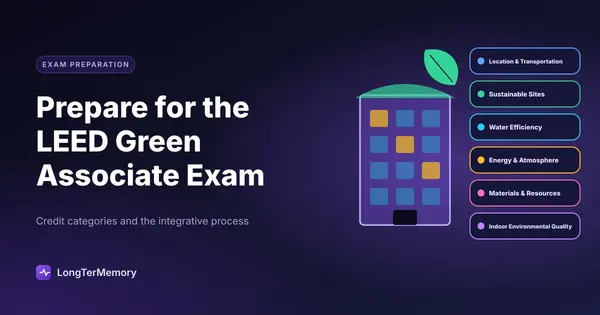
The main LEED credit categories you’ll be tested on include:
| Category | What It Covers |
|---|---|
| Location and Transportation | Site selection, access to transit, walkability |
| Sustainable Sites | Construction activity, light pollution, heat island effect |
| Water Efficiency | Indoor and outdoor water use reduction |
| Energy and Atmosphere | Energy performance, commissioning, renewable energy |
| Materials and Resources | Waste management, material sourcing, life-cycle thinking |
| Indoor Environmental Quality | Air quality, lighting, thermal comfort |
| Innovation | Exemplary performance and innovative strategies |
| Regional Priority | Locally prioritized credit areas |
You don’t need to memorize every single point threshold, but you do need to understand the intent behind each category, what kinds of strategies earn credit, and how these fit into the larger LEED certification process.
The Integrative Process
One concept that catches a lot of exam candidates off guard is the integrative process approach. LEED isn’t just a checklist of independent green features. It rewards projects that think about sustainability holistically, where decisions in one area (like site selection) affect outcomes in another (like energy efficiency). Understanding this interconnectedness is important for answering scenario-based questions correctly.
Green Building Basics
Beyond the LEED framework itself, the exam also tests foundational green building concepts. These include lifecycle assessment, commissioning, energy modeling, stormwater management, and the principles behind indoor air quality. You don’t need to be a technical expert in any of these, but you do need to understand the concepts well enough to apply them in context.
Study Resources and Reference Materials for LEED GA Preparation
There are a few core reference materials that form the foundation of your LEED GA study plan. Knowing which ones to use, and how to use them, makes a significant difference in how efficiently you prepare.
The LEED Green Associate Candidate Handbook
Before anything else, download the official LEED Green Associate Candidate Handbook from the GBCI (Green Business Certification Inc.) website. This is the primary document that defines exactly what the exam covers. It lists the knowledge domains, the weight of each section, and the competencies you’re expected to demonstrate.
Reading the candidate handbook before you open any study guide is like looking at a map before starting a road trip. It tells you where you’re going so you don’t waste time driving in the wrong direction.
Green Building: Project and Team Management for Sustainability
This is one of the primary reference books explicitly listed in LEED GA exam preparation materials. It covers project process and team roles in a green building context, which shows up throughout the exam in various forms. You don’t need to read it cover to cover, but understanding the key frameworks it presents is worthwhile.
LEED Reference Guides
The full LEED Reference Guides are comprehensive, expensive, and honestly more detailed than you need for the GA exam. However, the GBCI does make the LEED v4 for Building Design and Construction reference guide a key source for the exam content. Some prep programs include excerpts or summaries of the most exam-relevant sections.
Third-Party Study Guides and Courses
A strong third-party study guide can save you hours of wading through dense official documentation. Several well-reviewed options exist:
LEED GA Study Guides (print and digital) from providers like Green Exam Academy, Everblue, and similar LEED-focused educators are widely used and generally well-organized. Look for one that includes practice questions, not just content summaries.
Online prep courses from providers like Green Exam Academy, Leed Exam Prep, and similar platforms offer video-based instruction that many candidates find easier to absorb than reading. If you learn better by hearing explanations than reading them, a course is worth the investment.
Flashcards are your secret weapon for the LEED GA, and we’ll come back to this in detail. For now, know that digital flashcard tools make a big difference in how much vocabulary and concept-detail you retain heading into exam day.
How Long to Study
Most candidates report spending between 40 to 80 hours of total study time to pass the LEED GA. Where you land on that range depends on your background: if you already work in construction, architecture, or sustainability, you’ll absorb the material faster than someone coming in cold. A realistic study schedule for someone starting from scratch is 4 to 6 weeks of consistent daily study, roughly 1 to 2 hours per day.
Practice Question Strategy for LEED Certification Exam Readiness
This is where a lot of candidates make their biggest mistake. They study the content, feel confident they understand the material, and then get surprised on exam day because the questions are harder than expected. The LEED GA exam is not straightforward recall. It’s scenario-based, it uses LEED-specific vocabulary precisely, and it sometimes presents situations where multiple answers seem plausible.
The fix is simple: do a lot of practice questions, and start them earlier than you think you need to.
Start Practice Questions Early, Not Last
Many people wait until they feel like they “know the material” before they start testing themselves. This is exactly backwards. Starting practice questions early, even when you’re still learning, does several things:
It shows you which areas you actually understand versus which ones just seem familiar. It trains you to read LEED-style question phrasing, which has its own quirks. And it activates retrieval practice, the scientifically validated study technique where the act of trying to remember something strengthens that memory far more than re-reading ever could.
If you want to understand why retrieval practice works so powerfully, check out our piece on active recall techniques where the research behind testing yourself is laid out in detail.
Understand Question Anatomy
LEED GA questions tend to follow recognizable patterns. Many questions present a scenario and ask which strategy would earn a specific credit, or which approach best supports a given LEED goal. Understanding the intent behind each credit category helps enormously here.
When you see a question about reducing urban heat island effect, for example, you should immediately think about strategies like cool roofs, vegetated roofs, and shading from trees, because those are the strategies LEED recognizes and rewards. The exam is testing whether you know not just the fact, but which specific LEED-recognized solutions address which specific problems.
Flag and Review Consistently
When you work through practice questions, flag every question you got wrong or guessed on, even if you guessed right. Those are your learning opportunities. Go back to the explanations for every flagged question and make sure you understand why the correct answer is correct, not just which letter it is.
If you’re using a digital practice question tool, look for one that tracks your performance by content area. This lets you see at a glance which credit categories are still weak for you so you can direct your remaining study time accordingly.
The One-Week Push
In the final week before your exam, shift your time allocation heavily toward practice questions and away from content review. By this point, more reading isn’t going to move the needle much. What will help is doing as many practice questions as possible, reviewing every explanation carefully, and using flashcards to reinforce vocabulary that keeps tripping you up.
Aim for 200 to 300 practice questions in total across your preparation period. Some candidates do more. The point is to get comfortable with the question style and to have seen enough scenarios that nothing on exam day feels completely foreign.
Building Your LEED GA Study System
Rather than just consuming resources randomly, build a simple structured system for your preparation. Here’s what works for most candidates:
Week 1: Read through the candidate handbook and a study guide overview. Build a set of digital flashcards covering LEED credit categories, key terminology, and concepts like integrative process and lifecycle assessment. Start your first round of practice questions on familiar topics.
Weeks 2 to 3: Work systematically through each credit category. For each one, read the relevant section of your study guide, add specific strategies and intent statements to your flashcards, and do targeted practice questions on that category before moving to the next.
Week 4: Do full mixed practice tests. Review weak areas identified by your practice question performance. Begin reviewing flashcards with higher frequency.
Final days: Light review only. Focus on vocabulary you’re still unsure about. Do not cram new content. Get good sleep.
Using Spaced Repetition for Flashcard Review
The vocabulary load in LEED GA preparation is significant. Terms like commissioning agent, heat island effect, VOC limits, post-consumer recycled content, and dozens more all need to be immediately retrievable during the exam. Spaced repetition is the most efficient way to build this kind of vocabulary.
Tools like LongTerMemory let you upload your study materials and automatically generate flashcards you can review on a spaced schedule, meaning the platform shows you each card at exactly the right interval to lock it into long-term memory without wasting time on things you already know. For a vocabulary-heavy exam like the LEED GA, this approach dramatically reduces the time you need to spend on repetitive review.
On Exam Day
The LEED GA is a 100-question, computer-based exam with a 2-hour time limit. That’s 1.2 minutes per question, which is comfortable if you’re well prepared. A few tactical notes:
Read every question twice before answering. LEED questions often hinge on precise wording. “Would most likely” and “best supports” are different from “is required.”
Use process of elimination aggressively. Even if you’re not sure of the correct answer, you can often eliminate two obviously wrong options and improve your odds significantly on the remaining choices.
Flag questions you’re unsure about and come back to them. Don’t spend more than 2 minutes on any single question during your first pass. Get through the whole test, then return to flagged questions with whatever time remains.
Why the LEED GA Is Worth It
The LEED Green Associate credential signals more than technical knowledge. It signals a professional commitment to sustainability, and increasingly, it’s a baseline expectation for roles in green building, sustainable design, and ESG-adjacent professional environments.
Beyond the career signal, the study process itself gives you a working literacy in sustainable building practice that makes you more effective in cross-functional project work. When you understand what LEED is trying to achieve in each credit category, you can have more substantive conversations with architects, engineers, and project owners about sustainability trade-offs and strategies.
And once you have the GA, the path to the full LEED AP credential (with a specialty like Building Design and Construction, Neighborhood Development, or Operations and Maintenance) becomes significantly more accessible. The GA is both a standalone achievement and a foundation for deeper LEED expertise.
Putting It Together
The LEED Green Associate exam is achievable with focused preparation. The key ingredients are understanding the LEED credit framework deeply enough to apply it in context, using the right study resources without drowning in detail, and building enough practice question experience that the exam’s question style feels familiar before you sit down for the real thing.
Start early, use flashcards consistently, prioritize retrieval practice over re-reading, and make sure your study plan is organized around what the exam actually tests rather than what feels comfortable to review. Do those things and you’ll be well positioned to add that credential to your professional portfolio.
Good luck. The sustainability field needs more people who understand how the built environment can do better, and passing this exam is a meaningful step toward becoming one of them.