How to Memorize a List of Items in Order
Master ordered list memorization with the method of loci, acronyms, acrostics, and the linking method that turns any list into an unforgettable story.
Table of Contents
- The Method of Loci for Ordered List Memorization
- Building Your First Memory Palace
- Placing Items in the Palace
- Why the Method of Loci Works
- When to Use the Method of Loci
- Acronyms and Acrostics for Short Lists
- Acronyms: When the Letters Form a Word
- Creating Your Own Acronyms
- Acrostics: When the Letters Don't Form a Word
- Making Acrostics Stick
- The Limitation of Acronyms and Acrostics
- The Linking Method: Turning Lists Into Connected Stories
- How the Linking Method Works
- Why Stories Work
- Tips for Strong Links
- Combining Methods for Long Lists
- When to Use the Linking Method
- Choosing the Right Method for Your List
- Practicing Until the Methods Feel Natural
- The Core Insight
Lists are everywhere in education and professional life. The cranial nerves. The planets in order from the sun. The amendments to the Constitution. The steps of mitosis. The Seven Deadly Sins. The layers of the OSI model. The bones of the foot. Virtually every field has its canonical lists , sequences of items that you’re expected to know cold, in the right order, on demand.
Most people attack these lists the same way: they read through them repeatedly and hope repetition does the work. And to some extent, it does , given enough repetitions, almost any list will stick. But pure repetition is slow, fragile, and deeply unenjoyable. There are techniques that are faster, more reliable, and honestly more fun.
This guide covers three of the most powerful methods for memorizing ordered lists: the method of loci, acronym and acrostic mnemonics, and the linking method. Each has its strengths, and by the end you’ll know which to reach for depending on your situation.
The Method of Loci for Ordered List Memorization
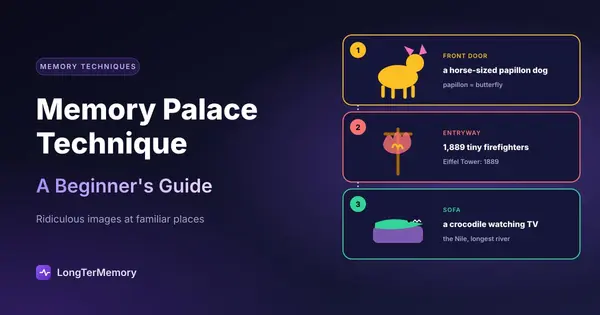
The method of loci , also called the memory palace technique , is one of the oldest memory techniques in recorded history. Ancient Greek and Roman orators used it to memorize hours-long speeches without notes. Contemporary memory champions use it to memorize the order of entire shuffled card decks in minutes.
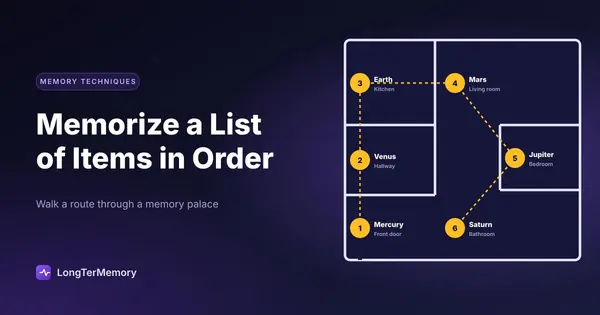
The reason it works so well for ordered lists is structural: the loci (locations) along a familiar spatial path give you a built-in ordering system. You don’t have to remember what comes third , you just walk to the third location in your palace, and whatever you placed there reveals itself.
Building Your First Memory Palace
A memory palace is any familiar spatial environment: your childhood home, your current apartment, your commute route, your school. The key requirements are:
- It should be deeply familiar. You need to be able to mentally “walk through” it with your eyes closed and know where everything is.
- It should have distinct waypoints. Specific locations you can use as “stations” where you’ll deposit memories.
- The path should be linear. You need a consistent route so you always encounter locations in the same order.
For a home-based memory palace, a typical sequence of stations might be: front door → shoe rack → coat closet → hallway mirror → living room sofa → coffee table → bookshelf → kitchen counter → kitchen table → refrigerator → and so on.
For a 10-item list, you need 10 stations. For a 20-item list, 20 stations. You can extend any palace by adding more rooms, or chain multiple palaces together.
Placing Items in the Palace
For each item in your list, create a vivid, absurd mental image and “place” it at the corresponding station. The image should:
- Be exaggerated , bigger, brighter, more bizarre than real life
- Interact with the location (rather than just sitting inertly in it)
- Involve action or movement where possible
- Engage multiple senses if you can
Example: Memorize the first five cranial nerves in order , Olfactory, Optic, Oculomotor, Trochlear, Trigeminal.
- Front door (Olfactory): A giant nose is glued to your front door. It’s sniffing aggressively, making the door rattle. Smell association: you can almost smell the coffee from inside.
- Shoe rack (Optic): A massive eyeball is sitting in your shoe. When you pick up the shoe to put it on, the eyeball stares back at you.
- Coat closet (Oculomotor): A tiny motor is attached to an eyeball, spinning it around in circles inside the coat closet. You hear the motor whirring.
- Hallway mirror (Trochlear): A trophy case (sounds like Trochlear) is reflected in your hallway mirror, but instead of trophies, it’s full of eyeballs on pedestals.
- Living room sofa (Trigeminal): Three identical twins (tri = three, gemi = twin) are sitting on your sofa, each looking identical and slightly smug. They wave at you simultaneously.
To recall the list, mentally walk through your palace. At each station, the image you placed there reveals the next item. The order is guaranteed by the order of the path.
Why the Method of Loci Works
Spatial memory is one of the most robust systems in the human brain, developed over millions of years of evolutionary pressure to navigate physical environments. Research on how and why we forget shows that memories with rich contextual associations , spatial, sensory, emotional , are significantly more resistant to forgetting than isolated facts. The method of loci essentially hijacks your spatial navigation system to carry non-spatial information.
When to Use the Method of Loci
The method of loci is the right tool when:
- The list is long (10+ items)
- Order matters and is non-obvious (the items don’t have a natural logical sequence)
- You need long-term retention (the method produces very durable memories)
- You have a few minutes for setup (you need to create and visualize the images)
For shorter lists or situations requiring quick memorization, the methods below are more efficient.
Acronyms and Acrostics for Short Lists
For lists of 3-8 items, especially in academic contexts, acronyms and acrostics are often the fastest and most practical memorization tools.
Acronyms: When the Letters Form a Word
An acronym takes the first letter of each item in the list and combines them into a single word (or word-like string) that can be memorized as one item instead of many.
Classic examples:
| Acronym | What It Encodes |
|---|---|
| HOMES | The Great Lakes: Huron, Ontario, Michigan, Erie, Superior |
| ROYGBIV | Colors of the rainbow: Red, Orange, Yellow, Green, Blue, Indigo, Violet |
| RICE | First aid for sprains: Rest, Ice, Compression, Elevation |
| PEMDAS | Order of operations: Parentheses, Exponents, Multiplication, Division, Addition, Subtraction |
| FITS | Signs of a stroke: Face drooping, Irregular heartbeat, Trouble speaking, Sudden numbness |
The power of acronyms is their extreme compression , you reduce a 6-item list to a single pronounceable word. The tradeoff is that the acronym itself gives you no clue about what the letters stand for; you need to know the unpacking.
Creating Your Own Acronyms
When you need to memorize a new list and no established acronym exists, creating one takes about two minutes:
- Write the first letter of each item
- Try to rearrange the letters into a pronounceable word or string
- If the exact letters don’t work, try near-homophones (replace a “C” that sounds like “K” with a “K,” etc.)
- If still stuck, move to acrostics
Acrostics: When the Letters Don’t Form a Word
An acrostic uses the first letter of each list item as the first letter of each word in a sentence. The sentence provides a memorable narrative structure even when the letters don’t form a word.
Classic examples:
| Acrostic | What It Encodes |
|---|---|
| My Very Educated Mother Just Served Us Nachos | Planets: Mercury, Venus, Earth, Mars, Jupiter, Saturn, Uranus, Neptune |
| Every Good Boy Does Fine | Musical lines on the treble clef: E, G, B, D, F |
| Please Excuse My Dear Aunt Sally | Order of operations (PEMDAS) |
| Oh Oh Oh, To Touch And Feel Very Good Velvet AH | Cranial nerves I-XII |
| Some Lovers Try Positions That They Can’t Handle | Carpal bones in order |
Making Acrostics Stick
The best acrostics are:
- Slightly absurd or funny , mild humor and surprise improve memory
- Concrete , “My Very Educated Mother” is more concrete than “Many Very Eager Mathematicians”
- In your own voice , sentences you create yourself stick better than ones you copied, because the creative act of generating the sentence is itself a memory event
If the standard acrostic for a list doesn’t click for you, spend two minutes making up your own. Your version will almost certainly stick better than someone else’s.
The Limitation of Acronyms and Acrostics
The weak spot of both techniques is that they give you the first letter of each item, not the full item. This is fine when the first letter uniquely identifies the item (there’s only one planet starting with M that comes second), but it’s a problem when multiple items start with the same letter, or when you might confuse similarly-named items.
For these cases, you need richer encoding , which is where the linking method shines.
The Linking Method: Turning Lists Into Connected Stories
The linking method , sometimes called the chain method , takes a list and turns it into a connected narrative where each item is vividly linked to the next. Unlike the memory palace (which requires a pre-existing spatial structure) or acronyms (which require short lists), the linking method can be applied to any list of any length with no setup required.
How the Linking Method Works
For each consecutive pair of items in the list, create a mental image of one item transforming into or interacting with the next item. The image should be vivid, exaggerated, and action-based.
Example: The planets in order , Mercury, Venus, Earth, Mars, Jupiter, Saturn, Uranus, Neptune.
- Mercury → Venus: A tiny silver ball (Mercury, the element) rolls across a smooth surface and transforms into a beautiful woman (Venus, goddess of love) who winks at you.
- Venus → Earth: The woman reaches down and picks up a giant ball of dirt and grass (Earth) like a basketball.
- Earth → Mars: The dirt ball suddenly turns red and a little green alien pops out of it holding a candy bar (Mars bar).
- Mars → Jupiter: The alien is so excited about the candy bar that it inflates to an enormous size (Jupiter, the largest planet) and floats upward.
- Jupiter → Saturn: The enormous inflated alien floats into a hula hoop (Saturn’s rings) that spins around its middle.
- Saturn → Uranus: The hula hoop suddenly turns into an electric ring that shocks the alien , “Yer-AIN-us!” it yells in pain.
- Uranus → Neptune: The shocked alien falls into the ocean (Neptune, god of the sea) and a giant trident appears.
To recall the list, start at Mercury and follow the chain: each image reminds you of the next item, which connects to the next image, and so on.
Why Stories Work
The human brain is extraordinarily well-adapted to remember narrative sequences. We remember stories far better than we remember lists. This is why oral traditions across cultures have passed down vast amounts of information through myth and story for thousands of years , before writing existed, story was the primary memory technology.
The linking method exploits this by forcing list items into a narrative structure. The absurdity and vivid imagery further reinforce each connection, because surprising and unusual events are encoded more deeply than ordinary ones.
For a deeper look at building these narrative chains across full subjects, see our guide to the story method, one of the most effective memory techniques for ordered information.
Tips for Strong Links
The links between items are the crucial component. Strong links share these features:
- Cause and effect: One item causes or produces the next (“the ball rolls into the woman”)
- Physical transformation: One item physically changes into the next
- Vivid sensory details: What do you see, hear, feel, smell?
- Exaggerated scale: Make things bigger, smaller, or more dramatic than real life
- Absurdity: The more unexpected the image, the better
Weak links are merely adjacent , “Mercury is next to Venus” , rather than causally or transformationally connected. Weak links break down under pressure.
Combining Methods for Long Lists
For very long lists (20+ items), the most powerful approach is to combine the memory palace with the linking method. Use your palace to provide the large-scale structure (Station 1, Station 2…) and use linking images within each station to encode the specific content. This gives you the navigational reliability of the palace with the narrative richness of the linking method.
When to Use the Linking Method
The linking method is ideal when:
- The list is medium length (5-20 items)
- You need to memorize it quickly (no setup needed beyond the chain itself)
- The items are concrete enough to visualize (or can be converted to concrete images)
- Order is critical but the items don’t have logical connections to exploit
Choosing the Right Method for Your List
| List Type | Recommended Method |
|---|---|
| 3-7 items, letters form a word | Acronym |
| 3-8 items, letters don’t form a word | Acrostic |
| 5-20 items, need quick encoding | Linking method |
| 10+ items, long-term retention needed | Method of loci |
| 20+ items, high-stakes recall | Memory palace + linking |
No single method dominates for all situations. The skill is knowing which tool to reach for and applying it confidently.
Practicing Until the Methods Feel Natural
The first time you use the method of loci or the linking method, it might feel slow and awkward. That’s normal. Like any skill, memorization technique fluency takes practice. The second time is faster. By the tenth time, creating a chain of images or walking a memory palace is nearly automatic.
A practical training regimen:
- Week 1: Use the linking method on one real list per day (shopping lists, to-do lists, vocabulary lists). Time yourself.
- Week 2: Try the method of loci for a subject-relevant list. Choose a palace you know well.
- Week 3: Use acronyms or acrostics for anything requiring short-list recall in a course you’re taking.
- Ongoing: Apply these methods to actual study material. Real application is the fastest path to fluency.
The investment is genuinely modest , 10-15 minutes per day for a few weeks , and the return is a permanent upgrade to your ability to memorize any ordered list. If you’re managing multiple lists for a course or exam, LongTerMemory can help track your study decks and apply spaced repetition scheduling, so you review each list at the optimal time rather than guessing what needs refreshing.
The Core Insight
Every technique in this guide is built on the same underlying principle: your brain was not designed to remember abstract sequences, but it is extraordinarily good at remembering stories, spaces, and images. The method of loci, acronyms, acrostics, and the linking method all work by translating abstract list content into formats your memory can actually grip.
The next time you’re faced with a list you need to memorize , whether it’s the layers of the earth’s atmosphere, the order of operations in a business process, or the chronological sequence of historical events , don’t just read it and hope. Build a story. Walk a palace. Make a word. Give your memory something to hold onto.