How to Move from Novice to Expert in Any Subject
Expertise is built, not born. Learn the stages of skill development, how deliberate practice works, and how to know when you've crossed into true mastery.
Table of Contents
- The Stages of Expertise and What Study Looks Like at Each Level
- Deliberate Practice as the Engine of Expertise Development
- How to Know When You've Crossed From Competent to Expert
- The Role of Time: Why Expertise Cannot Be Rushed
- Building Expertise in a New Field: A Practical Roadmap
- The Motivation Problem: Staying the Course
- How Technology Can Support Expertise Development
- The Bottom Line
There is a persistent myth that expertise is a gift. That some people are born with a natural talent for mathematics, or language, or music, and the rest of us are destined to be competent at best. This myth is not just wrong, it is actively harmful. It discourages people from pursuing difficult subjects, leads to premature abandonment of promising skills, and creates a fixed mindset that limits personal and professional growth.
The reality, supported by decades of research in psychology and cognitive science, is that expertise is overwhelmingly a product of specific types of practice conducted over extended periods. Natural ability plays a role, but its contribution is smaller than most people assume, and it is never sufficient by itself. The difference between a novice and an expert is not primarily in their starting point. It is in what they did after they started.
Understanding how expertise develops gives you a roadmap. Whether you’re trying to master a new subject for a certification, transition into a new field, or simply become genuinely good at something that currently frustrates you, the path from novice to expert is navigable. It is not easy, it is not quick, but it is knowable.
The Stages of Expertise and What Study Looks Like at Each Level
The most influential model of skill development comes from Stuart and Hubert Dreyfus, who identified five stages of expertise progression. Their framework, developed in the 1980s, has been validated and refined across numerous domains.
| Stage | Characteristics | Study Approach |
|---|---|---|
| Novice | Rules-based, context-independent, rigid | Follow explicit procedures, memorize definitions, practice basic mechanics |
| Advanced Beginner | Some situational awareness, begins to recognize patterns | Start identifying exceptions to rules, practice with varied examples |
| Competent | Sets goals, prioritizes, handles routine situations well | Deliberate practice on weak areas, study case analyses, seek feedback |
| Proficient | Intuitive grasp of situations, sees holistic picture | Study advanced material, teach others, work on complex integrated problems |
| Expert | Intuitive performance, transcends rules, sees novel solutions | Maintain skills, innovate, mentor, stay current with field developments |
At the novice stage, you are following rules without understanding why they work. A novice chess player knows how the pieces move. A novice programmer can write a for-loop. A novice medical student can recite the steps of a physical exam. Study at this stage is heavily memorization-based and procedural. You need explicit rules, clear examples, and lots of repetition.
At the advanced beginner stage, you start to recognize patterns. You’ve seen enough examples that some situations feel familiar even if you can’t fully articulate why. Study here shifts from pure memorization to pattern recognition. You need exposure to varied examples, edge cases, and exceptions.
At the competent stage, you can handle most routine situations without guidance. You set your own goals and prioritize your own study. This is where many professionals stop, and it’s a perfectly functional level for many careers. But it’s not expertise. To move beyond competence, you need to start doing something different from what got you this far.
At the proficient stage, your intuitions start to be reliable. You grasp situations as wholes rather than as collections of individual features. A proficient physician doesn’t run through a checklist for every patient; they notice the overall clinical picture and know what to investigate. Study at this stage involves advanced integration, teaching others, and tackling problems that don’t fit standard categories.
At the expert stage, your performance is largely intuitive and fluid. You see solutions that aren’t in the textbook. You handle novel situations creatively. The expert chess master doesn’t calculate every possible move; they see the right move. Study at this stage is about maintenance, innovation, and staying current. Expertise is not a destination you reach and then stop. It requires continuous engagement with the field.
Deliberate Practice as the Engine of Expertise Development
The concept of deliberate practice, popularized by Anders Ericsson, is the most important idea in expertise research. It is not the same as regular practice. It is not the same as working hard. It is a specific type of practice with specific characteristics.
Deliberate practice has four defining features:
It is designed to improve performance. The practice activity is intentionally structured to target a specific aspect of skill that needs development. It is not mindless repetition. It is focused, goal-directed work on well-defined weaknesses.
It is highly demanding mentally. Deliberate practice is not fun. It requires sustained concentration, error detection, and problem-solving. It pushes you beyond your current capability, which is cognitively exhausting. Ericsson estimated that experts engage in no more than 3-5 hours of deliberate practice per day because it is so mentally taxing.
It provides immediate feedback. You need to know whether you’re doing it right or wrong, quickly and accurately. Without feedback, you can’t identify errors and correct them. This is why self-study is often less effective than study with a coach, mentor, or structured program that provides feedback.
It involves repetition and refinement. Deliberate practice repeats the same or similar tasks, but with progressive adjustment based on feedback. Each repetition is slightly different from the last because you’re incorporating what you learned from the previous attempt.
Here is how deliberate practice differs from other types of practice:
| Type of Practice | Goal | Mental Effort | Feedback | Example |
|---|---|---|---|---|
| Naive practice | Just doing the activity | Low | Minimal | Playing chess for fun without analysis |
| Purposeful practice | Specific goal, effortful | High | Sometimes | Solving calculus problems with a timer |
| Deliberate practice | Designed by expert, feedback-driven | Very high | Immediate and accurate | Working with a tutor who corrects each step |
For students and professionals, the implication is clear: if you want to move from competent to expert, you need to find ways to engage in deliberate practice. This usually means identifying your weakest areas, designing specific exercises to target them, obtaining accurate feedback, and repeating until improvement is visible.
How to Know When You’ve Crossed From Competent to Expert
The transition from competent to expert is gradual, not sudden. But there are signs that indicate you’re moving into higher levels of skill.
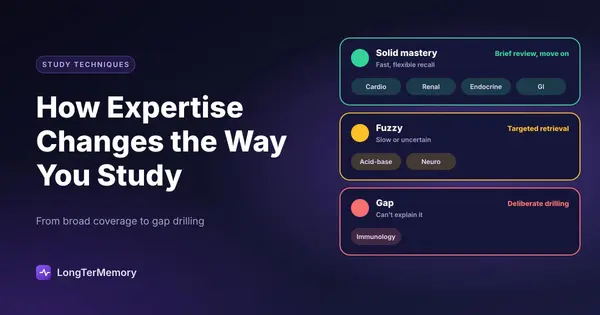
You solve problems faster than you can explain your reasoning. At the competent stage, you can solve problems but you consciously apply rules and procedures. At higher stages, you often arrive at the right answer before you can articulate why. Your intuition has become reliable enough to guide you, and your conscious analysis is playing catch-up.
You notice things that others miss. Experts perceive meaningful patterns in information that novices filter out as noise. A radiologist doesn’t just see a chest X-ray; they immediately notice the subtle opacity that suggests pathology. A programmer doesn’t just see code; they see architectural patterns and potential failure modes. If you’re starting to spot important details that others overlook, you’re developing expert perception.
You handle novel situations without panic. Competent performers rely on familiar patterns. When faced with something genuinely new, they freeze or fall back on inappropriate routines. Experts adapt. They decompose the novel situation into elements they recognize and invent solutions for the elements they don’t. If you find yourself remaining calm and resourceful in unfamiliar territory, your expertise is deepening.
Others ask you for help. This is perhaps the most practical indicator. When people who are themselves competent start seeking your input on difficult problems, you’ve crossed a threshold. Your judgment is valued because it has proven reliable in complex situations.
You can teach the material effectively. Teaching requires understanding at a deeper level than personal performance. When you can explain a concept clearly, anticipate common misconceptions, and adjust your explanation based on the learner’s response, you have organized your knowledge in a way that characterizes expertise.
The Role of Time: Why Expertise Cannot Be Rushed
There is no shortcut to expertise. The popular “10,000-hour rule,” while oversimplified, captures an important truth: expertise requires substantial investment of time. More precisely, research suggests that reaching international-level expertise in complex domains typically requires ten or more years of intense, deliberate practice.
This is not because expertise is magical. It is because expertise requires building vast, finely tuned mental representations of the domain. These representations are not stored as facts or rules. They are stored as patterns, intuitions, and procedural knowledge that can only be built through extensive experience. You cannot download them. You cannot cram them. You can only build them, one demanding practice session at a time.
For students preparing for certifications or career transitions, this has a sobering implication: you can become competent in a new field in months, but you cannot become an expert in months. If your goal is to pass an exam, competence may be sufficient. If your goal is to perform at a high level in a professional role, you need to commit to the longer trajectory.
That said, the quality of your practice matters as much as the quantity. Ten thousand hours of naive practice does not produce expertise. Ten thousand hours of deliberate practice does. Focus on making your practice as deliberate as possible, and trust that expertise will emerge over time.
Building Expertise in a New Field: A Practical Roadmap
If you’re starting from zero in a new subject, here is a practical sequence for building toward expertise:
Phase 1: Build the foundation (months 1-6). Focus on acquiring the core vocabulary, concepts, and procedures. Use structured courses, textbooks, and tutorials. Your goal is to reach competence, the ability to handle routine problems without constant reference to external resources. Don’t worry about deep understanding yet. You need the surface structure before you can see the deep structure.
Phase 2: Expand and integrate (months 6-18). Start working on problems that require combining multiple concepts. Seek feedback from mentors, peers, or online communities. Begin identifying your weak areas and targeting them specifically. This is where purposeful practice becomes important.
Phase 3: Deliberate practice (months 18-60). Find a coach, mentor, or structured program that can provide expert-designed practice with immediate feedback. Focus on your weakest areas, not your strengths. Work on problems at the edge of your capability. Track your progress and adjust your practice based on results.
Phase 4: Teaching and innovation (ongoing). Start teaching others, writing about the field, or working on novel problems. Teaching forces you to organize your knowledge explicitly. Innovation forces you to apply your knowledge in new ways. Both activities deepen and maintain expertise.
The Motivation Problem: Staying the Course
The biggest obstacle to expertise is not intelligence or opportunity. It is motivation. Deliberate practice is intrinsically unpleasant. It involves repeated failure, sustained mental effort, and slow visible progress. Most people who start on the path to expertise quit before they get there.
Set process goals, not outcome goals. Instead of “I want to pass the CFA exam,” set goals like “I will complete three deliberate practice problems every day.” Process goals are under your control. Outcome goals depend on factors you can’t fully control. Process goals keep you focused on what you can do today.
Find a community. Expertise is easier to sustain when you’re not alone. Study groups, online communities, mentors, and peers provide social accountability, emotional support, and feedback. The communities around specific exams or fields are often full of people at various stages of the same journey.
Track your progress. Expertise development is slow, and without tracking, it can feel like you’re not improving. Keep a log of your practice, your performance on assessments, and specific skills you’ve mastered. Review it monthly. The evidence of progress, even slow progress, sustains motivation.
Accept plateaus. Progress is not linear. You will have weeks or months where you feel stuck. This is normal. Plateaus often precede breakthroughs. The key is to keep practicing through the plateau rather than interpreting it as evidence that you’ve reached your limit.
How Technology Can Support Expertise Development
Modern tools can accelerate some aspects of expertise development, though they cannot replace deliberate practice.
Spaced repetition systems help you build the foundational knowledge that expertise requires. Before you can recognize patterns intuitively, you need to know the basic facts cold. Flashcard apps automate the review scheduling so you can focus on higher-level practice.
Simulation and practice environments provide safe spaces for deliberate practice. Flight simulators for pilots, coding platforms for programmers, and virtual patients for medical students all allow repeated practice with immediate feedback in contexts where real-world practice would be dangerous or expensive.
AI tutoring systems are beginning to provide personalized feedback at scale. While they cannot yet replace human mentors for high-level expertise development, they can support the early stages by identifying knowledge gaps and suggesting targeted practice.
LongTerMemory fits into this landscape by automating the foundational layer of knowledge acquisition. By generating flashcards from your study materials and scheduling them optimally, it frees up cognitive resources that you can then invest in the higher-level deliberate practice that builds true expertise.
The Bottom Line
Expertise is not a mystery. It is not a gift. It is a predictable outcome of specific behaviors conducted over extended periods. The stages are known. The type of practice required is known. The timeline, while long, is realistic.
What separates those who become experts from those who remain competent is not talent. It is the willingness to engage in the uncomfortable, effortful, feedback-driven practice that produces real improvement. It is the discipline to keep going through plateaus, to seek out weaknesses rather than avoid them, and to measure progress in years rather than weeks.
If you’re currently a novice in a subject that matters to you, the path to expertise is open. It starts with a single practice session, focused on a specific weakness, with clear feedback, repeated until you improve. Then another. Then another.
The experts in your field were not born that way. They walked the same path. And the path is still there, waiting for you to take the next step.