How to Prepare for the Praxis Core Academic Skills Exam
A complete guide to Praxis Core prep: what the test covers in reading, writing, and math, study resources, passing scores, and practice test strategy.
Table of Contents
- What the Praxis Core Tests Across Reading, Writing, and Math
- Reading (Test 5713)
- Writing (Test 5723)
- Mathematics (Test 5733)
- Study Resources and Passing Score Requirements for Teacher Licensure
- Passing Scores
- Best Study Resources
- Building Your Study Plan
- Practice Test Strategy for Praxis Core Readiness
- Start with a Diagnostic
- The Analysis Ritual
- Simulating Real Conditions
- Timing Strategy by Subtest
- The Final Week Before the Exam
- LongTerMemory for Praxis Core Vocabulary and Rules
- The Bottom Line
If you are on the path to becoming a licensed teacher in the United States, there is a good chance the Praxis Core Academic Skills for Educators is standing between you and your certification. For many aspiring teachers, it is one of the more stressful steps in the process, not because the content is advanced, but because the test covers a lot of ground and the stakes feel high.
The good news is that the Praxis Core is very learnable. It is not a test of innate ability. It is a test of academic skills that respond directly to targeted, structured preparation. This guide covers everything you need to know: what the exam actually tests, what resources to use, what the passing scores are, and how to use practice tests strategically so that test day feels like a formality rather than a gamble.
What the Praxis Core Tests Across Reading, Writing, and Math
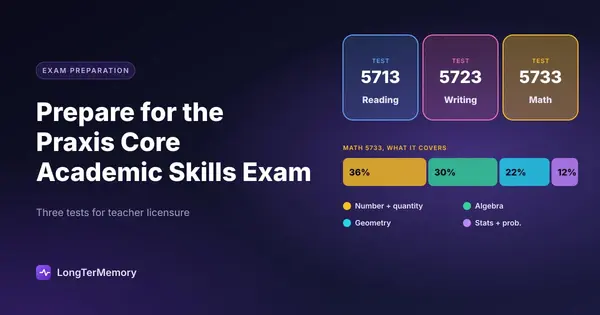
The Praxis Core consists of three separate subtests: Reading (5713), Writing (5723), and Mathematics (5733). You can take them individually or all on the same day. Each is scored separately, and most states require passing scores on all three before you can be admitted to a teacher education program or receive initial licensure.
Reading (Test 5713)
The Reading subtest is 56 questions, 85 minutes, and tests your ability to comprehend, interpret, and analyze written texts. You will not be tested on memorized facts. Everything you need to answer each question is in the passage in front of you.
The question types include:
Informational Texts: Longer prose passages on academic topics (science, social studies, humanities) paired with questions about main idea, supporting detail, inferences, tone, and argument structure.
Arguments: Questions about the logical structure of arguments, identifying assumptions, recognizing flaws in reasoning, and evaluating evidence.
Paired Passages: Two related passages on the same topic, with questions asking you to compare perspectives, identify agreement or disagreement, and synthesize information.
Vocabulary in Context: Questions where the meaning of a word depends on how it is used in the passage, not its general definition.
The skills being tested on Reading are the same ones that English and language arts teachers, in particular, will need to model and teach. But they matter for all subject areas: reading complex texts and extracting meaning accurately is a fundamental teaching competency.
Study focus for Reading: Practice reading complex, academic-style texts quickly and with close attention. The New York Times opinion section, academic journals, and Scientific American are useful daily reading practice. Work on identifying main ideas, author purpose, and argument structure explicitly rather than just absorbing the content.
Writing (Test 5723)
The Writing subtest has two sections: Selected Response (40 questions, 40 minutes) and Essay (two essays, 60 minutes total).
The Selected Response section covers:
- Usage questions: Identify errors in grammar, word usage, and sentence structure in underlined portions of sentences.
- Sentence correction: Choose the best revision of an underlined portion of a sentence.
- Revision in context: Read a draft essay and answer questions about how to improve it.
- Research skills: Questions about source evaluation, citation, and distinguishing reliable from unreliable sources.
The Essay section has two tasks:
Argumentative Essay: You are given a topic and asked to take a position, develop it with evidence and reasoning, and write a coherent essay in about 30 minutes.
Informative/Explanatory Essay: You are given two short source texts and asked to write an essay that uses and synthesizes them to develop a point. This is not a summary. You need to analyze and integrate the sources.
Both essays are scored on a 6-point scale by trained human raters. Scores of 1-6 on each are combined into a single writing score.
Study focus for Writing: Grammar rules matter here, specifically subject-verb agreement, pronoun reference, modifier placement, parallelism, and sentence boundary errors (run-ons, comma splices, fragments). Also practice writing structured academic essays under timed conditions. The more you write, the more automatic the structure becomes.
Mathematics (Test 5733)
The Mathematics subtest is 56 questions, 85 minutes, and covers content through roughly tenth-grade mathematics. A four-function calculator is provided on the computer-based test, but not for all questions.
The content categories are:
| Category | Approx. % of Test | Topics |
|---|---|---|
| Number and Quantity | 36% | Integers, ratios, percentages, basic number theory, estimation |
| Algebra | 30% | Linear equations, inequalities, functions, patterns, word problems |
| Geometry | 22% | Area, perimeter, volume, coordinate geometry, angles, similarity |
| Statistics and Probability | 12% | Mean, median, mode, graphs, basic probability |
Many test-takers find the math subtest the most challenging, especially if significant time has passed since high school math. The good news is that the content ceiling is not high. You do not need calculus or statistics beyond the basics. What you do need is reliable command of fundamentals that may have gotten rusty.
Study focus for Math: Identify which of the four content categories feels weakest for you and spend the majority of your math prep time there. Ratio and percentage problems trip up more test-takers than any other topic. Geometry formulas (area, perimeter, volume, coordinate distance) require memorization. Algebra word problems require translating verbal descriptions into equations, which is its own skill worth practicing separately.
Study Resources and Passing Score Requirements for Teacher Licensure
Passing Scores
Passing scores for the Praxis Core vary by state. ETS (the maker of the exam) sets a raw score scale of 100-200 for each subtest, but each state independently determines what score it accepts. The variation is significant.
| State | Praxis Core Reading | Praxis Core Writing | Praxis Core Math |
|---|---|---|---|
| New York | 156 | 162 | 150 |
| California | 156 | 158 | 150 |
| Texas | 156 | 162 | 150 |
| Georgia | 156 | 162 | 150 |
| Virginia | 156 | 158 | 150 |
Always verify your state’s current requirements directly with ETS at ets.org/praxis/scores/requirements. Requirements change periodically, and some states have additional or alternative requirements.
Some states have moved away from requiring the Praxis Core entirely and use their own assessments. Others accept it only for certain types of certification. Know your state’s specific pathway before you start studying.
Best Study Resources
ETS Official Materials: The first place to go is always the official ETS Praxis Core website. They publish free study companions for each subtest (large PDFs with content outlines and practice questions), as well as a paid interactive practice test for each subtest. The official practice tests are the most accurate representation of what the real exam is like.
Khan Academy: Free and excellent for the math content. Khan Academy’s coverage of arithmetic, algebra, geometry, and statistics maps closely to Praxis Core math. If you need to brush up on content from scratch, this is the most accessible option.
The Princeton Review Praxis Core Prep: One of the best full-length prep books, with comprehensive content review, strategy tips, and several full practice tests. Particularly useful for the writing grammar section, which ETS’s own materials cover less thoroughly.
Mometrix Praxis Core Study Guide: More affordable than Princeton Review and similarly comprehensive. The explanations for math topics are particularly clear.
YouTube: For specific math topics you are struggling with, finding a five-minute YouTube explanation is often faster and more effective than reading a textbook explanation. Math channels like Professor Leonard and Organic Chemistry Tutor (despite the name, they cover general math extensively) are excellent.
Building Your Study Plan
A realistic Praxis Core preparation timeline depends on how long it has been since you engaged with the content and how far you are from the passing scores on diagnostic tests.
If you are already within 5-10 points of passing on a diagnostic: Two to four weeks of focused, daily practice is usually sufficient.
If you have significant content gaps (especially in math): Six to eight weeks gives you time to rebuild foundational knowledge and develop exam-specific strategies.
If you are retaking after a failed attempt: Identify specifically which question types and content areas you missed on the real exam, and focus almost exclusively on those. Do not re-prepare material you already passed.
Structure your daily sessions around content review in the morning (when cognitive resources are freshest) and practice questions in the afternoon or evening. Always do practice questions after content review, not before, unless you are doing an initial diagnostic.
Practice Test Strategy for Praxis Core Readiness
The single most effective thing you can do to prepare for the Praxis Core is to take timed, realistic practice tests and then analyze your results systematically. More is not necessarily better. One well-analyzed practice test teaches you more than three practice tests you finish, check the answers to, and move on from.
Start with a Diagnostic
Before you do any content review at all, take one full practice test per subtest under timed conditions. This diagnostic tells you:
- Where you currently are relative to the passing score in your state
- Which content areas are already solid (do not need much review time)
- Which content areas are gaps (need focused attention)
- Which question types are most likely to cost you points
Without a diagnostic, you are essentially studying blind. You might spend two weeks on material you already know while neglecting the area that is actually keeping you from passing.
The Analysis Ritual
After every practice test, before you look at any scores, do this:
-
For every question you got wrong, identify why you got it wrong. Was it a content gap (you did not know the rule or fact)? A reasoning error (you understood the content but applied it incorrectly)? A careless mistake (you knew the right answer but mis-selected)? Or a time pressure error (you ran out of time and guessed)?
-
Group your wrong answers by category. If eight of your fifteen math mistakes fall in the number and quantity category, that is where to focus. If six of your writing errors are all modifier placement, you have identified a specific grammar skill to drill.
-
Set targeted practice goals for the next session based on the analysis. “I will do fifteen additional number and quantity practice problems and review modifier placement rules” is more useful than “I will study math and writing more.”
Simulating Real Conditions
The Praxis Core is a computer-based exam taken at a Prometric testing center. The environment is quiet, monitored, and slightly formal. When you take practice tests at home, try to replicate this as closely as you can:
- Use a computer or laptop, not paper and pen
- Sit at a desk, not on a couch or in bed
- Set a timer and stop when time is up, even mid-question
- Do not check your phone during the test
The goal is to have done the hardest version of the test (alone, at a desk, under time pressure) before you get to the real version. Test day should feel familiar, not novel.
Timing Strategy by Subtest
Reading: You have about 90 seconds per question. Most passages are followed by two to five questions, so read the passage once with focus, then answer the questions. Do not re-read the whole passage for each question. Scan for the specific relevant section instead.
Writing Selected Response: You have about 60 seconds per question for the grammar and usage section. These should be relatively quick once you know the rules. For the revision-in-context section, read the passage first, then the questions.
Writing Essays: Spend the first three to five minutes planning your essay before writing. A clear outline makes the actual writing faster and more coherent. Leave two minutes at the end to proofread for errors.
Math: You have about 90 seconds per question, but math questions vary enormously in difficulty and time required. Flag and skip questions that are taking more than two minutes, and return to them after finishing the rest. The easiest questions are worth the same as the hardest ones.
The Final Week Before the Exam
Do not introduce new content in the final week. Your brain needs time to consolidate what it has learned, and cramming new material at the end tends to create interference rather than clarity.
Instead: take one more full practice test early in the final week, do one targeted review session for any remaining weak spots, and then spend the last two days on light review and rest. Sleep is genuinely more valuable the night before an exam than another two hours of practice questions.
Review your most challenging question types one final time the morning of the exam, then trust your preparation.
LongTerMemory for Praxis Core Vocabulary and Rules
One of the most straightforward applications of LongTerMemory for Praxis Core prep is drilling grammar rules and mathematical formulas using spaced repetition. Upload your study notes or a grammar rules summary, and the platform generates practice questions that resurface rules at the right interval to keep them fresh in memory without over-reviewing material you already know.
This is especially useful in the two to three weeks before the exam, when the goal shifts from learning new material to consolidating and maintaining what you have already learned.
The Bottom Line
The Praxis Core is not designed to be a trick exam. It is testing whether you have the foundational academic skills to be an effective teacher. That means the content is genuinely learnable, and preparation genuinely moves the needle.
Take a diagnostic, identify your gaps, focus your study time where it matters most, and take timed practice tests with rigorous self-analysis. Most candidates who fail the Praxis Core do so because they studied broadly but not smartly, spending time on material they already know while avoiding the material that is actually hard.
Know your state’s passing scores. Give yourself enough time. And trust that the skills this exam tests are ones you can develop, because they are.
Good luck on the path to your certification. You have chosen one of the most important careers there is.