Professional Certifications: Smart Study Strategies for AWS, PMP, CFA
Preparing for AWS, PMP, CFA, or other professional certifications? Learn science-backed study strategies to pass faster and retain more.
Table of Contents
- Understanding What Certification Exams Actually Test
- Custom Study Plans for IT and Management Certifications
- IT Certifications (AWS, Azure, GCP, CISSP, CompTIA)
- Project Management (PMP, CAPM, PRINCE2)
- Financial Certifications (CFA, CFP, Series 7, CPA)
- How to Maintain Motivation During Long Preparation Cycles (3–6 Months)
- Break the Timeline into Phases
- Use Leading Indicators, Not Just Lagging Ones
- Build in Planned Recovery
- Managing Renewal Deadlines and Continuing Education Credits Efficiently
- Build a Credential Calendar
- Stack Your CPE/CPD Efficiently
- The Portfolio Approach
- The Week-Before-Exam Protocol
- You Can Pass This Exam
Professional certifications are a strange beast. Unlike a university degree, you can’t just absorb the material over a semester of lectures and essays. You need to demonstrate specific, testable knowledge , often under time pressure, often with significant consequences for failing, and almost always while holding down a job at the same time.
The AWS Solutions Architect exam. The PMP. The CFA Level I. The CISSP. The Series 7. Whatever your certification, the challenge is structurally similar: a large body of standardized knowledge, a fixed exam format, a deadline, and a daily life that doesn’t stop to let you study for it.
The good news is that certifications are more learnable than most people assume , not because the material is easy, but because the material is defined. Unlike a graduate seminar where the scope keeps expanding, a certification exam has a specific body of knowledge with a published outline. That’s actually an advantage, if you know how to use it.
This guide is about using that advantage intelligently.
Understanding What Certification Exams Actually Test
Before you open a study guide, understand what the exam is measuring. This sounds obvious, but most candidates skip it and waste significant study time on the wrong things.
Most professional certifications test one of three things (often in combination):
Knowledge recall. Can you define the concept, state the rule, or identify the right tool for a given situation? AWS exams heavily emphasize knowing which service does what. CFA Level I is substantially about definitions and formulas. PMP covers process groups and knowledge areas.
Applied judgment. Can you select the right course of action in a scenario you haven’t memorized? The PMP exam is notorious for “situational” questions where multiple answers are technically defensible , but one is more defensible given project management best practices. This requires internalized judgment, not just recalled facts.
Problem-solving under constraints. Some certifications (particularly financial and technical ones) require working through calculations or analyses correctly, often with limited time per question.
Knowing which of these your exam emphasizes shapes everything about how you study. A knowledge-recall exam rewards flashcard-heavy preparation. A judgment-based exam rewards practice questions and understanding the why behind rules, not just the rules themselves.
Do this first: Download the official exam outline or content specification document from the certifying body. This is the authoritative list of what the exam tests. Cross-reference it with your study materials to ensure you’re not over-studying peripheral topics.
Custom Study Plans for IT and Management Certifications
Different certification categories have genuinely different demands. Here’s how to adapt your approach by exam type.
IT Certifications (AWS, Azure, GCP, CISSP, CompTIA)
Cloud and security certifications emphasize breadth of knowledge across many services or domains, combined with judgment about when to use each one. The AWS Solutions Architect exam, for example, might ask about 30+ distinct services , not in deep technical detail, but enough to know what each does, when to use it, and its cost/performance tradeoffs.
What works:
- Service comparison flashcards. For each AWS service or security domain, create a card that captures: what it does, when you’d use it, and what it’s commonly confused with.
- Scenario-based practice questions. Official AWS practice exams and platforms like Tutorials Dojo are worth every minute. The exam is heavily scenario-based, so practicing with real exam-format questions is non-negotiable.
- Hands-on work where possible. For technical certifications, actually using the services , even in a free-tier sandbox , creates the kind of concrete mental model that pure reading can’t replicate.
Common mistake: Over-studying documentation depth. The Solutions Architect exam doesn’t ask you to configure an S3 bucket , it asks you to choose between S3, EFS, and EBS for a given architectural scenario. Your study time should match that level of granularity.
Project Management (PMP, CAPM, PRINCE2)
The PMP is unique among major certifications because it tests a specific way of thinking about project management , the PMI way , which sometimes conflicts with how projects actually run in practice.
What works:
- Learn the PMI logic. The exam has a “most correct” answer that reflects PMI’s process-based, stakeholder-focused methodology. Understanding the underlying framework matters more than memorizing individual facts.
- Practice with situational questions. 80% of PMP exam questions are situational. If you’re not doing hundreds of scenario-based practice questions, you’re underpreparing.
- Process flow mastery. Know the five process groups and ten knowledge areas well enough to identify which process applies in a given scenario. This is the backbone of the exam.
Common mistake: Treating the PMP like a knowledge test. Candidates who memorize the PMBOK and neglect practice questions consistently underperform those who do the opposite.
Financial Certifications (CFA, CFP, Series 7, CPA)
Financial certifications are among the most demanding in terms of volume , CFA Level I covers 10 topic areas across hundreds of learning outcome statements , and typically have pass rates below 50%.
What works:
- Formula mastery via spaced repetition. The CFA has a significant quantitative component. Formulas that you can’t derive instantly under exam pressure are formulas you don’t know yet.
- Ethics first and last. CFA Ethics is heavily weighted and commonly underestimated. Study it early, revisit it late, and don’t treat it as easy reading.
- End-of-chapter questions before the chapter. A counterintuitive but effective approach: read the end-of-chapter practice questions first to understand what the chapter will ask you to know, then read the chapter itself.
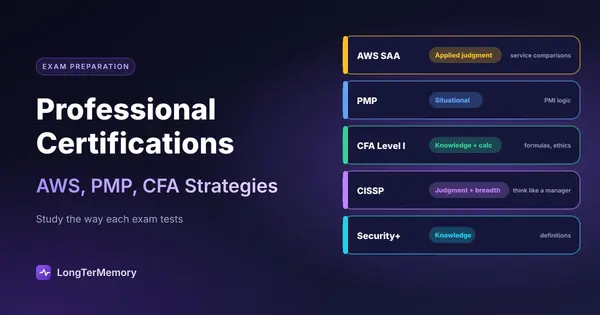
| Certification | Primary test type | Key study focus |
|---|---|---|
| AWS SAA-C03 | Applied judgment | Service comparison + scenarios |
| PMP | Situational | PMI logic + practice questions |
| CFA Level I | Knowledge + calculation | Formulas + ethics + volume |
| CISSP | Judgment + breadth | Domain concepts + thinking like a manager |
| CompTIA Security+ | Knowledge | Definitions + scenario matching |
How to Maintain Motivation During Long Preparation Cycles (3–6 Months)
Most professional certifications require 3–6 months of sustained preparation. This is long enough for motivation to go through several complete cycles , high at the start, low in the middle, anxious at the end.
The candidates who pass are not necessarily more motivated than those who don’t. They’re better at maintaining consistent effort when motivation is low. That’s a system design problem, not a willpower problem.
Break the Timeline into Phases
A 16-week study plan feels manageable when you divide it:
| Phase | Weeks | Focus |
|---|---|---|
| Foundation | 1–4 | Content survey, first flashcard build |
| Core study | 5–10 | Deep study by domain, daily practice Qs |
| Consolidation | 11–14 | Weak area drilling, full practice exams |
| Final prep | 15–16 | Review, timed simulations, light reinforcement |
Each phase has a different feel and different daily activities. Moving through phases gives you visible milestones , you’re not just “studying for the CFA,” you’re completing the Foundation phase, then the Core phase.
Use Leading Indicators, Not Just Lagging Ones
Your practice test score is a lagging indicator , it reflects weeks of work that already happened. It’s important, but it’s not the number to obsess over daily.
Set leading indicators: number of flashcards reviewed per day, number of practice questions completed per week, number of domains touched this week. These are under your control right now, and tracking them prevents the demoralizing experience of staring at a score that moves slowly.
Build in Planned Recovery
One of the most common ways long-haul study plans collapse is through unplanned exhaustion. A high-output week leads to burnout, which leads to a missed day, which leads to guilt, which leads to avoidance, which leads to a week off.
Pre-schedule lighter weeks every 3–4 weeks. Not days off , lighter days, reduced targets, maybe just 30 minutes of flashcard review instead of 2 hours of new material. This is recovery, not failure. It makes the surrounding high-output weeks sustainable.
According to research on applying cognitive psychology to education, distributed practice , studying in multiple shorter sessions rather than massed “cramming” , produces significantly better long-term retention, regardless of the total hours invested. This is both the most evidence-backed and the most ignored insight in professional exam preparation.
Managing Renewal Deadlines and Continuing Education Credits Efficiently
For many certifications, passing the exam is only the beginning. Maintenance requirements add another layer of complexity , especially when you’re managing multiple credentials or staying current in a fast-moving field.
Build a Credential Calendar
The moment you earn a certification, add these to your calendar:
- Expiration date with a 6-month advance reminder
- CPE/CPD annual minimums with quarterly checkpoints
- Any renewal exam requirements and their own prep timelines
The worst outcome is letting a certification lapse because you forgot the renewal timeline while focused on day-to-day work. A calendar with recurring reminders costs five minutes to set up and prevents a genuinely painful problem.
Stack Your CPE/CPD Efficiently
Most working professionals can meet continuing education requirements without taking formal courses , depending on the certification. Common pathways that count but often get overlooked:
- Webinars from professional associations (often free for members)
- Published articles in professional journals (writing, not just reading, in some programs)
- Conference attendance, including virtual
- On-the-job projects that qualify as applied learning
- Mentoring or teaching, which counts for some programs
Check the official documentation for your specific credential. The list of qualifying activities is often broader than candidates realize, and the difference between scrambling for CPE credits in December and having them completed by October is knowing your options in January.
The Portfolio Approach
If you’re planning multiple certifications , AWS Solutions Architect followed by AWS Developer, or CAPM followed by PMP , sequence them intentionally. Some certifications share study material heavily, and studying for them in sequence rather than simultaneously or in isolation significantly reduces total study time.
The CPA exam is divided into four sections that can be taken in any order. Most candidates who pass all four choose an order that builds on overlapping knowledge , typically FAR or REG first to establish the accounting foundation before the others.
Map your certification roadmap as a graph, not a list. Understand the dependencies and overlaps, and sequence accordingly.
The Week-Before-Exam Protocol
After months of preparation, the final week has a specific purpose that most candidates misunderstand. It is not a week to learn new material or dramatically improve your score. It is a week to protect and reinforce what you’ve already built.
What to do the week before:
- One full timed practice exam under real conditions (morning of a weekday, if your exam is in the morning)
- Daily review of your weakest 20% of material , not the areas you’re strong in
- Review your personal “miss log” , the practice questions you consistently got wrong and have since corrected
- Confirm logistics: exam center location, required IDs, calculator policy, break rules
What not to do:
- Start new topics
- Cram for 12-hour sessions
- Skip sleep to get more hours in (sleep is when your brain consolidates what you’ve spent months building)
The anxiety spike in the final week is real and nearly universal. What differentiates candidates who let it hurt their performance from those who don’t is usually this: the ones who trust their system are calmer than the ones who suddenly doubt it. Build a system you can trust over months, and you’ll walk into the exam room knowing you’ve done the work.
For long certification cycles, consistency matters more than intensity. LongTerMemory turns your official study guides, course PDFs, and notes into question and answer flashcards and schedules them with spaced repetition, so a short daily session keeps months of material fresh for exam day.
You Can Pass This Exam
Professional certifications have significant failure rates , not because the people taking them are incapable, but because most candidates either underestimate the preparation required or prepare inefficiently. The material is learnable. The exam is passable. The method matters enormously.
The candidates who consistently pass on their first attempt aren’t studying harder than those who don’t. They’re studying smarter: targeted to the actual exam, weighted toward practice over passive review, distributed across enough time to let retention build, and sustained through a system rather than willpower.
You have the same study hours they have. Use them the right way.