
How to Build Resilience Against Forgetting New Information
Learn why forgetting is normal, the three key practices that build durable memory, and how to design a review system that fights forgetting automatically.
Table of Contents
- Why Forgetting Is Normal and How to Work With It Rather Than Against It
- The Forgetting Curve Is Not Your Enemy
- The Difference Between Forgetting and Never Learning
- Working With Forgetting Instead of Against It
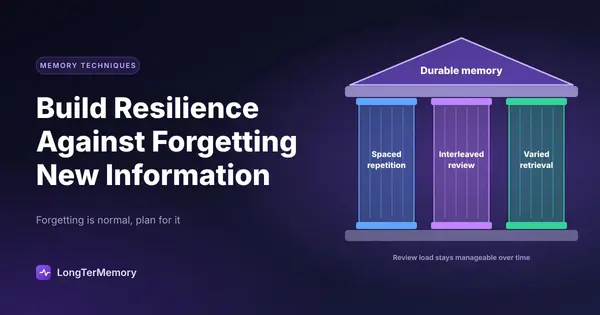
- The Three Key Practices That Build Durable Memory Over Time
- Practice 1: Spaced Repetition
- Practice 2: Interleaved Review
- Practice 3: Varied Retrieval Practice
- Designing a Review System That Fights Forgetting Automatically
- The Architecture of a Resilient Review System
- Managing Review Load Over Time
- What to Do After You Forget Something
- Bringing It All Together
You spent three hours studying last Tuesday. You felt like you had it. You could have explained the whole thing. And then you sat down to review it five days later and it was like you’d never seen it before.
Sound familiar? If so, you’re not experiencing a memory problem. You’re experiencing a completely normal feature of how human memory works, one that most study advice completely fails to address.
The goal isn’t to prevent forgetting entirely, that’s biologically impossible. The goal is to build a learning system that’s resilient against forgetting, one that accounts for memory decay and builds genuine, lasting retention despite it.
This post is about how to do exactly that.
Why Forgetting Is Normal and How to Work With It Rather Than Against It
The Forgetting Curve Is Not Your Enemy
In the 1880s, psychologist Hermann Ebbinghaus ran the first serious scientific experiments on his own memory. He memorized nonsense syllables and then tracked how quickly he forgot them at various intervals. The result was the famous forgetting curve: a steep exponential decline in recall within the first 24 hours, which then levels off into slower decay over the following days and weeks.
What Ebbinghaus also discovered, though this part gets talked about far less, is that each time you successfully review and retrieve information before you forget it completely, the forgetting curve resets, but less steeply. The next drop-off is slower. Each review cycle makes memory more durable.
This is the key insight: forgetting isn’t a failure of your memory system. It’s the system working as designed. Human memory is a dynamic, adaptive structure that retains things roughly in proportion to how often and how recently they’ve been needed. If you don’t use information, your brain gradually deprioritizes it. That makes sense for a biological organism with limited neural resources.
The problem is that this adaptive system was designed for a world where important information recurred naturally in your environment. Your hunter-gatherer brain didn’t need to memorize 400 pharmacology facts for an exam in six weeks. For that kind of goal, you need to deliberately replicate the natural repetition that your learning environment is no longer providing.
The Difference Between Forgetting and Never Learning
Before we go further, it’s worth distinguishing between two different problems that feel the same but have different causes.
The first is forgetting: you understood something, encoded it, and then lost access to it over time. This is normal and fixable.
The second is shallow encoding: you never really learned it in the first place. You read it, it seemed familiar, you moved on, but it never made it into long-term memory. This is also common and also fixable, but requires a different approach.
If you sit down to study and feel like nothing you’re reviewing is familiar, you likely encoded shallowly the first time around. If you sit down and the material feels vaguely familiar but you can’t actively recall details, you encoded it but it’s fading.
Both problems are real. The solution to the first is spaced review. The solution to the second is deeper initial encoding. Most people need both.
Working With Forgetting Instead of Against It
The mindset shift that makes the biggest difference is this: forgetting creates the conditions for stronger memory. When you attempt to retrieve something and struggle, that struggle is not a sign that you’ve wasted your time. Research consistently shows that effortful retrieval, even unsuccessful retrieval followed by seeing the correct answer, produces stronger memory than passive review.
The mechanism is called the testing effect, and it’s one of the most robust findings in all of educational psychology. Attempting to recall something activates the neural pathways associated with that memory. Even if you fail and have to look up the answer, the activation makes the subsequent encoding stronger than if you’d just read it passively.
In other words: stop trying to avoid the uncomfortable feeling of not knowing. That feeling is the signal that real memory work is happening.
The Three Key Practices That Build Durable Memory Over Time
Practice 1: Spaced Repetition
Spaced repetition is the most powerful single tool for building long-term memory resilience. The concept is simple: review material at increasing intervals, just before you would naturally forget it. Early reviews are spaced close together. As memory becomes more durable, intervals lengthen.
The mathematics of this, formalized in algorithms like SM-2 (the basis for Anki) and more recent variants, creates a highly efficient review schedule. You spend minimal time on material you already know solidly, and concentrate review time on material that’s genuinely at risk of being forgotten.
Done consistently over weeks and months, spaced repetition transforms material that would otherwise fade into reliable, long-term knowledge. Students who’ve used it seriously for a full semester of medical school content will tell you: things you reviewed months ago are somehow still there, accessible when you need them.
How to implement it: the most efficient method is digital flashcard software that handles the scheduling for you. Tools like LongTerMemory go a step further by automatically generating flashcards from your own PDFs and notes, so you’re not spending hours manually creating cards before you can even start reviewing.
Practice 2: Interleaved Review
Most people review material in the same order they learned it: chapter 1, then chapter 2, then chapter 3. This is called blocked practice, and while it feels orderly and satisfying, it’s less effective for long-term retention than interleaved review.
Interleaved review mixes material across topics and time periods within a single session. Instead of reviewing all your cardiovascular pharmacology and then all your respiratory pharmacology, you alternate between them, and throw in some older material from three weeks ago.
This feels harder, because it is. Your brain has to re-identify the relevant context for each item rather than sliding along a familiar groove. That extra effort is the point. The retrieval struggle produces stronger encoding.
Research by Rohrer and colleagues found that students using interleaved practice significantly outperformed blocked-practice students on delayed tests, even though their in-session performance was lower. The discomfort during practice is associated with better outcomes after it.
Practice 3: Varied Retrieval Practice
Most people who use active recall stick to one format: question and answer, or flashcard review. This works. But adding varied retrieval practice makes your memory more robust and transferable.
What does this mean in practice? Try recalling material in different formats:
- Write out everything you know about a topic from scratch, then check (blank page method)
- Explain a concept out loud as if teaching someone else
- Answer practice test questions that combine multiple topics
- Map connections between concepts you’ve learned without looking at notes
Each format activates the memory from a slightly different angle and builds richer associations. The result is memory that’s more flexible and accessible in novel contexts, not just in the exact format you drilled.
This matters enormously for exams that test application rather than pure recall. A multiple choice question about drug interactions is drawing on the same memory as a flashcard asking “what is the mechanism of Drug X?”, but it’s arriving at that memory from a different direction. If you’ve only ever practiced from one direction, you may know the fact without being able to access it when the question comes at you differently.
Designing a Review System That Fights Forgetting Automatically
The Architecture of a Resilient Review System
The problem with most study approaches is that they require you to make hundreds of small decisions every time you sit down to review. What should I review today? How long has it been? How well did I know this? These decisions are cognitively expensive and easy to get wrong.
A well-designed review system removes those decisions by automating them. Here’s how to build one:
Step 1: Capture everything into a single review pool. Notes, highlights, lecture content, textbook material, all of it gets converted into reviewable items. This is most efficiently done by turning content into question-and-answer pairs, though concept cards (term, definition, or mechanism) also work. The key is that your review pool covers everything you need to retain.
Step 2: Use an algorithm to schedule reviews. Manual scheduling is error-prone and time-consuming. A spaced repetition system like Anki, or an AI-powered tool like LongTerMemory, handles this automatically. You rate how well you knew each item, the system calculates when to show it again, and your review queue for tomorrow is built for you.
Step 3: Show up daily, even briefly. The single most important behavioral variable in a spaced repetition system is consistency. A 20-minute daily review session beats a 3-hour session once a week, because the daily version keeps items within their optimal review windows. Missing days means cards accumulate and intervals get thrown off.
Step 4: Trust the system even when individual reviews feel unnecessary. You’ll sometimes hit a card you know perfectly and feel like reviewing it is a waste of time. The system is showing it to you because the interval calculation says it’s time, and skipping reviews because they feel easy is how material eventually drops out of your long-term memory. Trust the algorithm.
Managing Review Load Over Time
One failure mode of spaced repetition systems is allowing the daily review queue to grow out of control. If you add 50 new cards a day and never consistently clear your reviews, the backlog compounds and eventually becomes demotivating.
A sustainable approach:
- Cap new cards per day at a number you can realistically sustain, 10 to 30 is typical depending on your subject and schedule
- Clear your daily review queue before adding new cards on any given day
- Reduce new card intake before major exams and focus on reviews only
The goal is a system you can actually maintain. A modest system you use every day for six months will produce far better retention than an ambitious system you abandon after three weeks.
What to Do After You Forget Something
This is worth addressing directly, because it will happen. You’ll review a card you’ve seen 20 times and draw a complete blank. This is not a failure. It’s information.
When you forget something during review, flag it for more frequent repetition. In most SRS systems, marking a card “again” (hard fail) resets its interval to near-zero and it comes back quickly. This is exactly right. The forgetting event is telling you that this item needs more reinforcement.
Resist the urge to delete cards you keep forgetting. The ones you keep forgetting are often the ones most worth knowing. What you find hardest to retain is usually the material that hasn’t yet been encoded deeply enough. More retrieval attempts, more varied practice, and more context (connecting the fact to a broader framework) will gradually make even stubborn items stick.
For a step-by-step explanation of how does spaced repetition work and how to schedule reviews before you forget, read our college study guide.
Bringing It All Together
Building resilience against forgetting isn’t about studying harder. It’s about studying in alignment with how your memory actually works rather than fighting against it.
Forgetting is normal. The forgetting curve is predictable. And because it’s predictable, you can design a system that intercepts memory decay at exactly the right moments and rebuilds those memories before they’re gone.
The three core practices, spaced repetition, interleaved review, and varied retrieval practice, work together to build memories that are deep, flexible, and genuinely durable. They’re not quick fixes. They’re the infrastructure of a learning system that compounds over time.
The students who never seem to forget what they’ve studied aren’t gifted with superior memories. They’ve built systems that do the forgetting-prevention work for them, almost automatically. You can build the same system, and the sooner you start, the more it compounds.
Start small. Build the habit. Let the science do the heavy lifting.