
How to Study Marketing for a Business or MBA Exam
Master marketing frameworks, case analysis, and exam strategy to ace your MBA, business school, or professional marketing certification exam.
Table of Contents
- What Marketing Exams Actually Test
- Building Framework Knowledge the Right Way
- The STP Framework in Depth
- The 4Ps and Their Interactions
- The BCG Matrix
- How to Approach Case Analysis Questions
- Studying Consumer Behavior for Exam Success
- Mastering Pricing Strategy
- Building a Flashcard System for Marketing Vocabulary
- Exam Time Management for Marketing
- A Note on Professional Marketing Certifications
- The Bottom Line
Marketing is one of those subjects that looks deceptively simple until you’re sitting in an exam. Everyone thinks they understand marketing because they’ve been exposed to advertising all their lives. But business school marketing exams don’t test whether you can recognize a good campaign. They test whether you can analyze market situations, apply strategic frameworks, and make defensible business recommendations under pressure.
That’s a genuinely different skill set, and developing it requires a different approach than most students take.
Whether you’re preparing for an MBA core course, a marketing certification like the AMA Professional Certified Marketer (PCM), or a business school entrance exam with a marketing component, this guide gives you the strategy and structure you need to perform well.
What Marketing Exams Actually Test
Before you can study effectively, you need to understand what you’re actually being tested on. Marketing exams don’t reward people who have memorized the most definitions. They reward people who can use frameworks to analyze real situations.
The core knowledge areas across most marketing exams include:
Strategic marketing frameworks: STP (segmentation, targeting, positioning), the 4Ps and their modern variant the 4Cs, Porter’s Five Forces, SWOT analysis, the Ansoff matrix, and the BCG growth-share matrix.
Consumer behavior: the buyer decision process, types of buying decisions, psychological factors in purchase decisions (perception, motivation, attitude, learning), and social and cultural influences.
Marketing metrics: customer lifetime value (CLV), customer acquisition cost (CAC), market share, net promoter score (NPS), brand equity, return on marketing investment.
Product and brand management: product life cycle stages, brand architecture, new product development, line extensions, and competitive positioning.
Pricing strategy: price elasticity, pricing objectives, pricing tactics (skimming, penetration, value-based), psychological pricing, and break-even analysis.
Distribution and channel strategy: direct vs. indirect channels, channel conflict, omnichannel approaches, and the role of intermediaries.
Marketing communications: the AIDA model (Attention, Interest, Desire, Action), integrated marketing communications, media planning concepts, and digital marketing fundamentals.
Understanding which of these areas your specific exam emphasizes is your first task. Check the exam syllabus, look at past paper questions if available, and talk to people who have taken the exam recently.
Building Framework Knowledge the Right Way
Frameworks are the backbone of marketing education. The problem is that most students memorize frameworks without learning to use them, which makes them nearly worthless in an exam.
Here’s the difference between a student who has memorized Porter’s Five Forces and one who has learned it:
Memorization: “The five forces are: threat of new entrants, bargaining power of suppliers, bargaining power of buyers, threat of substitute products, and rivalry among existing competitors.”
Understanding: “In the streaming industry, threat of substitutes is high because live TV, gaming, and social media all compete for the same evening attention window. Bargaining power of buyers is high because switching between platforms costs nothing. This combination of forces explains why platforms invest so heavily in exclusive content, it reduces substitutability and creates lock-in.”
The second version is what exam markers are looking for. Frameworks are analytical tools, not vocabulary lists.
The STP Framework in Depth
Segmentation, Targeting, and Positioning is arguably the most important marketing framework for exam purposes because it appears in virtually every case-based question about market strategy.
Segmentation means dividing a total market into distinct groups with different needs or behaviors. Know the four main segmentation variables: demographic (age, gender, income, occupation), psychographic (lifestyle, values, personality), behavioral (usage rate, occasion, benefits sought, loyalty status), and geographic (region, climate, urban/rural).
Targeting means selecting which segment(s) to serve. The targeting strategies are: undifferentiated (one message to all segments), differentiated (different messages for different segments), concentrated (all resources focused on one segment), and niche (serving a very small, specialized segment). Know when each strategy makes sense.
Positioning means designing the brand’s image and offer to occupy a distinctive place in the minds of the target segment. Positioning statements follow a format: “For [target segment], [brand] is the [category] that [unique benefit] because [reason to believe].”
For exams, if you see a case describing a company in a competitive market, STP is almost always the right framework to reach for first.
The 4Ps and Their Interactions
Product, Price, Place, Promotion seem elementary. But exam questions about the marketing mix almost always probe the interactions between elements, not each one in isolation.
A few interaction patterns worth knowing cold:
- Premium pricing requires supporting product signals: if you price high, your product design, packaging, and distribution must all support the premium positioning. A high price in a discount retailer creates cognitive dissonance.
- Distribution channel affects brand perception: luxury brands restrict distribution deliberately to protect exclusivity. Mass-market brands optimize for availability above all else.
- Promotion strategy depends on product life cycle stage: launch requires awareness-building communication; growth requires differentiation; maturity requires retention and loyalty.
The BCG Matrix
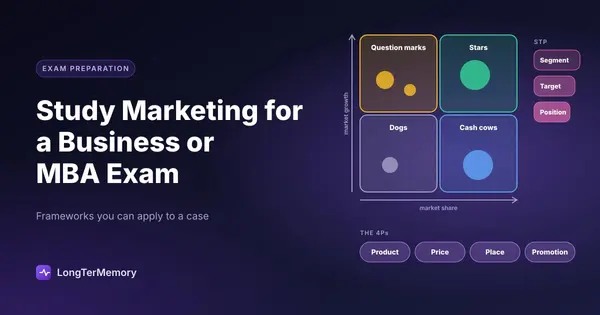
The BCG growth-share matrix categorizes a portfolio of products or business units into four quadrants: Stars (high growth, high share), Cash Cows (low growth, high share), Question Marks (high growth, low share), and Dogs (low growth, low share).
Know the strategic implication of each quadrant: invest in Stars, milk Cash Cows, decide whether to invest or divest Question Marks, and typically divest Dogs. Know the limitation: market share and growth rate don’t capture everything that matters about competitive position.
How to Approach Case Analysis Questions
Case analysis is where most marks are lost or won on MBA marketing exams. The case gives you a business situation, and your job is to analyze it using relevant frameworks and make a specific, defensible recommendation.
Here is a reliable four-step approach:
Step 1: Identify the core problem. Read the case twice before writing anything. The first read gives you the narrative. The second read tells you what’s actually being asked. Identify the central business decision: Should the company enter this market? Should they reposition their brand? How should they respond to a competitor’s move?
Step 2: Select the right framework. Match the question to the appropriate analytical tool. Competitive environment questions call for Porter’s Five Forces. Market strategy questions call for STP. Portfolio decisions call for the BCG matrix. Marketing mix questions call for the 4Ps. You may need more than one framework, but don’t apply every framework you know, that signals a lack of analytical judgment.
Step 3: Apply the framework to the case data. This is where many students fail. They describe the framework accurately but never actually apply it to the specific case. Every analytical point you make should reference specific information from the case. “Bargaining power of buyers is high in this case because the case states that customers can switch platforms at zero cost and there are four direct competitors with similar content libraries.”
Step 4: Make a recommendation. Don’t end your answer with “it depends.” Make a specific recommendation and defend it. Acknowledge trade-offs if they exist, but commit to a position. “Based on the analysis, I recommend a differentiated targeting strategy focused on the premium segment, because the cost structure of the company favors higher-margin customers and the premium segment is currently underserved by the two market leaders.”
Studying Consumer Behavior for Exam Success
Consumer behavior is often a significant portion of marketing exams and tends to get underprepared. It’s one of the more conceptual areas of marketing, so it requires more than just memorizing definitions.
The buyer decision process is fundamental: need recognition, information search, evaluation of alternatives, purchase decision, post-purchase behavior. Know what influences each stage (internal and external factors) and how marketers can intervene at each stage.
Know the types of buying decisions: complex (high involvement, significant differences between brands), habitual (low involvement, few differences), variety-seeking (low involvement, significant differences), and dissonance-reducing (high involvement, few differences). Different types require different marketing responses.
Psychological factors in buying decisions include motivation (Maslow’s hierarchy is the classic reference), perception (selective attention, selective distortion, selective retention), learning (classical and operant conditioning in consumer contexts), and attitudes (affective, cognitive, and behavioral components).
For exam purposes, practice applying these concepts to specific product categories. “What type of buying decision does purchasing a laptop represent? What are the implications for how a laptop brand should communicate to potential buyers?”
Mastering Pricing Strategy
Pricing questions are common and predictable once you know the key concepts.
Price skimming means entering with a high price and gradually reducing it. It works when: the product has unique value, the target segment is relatively price-insensitive, and competitors can’t quickly enter. Think of new technology products at launch.
Penetration pricing means entering with a low price to gain market share quickly. It works when: the market is price-sensitive, economies of scale exist, and a large installed base creates defensibility. Think of streaming services and ride-sharing apps in their early phases.
Value-based pricing sets price based on the perceived value to the customer rather than cost plus margin. This is increasingly the dominant approach in professional services and software.
Price elasticity measures how sensitive demand is to price changes. Demand is elastic when a price increase causes a proportionally larger decrease in quantity demanded. Demand is inelastic when price changes don’t significantly affect volume. Know which product categories tend to be elastic (luxury goods, easily substituted products) versus inelastic (necessities, highly differentiated products).
Building a Flashcard System for Marketing Vocabulary
Marketing has a substantial vocabulary: CLV, CAC, NPS, CPM, CTR, ROAS, GRP, SEM, AIDA, DAGMAR, and dozens more. These terms appear in questions and need to be second nature.
Flashcards are excellent for marketing definitions and acronyms, but they need to be designed for application, not just recognition. Instead of a card that says “CLV: Customer Lifetime Value,” create a card that asks “A subscription service acquires a customer who pays $50 per month, has a monthly churn rate of 2%, and costs $10 per month to serve. What is the approximate CLV?” This forces you to engage with the concept operationally.
LongTerMemory lets you upload your marketing textbooks, lecture notes, or course materials and automatically generates Q&A pairs covering the content. You can then review those questions on a spaced repetition schedule that keeps even complex multi-part concepts like pricing elasticity or BCG matrix interpretation fresh without requiring you to rebuild your deck every study session.
Exam Time Management for Marketing
Marketing exams, particularly at the MBA level, are often as much a time management challenge as they are a knowledge challenge.
For multiple choice sections: spend no more than 90 seconds per question. If you’re stuck, eliminate obvious wrong answers, make your best guess, mark the question, and return if time allows. Don’t get caught spending five minutes on one question while ten easier questions at the end go unanswered.
For case analysis sections: read the full case before starting any part of the answer. Allocate time by marks, not by interest. If one case question is worth 30 marks and another is worth 10, the 30-mark question deserves three times as much time.
For essay questions: plan before writing. Five minutes of outlining produces a more coherent, organized essay than diving straight into writing without a structure. A clear essay that covers four points in organized paragraphs beats a wandering essay that eventually addresses six points.
In the last ten minutes: quickly review any flagged questions. Check that you’ve answered every question (including sub-parts of case questions that are sometimes hidden at the end of a long prompt). For short-answer sections, make sure each answer directly addresses what was asked.
A Note on Professional Marketing Certifications
If you’re pursuing a professional certification rather than an academic exam, the preparation approach is similar but the question style often differs. Certifications like the AMA PCM, the CIM, or digital marketing certifications tend to emphasize application in professional contexts rather than academic theory.
For certification exams, pay close attention to the official study guide and the examination blueprint. Most certification bodies publish a detailed breakdown of which competencies are tested and at what percentage. That breakdown is your study plan.
Practice with official sample questions whenever possible. Certification exams often have specific ways of phrasing questions that reflect the perspective of the certifying body, and familiarity with that style helps significantly.
The Bottom Line
Studying marketing for a business or MBA exam is less about memorizing frameworks and more about developing the ability to use them analytically. The students who score highest can look at a business situation and immediately identify what type of problem it is, which framework fits, and what specific recommendation follows from applying that framework to the specific case.
That skill is built through practice: working through case examples, analyzing real companies’ marketing decisions through the lens of the frameworks you’ve learned, and testing yourself regularly on both the vocabulary and the application.
Marketing is one of the most practically interesting subjects in business education. Used well, the frameworks give you a genuinely powerful toolkit for understanding why businesses succeed and fail. That understanding, not memorized definitions, is what exam success and professional success in marketing both require.