Studying While Working: Efficient Learning for Busy Professionals
Learn how to study effectively with a full-time job. Science-backed micro-study techniques and time management strategies for working learners.
Table of Contents
- The Real Challenge: Why Working Learners Struggle More Than Full-Time Students
- Micro-Study Sessions: How to Leverage 30 Minutes Daily
- Designing a Micro-Session
- Where to Find Micro-Study Windows
- The Non-Negotiable Daily Minimum
- Optimizing Weekends for Memory Consolidation
- Saturday: The Deep-Work Session
- Sunday: Review and Consolidation
- Automating Your Review Process: How Technology Can Maintain Your Momentum
- Spaced Repetition Software Does the Math for You
- AI-Generated Flashcards Remove Creation Friction
- Use Audio for Passive Absorption
- Managing Cognitive Depletion on Workdays
- Transition Rituals
- Schedule High-Difficulty Material for Mornings
- Lower the Bar on Low-Energy Days
- Keeping Work and Study From Bleeding Into Each Other
- The Long Game
Here’s the situation a lot of people are in: you have a full-time job, possibly a family, definitely a list of responsibilities that doesn’t care about your study schedule. And somewhere in the middle of all that, you’re trying to learn something significant. A certification. A new skill. A degree. A professional qualification that’s been sitting on the “eventually” list for two years.
The conventional advice , “just wake up an hour earlier” or “give up Netflix” , is technically correct and practically useless. You’ve already considered those options. The real challenge isn’t finding the time. It’s making the time you do have count enough to justify the sacrifice.
This guide is about making that happen. Not through productivity theater, but through a clear-eyed understanding of how memory and learning actually work , and how to align those realities with the fractured, unpredictable schedule that comes with a working life.
The Real Challenge: Why Working Learners Struggle More Than Full-Time Students
It’s not just time. Full-time students who study for six hours a day often struggle to retain material just as much as working professionals who study for one hour. The time advantage matters, but it’s not the whole picture.
Working learners face three specific obstacles that full-time students largely don’t:
Cognitive depletion. By the time you sit down to study after a workday, your prefrontal cortex has been running executive functions for eight or more hours. Decision fatigue is real , your capacity for focused attention and self-regulation is measurably lower in the evening than in the morning. Studying in this state isn’t impossible, but it requires deliberate strategies to compensate.
Context contamination. Work thoughts don’t stop when you open a textbook. The email you need to send, the meeting tomorrow morning, the project deadline , these compete for cognitive bandwidth. The mental overhead of managing a work life while trying to learn something new is a constant drag on study quality.
Inconsistent availability. A meeting runs long. A client calls. A deliverable moves up. The hour you planned to study at 7 PM disappears. Working learners have to build study systems that are resilient to interruption in ways that full-time students simply don’t.
Understanding these obstacles is the first step to designing around them. The strategies below address each one directly.
Micro-Study Sessions: How to Leverage 30 Minutes Daily
The single most impactful reframe for working learners is this: 30 focused minutes is worth more than 2 distracted hours. This isn’t motivational language , it’s what the research on spaced repetition and distributed practice consistently shows.
Your brain doesn’t care that you only had half an hour. It cares about the quality of the retrieval practice that happened in those 30 minutes, and whether you come back tomorrow to do it again.
Designing a Micro-Session
A well-designed 30-minute micro-session has three phases:
Minutes 1–5: Context reset. Don’t open your study materials first. Spend the first five minutes doing a brief recall of the last session , what did you cover? What were the key points? What did you struggle with? This serves two purposes: it’s active retrieval practice, and it mentally transitions you from work mode to study mode.
Minutes 5–25: Focused new content or review. This is the core of the session. One topic cluster, not several. If you’re using flashcards, review the due cards first, then introduce a small batch of new ones. If you’re doing practice questions, do a focused set on a specific domain. If you’re reading, cover one section and stop to recall before moving on.
Minutes 25–30: Forward planning. Spend the last five minutes noting what you’ll pick up next session. This isn’t busywork , it dramatically reduces the cognitive friction of starting the next session, which is often what prevents people from beginning at all.
Where to Find Micro-Study Windows
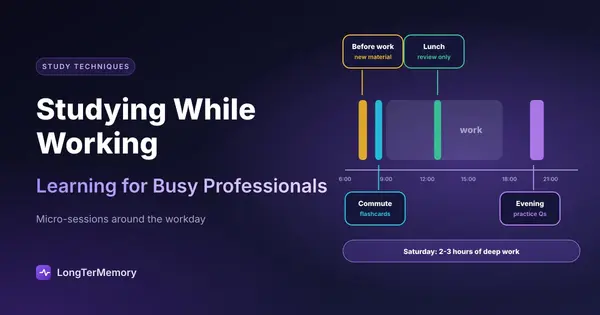
| Time slot | Duration | Best use |
|---|---|---|
| Morning (before work) | 20–45 min | New material , cognitive freshness is highest |
| Commute (transit) | 15–30 min | Flashcard review, audio content |
| Lunch break | 20 min | Focused review only (not new concepts) |
| Evening | 30–60 min | Practice questions, consolidation |
| Waiting time | 5–10 min | Single flashcard topic, quick review |
The key is not to require large blocks. Large blocks are the exception in a working life. Design your study system around the 20–30 minute slot as the primary unit, not the 2-hour session.
The Non-Negotiable Daily Minimum
One of the most effective commitments a working learner can make is setting a daily minimum so small it’s nearly impossible to miss. Not an aspirational target , a floor.
For many people, this is 15 minutes of flashcard review. That’s it. Some days you’ll do more. But on the days when everything went wrong and you’re running on empty, you do the 15 minutes. You keep the streak alive. And because spaced repetition rewards consistency above all else, that streak compounds into something significant over weeks and months.
Optimizing Weekends for Memory Consolidation
Weekends are your leverage point. They’re where the working learner can put in the volume that weekdays can’t accommodate. But most people use weekends inefficiently , either cramming for hours in a way that doesn’t consolidate well, or avoiding study entirely to decompress.
Both extremes miss the opportunity. Here’s a better model.
Saturday: The Deep-Work Session
Dedicate two to three uninterrupted hours on Saturday morning , the earlier the better, before the weekend’s social and domestic demands accumulate , to your highest-priority study work.
Use this time for the things that require sustained attention: working through difficult problem sets, reading dense material actively, or doing a full timed practice exam. These are the activities that feel impossible to fit into 30-minute windows during the week.
One Saturday morning session per week, maintained consistently, is the equivalent of several unfocused evening sessions. The quality of attention in that first morning window is qualitatively different from the depleted state most weeknight sessions operate in.
Sunday: Review and Consolidation
Sunday is not a second intensive session. Sunday is for review and gentle consolidation.
Go through the week’s flashcards. Revisit the practice questions you got wrong. Do the blank-page recall on the topics you covered during the week. This is lower intensity but cognitively important , you’re reinforcing what the week built before the coming week pushes new material in.
The weekend structure creates a rhythm: weekdays build incrementally, Saturday goes deep, Sunday consolidates, repeat. This rhythm is both psychologically sustainable and neurologically optimal.
Automating Your Review Process: How Technology Can Maintain Your Momentum
The biggest logistical obstacle for working learners isn’t motivation , it’s memory management overhead. Tracking which topics to review, when, and with what frequency is genuinely complicated when your study sessions are fragmented across a week.
This is where technology stops being a distraction and starts being a genuine enabler.
Spaced Repetition Software Does the Math for You
A spaced repetition system (SRS) , whether Anki, a dedicated platform, or an AI-powered tool like LongTerMemory , calculates exactly which cards need review today based on your past performance. You don’t need to remember what you last studied or how well you knew it. The algorithm knows.
For a working learner, this is transformative. Every session can start with “do today’s due cards” rather than “figure out what I should be studying.” The cognitive overhead of managing a study plan drops to near zero. You just open the app and do the work.
AI-Generated Flashcards Remove Creation Friction
The other major time sink for working learners is creating study materials. Converting a 50-page PDF into usable flashcards takes hours if done manually. AI-powered tools can do it in minutes , not perfectly, but well enough that a quick editing pass takes 10–15 minutes instead of hours.
For someone with limited study time, this is a significant shift. You’re not spending your precious study hours building materials. You’re spending them actually studying.
Use Audio for Passive Absorption
Not everything requires full cognitive attention. During commutes, workouts, or cooking, learning via audio can supplement your active study sessions. Podcasts in your field, recorded lectures, or text-to-speech of your notes serve as a low-intensity exposure layer that reinforces concepts you’ve already actively studied.
The key word is “supplement.” Audio-only learning is passive and doesn’t produce the retention that active recall does. But it can meaningfully increase your total exposure to material without requiring a dedicated time slot.
According to research on how sleep affects memory, the consolidation process that turns short-term learning into long-term memory happens primarily during sleep , specifically during slow-wave and REM phases. For working learners who may be tempted to sacrifice sleep for extra study time, this is a critical finding: the hours you study are important, but the hours you sleep immediately afterward determine how much of what you studied actually sticks.
Managing Cognitive Depletion on Workdays
The evening study problem is real. Your brain has been running all day, and demanding another 90 minutes of high-quality cognitive output from it feels like asking a runner to sprint after a marathon.
A few strategies that actually help:
Transition Rituals
Your brain needs a signal that work mode is ending and study mode is beginning. Without a deliberate transition, the cognitive residue of the workday bleeds into your study session.
A transition ritual doesn’t need to be elaborate. Ten minutes of walking, a specific playlist, a short meditation, or even just changing physical location creates the context shift your brain needs. The specific activity matters less than the consistency , after enough repetitions, your brain starts shifting modes when the ritual begins.
Schedule High-Difficulty Material for Mornings
If at all possible, do your hardest studying before work, not after. Even 30–45 minutes of active recall or new concept study in the morning , before email, before the workday’s demands set in , will outperform 90 distracted minutes in the evening.
This requires going to bed early enough to make the morning viable, which is its own challenge. But for people who genuinely commit to it, morning study consistently produces better retention outcomes than evening study.
Lower the Bar on Low-Energy Days
Some evenings, you’re going to sit down to study and feel completely empty. On those nights, don’t fight it with heroic effort , lower the bar.
Do your flashcard reviews. Just the reviews. If you’ve built a spaced repetition system, even 15 minutes of reviewing due cards is a legitimate study session. You’re maintaining the habit, maintaining the streak, and doing active retrieval practice. That’s real learning, even if it doesn’t feel like it.
What you want to avoid is the all-or-nothing trap: deciding that because you can’t do a full productive session, you’ll do nothing. A small, consistent session is worth dramatically more than an occasional marathon. The research on distributed practice is unambiguous on this.
Keeping Work and Study From Bleeding Into Each Other
One underrated challenge for working learners is the way work concerns contaminate study time. You open your notes, and your brain immediately starts processing the work email you forgot to send.
Strategy: Brain dump before studying. Take 3 minutes before every study session to write down all the work tasks, concerns, and loose threads floating in your head. Getting them onto paper , even just a scrappy list , gives your brain permission to stop holding them in working memory. The cognitive bandwidth they were consuming becomes available for learning.
Strategy: Compartmentalize physically. Study in a different location than where you work, or at minimum, clear your workspace of work materials before starting. Physical environment is a powerful context cue. Your brain behaves differently at your “work desk” than at your “study desk,” even if it’s the same desk with the same laptop , as long as you’re consistent about the association.
Strategy: Set a hard stop on work before studying. If you check email until 8:30 PM and then try to study at 8:31 PM, you’ll spend the first 20 minutes of your session mentally still at work. A buffer , even 20 minutes of non-work, non-study activity , creates the separation your brain needs.
The Long Game
Studying while working is genuinely harder than studying full-time. Not because you’re less capable, but because the constraints are more severe. You have less time, less cognitive freshness, and more competing demands. That’s just true.
But the people who succeed at this aren’t the ones who somehow find three extra hours a day. They’re the ones who build a system that works in the time they actually have , short sessions, consistent daily minimums, strategic weekends, automated review, and the discipline to protect study time like the finite resource it is.
The material is learnable. The certification is achievable. The degree is completable. The constraint isn’t ability , it’s system design. And system design is something you can control.