
How to Prepare for the Uniform Bar Exam (UBE): Full Study Guide
A complete UBE study guide covering the MEE, MPT, and MBE components, study timelines, resource selection, and proven strategies to pass on your first attempt.
Table of Contents
- Understanding the UBE Structure
- Component 1: The MBE (200 Points, 50% of Score)
- MBE Study Strategy
- Component 2: The MEE (30% of Score)
- How MEE Grading Works
- MEE Study Strategy
- Component 3: The MPT (20% of Score)
- MPT Study Strategy
- Building Your UBE Study Schedule
- Weeks 1-3: Foundation Phase
- Weeks 4-6: Intensive Practice Phase
- Weeks 7-8: Consolidation and Simulated Exam Phase
- Final Week
- Allocating Study Time Across Subjects
- Essay and Performance Test Practice Strategy
- The Mental Side of Bar Prep
- Passing the UBE
The Uniform Bar Exam is one of the most demanding credentialing exams in any profession. It covers more legal subjects than most law school curricula, tests three distinct skill sets in two days, and holds a passing score that varies by jurisdiction. For most people taking it, bar prep is a full-time job for 8-10 weeks, and still roughly one in four first-time takers doesn’t pass.
But passing isn’t a matter of luck or raw intelligence. It’s a matter of strategy. The students who pass, including those who don’t come from top law schools and those who struggle with test-taking anxiety, almost always have one thing in common: they understood what the exam was actually testing and built their preparation around that understanding.
This guide gives you that understanding. Here’s what the UBE is, what each of its three components requires, how to allocate your study time, and how to practice in ways that actually prepare you for exam conditions.
Understanding the UBE Structure
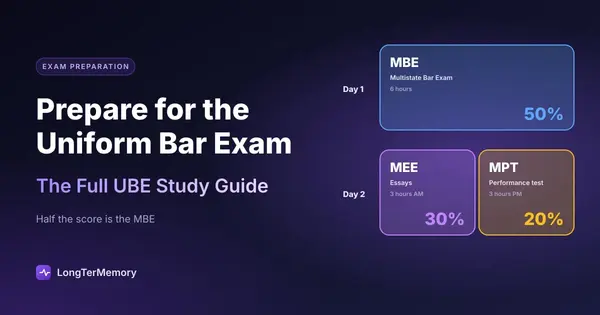
The Uniform Bar Exam is administered over two days and consists of three components:
| Component | Full Name | Time | Weight |
|---|---|---|---|
| MBE | Multistate Bar Examination | Day 1: 6 hours | 50% |
| MEE | Multistate Essay Examination | Day 2 AM: 3 hours | 30% |
| MPT | Multistate Performance Test | Day 2 PM: 3 hours | 20% |
Total score: 400 points (200 from MBE scaled to 200, 210 from MEE, 90 from MPT, all scaled to produce a combined 400-point score)
Passing scores vary by jurisdiction. Most UBE jurisdictions have passing scores between 260 and 280, with several outliers at 266 (many states) or 273-275 (New York, California equivalents). Check your specific jurisdiction’s requirement.
The UBE is accepted in 41 jurisdictions as of 2026, and your score is portable, meaning you can apply it to seek admission in multiple UBE jurisdictions without retaking the exam.
Component 1: The MBE (200 Points, 50% of Score)
The Multistate Bar Examination is 200 multiple-choice questions covering seven subjects, delivered in two 3-hour sessions of 100 questions each.
MBE Subjects:
- Civil Procedure
- Constitutional Law
- Contracts
- Criminal Law and Procedure
- Evidence
- Real Property
- Torts
Each question presents a factual scenario followed by four answer choices. You have roughly 1 minute and 48 seconds per question on average, though in practice the pace varies significantly by question.
MBE Study Strategy
Volume of practice is essential. The MBE is a pattern recognition exam. The more questions you’ve worked through across every subject, the better you become at identifying which rule applies, which distractors to avoid, and how the examiners frame issues. Most successful bar takers complete between 2,000 and 3,000 MBE practice questions during their prep.
Quality matters more than speed. Don’t race through practice questions. After each question, whether you got it right or wrong, read the explanation fully. Understand why the right answer is right and, critically, why each wrong answer is wrong. The wrong answers are wrong for specific reasons, and those reasons often reappear in future questions.
Analyze your errors by category. Every time you miss a question, log it by subject and sub-issue. After a week of practice, you’ll see patterns: the Contracts questions about third-party beneficiaries keep tripping you up; the Evidence questions about hearsay exceptions are your blind spot. These patterns tell you exactly where to concentrate remedial study.
Do timed full-length practice sets. At least 3-4 weeks before the exam, start doing 50-question sets under timed conditions. The physical and cognitive stamina required for 100 questions in 3 hours is not trivial. Build it before exam day.
Start with subjects you’re weakest in. Most people’s instinct is to start with subjects they know well. Resist this. The subjects where you’re weak will require the most repetitions to reach competence, and starting there gives you the most time to close those gaps.
Component 2: The MEE (30% of Score)
The Multistate Essay Examination consists of 6 essays, each 30 minutes long, covering a broader range of subjects than the MBE. In addition to the 7 MBE subjects, the MEE may test:
- Agency and Partnership
- Business Organizations (Corporations, LLCs)
- Conflict of Laws
- Family Law
- Secured Transactions (UCC Article 9)
- Trusts and Estates (Wills and Decedents’ Estates)
How MEE Grading Works
MEE answers are graded by attorney-graders in your jurisdiction using point allocation rubrics. The grader is looking for identification of issues, application of the correct rule, and reasoned analysis applied to the facts. They are not looking for flowery writing or lengthy introductions.
Issue spotting matters. If you don’t identify the legal issue, you can’t analyze it. Many MEE points are earned just by correctly identifying that a question is about, say, promissory estoppel under contracts or hearsay under evidence, stating the rule, and applying it to the facts.
IRAC is your structure. Issue, Rule, Application, Conclusion. Every sub-issue gets its own IRAC paragraph. A 30-minute MEE answer typically has 3-6 IRAC paragraphs depending on how many issues are present.
MEE Study Strategy
Master the big subjects first. Some subjects appear on the MEE with much higher frequency than others. Contracts, Torts, Evidence, and Constitutional Law are consistently among the most tested. Don’t spend equal time on every subject. Weight your attention to frequency.
Practice with past MEEs. The National Conference of Bar Examiners (NCBE) publishes past MEE questions with point sheets showing what issues earns points. Work through these as timed practice, write your answer without looking at the point sheet, then compare. Where did you miss issues? Where did you get the rule wrong? Where was your analysis thin?
Write, don’t just outline. Many students practice MEEs by outlining what they would write rather than actually writing. This is inadequate preparation. The physical act of writing a full essay under time pressure is different from outlining, and you need practice doing it at speed. Your handwriting (or typing) needs to be legible. Your time management within 30 minutes needs to be practiced.
Use issue checklists. For each MEE subject, build a checklist of the major issues that can appear. Before writing your essay, run through the checklist mentally to ensure you haven’t missed anything. Issue spotting is the hardest skill to build quickly, and checklists are a significant safeguard.
Use spaced repetition for rules. The MEE requires you to know the rules cold, not just recognize them when you see them. Flashcards with active recall, particularly for the non-MBE subjects that don’t get as much practice repetition, are essential. A tool like LongTerMemory can help you generate Q&A pairs from your bar prep outlines and review them efficiently with spaced repetition, which is particularly helpful for the non-MBE subjects where you need more deliberate practice.
Component 3: The MPT (20% of Score)
The Multistate Performance Test is often the most misunderstood component of the UBE. Two 90-minute tasks where you’re given a File (facts, memos, client correspondence, deposition excerpts) and a Library (relevant cases, statutes, regulations), and asked to produce a legal work product.
The MPT tests whether you can practice law, not just know it. You might be asked to write a persuasive brief, a client memo, a contract provision, a demand letter, or an objective analysis.
The key insight about the MPT: everything you need to answer the question is in the materials you’re given. You don’t need to know the law beforehand. You need to read carefully, extract the relevant rules from the Library, apply them to the facts in the File, and produce the requested document type in the appropriate format.
MPT Study Strategy
Learn the document formats. There are a limited number of work products the MPT asks you to produce: objective memoranda, persuasive briefs, client letters, contract sections, closing arguments. Each has a standard format. Learn those formats and practice producing them. Points are lost when students produce the wrong document type or ignore the format instructions in the task memo.
Practice reading and extracting from library materials. A common MPT failure mode is spending too long reading and not enough time writing. Practice getting in and out of the Library efficiently: read a case, extract the rule and how it applies, move on.
Do full timed MPT practice. At least 6-8 timed MPT practices before exam day. At 90 minutes each, this is a significant time commitment. But the MPT is a skill-based component that improves dramatically with practice and almost not at all with mere knowledge study.
Don’t neglect the MPT in your schedule. Because it doesn’t require knowledge of specific law, many students treat MPT preparation as lower priority. This is a significant mistake. The MPT is 20% of your score and is one of the most reliable score-improvement opportunities because it responds well to focused practice.
Building Your UBE Study Schedule
Most bar takers have 8-10 weeks of dedicated study time. Here’s a framework for allocating that time:
Weeks 1-3: Foundation Phase
- Complete all subject lectures if using a commercial course
- Read core outlines for all MBE and MEE subjects
- Start MBE practice questions (50-75 per day minimum)
- Do 1-2 MEE practice essays per week
- Do 1 MPT per week to build familiarity
Weeks 4-6: Intensive Practice Phase
- Increase MBE to 100+ questions per day
- Do 2-3 MEE essays per week under timed conditions
- Do 2 MPTs per week
- Identify and prioritize weak subjects
- Begin creating condensed rule outlines from memory for key subjects
Weeks 7-8: Consolidation and Simulated Exam Phase
- Full-length MBE simulations (200 questions) at least twice
- Full MEE sets (6 essays in 3 hours) at least twice
- Full MPT under timed conditions at least twice
- Daily flashcard review for rules in weak areas
- No new material after Week 7, focus on consolidation
Final Week
- Lighter review, not intensive new work
- Sleep and physical recovery are priority
- Brief daily review of rule summaries
- Logistics preparation (exam location, materials, timing)
Allocating Study Time Across Subjects
Not all subjects deserve equal study time. Weight your effort based on three factors: how heavily the subject is tested, how well you already know it, and how much the subject overlaps between MBE and MEE.
High priority (most study time):
- Contracts: Appears on both MBE and MEE, complex rules, high testing frequency
- Evidence: MBE subject with many hearsay rules and exceptions, MEE tested
- Civil Procedure: Complex, heavily tested on MBE, MEE tested
- Constitutional Law: Broad doctrine, frequently tested on both
Medium priority:
- Torts: Tested on MBE and MEE, but rules tend to be more straightforward
- Criminal Law and Procedure: MBE and MEE, but relatively contained ruleset
- Real Property: Dense but predictable MBE testing patterns
Build sufficient competence in:
- Business Organizations, Trusts and Estates, Secured Transactions (MEE only, less frequent but can appear)
- Family Law, Conflict of Laws (MEE only, appear less often but worth knowing)
Essay and Performance Test Practice Strategy
The most common mistake in UBE preparation is under-practicing written components and over-practicing MBE. For general essay exam strategy that applies across subjects, see our guide on how to study for an essay exam. Most commercial courses are MBE-heavy, and MBE is easier to practice (click a question, get a result). But the MEE and MPT together are 50% of your score.
Write your essays. Don’t outline them. Every essay should be a full write-out, every time. Your speed, structure, and issue coverage will improve with each practice. Students who only outline during prep are not practicing the actual exam skill.
Review NCBE published answer guides carefully. The point sheets show not just what issues to address, but how many points each issue is worth. This is your grading rubric. Align your practice to it.
Have someone read your essays. If you’re doing self-study without a commercial course, find a practicing attorney, a law school professor, or a study partner to read a sample of your essays and give feedback. The structural errors that lose points are often invisible when you’re grading your own work.
The Mental Side of Bar Prep
Bar prep is a mental endurance event as much as an intellectual one. The cognitive demands of 8-10 weeks of intensive study, combined with the stakes involved, create significant psychological pressure.
A few principles that help:
Treat rest as part of preparation. Sleep deprivation impairs memory consolidation and recall. Students who consistently get 7-8 hours of sleep perform better on the bar than those who sacrifice sleep for additional study hours. This isn’t a convenience, it’s a physiological reality.
Track progress, not just gaps. It’s easy during bar prep to focus exclusively on what you don’t know yet. Deliberately track improvement: your MBE percentage score from week to week, the MEE issues you’ve gone from missing to hitting consistently. Progress is real even when it doesn’t feel that way.
Accept partial knowledge. The bar exam does not require perfection. It requires sufficient mastery of a wide range of material to produce a passing score. Some things you’ll know cold. Some things you’ll know mostly. Some things you’ll have to reason through on exam day. That’s acceptable and expected. Don’t let perfect be the enemy of good enough.
Simulate exam conditions regularly. The anxiety of exam day is partly a response to unfamiliarity. Each time you practice under timed conditions, in an environment that simulates the exam, you reduce the novelty factor and make the actual exam day feel more routine.
Passing the UBE
The Uniform Bar Exam is hard, but it is learnable. The students who pass are not uniquely brilliant. They are typically students who prepared strategically, practiced written components as seriously as multiple-choice, reviewed their errors with discipline, and treated the exam as a skill to be developed rather than a test of innate legal talent.
Build your preparation around the three components equally. Practice in writing. Review your errors with discipline. Sleep enough. That formula, applied consistently over 8-10 weeks, is the bar prep approach that works.
The day you’re admitted to practice is worth the effort. Build toward it one practice essay and one MBE set at a time.