How to Prepare for USMLE Step 1: The Full Study System
A complete USMLE Step 1 study system covering resource stacks, dedicated period pacing, and how to use NBME practice exams to score higher.
Table of Contents
- Anki vs. First Aid vs. Sketchy: Building Your Resource Stack
- The Core Framework
- How to Choose Between Competing Resources
- How to Pace a Dedicated Study Period for Step 1
- Week-by-Week Structure
- The Anki Maintenance Problem
- Daily Rhythm in Dedicated
- NBME Practice Exams: When to Take Them and How to Analyze Results
- When to Start Taking NBMEs
- How Often to Take Them
- How to Analyze an NBME Result
- What Score Gap Is Normal Between NBMEs and Step 1?
- The Mental Game Nobody Talks About Enough
- After Step 1: Transitioning Efficiently
Let me be upfront about something: there is no single “right way” to prepare for USMLE Step 1. Anyone who tells you otherwise is either selling something or has forgotten what medical school is actually like. What exists is a body of strategies that consistently produce good results, and a few common mistakes that consistently produce disappointment. This guide covers both.
Step 1 has changed significantly since it went pass/fail in January 2022. The pressure dynamic is different now, but the knowledge you need to demonstrate is not. You still need to understand mechanisms, not just memorize facts. You still need to integrate physiology, pathology, pharmacology, and microbiology in ways that application-style questions demand. The foundation matters as much as it ever did, which means your study system matters.
Let us build one.
Anki vs. First Aid vs. Sketchy: Building Your Resource Stack
The first decision most students agonize over is which resources to use. The honest answer is that almost every combination of major resources can work if used correctly, and almost any combination can fail if used passively. That said, there are patterns that tend to produce more reliable results.
The Core Framework
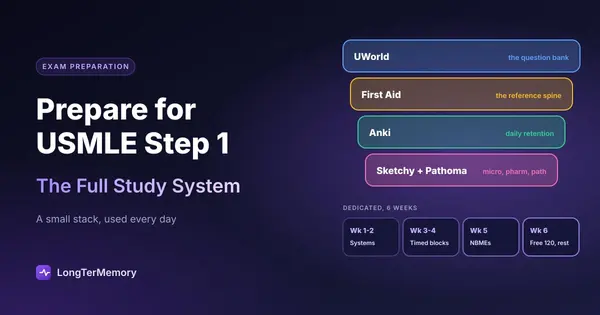
Think of your Step 1 resource stack in layers:
The foundation layer is where your conceptual understanding lives. Most students use First Aid as their primary reference document, not as their primary learning tool. First Aid is dense, non-narrative, and difficult to build genuine understanding from if you are reading it cold. It works best as a review structure, a checklist of what you need to know, not as the thing you learn from.
For actual concept building, resources like Pathoma (pathology), BnB (boards and beyond) for physiology, and Sketchy for microbiology and pharmacology do a much better job of teaching mechanisms in ways that stick. Pick one anchor resource per major subject and commit to it.
The retrieval layer is where Anki lives. Anki for USMLE Step 1 is not optional for most high scorers; it is the engine that keeps everything you have learned from evaporating. The Anki Step 1 deck (often called Zanki or AnKing, an integrated deck that tags cards to First Aid, Sketchy, Pathoma, and more) gives you pre-built flashcards that cover the high-yield material systematically.
The key mistake students make with Anki is treating it like a separate study task instead of integrating it with their learning. Review the Anki cards for each topic immediately after learning that topic from your conceptual resource. The encoding is freshest right after learning, and doing active retrieval within 24 hours dramatically improves long-term retention.
The application layer is Uworld. Do not save it until the dedicated period. Uworld questions while you are learning each organ system reinforce the clinical reasoning patterns that Step 1 demands. Doing random timed blocks simulates exam conditions. Reviewing each question thoroughly, including every explanation for wrong answers, is where a huge amount of your learning actually happens.
How to Choose Between Competing Resources
You will get advice from dozens of sources about which resources are best. Here is a filtering principle that cuts through most of the noise: choose resources that teach mechanisms, not just facts. Step 1 has moved steadily toward application-style questions that require you to understand why something happens, not just that it happens.
A resource that helps you understand why thiazide diuretics cause hyponatremia is more valuable than one that just lists the side effects. A resource that explains how ACE inhibitor-induced cough is mechanistically different from ACE inhibitor-induced angioedema teaches you something genuinely useful.
Resources that rely heavily on mnemonics without building the underlying mechanistic understanding are weaker for Step 1 specifically, because mnemonics break down when questions are presented in novel clinical contexts.
How to Pace a Dedicated Study Period for Step 1
The dedicated study period is typically four to eight weeks, depending on your school’s scheduling. How you structure those weeks makes an enormous difference in how much you actually consolidate versus how much you feel like you are studying.
Week-by-Week Structure
| Week | Focus |
|---|---|
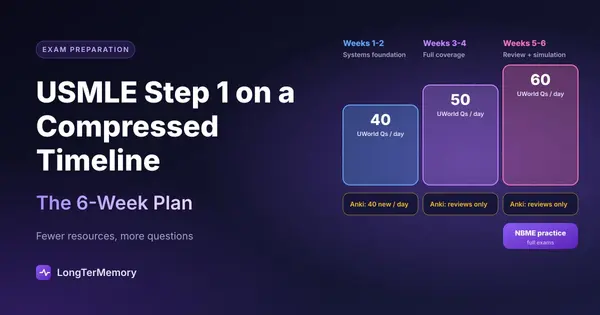
| Weeks 1-2 | High-yield organ systems review + Anki maintenance + Uworld (untimed) |
| Weeks 3-4 | Complete Uworld blocks (timed, random) + First Aid review + weak areas |
| Week 5 | NBME practice exams + targeted review of wrong answers + Anki |
| Week 6 | Final review, NBME free 120, rest |
The principle behind this structure is that early dedicated period is for filling gaps, and late dedicated period is for consolidation and calibration. Trying to learn brand new material in the final week is rarely effective and tends to increase anxiety without improving performance.
The Anki Maintenance Problem
One of the most common dedicated period disasters is Anki review piling up. During pre-clinical years, you may have added hundreds or thousands of new cards. Going into dedicated, your daily review burden can easily reach 400 to 600 cards if you have been adding consistently.
You have three realistic options:
First, suspend cards that are not high-yield for Step 1 specifically. The AnKing deck tags cards by resource, which lets you suspend whole categories. Be strategic.
Second, accept that Anki maintenance will take one to two hours per day and plan your schedule accordingly. Most productive dedicated period schedules build this in explicitly.
Third, shift to a more manual review system for dedicated period if Anki reviews are taking more than two hours daily. Some students find it more efficient to do traditional flashcard review of First Aid pages they have annotated.
There is no universally right answer. The wrong answer is spending four hours daily on Anki review and having no time for new learning and practice questions.
Daily Rhythm in Dedicated
A dedicated period schedule that works for most students:
Morning block (3 hours): Uworld questions, timed blocks of 40. After the block, review every question including the ones you got right. Understand why wrong answers are wrong.
Midday (1 to 2 hours): Anki review. This is not a passive activity. When you miss a card, reread the associated section in First Aid or your conceptual resource.
Afternoon block (2 to 3 hours): Targeted content review based on weak areas identified from Uworld. Do not just read. Make notes, draw diagrams, explain the mechanism out loud.
Evening (30 to 45 minutes): Light Anki review if needed, First Aid annotation, planning next day.
Sleep. This is not negotiable. Memory consolidation during sleep is a literal biological process. Students who cut sleep to study more in dedicated period consistently underperform relative to their practice scores. The research on this is not ambiguous.
NBME Practice Exams: When to Take Them and How to Analyze Results
NBME practice exams (also called NBMEs or shelf exams for Step 1 purposes) are the most reliable predictors of your actual Step 1 score. They are written by the same organization, use the same style of question, and are scored on the same scale. Treating them as anything other than your primary calibration tool is a mistake.
When to Start Taking NBMEs
Most students benefit from taking their first NBME around the midpoint of dedicated, once they have done a meaningful portion of Uworld and reviewed the major organ systems. Taking an NBME before you have meaningful content coverage produces a score that is hard to interpret and can be demoralizing without being informative.
The exception: if your dedicated period is longer (eight or more weeks), a baseline NBME in week two can be useful for identifying massive gaps early enough to do something about them.
How Often to Take Them
Most students in a standard four to six week dedicated period benefit from taking two to four NBMEs total. More than that tends to eat study time without adding proportional benefit. Each NBME should be taken under realistic exam conditions: timed, full-length block, no breaks except the ones you would take on exam day.
The free NBME 120 questions (available on the USMLE website) should be saved for the final week. They are the closest thing to actual exam questions you will find, and doing them the week before your exam is valuable both for practice and for calibration.
How to Analyze an NBME Result
The score matters. The analysis of what went wrong matters more.
After every NBME practice exam, go through every question you got wrong and categorize the errors:
Conceptual errors: You did not know the content. These identify specific topics to review.
Application errors: You knew the content but failed to apply it correctly in the clinical context. These are often more fixable than they seem; they typically indicate that you have learned facts without connecting them to clinical reasoning.
Test-taking errors: You misread the question, changed a correct answer to a wrong one, or ran out of time. These are addressed by technique rather than content review.
Students who carefully analyze their NBME errors and specifically target conceptual gaps in the days after the exam consistently see score improvement on subsequent assessments. Students who review quickly and move on tend to repeat the same errors.
What Score Gap Is Normal Between NBMEs and Step 1?
The general rule of thumb is that your real Step 1 score will be within 5 to 10 points of your average NBME score in the two weeks before the exam, assuming your preparation has been consistent. Large discrepancies in either direction are possible but unusual.
If your NBMEs are inconsistent, swinging by more than 15 points between tests, it often indicates preparation that is not yet solid, or significant test anxiety that is affecting performance differentially. Both are worth addressing directly before exam day.
The Mental Game Nobody Talks About Enough
Step 1 preparation is a cognitive endurance event, and treating it as pure information transfer without attending to your mental state is a mistake.
Anxiety management is a real performance variable. High-stakes test anxiety can suppress performance by five to fifteen points or more on a single sitting. If you know you are someone who blanks under pressure, building in explicit anxiety management practice, whether through breathing techniques, consistent pre-exam routines, or working with a therapist, is not optional.
Rest days are not wasted study days. One real rest day per week, where you do not study, produces better performance over a six-week period than studying seven days straight. The research on this is consistent. Your brain consolidates during rest, not just during active review.
Comparison with peers is almost always unhelpful. Someone in your cohort finishing Uworld faster than you, getting higher NBME scores early, or studying more hours per day tells you very little about what you need to do. Optimize for your own data, not someone else’s.
After Step 1: Transitioning Efficiently
Once you have taken Step 1, the knowledge you built is an asset that will serve you in clinical rotations, Step 2, and residency. The students who tend to perform best throughout medical training are not those who crammed hardest for Step 1 and then forgot everything. They are the ones who built genuine mechanistic understanding during Step 1 prep and maintained it.
Spaced repetition after Step 1, even at reduced volume, keeps that knowledge accessible. A few Anki reviews per day maintains a remarkable amount of the pharmacology, pathophysiology, and microbiology you worked so hard to learn. It takes dramatically less time to maintain than it took to build.
If you want a study system that handles spaced repetition scheduling automatically, LongTerMemory lets you upload study materials and generates practice questions scheduled for review at optimal intervals. It is one fewer logistical thing to manage when you are already tracking Uworld percentages, NBME scores, and a rotating cast of organ system reviews.
Step 1 preparation is genuinely hard work. But it is also manageable work, if you build a system and execute it consistently rather than trying to will yourself through on effort alone.