Why You Forget What You Study: The Science of Memory Loss
Discover the 4 enemies of long-term memory, what research says about why we forget, and a self-assessment checklist to fix your study method.
Table of Contents
- The 4 Enemies of Long-Term Memory (And How to Defeat Them)
- Enemy 1: Passive Encoding
- Enemy 2: Interference
- Enemy 3: Insufficient Retrieval Practice
- Enemy 4: Poor Spacing
- Sleep, Nutrition, and Memory: What Peer-Reviewed Research Reveals
- Sleep: The Non-Negotiable
- Stress: The Memory Blocker
- Nutrition: The Supporting Role
- Self-Assessment Checklist: Is Your Current Study Method Actually Working?
- The Method Fix: What Changes Immediately
You studied for hours. You understood it while you were reading it. You could follow the argument, track the logic, recognize the examples. And then three days later, almost none of it is there.
This is one of the most frustrating experiences in learning, and it’s almost universal. Students, professionals, lifelong learners , everyone has sat down after a review session and realized with a sinking feeling that the material they spent significant time on has quietly slipped away.
The maddening part is that it happened even though you felt like you understood it. You weren’t spacing out. You were engaged. You took notes. And still , gone.
Understanding why this happens is not just academically interesting. It’s practically essential, because the reason your studying isn’t sticking reveals exactly what you need to change. And in almost every case, the fix is not “study more” , it’s “study differently.”
The 4 Enemies of Long-Term Memory (And How to Defeat Them)
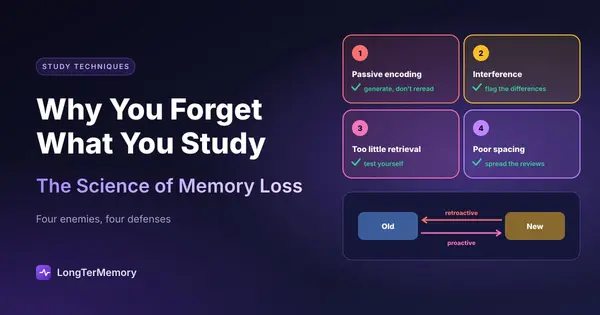
Memory loss isn’t random. The research on forgetting consistently points to a handful of mechanisms that account for most of what we lose. Here are the four main culprits, and what to do about each one.
Enemy 1: Passive Encoding
The most common cause of forgetting is also the most overlooked: information was never properly encoded in the first place.
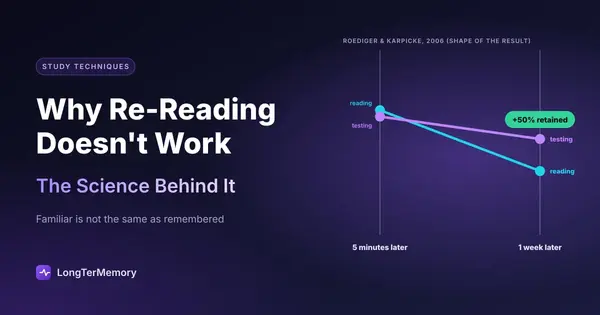
Reading something and understanding it in the moment does not mean the information has been stored in long-term memory. What it means is that the information passed through your working memory, made enough sense to your brain to feel comprehensible, and then , if you didn’t actively engage with it further , began to fade almost immediately.
This is why re-reading is so ineffective as a primary study method. You’re experiencing the material, not encoding it. The comprehension you feel in the moment is working memory comprehension, not long-term memory storage. Without active processing , retrieval practice, elaboration, connection to prior knowledge , much of what you read doesn’t make it past the gate.
The fix: Convert passive exposure into active encoding. After reading any section, close the material and attempt to reconstruct what you just covered from memory. The effort of retrieval , even failed retrieval , triggers the encoding mechanisms that passive reading bypasses.
Enemy 2: Interference
Your brain doesn’t store memories in isolation. They exist in relationship to other memories, and those relationships can work for you or against you. When they work against you, it’s called interference.
Retroactive interference occurs when new learning disrupts existing memories. You study Topic A, then Topic B, and the new material from B overwrites or confuses what you just learned from A. This is why studying multiple new topics in the same session without review gaps between them often produces worse retention than studying one topic thoroughly.
Proactive interference is the reverse: older memories disrupt new learning. If you’ve been programming in Python for three years and you’re now trying to learn JavaScript, your existing Python knowledge will interfere with correctly learning JavaScript syntax.
| Interference type | What happens | How to minimize it |
|---|---|---|
| Retroactive | New info disrupts old | Space out topics, review old material before adding new |
| Proactive | Old info disrupts new | Explicitly flag differences from what you already know |
The fix: Don’t cram unrelated topics back-to-back without review. Space them out. When learning something that conflicts with prior knowledge, explicitly compare and contrast the old and new versions , this makes the distinction concrete rather than letting the two blur together.
Enemy 3: Insufficient Retrieval Practice
Memory is strengthened by retrieval. Every time you successfully pull a piece of information from memory, the neural pathway associated with that memory is reinforced. Every time you don’t , because the information is always presented to you rather than retrieved by you , that pathway stays weak and vulnerable to decay.
Most study methods are heavy on input (reading, listening, watching) and light on retrieval practice (testing yourself, recalling from scratch, applying the information). This imbalance is the primary reason why hours of studying can produce surprisingly little retention.
Think of it this way: reading builds familiarity; retrieval builds memory. Familiarity feels like knowledge because you can recognize information when you see it. But recognition and recall are different cognitive skills, and exams test recall. If your studying produces only familiarity, you’ll feel prepared and then underperform.
The fix: Flip the ratio. The majority of your study time , at least half, ideally more , should be spent retrieving information rather than consuming it. Flashcards, practice tests, blank-page recall, explaining concepts out loud , all of these are retrieval. Re-reading and highlighting are not.
Enemy 4: Poor Spacing
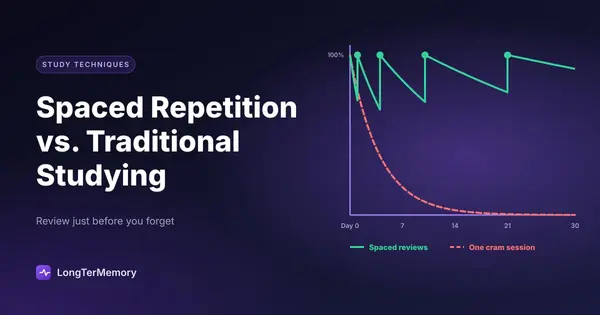
Even if you encode information well and practice retrieval, the timing of that practice matters enormously. Cramming , reviewing material heavily right before it’s needed, then not reviewing it again , produces short-term retention that collapses quickly.
The reason is biological. Your brain consolidates memories during sleep, and it decides which memories to consolidate partly based on recency and frequency of retrieval. A memory that was retrieved once last Tuesday looks, to your consolidation systems, like less important information than a memory retrieved on Monday, Wednesday, and Friday of last week.
Spaced review , reviewing material at increasing intervals over time , exploits this mechanism directly. The first review might happen a day after initial study. The next, three days later. Then a week. Then two weeks. Each review resets the consolidation clock and tells your brain: this information keeps coming up, it must be important, encode it more durably.
According to research on memory consolidation and the spacing effect, distributed practice produces retention gains of 10–30% over massed practice with equivalent total study time , and the advantage grows larger the longer the retention interval. In other words, the longer you need to remember something, the more critical spacing becomes.
The fix: Stop treating each topic as a one-time study event. Build in scheduled reviews at expanding intervals. Spaced repetition software automates this calculation, but even a manual schedule based on the intervals above will dramatically improve long-term retention.
Sleep, Nutrition, and Memory: What Peer-Reviewed Research Reveals
Memory formation is not a purely cognitive process. It’s a biological one , dependent on the physical state of your body and brain in ways that most study advice ignores.
Sleep: The Non-Negotiable
Sleep is not downtime for your brain. It’s when the memory consolidation that determines what you actually remember happens. During slow-wave sleep, your hippocampus replays the day’s learning and transfers it to the cortex for longer-term storage. During REM sleep, your brain integrates new information with existing knowledge networks.
Cut sleep short and you cut this process short. Studies consistently show that sleep deprivation of even one night significantly impairs memory consolidation , often erasing the gains from several hours of study the previous day.
The implications for studying are direct:
- Study before sleep, not instead of it. A short review session before bed takes advantage of the consolidation window without sacrificing the consolidation itself.
- Never sacrifice sleep for study. The hour you gain in study time costs you more than an hour in consolidation. It’s a losing trade.
- Naps can reinforce morning learning. A 20–30 minute nap in the afternoon has been shown to improve retention of material studied in the morning. For working learners with schedule flexibility, this is underused leverage.
Stress: The Memory Blocker
Chronic stress significantly impairs memory formation and retrieval. The mechanism involves cortisol , the primary stress hormone , which at high levels interferes with hippocampal function. The hippocampus is the brain structure most critical for forming new declarative memories.
This is relevant for students and professionals facing exam pressure. The stress of the deadline, ironically, impairs the very cognitive processes needed to prepare for it. Managing stress is not a soft concern , it’s a cognitive performance concern.
Practical stress management strategies that have documented effects on memory: regular aerobic exercise (even 20 minutes has acute cognitive benefits), adequate sleep, social connection, and structured relaxation techniques like deep breathing before study sessions.
Nutrition: The Supporting Role
The connection between nutrition and memory is real but often overstated. No food dramatically improves memory. But some nutritional patterns measurably impair it:
- Glucose regulation. The brain runs on glucose. Blood sugar crashes , from skipping meals or eating high-glycemic foods without protein or fat , produce cognitive fatigue and impair focus.
- Omega-3 fatty acids. Long-chain omega-3s (EPA/DHA, found in fatty fish) are structural components of brain cell membranes. Chronic deficiency is associated with impaired cognitive performance.
- Hydration. Even mild dehydration , 1–2% of body weight , measurably impairs working memory and concentration.
None of these require dramatic dietary changes. Regular meals, adequate hydration, and some fatty fish or supplemental omega-3s are sufficient for the neurological baseline that supports effective learning.
Self-Assessment Checklist: Is Your Current Study Method Actually Working?
The best way to diagnose a memory problem is to test the memory, not to review the material. Here’s a checklist to run on any topic you’ve recently studied.
Go through these questions without looking at your notes:
Level 1 , Basic recall
- Can you state the core definition or principle in one sentence?
- Can you name the main categories, steps, or components?
- Can you give a specific example without prompting?
Level 2 , Understanding
- Can you explain why this concept works the way it does?
- Can you explain what would change if one variable were different?
- Can you connect this concept to at least two others you’ve studied?
Level 3 , Application
- Can you correctly apply this concept to a novel scenario you haven’t seen before?
- Can you identify when this concept applies and when it doesn’t?
- Can you explain it clearly to someone who has no background in the subject?
Scoring guide:
| Level reached | What it means |
|---|---|
| None | The material wasn’t encoded , needs re-study with active recall |
| Level 1 only | Surface familiarity , vulnerable to forgetting, needs retrieval practice |
| Levels 1–2 | Solid understanding , maintain with spaced review |
| All three levels | Deep mastery , extend review intervals significantly |
Most students who feel they “know” a topic can pass Level 1 on some concepts, struggle with Level 2, and find Level 3 nearly impossible on the first honest attempt. That’s not failure , it’s diagnostic information. It tells you exactly where your current study method is leaving gaps.
The fastest way to beat the forgetting curve is to automate the review timing. LongTerMemory turns your PDFs, notes, and slides into question and answer flashcards and schedules each one with spaced repetition, so you review material just before it fades instead of after it is gone.
The Method Fix: What Changes Immediately
Based on everything above, here’s the shortest possible summary of what to do differently:
Stop doing more of what isn’t working. If you’ve been re-reading your notes and the retention isn’t there, reading them again won’t fix it. The problem isn’t volume , it’s method.
Start testing before you feel ready. The optimal moment to test yourself is not when you feel confident. It’s as soon as you’ve had initial exposure. The discomfort of failing a retrieval attempt early is not a sign you’re not ready , it’s the signal that you’re in the learning zone.
Review on a schedule, not on a feeling. “I’ll review this when I feel like I’m forgetting it” is not a review schedule. By the time you feel like you’re forgetting something, you’ve often already lost most of it. Proactive spaced review , based on a schedule rather than a feeling , is the only reliable way to stay ahead of the forgetting curve.
Protect your sleep. Studying until midnight and sleeping five hours is not a study advantage. It’s a memory consolidation deficit. The math doesn’t work in your favor.
Use the self-assessment checklist. Once a week, pick the most important topic from that week’s study and run through all three levels of the checklist from memory. Your score tells you where to focus next week with much more precision than any amount of re-reading could.
The forgetting problem has a solution. It’s just not the one that feels most natural.