Active Studying vs. Passive Studying: The Key Differences
Understand what separates active from passive study, why the research gap is so stark, and get a practical checklist to make every study session more effective.
Table of Contents
- What Qualifies as Active vs. Passive in a Study Session
- Passive Studying: What It Looks Like
- Active Studying: What It Actually Looks Like
- The Subtle Middle Ground
- The Research Gap Between What Students Do and What Works
- What the Research Shows About Passive Techniques
- What the Research Shows About Active Techniques
- Why Students Default to Passive Techniques Anyway
- A Practical Checklist for Making Every Session More Active
- Before You Start
- During the Session
- After the Session
- Weekly Review
- The Ratio to Aim For
- Making Active Studying Sustainable
Most people who study a lot still do not study particularly well. That sounds harsh, but the research on how students actually spend their time versus what produces learning is pretty consistent on this point. The hours put in and the results achieved are less correlated than you would expect, and the reason comes down to one fundamental distinction: active versus passive studying.
Understanding that distinction, really understanding it, not just knowing the words but being able to recognize it in your own behavior in real time, is probably the single most valuable thing you can do for your academic or professional learning performance.
Let us break it down.
What Qualifies as Active vs. Passive in a Study Session
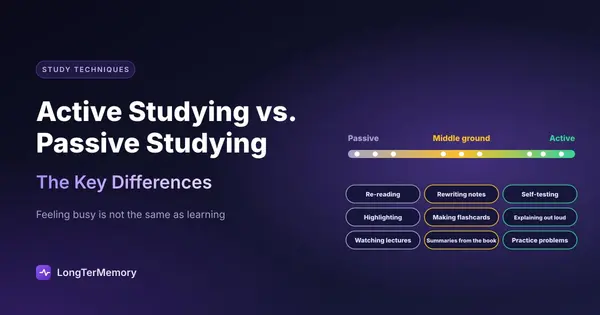
The defining feature of passive studying is that your brain is in receiving mode. You are taking information in. You feel engaged. You might be very focused. But you are not required to produce anything, retrieve anything, or transform the material in any meaningful way.
The defining feature of active studying is that your brain is in production mode. You are generating something: an answer, an explanation, a question, a diagram, a summary, a connection. You are being tested, even if only by yourself.
Passive Studying: What It Looks Like
Here is an honest inventory of what passes for studying in most study sessions:
Re-reading. You read your notes or textbook again. It feels productive, especially when the material starts to feel familiar. The familiarity is real. The learning is largely illusory.
Highlighting. You mark important passages. This gives you something to do with your hands while reading, which creates a sense of engagement, but the cognitive work involved is essentially zero. Your brain barely has to process the information to decide it is important enough to highlight.
Watching lecture videos. Passive in its default mode, though it can become active if you pause and test yourself regularly. Most people do not do that.
Copying notes. Writing out information that is already in front of you in another format is marginally better than re-reading, because the transcription process requires some attention, but the cognitive engagement is still minimal if you are just copying rather than transforming.
Listening to recorded lectures. Same issue as watching. Easy to feel like you are studying. Hard to actually retain the information.
None of these are useless in all contexts. Initial exposure to new material often requires some passive intake. The problem is not that passive activities exist, it is that most students use them far beyond the point where they are generating any learning value, and mistake the feeling of familiarity they create for actual understanding.
Active Studying: What It Actually Looks Like
Active studying requires your brain to work, to produce, to retrieve. Here is what it looks like in practice:
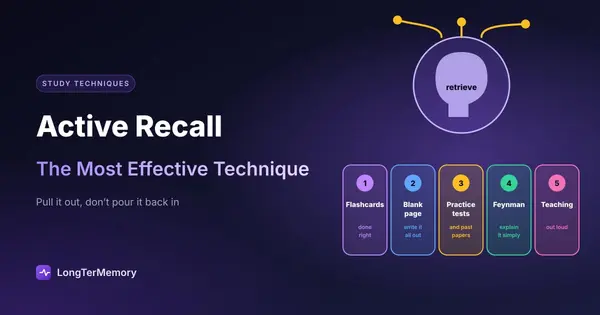
Retrieval practice. Closing your notes and trying to reproduce what you have learned from memory. Flashcards used with genuine effort (committing to an answer before flipping). Practice questions. Self-testing before checking any reference material.
The blank page technique. After a reading session, take a blank sheet of paper and write down everything you can remember. No peeking. The gaps you find are your actual study agenda.
Teaching or explaining. Explaining a concept out loud to someone else, or even to yourself, requires organizing and articulating the material in a way that passive review does not. If you can explain it clearly without your notes, you probably understand it. If your explanation falls apart, you have found a gap.
Problem-solving. Working through practice problems, past papers, or questions from scratch, without looking at worked examples first. This is especially critical in quantitative subjects.
Making connections. Actively writing or drawing how different concepts relate to each other. Concept maps, diagrams, comparison tables. The work here is in the connections you are forced to make, not the information you are transferring.
Generating questions. Taking your study material and writing exam-style questions based on it. The process of figuring out what would be a good question on this material forces you to think hard about what the material actually means.
The Subtle Middle Ground
Some activities look active but are actually closer to passive:
Taking notes during a lecture is closer to passive if you are transcribing what you hear verbatim. It becomes more active when you are processing and paraphrasing, synthesizing the lecture with what you already know, or stopping to write your own questions.
Re-reading with annotations is better than plain re-reading, but still largely passive. The annotations add value mostly if you use them as cues for active recall later, not if they are just reminders of what you thought was important.
Making flashcards is a preparation step, not the active study itself. The active part is using the flashcards with genuine retrieval effort.
The question that distinguishes active from passive is simple: is your brain being required to produce something, or just receive it? If you can do it while sort-of watching TV, it is probably passive.
The Research Gap Between What Students Do and What Works
Here is where things get uncomfortable. The research on study techniques is pretty clear, and the gap between what students report doing and what actually works is striking.
What the Research Shows About Passive Techniques
A comprehensive review of study techniques published by cognitive psychologists John Dunlosky and colleagues examined the research on ten commonly used strategies and rated their utility based on the evidence. Their findings:
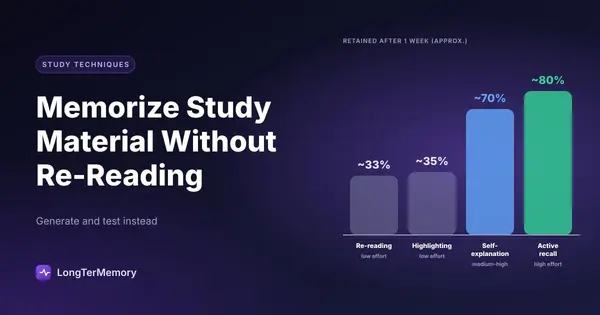
Highlighting and underlining: Low utility. The evidence that it improves learning is weak across a wide range of conditions. Students who highlight heavily do not perform better than those who do not.
Re-reading: Low utility. Produces better performance than a single reading in the short term, but is far inferior to retrieval practice for long-term retention and for transferable understanding.
Summarization: Moderate utility for students who are taught to do it well, low utility when done in the way most students actually do it (which is often closer to paraphrasing than genuine synthesis).
Keyword mnemonics: Low to moderate utility, depending on context. Good for specific retrieval but does not build the kind of understanding that transfers well to novel questions.
What the Research Shows About Active Techniques
Retrieval practice (practice testing): High utility. One of the most replicated findings in educational psychology. Consistently produces better long-term retention than re-studying. Works across age groups, subjects, and time periods.
Distributed practice (spaced repetition): High utility. Spreading study sessions over time rather than massing them together produces dramatically better long-term retention. The spacing effect has been studied for over 100 years and is one of the most robust findings in memory research.
Interleaved practice: Moderate to high utility. Mixing up different topics or problem types within a single study session feels harder but produces better retention and transfer than blocked practice (studying one topic completely before moving to the next).
The gap in outcomes between these two groups of techniques is not small. Studies comparing retrieval practice to re-reading typically find retention advantages of 40 to 80 percent or more in favor of retrieval practice, depending on the time interval and material being tested.
Why Students Default to Passive Techniques Anyway
Given the evidence, why do most students still spend most of their time highlighting and re-reading? A few reasons:
Passive techniques feel like studying. The fluency illusion, where familiar material feels like understood material, is real and persistent. When you read something and it makes sense, your brain registers that as success. It takes metacognitive effort to recognize that recognition and recall are completely different skills.
Active techniques feel harder in the moment. Trying to retrieve information and struggling before you find it is uncomfortable. Re-reading is comfortable. The discomfort of active recall is a feature, not a bug (it is called desirable difficulty in the research literature), but it runs counter to what feels productive.
Active techniques require more preparation. You need to make flashcards before you can use them. You need practice questions to do practice questions. Passive techniques require nothing but the material itself.
Nobody explicitly teaches study strategies. Most people develop their study habits in primary and secondary school, where passive techniques work well enough for the kind of lower-order recall those environments typically demand. By the time the stakes get higher and the material gets more complex, the habits are ingrained.
A Practical Checklist for Making Every Session More Active
Here is a concrete checklist you can use before, during, and after every study session to shift the balance toward active learning.
Before You Start
- Write down three to five specific questions you want to be able to answer by the end of this session
- Set a timer or define a clear end point (session structure improves focus)
- Pull out your most recent study material and do a two-minute free recall of what you remember from last time, before reviewing anything
During the Session
- For every page or section you read, stop before moving on and ask: “What were the main points? Can I reproduce them without looking?”
- Paraphrase new information in your own words rather than copying verbatim
- When you encounter something confusing, write the question down rather than just re-reading the confusing passage
- Use flashcards or practice questions as a primary activity, not just at the end
After the Session
- Spend five to ten minutes doing a blank-page recall: write down everything you remember from the session without looking at your notes
- Compare what you recalled to your material and note the gaps explicitly
- Set up your spaced repetition review for this material (schedule your next review before you close your notes)
- Write one question you still have or one thing you want to investigate further in the next session
Weekly Review
- Review your flashcard deck with genuine retrieval effort (do not just look at both sides)
- Do at least one practice test or timed question block per week if your subject has one available
- Identify which topics you are consistently getting wrong and prioritize them next week
The Ratio to Aim For
A rough target for most subjects: 70 percent of your study time should be active retrieval and application, 30 percent initial exposure and passive intake. Most students have this approximately backwards.
For the initial learning of genuinely new material, some passive intake is necessary and appropriate. You cannot retrieve what you have never encountered. But once you have been through material once, the re-reading and re-watching add very little compared to retrieval practice, and they crowd out the time that retrieval practice needs.
If you look at your last study session honestly and cannot identify clear examples of active retrieval, practice questions, or production tasks, you spent the session in passive mode. That is fine as a diagnostic, less fine as a permanent strategy.
Making Active Studying Sustainable
One thing worth acknowledging: active studying is harder in the moment than passive studying. It requires more cognitive effort. It produces the uncomfortable experience of not knowing, of reaching for an answer and not finding it, of recognizing gaps you did not know existed. For a lot of people, that discomfort is a signal that they are doing something wrong.
It is actually a signal that learning is happening.
The term researchers use is desirable difficulty. Difficulties that require more cognitive work during study tend to produce better long-term retention, even when they reduce apparent performance in the short term. Struggling to recall something before checking the answer produces better retention than reading the answer immediately. Interleaving topics feels confusing but produces better transfer than blocked practice. The effort is the point.
A few things that make active studying more sustainable:
Start small. If you have been studying entirely passively, do not try to flip everything at once. Add ten minutes of retrieval practice to the end of your normal session. Build from there.
Use tools that reduce friction. The more effort it takes to do active retrieval, the less often you will do it. Spaced repetition tools like LongTerMemory handle the scheduling automatically, so you do not have to figure out which cards to review when. Lower friction means more consistent practice.
Pair it with something you already do. Attach flashcard review to your morning coffee, your commute, or the first ten minutes of lunch. Small habits attached to existing routines are more sustainable than large habits requiring new time blocks.
Track your progress in something other than time spent. Hours studied is a proxy for learning that passive techniques can inflate indefinitely without producing results. Cards reviewed, practice questions attempted, and topics you can explain from memory are better measures of actual progress.
The distinction between active and passive studying is not complicated. It is just underused. The research is clear, the techniques are accessible, and the results, better retention, stronger performance under pressure, and less time wasted on strategies that feel productive but do not work, are genuinely worth pursuing.
You do not need to study more. You need to study better. And the difference is almost always this: are you retrieving, or are you just reading?
LongTerMemory turns your study materials into spaced repetition flashcard sessions automatically. Upload your notes or PDFs and get a practice system built around retrieval, not passive review.