How to Memorize Study Material Without Re-Reading
Discover why re-reading kills your memory and learn active memorization strategies that actually make study material stick for exams and beyond.
Table of Contents
- Why Re-Reading Feels Like It Works (But Doesn't)
- The Generate-and-Test Method
- Building a Card Deck That Replaces Your Notes
- Turn Statements Into Questions
- Use the Minimum Information Principle
- Drill With Intention
- The Elaboration Strategy
- The Teach-Back Method
- The Pre-Test Strategy
- A Daily Workflow That Eliminates Re-Reading
- Morning (15 minutes)
- Study Session (whatever your schedule allows)
- Evening (10 minutes)
- What to Do When You Hit a Wall
- The Uncomfortable Truth About Effective Studying
- Making the Switch
- The Bottom Line
Let’s be honest for a second. You’ve probably spent hours re-reading your notes, highlighting sentences, flipping through textbook chapters for the third time, and walking away feeling like you’ve done solid work. It feels productive. It feels like learning. And that’s exactly the problem , it feels like learning without actually being learning.
The research on this is pretty devastating. Re-reading is one of the least effective study strategies that exists. It creates a warm sense of familiarity that your brain mistakes for actual knowledge, but when the exam hits and you’re staring at a blank page, that familiarity evaporates. You recognize the material when you see it, but you can’t produce it from memory. And producing it from memory is the only thing that matters.
So what do you do instead? You stop reviewing and start generating. That single shift , from passively looking at information to actively producing it , changes everything about how well you remember.
Why Re-Reading Feels Like It Works (But Doesn’t)
Here’s the sneaky thing about re-reading: it gets easier every time. The second time you read a chapter, it flows more smoothly. The third time, you barely have to think. Your brain interprets that ease as mastery. Psychologists call this the fluency illusion , the tendency to confuse processing ease with genuine understanding.
But think about what’s actually happening during re-reading. Your eyes move across words you’ve already seen. Your brain recognizes patterns it encountered before. At no point are you being asked to do anything difficult. And difficulty, it turns out, is the entire engine of memory formation.
When something is easy, your brain files it under “already handled.” When something is hard , when you have to strain to pull an answer out of your head , your brain treats that information as important and worth preserving. This is why the most effective study methods all share one thing in common: they’re uncomfortable.
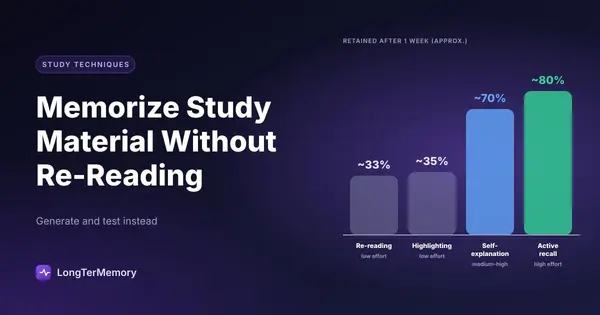
| Study Method | Effort Level | Retention After 1 Week |
|---|---|---|
| Re-reading notes | Low | ~33% |
| Highlighting text | Low | ~35% |
| Active recall testing | High | ~80% |
| Self-explanation | Medium-High | ~70% |
The gap between passive and active methods isn’t subtle. It’s massive. And it shows up consistently across decades of research, different subjects, and different age groups.
The Generate-and-Test Method
If re-reading is out, what’s in? The answer is a simple two-step cycle that researchers sometimes call generate-and-test. Here’s how it works:
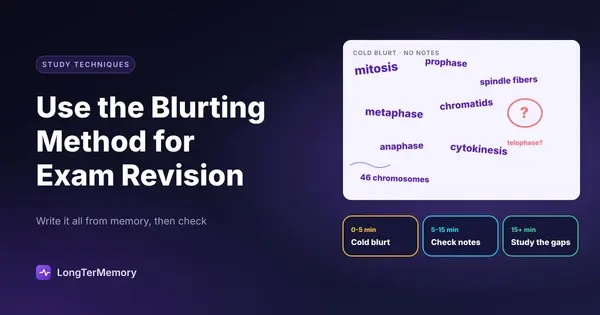
Step 1: Generate. After studying a section of material, close everything , your notes, your textbook, your laptop , and try to write down everything you remember. Don’t peek. Don’t organize. Just dump everything your brain can produce onto a blank page.
Step 2: Test. Now open your materials and compare. What did you get right? What did you miss? What did you get wrong? The gaps you discover are your actual study agenda. Those are the things your brain hasn’t encoded properly yet, and those are where you need to focus your next session.
This cycle works because it forces your brain to do the hard work of retrieval , pulling information out of storage rather than just looking at it. Every successful retrieval strengthens the memory trace. Every failed retrieval tells you exactly where to direct your attention.
The beauty of generate-and-test is that it replaces the vague feeling of “I think I know this” with concrete evidence of what you actually know and what you don’t. No more guessing. No more surprises on exam day.
Building a Card Deck That Replaces Your Notes
One of the most powerful ways to eliminate re-reading from your study routine is to convert your notes into questions. Instead of having a page of information you read over and over, you create a deck of cards , physical or digital , where each card forces you to retrieve a specific piece of knowledge.
Here’s the process:
Turn Statements Into Questions
Take every key concept, definition, process, or fact from your notes and rewrite it as a question. For example:
- Note says: “Mitochondria are the powerhouses of the cell, responsible for ATP production through cellular respiration.”
- Card front: “What organelle produces ATP through cellular respiration?”
- Card back: “Mitochondria , the powerhouse of the cell.”
This transformation is more powerful than it looks. The act of figuring out what question a piece of information answers forces you to think about its meaning and significance. You’re not just copying , you’re processing.
Use the Minimum Information Principle
Each card should test exactly one thing. If you find yourself putting three related facts on one card, split it into three cards. The reason is simple: when a card tests multiple things, you can get partial credit in your head. “I got two out of three, close enough.” But close enough isn’t good enough for real recall. You need each piece of knowledge to stand on its own.
Drill With Intention
When you go through your cards, commit to an answer before flipping. This is non-negotiable. If you flip the card while still thinking, you’ve just turned active recall into passive recognition. The whole point is the struggle of producing the answer from memory.
Sort your cards into three piles after each session:
- Got it easily , review these less frequently
- Got it with effort , these are in the sweet spot, keep drilling
- Missed it , these need the most attention in your next session
This sorting system naturally creates a form of spaced repetition, concentrating your time where it matters most.
The Elaboration Strategy
Beyond simple retrieval, there’s another technique that crushes re-reading: elaborative interrogation. It sounds fancy, but the concept is straightforward. Instead of just reading a fact, you ask yourself “why?” and “how?” about it.
For example, instead of reading “The heart has four chambers” and moving on, you stop and ask: Why four chambers? What would happen with three? How does having four chambers relate to the circulatory system’s function?
This works because it forces you to connect new information to things you already know. Isolated facts are fragile , they sit in your memory like loose papers on a desk, easily blown away. But facts connected to a web of understanding are anchored. They have multiple retrieval paths, which means more ways for your brain to find them when you need them.
The generation effect , the finding that information you generate yourself is remembered better than information you simply read , is one of the most robust results in memory research. When you explain why something is true, you’re generating understanding rather than consuming it. And generated knowledge sticks.
The Teach-Back Method
Here’s a rule of thumb that never fails: if you can’t explain it without your notes, you don’t know it. The teach-back method uses this principle as a study tool.
After studying a topic, find someone , a classmate, a friend, a family member, even your reflection in the mirror , and explain the material to them as if they’ve never heard of it before. Use simple language. Give examples. Answer their questions (or imagine what questions they might ask).
Every point where you stumble, hesitate, or reach for vague hand-waving is a gap in your understanding. These gaps are invisible when you’re re-reading because the text fills them in for you. But when you’re standing in front of someone trying to explain cellular respiration or the causes of World War I, there’s nowhere to hide.
The teach-back method works on two levels:
- It forces retrieval , you have to pull the information out of memory, not read it off a page
- It forces organization , you have to structure the information logically, which deepens your understanding of how concepts relate to each other
The Pre-Test Strategy
Here’s something counterintuitive: testing yourself before you’ve even studied can improve how well you learn the material. This is called pretesting, and the research behind it is surprisingly strong.
Before you read a chapter or attend a lecture, write down everything you think you already know about the topic. Then write questions you expect the material to answer. When you then actually study the material, your brain is primed to pay special attention to the answers to those questions and to the gaps in your prior knowledge.
Pretesting works because it creates what psychologists call a “search set” in memory. Your brain has been asked a question it couldn’t answer, and it keeps that question active in the background, ready to grab relevant information when it encounters it. It’s like telling your brain what to look for before you walk into a store , you’ll notice the right things immediately instead of wandering aimlessly through the aisles.
A Daily Workflow That Eliminates Re-Reading
Here’s a practical daily study routine that replaces passive re-reading with active memorization:
Morning (15 minutes)
- Review your card deck from the previous day
- Focus on the “missed” pile first
- Don’t add new cards yet , just consolidate what you’ve already studied
Study Session (whatever your schedule allows)
- Read new material actively , pause after each section
- Do a blank-page recall: close everything and write what you remember
- Convert missed items into new cards
- Ask “why?” and “how?” for each key concept
Evening (10 minutes)
- Quick pass through all new cards created today
- Sort into easy/medium/hard piles
- Spend extra time on the hard pile
- Optional: teach-back one concept to someone (or out loud to yourself)
The total active memorization time here is about 25 minutes on top of your normal study session. That’s not a lot. But those 25 minutes of active work will produce more durable memory than hours of passive re-reading.
What to Do When You Hit a Wall
Sometimes you’ll sit down to recall something and your mind will go completely blank. This is normal. It’s also incredibly valuable , it’s your brain telling you exactly where the gaps are.
When this happens, resist the urge to immediately open your notes. Instead:
- Wait 10-15 seconds. Often, the information is there but needs time to surface.
- Think about related concepts. What else do you know about this topic? Sometimes approaching from a different angle triggers the memory.
- Recall the context. Where were you when you studied this? What was on the page? What came before and after it? Context cues can pull memories forward.
- If nothing comes, check your notes , but only for that specific gap. Don’t re-read the whole section. Find the answer, close the notes, and immediately try to recall it again.
That last step is critical. The moment after a failed retrieval is actually one of the best moments for learning. Your brain is primed and searching for the information. When you find it and immediately practice recalling it, the memory forms much more strongly than if you’d just read it passively.
The Uncomfortable Truth About Effective Studying
Here’s the thing nobody wants to hear: effective studying is supposed to feel hard. If your study session feels smooth and easy, you’re probably not learning much. The strain of trying to remember, the discomfort of realizing you’ve forgotten something, the effort of generating explanations from scratch , that friction is where memory is built.
Re-reading feels productive because it’s easy. Active memorization feels unproductive because it’s hard. But the results tell the opposite story. Students who use active retrieval consistently outperform re-readers by enormous margins, often needing less total study time to achieve better results.
The shift from passive to active study isn’t just a technique change , it’s a mindset change. You stop asking “have I seen this material enough times?” and start asking “can I produce this material from memory?” The first question leads to re-reading marathons. The second question leads to actual learning.
Making the Switch
If you’ve been a lifelong re-reader, making the switch to active memorization can feel jarring at first. Here’s how to ease into it:
Week 1: After every study session, spend just 5 minutes doing a blank-page recall. Don’t change anything else about your routine.
Week 2: Start converting your most important notes into question cards. Aim for 10-15 cards per study session.
Week 3: Replace one re-reading session with a card review session. Notice how much more you remember.
Week 4: By now, you’ll have enough evidence to trust the process. Start phasing out re-reading entirely and building your study routine around retrieval, elaboration, and teaching.
The transformation isn’t instant, but it’s real. Within a month, you’ll wonder how you ever thought re-reading was studying. Because once you experience what it feels like to actually remember things , reliably, confidently, under pressure , going back to passive review becomes unthinkable.
The hardest part of switching from rereading to retrieval is writing all the questions. LongTerMemory does that for you: upload your notes, slides, or textbook PDFs and it generates question and answer flashcards automatically, then schedules them with spaced repetition.
The Bottom Line
Re-reading is comfortable. It’s familiar. And it’s holding you back. Every hour you spend passively scanning your notes is an hour you could have spent building real, durable, exam-proof knowledge through active retrieval.
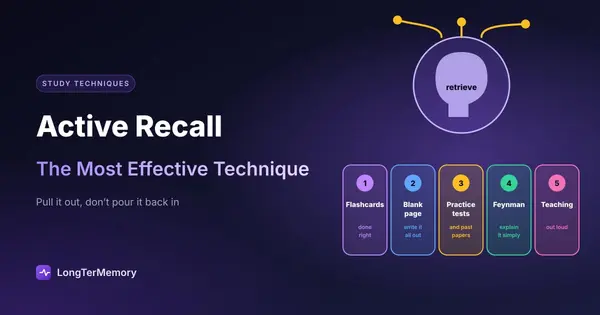
The tools are simple: blank-page recall, question cards, elaboration, teach-backs, and pretesting. None of them require special equipment or apps. All of them require you to do the uncomfortable work of pulling information out of your brain instead of just putting it in front of your eyes.
For a full breakdown of what this approach looks like and five techniques to start with, see our guide to active studying.
Stop re-reading. Start retrieving. Your future exam scores will thank you.