
How to Annotate a Textbook to Boost Memory Retention
Learn how to annotate a textbook effectively using question-based methods that turn passive reading into active memory building.
Table of Contents
- Why Most Textbook Annotation Fails
- The Two Types of Useful Annotation
- 1. Questions in the Margins
- 2. Connection Notes
- What to Annotate (And What to Leave Alone)
- Using Your Annotations as a Self-Testing Resource
- A Practical Annotation System You Can Start Today
- Annotation for Different Subject Types
- Science and Medicine
- Law and Social Sciences
- Mathematics
- History and Literature
- The Annotation Mindset
- The Bottom Line
You’ve probably been there: you sit down with a textbook, pen in hand, ready to be a serious student. You read a paragraph, underline something that seems important, move on. Two hours later you’ve covered twenty pages, your book is striped yellow and pink, and you feel like you’ve done something meaningful.
Then exam day arrives, and you remember almost none of it.
The problem isn’t that you annotated. The problem is how you annotated. Most textbook annotation habits are built around highlighting and underlining, which are almost entirely passive activities. Your eyes move, your hand moves, but your brain stays mostly quiet. And a quiet brain during study time is not a learning brain.
The good news: textbook annotation can be one of the most powerful study tools you have, but only if you redesign how you do it. This guide walks you through what to annotate, how to annotate it, and how to use your annotations as a self-testing resource long after you’ve closed the book.
Why Most Textbook Annotation Fails
Before getting into the good stuff, it’s worth understanding why the standard approach falls apart.
When you highlight a sentence, you’re making a decision about importance, which takes maybe half a second of thought. Then you move on. The cognitive load is minimal. And minimal cognitive load means minimal encoding. Your brain has no reason to build a durable memory of that sentence because you didn’t actually do anything with it.
There’s a term for this in cognitive science: the illusion of knowing. When you read something and highlight it, it feels familiar. And familiarity feels like knowledge. But familiarity and knowledge are very different things. Familiarity means you recognize something when you see it. Knowledge means you can reproduce it, apply it, and explain it without the text in front of you.
The test of real learning isn’t whether you can find the highlighted sentence again. It’s whether you can reconstruct what it said, why it matters, and how it connects to everything else you’ve studied.
Annotation that actually works forces you to do exactly that.
The Two Types of Useful Annotation
There are really only two types of annotation worth making in a textbook. Everything else is decoration.
1. Questions in the Margins
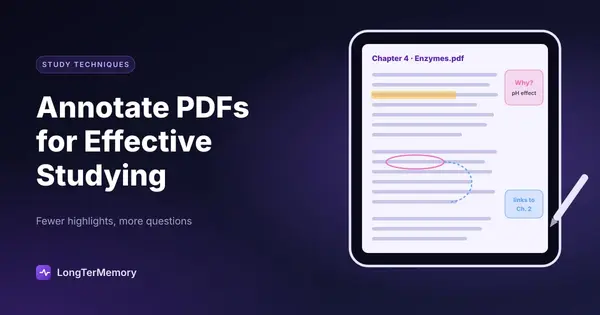
This is the most underused and most powerful annotation technique. As you read, write questions in the margin next to the key content.
Not summaries. Not paraphrases. Questions.
If a paragraph explains the mechanism of photosynthesis, don’t write “light converts CO2 to glucose.” Write: “What is the role of chlorophyll in converting light energy?” or “What happens to CO2 in the Calvin cycle?”
The shift is subtle but the effect is enormous. You’ve just converted a passive reading note into a retrieval prompt. Every time you flip back to that page, you can cover the text and try to answer the question before looking. You’ve turned your textbook into a self-testing tool without any additional materials.
This is why question-based annotation is so effective: it forces your brain to engage at the level of application, not just recognition. Writing the question requires you to identify what the core testable idea actually is. Answering it later requires actual recall.
A few practical tips for this method:
- Use a pencil or a specific color pen just for questions so they stand out visually
- Aim for one question per substantial paragraph or concept block, not every sentence
- Phrase questions the way an exam might phrase them, using words like “explain,” “describe,” “what causes,” “how does”
2. Connection Notes
The second type of annotation that builds memory is the connection note: a short marginal note that links what you’re reading to something else you already know.
“This is similar to what we covered in chapter 3 about cellular respiration,” or “this contradicts what the lecturer said about enzyme specificity,” or “this is the same principle as Newton’s third law in a biological context.”
Connection notes work because they create what cognitive scientists call elaborative encoding. Your brain doesn’t store memories in isolation. It stores them in networks. Every time you connect a new piece of information to something already in that network, you create another retrieval pathway. More pathways means more ways to find the memory when you need it.
Connection notes also force you to actually think about the content rather than just register it. Noticing that two things are related requires a higher level of cognitive processing than underlining a sentence ever does.
What to Annotate (And What to Leave Alone)
One of the most common mistakes students make is annotating too much. If you highlight 40% of a page, you’ve accomplished nothing. The goal of annotation is to identify what actually matters, and that requires making real judgments.
Here are the things genuinely worth annotating:
Core definitions and concepts: The first time a key term appears with its formal definition, that’s worth marking. But only the first time, and with a question in the margin: “What is X? What distinguishes it from Y?”
Causal relationships: Passages that explain why something happens or how one thing leads to another are extremely high-value. These are almost always exam material. Mark them with a brief “mechanism” note in the margin.
Exceptions and edge cases: Textbook authors almost always highlight exceptions and special cases because they matter. If a general rule has a notable exception, that exception is likely to appear on a test. Mark it with a star or a brief “exception” note.
Anything that confuses you: If you read a paragraph and it doesn’t quite make sense, don’t keep going. Write a question mark and a brief note about what you didn’t understand. These annotations become your study agenda for the next session.
Leave alone:
- Long descriptive passages that are clearly context or background
- Examples that illustrate concepts you already fully understand
- Anything you’re marking just to feel productive
The discipline of selective annotation is itself a form of active engagement. Deciding what not to mark requires you to genuinely evaluate importance, which means you’re processing the content much more deeply.
Using Your Annotations as a Self-Testing Resource
Annotation creates a study resource. But the resource is only valuable if you actually use it, and most students don’t.
The standard approach is to re-read annotations before an exam, which collapses back into passive review. The better approach is to use your annotations as prompts for active retrieval.
Here’s a simple method:
- Open your annotated textbook to any chapter
- Cover the main text with a piece of paper, leaving only your margin questions visible
- Try to answer each question from memory before uncovering the text
- Check your answer, note what you got right and wrong
- For anything you missed, go back to the text and re-read that specific passage, then try the question again
This turns annotation review into a genuine retrieval practice session. You’re not re-reading the chapter. You’re testing yourself on the specific information you flagged as important during your first pass.
If you combined question-based annotation with spaced repetition, this approach becomes even more powerful. Instead of reviewing all your annotations together before an exam, revisit them in spaced intervals: once two days after your initial reading, once a week later, once three weeks later. Each review session takes a fraction of the time of re-reading the chapter, but the retention impact is dramatically higher.
A tool like LongTerMemory can help automate this process, turning your annotated questions into spaced-repetition flashcards that surface at the right intervals. You do the annotation, the system handles the scheduling.
A Practical Annotation System You Can Start Today
If you want a concrete system to use from your next study session, here it is.
| Annotation Type | Symbol | When to Use |
|---|---|---|
| Question | Q: | Core concepts, definitions, mechanisms |
| Connection | C: | Links to prior knowledge or other chapters |
| Exception | ! | Rules with notable exceptions |
| Confused | ? | Passages that didn’t fully make sense |
| Key term | Circle | First use of an important term |
Keep your symbols consistent so scanning the margins is fast. When you return for review, you immediately know what type of retrieval practice each annotation is asking for.
This takes some adjustment at first. You’ll feel the pull toward just highlighting, because highlighting is easier and more comfortable. The friction of writing a question in the margin is a feature, not a bug. That friction is your brain working harder, encoding more deeply.
Annotation for Different Subject Types
The basic approach works across subjects, but the emphasis shifts depending on what you’re studying.
Science and Medicine
Focus your annotations on mechanisms and processes. “How does X cause Y?” is your default question format. For anything with a diagram, annotate the diagram itself with labels and questions, not just the surrounding text. If a biological process has multiple steps, number them in the margin.
Law and Social Sciences
Focus on the relationship between cases, arguments, and principles. Your connection notes will do a lot of work here: linking current case law to precedents, connecting theories to each other, noting where two scholars disagree and why. Law especially benefits from annotations that frame content as argument: “What is the strongest objection to this rule?”
Mathematics
You probably shouldn’t annotate math textbooks the same way. What works in math is writing “this is the same move as [previous technique]” when you recognize a pattern, and “I don’t see why this step works” when you don’t. Math annotation is mostly about tracking understanding and confusion, not about creating retrieval prompts, because the retrieval practice in math is working problems.
History and Literature
Focus on cause-and-effect chains and themes. “What conditions led to X?” and “How does this connect to the theme of Y?” are the standard question formats. For literature, annotate patterns, motifs, and moments where a character changes, as these tend to be the exam material.
The Annotation Mindset
The deeper shift that makes all of this work isn’t about specific techniques. It’s about why you’re annotating in the first place.
If you annotate to create a record of what you read, you’ll default to highlighting and underlining, because those are efficient ways to mark the text.
If you annotate to create a resource for future retrieval practice, you’ll default to questions and connections, because those are the things that actually help you remember.
The first mindset produces colorful books and poor exam performance. The second produces a personal study tool you can use repeatedly, with each pass building on the last.
Reading a textbook once, even carefully, is rarely enough to retain complex information. Annotation that creates retrieval prompts transforms that single reading into the first pass of a multi-stage learning process. Every time you return to your questions, you’re doing the thing that actually builds memory: pulling information out of your brain and checking it against reality.
For a complete system on how to memorize a textbook, see our guide on how to memorize a textbook.
That’s the whole point of annotation. Not to mark the book. To mark what matters so you can test yourself on it later, and again, and again, until it’s genuinely yours.
The Bottom Line
The best textbook annotation isn’t the most thorough or the most colorful. It’s the kind that turns a passive reading session into an active, self-testing process.
Focus on questions in the margins over highlights on the text. Make connection notes when you see links to prior knowledge. Annotate selectively so the margin notes are signal, not noise. And then actually use your annotations as retrieval prompts rather than re-reading cues.
The students who retain what they read aren’t the ones who cover the most pages per session. They’re the ones who give their brain something to actually do with the content. Annotation done right gives your brain exactly that.