How to Memorize Chemistry Equations Quickly
Learn to memorize chemistry equations fast with reaction type understanding, smart flashcard design, and color coding strategies that make formulas stick.
Table of Contents
- Understanding Reaction Types Before Memorizing Specific Equations
- The Major Reaction Type Categories
- Why Learning Reaction Types First Is So Powerful
- The Activity Series for Single Displacement Reactions
- Flashcard Design for Balanced Chemical Equations
- What Not to Put on a Chemistry Flashcard
- Card Type 1: Predict the Products
- Card Type 2: Identify and Balance
- Card Type 3: Reaction Type Identification
- Card Type 4: Conceptual "Why" Cards
- Organizing Your Flashcard Decks by Reaction Type
- Using Color Coding and Visual Diagrams for Chemistry Recall
- Color Coding by Element and Role
- Energy Diagrams as Memory Anchors
- Molecular Model Drawing for Organic Reactions
- The "Before and After" Diagram Method
- Balancing Equations: A Skill, Not a Memorization Task
- When You Do Need to Memorize Specific Equations
- Building a Chemistry Study Routine That Actually Works
- The Big Picture
Chemistry equations have a reputation for being some of the hardest content to memorize in all of STEM. Unlike math equations, which typically express clean relationships between abstract variables, chemistry equations describe specific reactions between specific substances , and there are a lot of them. Combustion reactions. Acid-base neutralizations. Redox reactions. Equilibrium expressions. Solubility products. Thermochemical equations. The list goes on.
The students who struggle most with chemistry equations are usually the ones trying to memorize them as strings of symbols, disconnected from meaning. The students who handle it well have figured out something crucial: chemistry equations aren’t arbitrary sequences , they’re descriptions of physical and chemical processes. When you understand the process, the equation becomes a natural expression of that process rather than a random string to memorize.
This guide will walk you through three interconnected strategies: building conceptual understanding before memorizing specific equations, designing flashcards that test real chemistry knowledge, and using visual techniques that make molecular content stick.
Understanding Reaction Types Before Memorizing Specific Equations
The most important thing you can do before you start memorizing individual chemistry equations is learn to categorize reactions by type. There are a manageable number of reaction types, and each type follows predictable patterns. Once you know the patterns, specific equations within a type become much easier to recall , because you already know what shape the answer should take.
The Major Reaction Type Categories
Combination (Synthesis) Reactions Two or more reactants combine to form a single product.
- Pattern: A + B → AB
- Example: 2Na + Cl₂ → 2NaCl
- Cue: “Coming together”
Decomposition Reactions A single compound breaks down into two or more products.
- Pattern: AB → A + B
- Example: 2H₂O₂ → 2H₂O + O₂
- Cue: “Falling apart”
Single Displacement (Substitution) Reactions One element displaces another from a compound.
- Pattern: A + BC → AC + B
- Example: Zn + 2HCl → ZnCl₂ + H₂
- Cue: “Musical chairs , one element takes another’s place”
Double Displacement (Metathesis) Reactions The cations of two ionic compounds exchange partners.
- Pattern: AB + CD → AD + CB
- Example: NaCl + AgNO₃ → AgCl↓ + NaNO₃
- Cue: “Swapping partners”
Combustion Reactions A substance reacts with oxygen, producing CO₂ and H₂O (for organic fuels).
- Pattern: Fuel + O₂ → CO₂ + H₂O
- Example: C₃H₈ + 5O₂ → 3CO₂ + 4H₂O
- Cue: “Burning produces carbon dioxide and water”
Acid-Base (Neutralization) Reactions An acid and a base react to form salt and water.
- Pattern: Acid + Base → Salt + Water
- Example: HCl + NaOH → NaCl + H₂O
- Cue: “Neutralization always makes salt and water”
Why Learning Reaction Types First Is So Powerful
When you know these patterns, memorizing a specific equation becomes pattern matching + specific details rather than memorizing an entirely novel string.
Take a combustion reaction: C₆H₁₂O₆ + 6O₂ → 6CO₂ + 6H₂O (combustion of glucose). If you know combustion always produces CO₂ and H₂O from an organic fuel, you only need to remember the specific stoichiometry (the 6s) , not the whole equation from scratch.
Contrast this with trying to memorize the equation cold as a string of symbols. The pattern knowledge reduces what you need to hold in memory by 50-70% per equation.
The Activity Series for Single Displacement Reactions
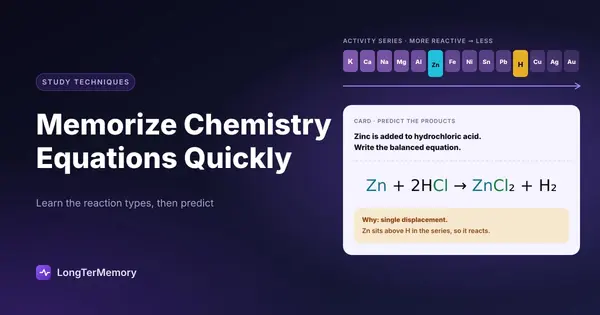
For single displacement reactions, there’s an additional shortcut: the activity series (or reactivity series) of metals. This is a ranked list of metals by how readily they give up electrons. A metal higher on the series will displace a metal lower on the series from a compound , but not vice versa.
| More Reactive → Less Reactive |
|---|
| K > Ca > Na > Mg > Al > Zn > Fe > Ni > Sn > Pb > H > Cu > Ag > Au |
Once you’ve memorized this series (using the mnemonics below), you can predict whether a single displacement reaction will occur at all , you don’t need to memorize every possible pairing. You just check the series.
Mnemonic for the activity series (K, Ca, Na, Mg, Al, Zn, Fe, Ni, Sn, Pb, H, Cu, Ag, Au):
“Kings Can Never Make A Zoo For Nearly Stupid People, However Clever Alligators Are”
This kind of structural knowledge , understanding the underlying principle rather than memorizing outcomes , is what separates students who do well in chemistry from those who feel like they’re drowning in equations.
Flashcard Design for Balanced Chemical Equations
Flashcards are the right tool for chemistry equations, but the design of the card matters enormously. A poorly designed flashcard produces weak, superficial recall. A well-designed card builds the kind of robust, applicable knowledge that performs on exams.
What Not to Put on a Chemistry Flashcard
The most common mistake: writing a balanced equation on the front and “the name of the reaction” on the back (or vice versa). This tests name-to-equation recognition in isolation , which is almost never what exams require.
Exams ask you to:
- Predict products given reactants
- Balance equations
- Identify reaction type from reactants or products
- Explain why a reaction does or doesn’t occur
- Apply stoichiometry to calculate amounts
Your flashcards should train all of these, not just symbol recognition.
Card Type 1: Predict the Products
- Front: “Zinc metal is added to a solution of hydrochloric acid. Write the balanced equation.”
- Back: Zn + 2HCl → ZnCl₂ + H₂ (single displacement; Zn is above H in activity series, so reaction occurs)
Note that the back includes not just the equation but the reasoning: why does this reaction occur, and what type is it?
Card Type 2: Identify and Balance
- Front: “Unbalanced: Na + O₂ → Na₂O. Balance this equation.”
- Back: 4Na + O₂ → 2Na₂O (combination reaction; note: Na is +1, O is -2, so Na₂O is the correct formula)
Card Type 3: Reaction Type Identification
- Front: “Fe₂O₃ → Fe + O₂ (unbalanced). What type of reaction is this? Does it require energy input or release energy?”
- Back: Decomposition reaction; requires energy input (the oxide must be reduced, which doesn’t happen spontaneously , this is why iron doesn’t just decompose on its own)
Card Type 4: Conceptual “Why” Cards
- Front: “Why does combustion of a hydrocarbon always produce CO₂ and H₂O?”
- Back: Carbon atoms in the fuel bond with oxygen to form CO₂ (most stable carbon-oxygen compound); hydrogen atoms bond with oxygen to form H₂O. This is determined by the electronegativity of oxygen and the stable oxidation states of C (+4 in CO₂) and H (+1 in H₂O).
This last card type , the “why” card , builds genuine chemical understanding rather than rote symbol recognition. Students with a strong grasp of “why” can reconstruct equations they’ve partially forgotten, make educated guesses about unfamiliar reactions, and write better explanations on open-ended exam questions.
Organizing Your Flashcard Decks by Reaction Type
Structure your chemistry flashcard decks to mirror the reaction type categories above. Within each deck, include:
- Core examples of the reaction type (3-5 canonical equations)
- Predicting products cards for that type
- Balancing practice cards for that type
- Exceptions and unusual cases (e.g., combustion of sulfur compounds, reactions that don’t follow the expected pattern)
Studying deck-by-deck , mastering one reaction type before moving to the next , beats random mixed practice during the initial learning phase. Once each type is solid on its own, then you switch to mixed review to practice pattern recognition.
The National Academies’ “How People Learn II” synthesizes decades of cognitive science research showing that structured, organized knowledge representations lead to significantly better long-term retention and transfer compared to memorizing isolated facts. Chemistry equations are a perfect application of this principle.
Using Color Coding and Visual Diagrams for Chemistry Recall
Chemistry is an inherently visual subject. Molecules have shapes. Reactions have directions. Electron transfers can be illustrated as flows. Students who build strong visual representations of chemistry content consistently outperform those who study only through text and equations.
Color Coding by Element and Role
Assign consistent colors to elements and molecular groups across all your study materials. This mirrors how chemistry visualization software works, and for good reason , color encodes information efficiently.
| Color | Assignment |
|---|---|
| Red | Oxygen (O) |
| White | Hydrogen (H) |
| Black or dark gray | Carbon (C) |
| Blue | Nitrogen (N) |
| Yellow | Sulfur (S) |
| Green | Chlorine / Halogens |
| Purple | Potassium / Metals |
| Orange | Organic groups / radicals |
When you write out equations using this color system, the visual pattern of colors communicates chemical information. In a combustion equation, you immediately see the red oxygens joining with carbons and hydrogens to form CO₂ and H₂O. The pattern is visible, not just symbolic.
Apply the same system to your molecular diagrams. When you draw Lewis structures, label them with color. When you sketch reaction mechanisms, use arrows in a consistent color to show electron flow.
Energy Diagrams as Memory Anchors
For reactions involving thermodynamics (exothermic vs. endothermic), reaction coordinate diagrams (also called energy profiles) are powerful memory tools.
An exothermic reaction diagram shows:
- Reactants at higher energy than products
- A “hump” representing activation energy
- A downward slope from reactants to products
- The energy released = the difference in height
An endothermic diagram shows the opposite: products at higher energy than reactants, an upward slope, energy absorbed.
When you’ve drawn these diagrams for specific reactions, you anchor the equation to a visual memory of energy flow. Recalling the diagram helps you recall the equation , and also ensures you remember whether the reaction is exo- or endothermic, which is frequently tested.
Molecular Model Drawing for Organic Reactions
For organic chemistry specifically, drawing Lewis structures and 3D molecular representations is one of the most powerful things you can do. Don’t just write CHOH , draw the structure with bonds and spatial arrangement.
When you’ve drawn the structural formula of ethanol, the equation for its combustion (C₂H₅OH + 3O₂ → 2CO₂ + 3H₂O) is no longer an abstract string. You can visualize the 2 carbons becoming 2 CO₂ molecules and the 6 hydrogens (plus the OH hydrogen) becoming 3 H₂O molecules. The stoichiometry has visual logic.
The “Before and After” Diagram Method
For any reaction you’re struggling to remember, draw a simple “before and after” diagram:
Before (reactants): Draw the molecules/atoms that go in, labeled with their names and formulas.
Arrow in the middle: Label with reaction conditions (heat, catalyst, light, etc.)
After (products): Draw the molecules/atoms that come out, labeled with names and formulas.
This diagram forces you to think about what each atom is doing , where it comes from, where it goes. The process of drawing the transformation creates a much stronger memory trace than writing the equation as a string of symbols.
Balancing Equations: A Skill, Not a Memorization Task
A quick but important note: balancing equations is a skill, not content to memorize. You should not be memorizing the specific coefficients of balanced equations as static facts. Instead, you should be practicing the balancing procedure until it becomes fast and automatic.
The procedure for balancing by inspection:
- Count atoms on each side of the unbalanced equation
- Identify what’s out of balance (which elements have different counts on each side)
- Add coefficients to one side to balance the imbalanced element (don’t change subscripts , only add coefficients)
- Check all elements after each adjustment
- Ensure coefficients are in lowest whole-number ratio
For more complex reactions (especially redox), the half-reaction method or oxidation number method is more systematic. Learning these methods is worth the investment because they apply to entire classes of reactions rather than requiring individual memorization.
When You Do Need to Memorize Specific Equations
Some equations appear often enough, and are complex enough to derive, that memorizing them directly is worthwhile:
| Equation | Why It’s Worth Memorizing |
|---|---|
| N₂ + 3H₂ ⇌ 2NH₃ | Haber process , appears constantly in industrial chemistry |
| 2H₂ + O₂ → 2H₂O | Formation of water , foundational |
| CH₄ + 2O₂ → CO₂ + 2H₂O | Methane combustion , prototype for all hydrocarbon combustion |
| HCl + NaOH → NaCl + H₂O | Prototypical neutralization |
| 2NaHCO₃ → Na₂CO₃ + H₂O + CO₂ | Thermal decomposition of baking soda , appears in many contexts |
For these equations, use the flashcard designs described earlier: predict products, balance the reaction, explain the type and mechanism. Review them using spaced repetition.
Building a Chemistry Study Routine That Actually Works
A weekly routine for a chemistry student who needs to master a new unit of equations and reactions:
Day 1 (Learn): Study reaction types and principles for the unit. Create “why” cards for each type. Build reaction type diagrams.
Day 2 (Practice): Work 10-15 unbalanced equations for practice , balance them without looking up coefficients. Create predict-the-products cards.
Day 3 (Review + New): Review Day 1-2 flashcards using spaced repetition. Add color coding to your diagrams.
Day 4 (Apply): Work practice problems that combine equations with stoichiometry. No formula sheet.
Day 5 (Mixed Review): Flashcard review from all decks studied this week. Focus extra time on cards you got wrong.
Day 6-7: Rest, light review if needed, let consolidation happen.
If you’re managing multiple chemistry decks alongside other subjects, LongTerMemory can auto-generate flashcards from your notes and apply spaced repetition scheduling , so you spend your study time on actual review rather than manually setting up card systems.
The Big Picture
Chemistry equations become memorable when they’re understood, not just seen. Learn the reaction type patterns first , they reduce what you need to memorize by telling you the shape of the answer before you even start. Design flashcards that test real understanding: predicting products, balancing, explaining why. Use color coding and visual diagrams to build spatial and visual memory alongside symbolic memory.
The students who feel buried by chemistry equations are usually trying to memorize 50 individual strings of symbols. The students who handle chemistry well are memorizing a handful of patterns and using those patterns to reconstruct specific equations on demand. That’s the difference , and it’s a difference that’s entirely learnable.