
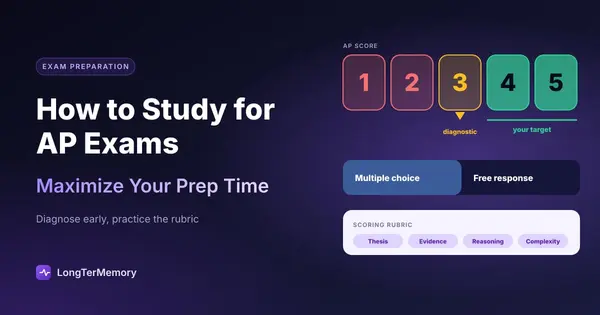
How to Study for AP Exams: Maximizing Your Prep Time
A focused system for AP exam prep: how to read the exam format, use practice tests as diagnostics, and build a study timeline that produces 4s and 5s.
Table of Contents
- Understanding the AP Exam Format for Your Specific Subject
- Know Your Score Breakdown Cold
- Read the Actual Scoring Rubrics
- Using AP Practice Tests as Diagnostic and Study Tools
- Front-Load One Practice Test, Early
- Turn Every Wrong Answer Into a Study Target
- Space Your Practice Tests, Don't Cram Them
- The Review Timeline That Consistently Produces 4s and 5s
- Managing Multiple AP Exams at Once
- Common Mistakes That Cost Students a Point Level
- The Bottom Line
If you are taking multiple AP exams in the same May, you already know the core problem: there is not enough time to give every class the deep, leisurely review it deserves. You are juggling five or six subjects, each with its own content, its own exam format, its own quirks, and the exams are all clustered into roughly two weeks. Generic study advice (“just review more”) does not solve a scheduling problem like this.
What actually solves it is being ruthlessly strategic about where your prep time goes, understanding exactly what each exam format rewards, and using practice tests as a diagnostic tool rather than a confidence check you do once at the end. Let’s build that system.
Understanding the AP Exam Format for Your Specific Subject
Here is something that trips up a lot of students: they assume all AP exams are structured similarly, so they prep the same way for AP Biology as they do for AP US History. That is a mistake, because the format differences directly determine what kind of studying pays off.
Know Your Score Breakdown Cold
Every AP exam splits its score between multiple-choice and free-response sections, but the ratio varies significantly by subject, and so does the weighting within those sections.
| Exam type | Typical structure | What it rewards |
|---|---|---|
| STEM exams (Bio, Chem, Physics) | MCQ + free-response problems | Content mastery + calculation accuracy under time pressure |
| History exams (US, World, Euro) | MCQ + DBQ + long essay + short answer | Argument construction using evidence, not just fact recall |
| Language exams (Spanish, French) | Listening, reading, writing, speaking | Fluency and real-time production, not passive recognition |
| English exams (Lang, Lit) | MCQ + timed essays | Close reading and structured argumentation under time pressure |
If you do not know exactly how your specific exam is weighted, you are essentially studying blind. A student who spends 80% of their AP US History prep time memorizing dates and 20% practicing DBQ writing has the ratio almost exactly backwards, because the essays carry the majority of the score and reward argument quality far more than isolated fact recall.
Read the Actual Scoring Rubrics
This sounds tedious, but it is one of the highest-leverage things you can do, especially for free-response and essay-based exams. College Board publishes real rubrics and sample responses with scorer commentary for past exams. Reading a handful of these will teach you, faster than almost anything else, exactly what separates a 5-scoring response from a 3-scoring response on your specific exam. Often the gap is not “knowing more facts,” it is structural: did you address the prompt directly, did you use specific evidence, did you address complexity or counterargument where required.
Using AP Practice Tests as Diagnostic and Study Tools
Most students treat practice tests as a final check, something you do once, close to the exam, to see how ready you are. That is a huge waste of what practice tests can actually do for you.
Front-Load One Practice Test, Early
Take a full, timed practice test for each subject early in your prep window, even if you feel underprepared. This feels counterintuitive, nobody likes doing badly on purpose, but the diagnostic value is enormous. It tells you, with real specificity, which content areas and which question types are actually costing you points, rather than which ones you feel shaky on. Those two things are frequently different, and gut feeling is a surprisingly unreliable guide to where your actual weaknesses are.
Turn Every Wrong Answer Into a Study Target
After a practice test, do not just check your score and move on. Go through every missed question and sort your mistakes into categories: content gaps (you didn’t know the material), reasoning errors (you knew the material but applied it wrong), and format errors (you understood the content but misread the question or ran out of time). Each category needs a different fix. Content gaps mean you need more review. Reasoning errors mean you need more practice applying concepts, not more passive re-reading. Format errors mean you need more timed practice, not more content study at all.
This kind of granular error analysis, repeated across two or three practice tests per subject, is dramatically more useful than taking five practice tests and reviewing none of them carefully.
Space Your Practice Tests, Don’t Cram Them
Spread your practice tests out rather than doing them back to back in the final week. A test three weeks out, a second one two weeks out, and a final one about a week before the real exam gives you time to actually act on what each one reveals. A practice test taken two days before the real exam has almost no time left to influence your prep, it just becomes a stressful confidence check.
The Review Timeline That Consistently Produces 4s and 5s
Students who consistently score well on multiple AP exams tend to follow a fairly predictable structure, even across very different subjects. Here is a general timeline you can adapt.
8 to 6 weeks out: Finish content review for anything you haven’t fully covered in class. Take your first diagnostic practice test per subject. Identify your two or three weakest content areas per exam.
6 to 3 weeks out: This is your heaviest active-recall phase. Convert weak-area content into practice questions, flashcards, or essay outlines rather than re-reading notes. For essay-based exams, practice writing timed responses to real past prompts, not just outlining them. For a complete system, see our guide on how to study for an essay exam. Take a second practice test per subject around the 3 to 4 week mark.
3 to 1 week out: Shift toward interleaved practice, mixing question types and topics rather than studying one unit at a time, since the real exam will mix everything together too. Take your final full practice test with about a week left, so you have time to shore up any last gaps it reveals.
Final week: Light review only. Revisit your weakest flashcards or notes, redo a handful of practice free-response questions, but avoid trying to learn large amounts of new content this late. Sleep and stress management matter more in this window than additional cramming does.
Managing Multiple AP Exams at Once
If you are juggling several exams, the biggest efficiency gain comes from staggering your subjects rather than rotating evenly through all of them every day. Give each subject a dedicated block of several consecutive days for its heaviest review phase, rather than splitting every study session evenly across five subjects. Constant context-switching between very different content, say, organic chemistry mechanisms and DBQ argument structure, in the same session is cognitively expensive and tends to produce shallower learning than a more focused block would.
A simple weekly structure that works well for multiple exams: assign each subject two or three dedicated days per week rather than a little bit of everything every day, and use spaced repetition for the memorization-heavy content (vocabulary, formulas, dates, definitions) so that it stays fresh in the background without needing a dedicated re-study session for it later. Feeding your flashcard-style content into a spaced repetition system like LongTerMemory means the dates, vocabulary, and formulas you covered six weeks ago are still being surfaced for review right when you would otherwise start forgetting them, instead of needing an entire cram session to relearn material you technically already studied once.
Common Mistakes That Cost Students a Point Level
A few patterns show up again and again in students who study hard but underperform their preparation:
Over-studying the subject you already like and under-studying the one you’re avoiding. It is human nature to gravitate toward the material that feels comfortable. The subject you are avoiding is almost always the one costing you the most points.
Treating free-response practice as optional. Multiple-choice practice feels more comfortable because it is self-checking and low-stakes. Essay and free-response practice feels harder and more exposing, which is exactly why it tends to get skipped, and exactly why skipping it is expensive given how much of the score it usually represents.
Not reviewing scoring guidelines. Students frequently lose points not because they don’t know the content, but because they don’t know what the graders are specifically looking for in terms of structure and evidence use.
The Bottom Line
AP exam prep rewards precision more than raw hours. Understand exactly how your specific exam is scored, use practice tests early and often as a diagnostic rather than a one-time gut check, and build a timeline that front-loads content review and tapers into active, timed practice as the exam approaches.
Do that consistently across your subjects, staying honest about which ones actually need the most attention, and the score you walk away with in July will reflect the quality of your preparation, not just the quantity of hours you put in.