How to Study for an Essay Exam: Complete Guide
Learn how to study for an essay exam with argument templates, timed practice, and prediction strategies that actually work.
Table of Contents
- Why Essay Exams Are Different (And Why Most Study Strategies Fail Them)
- Building Argument Templates for Common Essay Question Types
- For Humanities and Social Sciences
- For Law and Legal Studies
- For History
- For Science and Engineering
- How to Practice Essay Writing Under Timed Conditions
- The Power of Timed Practice
- Focused Structural Drills
- Simulate the Full Exam Environment
- Using Past Essay Questions to Predict and Prepare
- Reason 1: Understanding What the Exam Actually Tests
- Reason 2: Practicing With Authentic Material
- Common Essay Exam Mistakes and How to Avoid Them
- Not Planning Before Writing
- Answering the Question You Wish They'd Asked
- Using Knowledge as a Substitute for Argument
- Writing Too Much Introduction and Conclusion
- Ignoring Counterarguments in Analytical Essays
- How to Study for an Essay Exam: Your Complete Study Plan
- AI Tools and Essay Exam Preparation
- How to Study for an Essay Exam FAQ
- What is the best way to study for an essay exam?
- How far in advance should you start studying for an essay exam?
- Is re-reading notes effective for essay exams?
- The Bottom Line
Multiple-choice exams have an answer somewhere on the page. Essay exams don’t. You have to supply the whole thing: the structure, the argument, the evidence, the conclusion, all of it, under time pressure, from memory. That’s a fundamentally different skill, and studying for it requires a fundamentally different approach.
Most students treat essay exams like they’d treat any other exam: read the material more, review their notes, maybe write a few practice answers the night before. That works if you’re lucky. But luck isn’t a strategy, and essay exams reward something specific that passive review almost never builds: the ability to construct a coherent, evidence-supported argument on demand. If you want to know how to study for an essay exam effectively, you need to build that skill deliberately.
This guide covers exactly how to study for an essay exam: how to build argument templates before the exam, how to practice under conditions that mirror the real thing, and how to use past questions to predict what’s coming.
Why Essay Exams Are Different (And Why Most Study Strategies Fail Them)
Before getting into tactics, it helps to understand what essay exams are actually testing.
A multiple-choice exam tests recognition and recall. You need to know the right answer and identify it among distractors. It’s fundamentally a memory task, which is why retrieval practice and spaced repetition work so well for it.
An essay exam tests synthesis and argumentation. You need to:
- Understand the question being asked
- Recall relevant content from across the course
- Select the most relevant material for this specific question
- Organize it into a coherent structure
- Write clearly and persuasively under time pressure
- Reach a supported conclusion
Steps 3 through 6 require more than memory. They require practice with the act of constructing and communicating arguments. You can know your subject deeply and still write a weak essay under exam conditions if you’ve never practiced the production process itself.
This is why students who study hard for essay exams and still underperform are often doing everything right for the wrong test format. They’re building knowledge. They’re not building the skill of deploying knowledge in essay form.
Building Argument Templates for Common Essay Question Types
The most efficient preparation strategy for essay exams is building reusable argument templates before the exam, so that during the exam you’re filling in content rather than inventing structure from scratch.
Different essay disciplines have recurring question types. Once you recognize them, you can pre-build frameworks.
For Humanities and Social Sciences
Common question types include:
- “Discuss” or “Analyze”: Requires you to examine an idea from multiple angles and reach a reasoned position.
- “Compare and contrast”: Requires you to identify similarities and differences and draw conclusions from them.
- “To what extent”: Requires a nuanced position on a spectrum, not a binary yes/no.
- “Account for” or “Explain why”: Requires causal reasoning.
A general template for analytical essays:
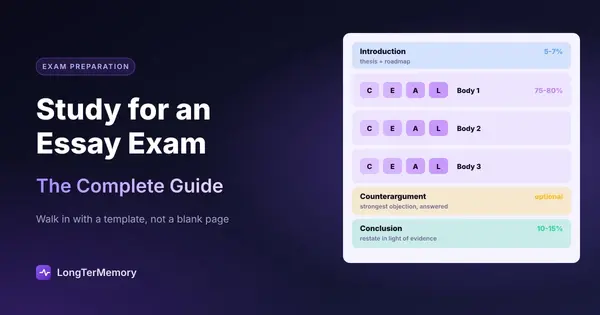
Introduction (5-7% of word count): Restate the question in your own terms. Signal your main argument (thesis). Briefly preview the structure.
Body paragraphs (75-80%): Each paragraph = one supporting point. Structure: Claim, Evidence, Analysis, Link back to argument. Minimum 2, usually 3-4 paragraphs.
Counterargument paragraph (optional but strong): Acknowledge the strongest objection to your thesis. Explain why your argument holds despite it.
Conclusion (10-15%): Restate argument in light of evidence. Avoid introducing new points.
This template works for almost any analytical essay question. Knowing it going in means you never stare at a blank page. You just start filling in content.
For Law and Legal Studies
Law essays typically require IRAC structure:
- Issue: What legal question is being raised?
- Rule: What is the applicable law or precedent?
- Application: How does the law apply to the specific facts?
- Conclusion: What is the likely legal outcome?
Build a template around each major area of law in your course. For contract law: what’s the issue type (formation, breach, remedies)? What rules apply? What’s the analysis pattern? Practice applying these to hypothetical fact patterns before the exam.
For History
History essays often ask you to evaluate causation, significance, or change over time. A useful template:
- Claim: State your historical argument clearly in the introduction.
- Factor analysis: Examine each significant cause or factor, one per paragraph, with specific evidence.
- Relative weighting: Explain which factors were most significant and why.
- Historiography (where required): Acknowledge how historians have interpreted this differently.
- Conclusion: Return to your claim and affirm it in light of the evidence examined.
The key discipline for history essays is avoiding narrative (just retelling what happened) in favor of analysis (explaining why it happened and what it meant).
For Science and Engineering
In subjects where essays appear alongside problem sets, they usually ask you to explain mechanisms, evaluate methodologies, or discuss implications. Templates here are less structural and more conceptual: know the standard vocabulary for your field, know how to distinguish between types of processes or phenomena, and practice explaining technical content in prose rather than in equations.
How to Practice Essay Writing Under Timed Conditions
Knowing structure is necessary but not sufficient. You also need to practice the physical and cognitive experience of writing under time pressure. This is where most students underinvest.
The Power of Timed Practice
Writing a practice essay without a timer is significantly easier than writing one with a timer. Under time pressure, your planning has to be faster, your decisions about what to include have to be more decisive, and your writing has to be more direct. If you’ve never practiced under realistic time conditions, the exam itself becomes the first time you’ve done it, which is a poor strategy.
How to set up timed practice:
- Pick a past question from your subject
- Set a timer for the actual exam time (or a proportional slice if it’s one question among several)
- Write the essay from start to finish without pausing to research
- Review what you wrote against your notes after
This process is uncomfortable, especially early on. Your first timed essay will likely be worse than a relaxed draft. That’s normal, and it’s also the point. The gap between your relaxed performance and your timed performance is exactly what practice is meant to close.
Focused Structural Drills
You don’t always have to write full essays to practice. Isolated drills on specific essay skills are often more efficient:
Introduction drills: Take 5 past questions. Write just an introduction (thesis + structure preview) for each, aiming for under 3 minutes each. Review: is your thesis arguable? Does it directly address the question?
Outline drills: Take a question and spend 5 minutes building a complete outline: main argument, 3 body paragraph claims, evidence for each, counterargument. Practice doing this quickly. An exam outline doesn’t need to be beautiful. It needs to exist before you start writing.
Topic sentence drills: Write topic sentences for 10 hypothetical essay body paragraphs. A good topic sentence states the paragraph’s claim clearly and connects it to the essay’s main argument. This is harder than it sounds.
Conclusion drills: Practice writing conclusions for prompts you haven’t fully answered. A strong conclusion synthesizes rather than just summarizing. It adds weight to the argument, not just repetition.
Simulate the Full Exam Environment
At least once before your exam, simulate the complete experience: no notes, no research, timed, under realistic conditions. If you can, do this in a library or quiet space that feels different from your comfortable study environment.
The exam is not a performance of what you know. It’s an experience of demonstrating what you know under pressure. Practicing the experience, not just the content, is what builds genuine readiness.
Using Past Essay Questions to Predict and Prepare
One of the highest-leverage activities you can do before an essay exam is working systematically through past papers.
Past questions are valuable for two distinct reasons that most students confuse.
Reason 1: Understanding What the Exam Actually Tests
Reading past questions tells you what your examiner values. Look for patterns:
- What topics appear most frequently?
- What question types appear most often (compare, evaluate, analyze)?
- Are there topics that have never appeared in past papers?
- Are there themes that appear in almost every paper?
Once you know the pattern, you can allocate your study time accordingly. Spending equal time on all topics regardless of exam weighting is inefficient. The topic that’s appeared in 8 of the last 10 papers deserves more preparation than the one that’s appeared once.
Reason 2: Practicing With Authentic Material
Past questions are also the best raw material for practice. They’re written in the actual style and language of your examiner, they test at the right level of difficulty, and comparing your practice answers to model answers (if available) gives you direct feedback on where your essay skills need work.
A systematic approach:
- Collect 5-10 years of past papers for your subject
- Identify the 5-6 most common question themes
- Build an argument template for each theme (see above)
- Write at least one timed practice essay per major theme
- Compare to model answers or ask your tutor to review
This is preparation, not prediction. You’re not trying to guess the exact question. You’re building deep familiarity with the intellectual terrain your essay exam will cover, so that whatever question appears, you have the content and the structure to respond.
Common Essay Exam Mistakes and How to Avoid Them
Not Planning Before Writing
Students who skip the outline and start writing immediately often produce structurally chaotic essays. Even in a timed exam, spend 5-10% of your time planning. A 90-minute exam deserves at least 8 minutes of planning. The essay you write with a plan will almost always be better than one without.
Answering the Question You Wish They’d Asked
This is the most common examiner complaint: essays that are clearly prepared but that don’t engage with the actual question asked. Read the question at least twice. Underline the key instruction word (analyze, evaluate, compare) and the topic focus. Let both shape your response. A brilliant essay that answers a slightly different question scores poorly.
Using Knowledge as a Substitute for Argument
Demonstrating that you know a lot of facts is not the same as making an argument. Essays require a thesis, a claim your evidence supports. “During the French Revolution many things changed” is not a thesis. “The French Revolution fundamentally transformed the relationship between state and citizen by replacing inherited obligation with civic contract” is a thesis.
Every paragraph should be in service of your thesis, not just adding more information to the pile.
Writing Too Much Introduction and Conclusion
A common mistake, especially under anxiety, is spending too long introducing and concluding and not enough time developing the actual argument. Aim for the ratios in your template: roughly 80% of word count in the body paragraphs where your argument is actually built.
Ignoring Counterarguments in Analytical Essays
The strongest essays acknowledge complexity. If you argue that a particular policy was effective, a strong essay will briefly acknowledge the evidence against that view and explain why your conclusion holds despite it. Examiners consistently reward intellectual honesty over one-dimensional advocacy.
How to Study for an Essay Exam: Your Complete Study Plan
Here’s how to structure your preparation in the weeks before an essay-based exam:
4+ weeks out:
- Read actively, making notes organized by essay theme (not just by chapter)
- Identify the major argument types your subject requires
- Build argument templates for the 4-5 most likely question themes
2-3 weeks out:
- Practice introductions and outlines for past questions
- Identify your content gaps and fill them through targeted reading
- Create and review flashcards for key facts, names, dates, and theories that essays frequently reference
1 week out:
- Write at least 2 full timed practice essays
- Review model answers or past tutor feedback
- Consolidate your templates: write them out one more time from memory
Day before:
- Review your templates and key content notes
- Do not try to cram new information at this stage
- Sleep well, this is more important than late-night review for essay exams
Day of:
- Read each question twice before writing anything
- Plan before you write
- Watch your time allocation across questions if it’s a multi-essay exam
AI Tools and Essay Exam Preparation
AI tools like LongTerMemory are particularly useful for essay exam preparation in one specific way: they can generate practice questions from your course materials, which helps you practice answering unexpected questions on familiar content.
The weakness of practicing only past questions is that you can over-fit to those specific prompts. Practicing with AI-generated questions from the same content base exposes you to phrasing and angles you wouldn’t have thought to prepare for, which is closer to what you’ll face in a real exam where the exact wording is always slightly different from what you’ve seen before.
Use AI-generated questions alongside past papers, not as a replacement for them.
How to Study for an Essay Exam FAQ
What is the best way to study for an essay exam?
The best way is to build argument templates for common question types, practice writing full answers under timed conditions, and use past papers to predict what will be asked. Passive review alone is not enough.
How far in advance should you start studying for an essay exam?
Ideally four weeks or more. The first two weeks should focus on building templates and content knowledge. The final two weeks should prioritize timed practice and past-question analysis.
Is re-reading notes effective for essay exams?
No. Essay exams test synthesis and argumentation, not just recall. Timed practice writing and outlining are far more effective than re-reading.
The Bottom Line
Learning how to study for an essay exam means recognizing that it tests a skill: the ability to build and communicate an argument under pressure. That skill is developed through practice, not just through knowledge accumulation.
The three pillars of effective essay exam preparation are:
- Argument templates: Know the structural patterns before the exam so you’re filling in content, not inventing form.
- Timed practice: Write under real conditions before the real exam, so the conditions themselves aren’t a surprise.
- Past question analysis: Understand what gets asked, what gets rewarded, and what your examiner values.
Build these three things, and you walk into the exam room with something more than knowledge. You walk in with a system for deploying that knowledge under pressure. That’s what the essay exam is actually asking for, and that’s exactly what your preparation should produce.