How to Prepare for the AWS Database Specialty Exam
A complete study guide for the AWS Database Specialty (DBS-C01) exam: what it tests, key services to master, and practice question strategies that work.
Table of Contents
- What the Database Specialty Exam Tests Across RDS, DynamoDB, and Migration
- The Exam Structure at a Glance
- What RDS Knowledge the Exam Expects
- DynamoDB Depth You'll Need
- Migration Scenarios
- Key AWS Database Services and Use Case Scenarios to Understand Deeply
- The Service Selection Matrix
- ElastiCache: Redis vs. Memcached
- Aurora Serverless v2 Scenarios
- Redshift and the Data Warehouse Scenarios
- Practice Question Strategy and Lab Readiness for Database Specialty
- How to Use Practice Questions Effectively
- The Role of Hands-On Lab Experience
- Building Your Study System
- Recommended Study Timeline
- Final Thoughts
If you’re targeting the AWS Database Specialty certification, you already know this isn’t a beginner-level exam. The AWS Certified Database, Specialty (DBS-C01) is one of the harder specialty certifications Amazon offers, and it rewards people who’ve actually worked with AWS database services in production, not just people who’ve read the documentation.
That said, with the right preparation strategy you don’t need years of AWS experience to pass it. You need to understand how the services work, when to use which one, and how AWS frames database architecture questions in exam scenarios. This guide gives you the map.
What the Database Specialty Exam Tests Across RDS, DynamoDB, and Migration
The Exam Structure at a Glance
The DBS-C01 exam consists of 65 questions (scored) across a 3-hour window, with a passing score of 750 out of 1000. Questions are scenario-based: AWS gives you a situation, a set of constraints, and asks you to identify the most appropriate solution.
The content is organized across six domains:
| Domain | Approximate Weighting |
|---|---|
| Workload-Specific Database Design | 26% |
| Deployment and Migration | 20% |
| Management and Operations | 18% |
| Monitoring and Troubleshooting | 14% |
| Database Security | 12% |
| Designing for High Availability and Fault Tolerance | 10% |
Workload-Specific Database Design is the largest and most concept-heavy domain. It covers when to use relational vs. non-relational databases, the right engine for specific access patterns, and how to architect database solutions that meet latency, throughput, and cost requirements.
Deployment and Migration focuses on getting databases into AWS, moving between database engines, and using services like AWS Database Migration Service (DMS) and Schema Conversion Tool (SCT).
Security covers encryption at rest and in transit, IAM policies for database access, VPC configurations, and audit logging.
What RDS Knowledge the Exam Expects
Amazon RDS is the bread-and-butter managed relational database service, and it’s tested extensively. You need to understand:
- Multi-AZ vs. Read Replicas: these serve very different purposes. Multi-AZ is for high availability and automatic failover. Read Replicas are for read scaling and cross-region replication. Confusing these on an exam scenario is a common error.
- RDS Proxy: reduces connection overhead for Lambda functions and high-connection workloads. Know when it’s appropriate and what it solves.
- Aurora vs. standard RDS engines: Aurora is AWS’s proprietary MySQL and PostgreSQL-compatible engine with higher performance and built-in replication across 3 AZs. Aurora Serverless v2 is frequently tested for variable workload scenarios.
- Backup and restore: understand automated backups, manual snapshots, point-in-time recovery (PITR), and the difference between backup retention windows.
- Parameter groups and option groups: how to tune engine configuration at scale.
- Performance Insights: what it reveals, how to interpret wait events, and when to use it over CloudWatch metrics.
DynamoDB Depth You’ll Need
DynamoDB is tested heavily, and this is where many candidates underestimate the complexity. Surface-level knowledge of “it’s a NoSQL key-value store” won’t get you through the scenario questions.
Focus on:
- Partition key design: understanding how to design partition keys that distribute load evenly, avoid hot partitions, and support your access patterns. The exam will present you with access pattern requirements and ask which key design is optimal.
- Global Secondary Indexes (GSI) vs. Local Secondary Indexes (LSI): when each is appropriate, their limitations (LSIs must be defined at table creation), and the trade-offs between them.
- DynamoDB Streams: what events they capture, ordering guarantees, and how they integrate with Lambda for event-driven processing.
- DAX (DynamoDB Accelerator): the in-memory caching layer, when it’s appropriate, and what it doesn’t help with (write-heavy workloads).
- Read and write capacity modes: on-demand vs. provisioned, when to use each, and auto-scaling behavior.
- Global Tables: multi-region, multi-active replication, and the eventual consistency model.
Migration Scenarios
DMS and SCT appear frequently in scenario questions. Understand the high-level flow:
- SCT handles schema conversion when migrating between incompatible engines (e.g., Oracle to PostgreSQL)
- DMS handles the actual data migration and can run continuous replication for minimal-downtime cutover
- Homogeneous migrations (same engine family) can sometimes skip SCT
- Know the differences between full load, change data capture (CDC), and full load plus CDC migration types
Key AWS Database Services and Use Case Scenarios to Understand Deeply
The biggest differentiator between candidates who pass and those who fail the DBS-C01 is the ability to select the right database service for a given scenario. AWS offers a wide portfolio, and the exam tests whether you know which service fits which workload.
The Service Selection Matrix
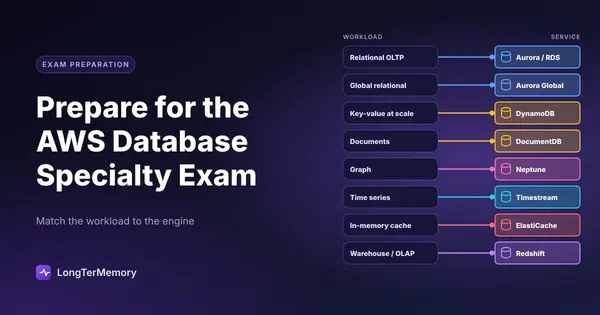
Here’s a simplified decision framework:
| Use Case | Primary Service |
|---|---|
| Relational OLTP workload | Aurora or RDS MySQL/PostgreSQL |
| Global relational, low-latency | Aurora Global Database |
| Key-value at scale | DynamoDB |
| Document storage | DynamoDB or DocumentDB |
| Graph relationships | Neptune |
| Time-series data | Timestream |
| In-memory caching | ElastiCache (Redis or Memcached) |
| Data warehousing / OLAP | Redshift |
| Full-text search | OpenSearch Service |
| Ledger / immutable audit | QLDB |
The exam will present scenarios with specific requirements, performance targets, and constraints, and ask you to pick the right service or combination of services. The decision isn’t always obvious, so understanding the trade-offs between options is more important than memorizing which service does what.
ElastiCache: Redis vs. Memcached
This is a commonly tested distinction. Redis supports more data structures (strings, hashes, sorted sets, etc.), persistence, replication, and clustering. It’s appropriate for session management, leaderboards, pub/sub messaging, and any use case requiring persistence or replication.
Memcached is simpler, multi-threaded, and scales horizontally well. It’s appropriate for high-throughput, simple caching use cases where you don’t need persistence or complex data structures.
Most modern use cases prefer Redis. The exam will test your ability to choose Redis when the scenario requires persistence, replication, or complex data types.
Aurora Serverless v2 Scenarios
Aurora Serverless v2 scales ACUs (Aurora Capacity Units) up and down in fine-grained increments based on load. Know that it’s appropriate for:
- Variable or unpredictable workloads
- Development and test environments
- Infrequently accessed applications
It’s not optimal for constant, steady high-throughput workloads where provisioned Aurora would be more cost-effective.
Redshift and the Data Warehouse Scenarios
Redshift questions typically involve distinguishing OLTP from OLAP workloads. When a scenario mentions reporting, analytics, aggregation over large historical datasets, or BI tool integration, Redshift is usually the right answer.
Know about Redshift Spectrum for querying data directly in S3, RA3 nodes for separating compute from storage, and Redshift Serverless for on-demand analytics capacity.
Practice Question Strategy and Lab Readiness for Database Specialty
How to Use Practice Questions Effectively
Practice exams are essential for DBS-C01, but only if you use them right. Don’t just grind through questions and check whether you got them right. Analyze every wrong answer to understand exactly why it was wrong and why the correct answer was right.
AWS exam questions often have two or three answers that seem plausible at first glance. The correct answer usually satisfies all the constraints in the scenario, while the wrong answers satisfy most of them but fail on one specific requirement. Learning to identify which constraint eliminates which answer is a core test-taking skill for AWS specialty exams.
Recommended approach:
- Do a full-length practice exam under timed conditions
- After completing it, review every wrong answer before looking at explanations
- For each wrong answer, write out why you chose it and why it was incorrect
- For each correct answer you got by elimination or guessing, understand the full reasoning
- Flag the service or concept area for deeper study
Useful practice sources include the official AWS sample questions, Tutorials Dojo (Jon Bonso’s practice exams are widely regarded as the closest to actual exam difficulty), and Neal Davis’s courses on Udemy.
The Role of Hands-On Lab Experience
The DBS-C01 is significantly harder to pass from documentation alone than from hands-on experience. If you haven’t worked with many of these services in a real AWS environment, set up a free-tier or personal account and build things.
Essential hands-on practice:
- Create an RDS instance, enable Multi-AZ, and simulate a failover
- Create a DynamoDB table with a composite key, add a GSI, and run some queries
- Configure DMS to replicate data between two test databases
- Set up an ElastiCache Redis cluster and connect to it from an EC2 instance
- Enable encryption at rest and in transit on an RDS instance and verify the configuration
These don’t need to be production-scale exercises. The goal is to make the console workflows and service behaviors feel familiar rather than abstract.
Building Your Study System
Given the breadth of the DBS-C01 content, this exam rewards a systematic approach to content retention. The key concepts, service comparisons, and scenario patterns are ideal for active recall flashcards.
Rather than re-reading service documentation passively, convert what you learn into question-and-answer pairs:
- “What is the difference between RDS Multi-AZ and Read Replicas?”
- “When should you use DynamoDB DAX vs. ElastiCache?”
- “What happens to DynamoDB requests that exceed provisioned throughput?”
- “Which migration strategy is appropriate for Oracle to Aurora PostgreSQL with minimal downtime?”
Tools like LongTerMemory let you upload your study notes and automatically generate these Q&A pairs, then schedule them for spaced review. For an exam with this much content, having an automated review system is genuinely valuable, because the service comparisons and scenario patterns you need to know are exactly the type of detail that fades without regular reinforcement.
Recommended Study Timeline
For candidates with 1 to 2 years of AWS experience and some database background:
| Week | Focus |
|---|---|
| 1-2 | RDS, Aurora, and relational fundamentals |
| 3-4 | DynamoDB deep dive (access patterns, GSI/LSI, Streams, DAX) |
| 5 | Migration services (DMS, SCT) |
| 6 | ElastiCache, Redshift, Neptune, Timestream, QLDB |
| 7 | Security domain (encryption, IAM, VPC, audit) |
| 8 | Full practice exams + targeted review of weak areas |
For candidates with less AWS experience, add 2 to 4 weeks of foundational AWS study before beginning the above.
Don’t neglect the Security domain. It’s 12% of the exam, which is smaller than the design domains, but the questions are often straightforward if you’ve prepared, and completely unexpected if you haven’t. Encryption at rest and in transit, IAM database authentication, VPC security groups, and CloudTrail auditing are all fair game.
Final Thoughts
The AWS Database Specialty certification is a genuine validation of database architecture expertise on AWS. It’s not a certification you can fake with a weekend of cramming. But with consistent, structured preparation over 6 to 8 weeks, it’s absolutely achievable.
The candidates who pass consistently are those who combine conceptual understanding (when and why to use each service) with scenario practice (recognizing which constraints map to which solution). Hands-on experience accelerates both.
If you’re just starting your prep: prioritize RDS and DynamoDB first, since they have the heaviest exam weighting. Build hands-on familiarity with both. Then work outward through the rest of the service portfolio.
You’ve got this. The exam rewards genuine knowledge of AWS databases, and genuine knowledge is learnable by anyone willing to put in the structured work.