Best Study Methods Ranked by Research Evidence
Not all study methods are equal. See how retrieval practice, spaced repetition, and other techniques rank according to decades of learning science research.
Table of Contents
- High-Utility Methods: Retrieval Practice and Spaced Repetition
- Practice Testing (Retrieval Practice)
- Distributed Practice (Spaced Repetition)
- Moderate-Utility Methods: Elaborative Interrogation and Self-Explanation
- Elaborative Interrogation
- Self-Explanation
- Interleaved Practice
- Low-Utility Methods: Re-Reading and Highlighting Explained
- Highlighting and Underlining
- Re-Reading
- Summarization
- Keyword Mnemonics and Mental Imagery
- What This Means for Your Study Routine
- Why Ineffective Methods Remain So Popular
- The Compound Effect of Getting This Right
Most students have strong opinions about how they study best. Some swear by highlighting. Others re-read chapters multiple times. Some write out summaries. Some make colour-coded notes that look beautiful but somehow don’t translate into exam performance.
Here’s the uncomfortable reality: almost everything most students do when they study is near the bottom of the evidence rankings.
In 2013, a landmark review by cognitive psychologists John Dunlosky and colleagues set out to evaluate 10 of the most commonly used study techniques. They assessed each one on five dimensions: learning conditions, student characteristics, types of material, level of outcome measured, and overall usefulness. The results were published in Psychological Science in the Public Interest and sent a clear message about which techniques work and which ones only feel like they work.
This guide walks through what they found, why it matters, and what it means for how you should actually spend your study time.
High-Utility Methods: Retrieval Practice and Spaced Repetition
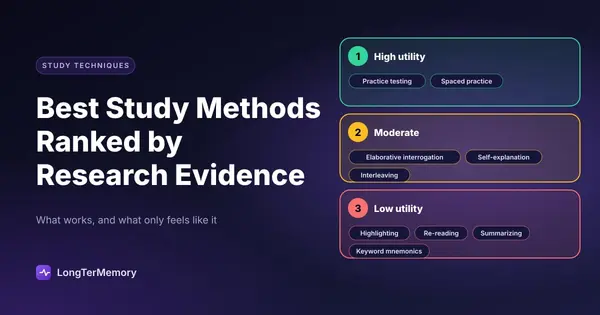
Two techniques received the highest utility ratings in the Dunlosky review. These aren’t niche academic findings. They’re the most robustly supported learning methods in educational psychology, replicated across decades of research, across different ages, subjects, and contexts.
Practice Testing (Retrieval Practice)
Utility rating: HIGH
Practice testing, also called retrieval practice or the testing effect, involves actively retrieving information from memory rather than passively reviewing it. This means answering questions, doing practice problems, covering your notes and trying to reproduce them, or using flashcards where you commit to an answer before checking.
The research on practice testing is remarkably consistent. A meta-analysis by Roediger and Karpicke (2006) found that students who studied by self-testing outperformed students who re-read material by around 50% on delayed tests. Other studies have found similar effects across subjects from biology and chemistry to history and foreign languages.
Why does it work so powerfully? The act of trying to retrieve something from memory, even when you fail, strengthens the memory trace for that information. Each retrieval attempt is a learning event in itself. This is called the generation effect: information you generate from your own memory is retained better than information you passively receive.
The implication: every study session should involve some form of self-testing. Not just after you’ve studied, but woven throughout the session. Read a section, close the book, try to reproduce the key points. Use flashcards with real commitment to your answer before you flip. Write practice exam responses without referring to notes.
The discomfort of not knowing when you try to retrieve something is not a sign that something’s wrong. It’s a sign that actual learning is happening.
Distributed Practice (Spaced Repetition)
Utility rating: HIGH
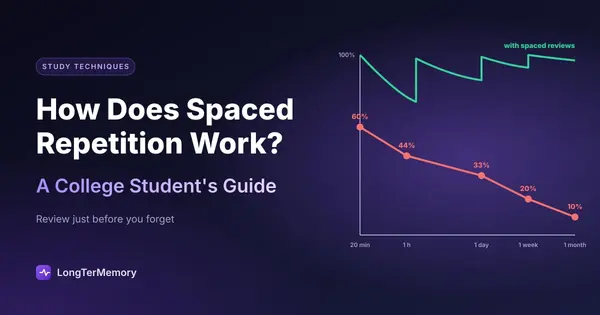
Distributed practice means spreading your study of any given topic over multiple sessions, with gaps between them, rather than massing it all into one block. Spaced repetition is the algorithm-driven version of this: it uses your performance history to schedule each piece of information for review just as you’re about to forget it, which maximizes the memory-strengthening effect of each review.
The spacing effect is one of the oldest and most replicated findings in memory research, going back to Hermann Ebbinghaus in the 1880s. It’s also consistently underused by students, who tend to cram.
Here’s the comparison that makes this concrete:
| Approach | Total Study Hours | Retention After 1 Week |
|---|---|---|
| Massed (all in one session) | 5 hours | ~20-35% |
| Distributed (1 hour/day for 5 days) | 5 hours | ~50-80% |
Same total time. Dramatically different retention.
The reason cramming works for short-term performance (a test tomorrow) is that recently encoded information is still accessible. The reason it fails for long-term retention is that without spaced review, that information decays rapidly. If you need to remember something for more than a week, cramming is genuinely one of the worst strategies available.
Tools like Anki and LongTerMemory implement spaced repetition automatically. You don’t need to manage your review schedule manually. The algorithm tracks when you last reviewed each item and how well you performed, then schedules it again at the optimal interval. The combination of retrieval practice (flashcards) with spaced intervals is the most evidence-based study approach available.
Moderate-Utility Methods: Elaborative Interrogation and Self-Explanation
Three techniques were rated moderate utility: elaborative interrogation, self-explanation, and interleaved practice. These are genuinely effective methods, but with more conditions and limitations than the top two.
Elaborative Interrogation
Utility rating: MODERATE
Elaborative interrogation means asking “why” and “how” about the material you’re studying. Instead of reading that “the liver produces bile,” you stop and ask: “Why does the liver produce bile? What does bile actually do? Why does digestion need emulsification of fats?”
This technique works because it forces you to connect new information to existing knowledge, which creates richer and more retrievable memory traces. It’s particularly effective for factual material in science and medicine, where understanding the mechanism is often as important as knowing the fact.
The limitation: elaborative interrogation works best when you have enough prior knowledge to generate meaningful explanations. If you’re completely new to a topic and you ask “why is mitosis important?”, you might not be able to generate a coherent answer, which limits the technique’s benefit. It tends to work better in mid-to-late stages of learning a topic rather than at the very beginning.
Practical application: after reading a section, pick the three most important facts and ask “why” about each one before moving on. Try to connect each answer to something you already understand.
Self-Explanation
Utility rating: MODERATE
Self-explanation involves talking yourself through material as you study it, explaining it to yourself in your own words. “Okay, so the way this circuit works is… the current goes from… and when the resistance increases, the voltage drop… which means…”
This forces you to monitor your own understanding in real time. When the explanation breaks down, you’ve found a gap. When it flows clearly, you have genuine comprehension rather than the illusion of it.
Self-explanation is closely related to the Feynman Technique: explain a concept as if teaching it to someone with no background in the subject. Where the explanation becomes vague or jargon-heavy, that’s a knowledge gap. Go back and fill it.
The research on self-explanation shows consistent benefits for comprehension and transfer, meaning the ability to apply knowledge to new situations. It’s more cognitively demanding than passive reading but significantly more effective for building usable knowledge.
Interleaved Practice
Utility rating: MODERATE
Interleaving means mixing different topics or problem types within a study session rather than completing all of one topic before moving to the next.
Most students use blocked practice: all calculus problems, then all statistics problems. Interleaved practice would mix them: one calculus problem, one statistics problem, one physics problem, back to calculus.
This feels harder and less efficient. You can’t build momentum within one topic because you keep switching. But research consistently shows that interleaved practice produces better long-term retention and, crucially, better ability to identify which technique to apply when, which is exactly what exams test.
The reason: blocked practice lets you develop a rhythm where you’re essentially doing the same operation repeatedly. Interleaving forces you to make the discrimination, “what kind of problem is this?” every time, which is the harder cognitive work, and the more valuable learning.
Low-Utility Methods: Re-Reading and Highlighting Explained
This is the part that most students find uncomfortable to hear, because these are the techniques most of us were never told to stop using.
Highlighting and Underlining
Utility rating: LOW
Highlighting is everywhere. Students cover textbook pages in fluorescent yellow and feel productive. But the research is pretty unambiguous: highlighting and underlining produce little to no benefit for learning beyond simple reading.
The reason is that the cognitive work required to highlight something is essentially zero. You read a sentence, you decide it seems important, you move the highlighter across it. There’s no retrieval, no generation, no elaboration. The information goes into your working memory briefly and then leaves.
The only way highlighting can help is if you subsequently use your highlights as a basis for self-testing, going back and covering the text and trying to reproduce what you highlighted. At that point, you’re doing retrieval practice, and the highlighting was just a way of selecting material for that practice.
If you want to keep using a highlighter, use it sparingly (highlight no more than 10% of any page) and immediately after, close the book and try to recall what you just highlighted. That transforms a low-utility activity into a moderate-utility one.
Re-Reading
Utility rating: LOW
Re-reading feels productive. Material becomes familiar when you’ve seen it before. Reading it again, that familiarity increases. And familiarity feels like understanding.
But this is the fluency illusion: the feeling that you know material because it’s familiar, when in fact familiarity and retrievability are completely different things. You can recognize text as familiar without being able to produce any of the information it contains from scratch.
This is exactly the experience students have when they’ve re-read their notes five times and then sit down for an exam and go blank. The information was never in a form they could retrieve. It was just recognizable.
The time you would spend re-reading is almost always better spent testing yourself on the same material instead. Read once thoroughly, then switch to practice questions or blank-page recall. That single change, from re-reading to retrieval practice, will outperform multiple re-reads on every measure that matters.
Summarization
Utility rating: LOW to MODERATE
Summarization, writing summaries of what you’ve studied, has mixed evidence. It can be beneficial when students have been trained to identify the most important information and express it concisely. Without that training, students tend to produce summaries that are too close to the original text, essentially just copying with a few words changed.
Where summarization becomes more useful is in extreme compression: taking 30 pages of notes down to one page of key points from memory. That version of summarization is essentially a blank-page recall exercise, which makes it high-utility retrieval practice in disguise.
Keyword Mnemonics and Mental Imagery
Utility rating: LOW to MODERATE depending on content
These techniques work well for specific types of content: foreign language vocabulary, ordered lists, or factual content with arbitrary associations. But they don’t scale well to complex conceptual material and require significant upfront effort to create.
For the material where they work, they can be genuinely effective. For complex subject matter where you need to understand relationships, not just remember associations, they’re usually not worth the setup cost.
What This Means for Your Study Routine
The research picture is actually simpler than it looks once you distill it:
Do more of: Retrieval practice (flashcards done properly, practice questions, blank-page recall, practice tests) and distributed practice (spreading review over time with gaps).
Do less of: Re-reading the same material repeatedly, passive highlighting, summarization that stays close to the source.
Use judiciously: Elaborative interrogation (ask “why”), self-explanation (explain it to yourself), interleaved practice (mix topics).
| Method | Research Rating | Time Efficiency | When to Use |
|---|---|---|---|
| Retrieval practice | HIGH | Very high | Throughout every session |
| Spaced repetition | HIGH | Very high | Ongoing review system |
| Elaborative interrogation | MODERATE | High | Mid-learning for science/medicine |
| Self-explanation | MODERATE | High | When understanding feels fuzzy |
| Interleaved practice | MODERATE | Medium | Problem-solving subjects |
| Summarization | LOW-MOD | Medium | Only if compressing from memory |
| Highlighting | LOW | Low | Avoid as primary method |
| Re-reading | LOW | Very low | Avoid once material is encountered |
Why Ineffective Methods Remain So Popular
If re-reading and highlighting are so ineffective, why do most students default to them?
Two reasons, both rooted in cognitive bias.
First: ineffective methods feel easier, and easier feels better in the moment. Re-reading is cognitively comfortable. Retrieval practice is uncomfortable. That discomfort, the experience of trying to remember and struggling, is actually what learning feels like. But it doesn’t feel like productivity. It feels like confusion.
Second: the feedback loop is broken. If you re-read your notes tonight, you’ll recognize them as familiar tomorrow. You’ll tell yourself “I know this.” The test that reveals you don’t come much later. By then, the connection between your ineffective study method and your poor performance is hard to make.
With retrieval practice, the feedback is immediate: you either produced the answer or you didn’t. It’s uncomfortable and humbling, but it tells you the truth about what you actually know.
The Compound Effect of Getting This Right
The good news in all of this: shifting your study habits toward high-utility methods doesn’t require more time. It usually requires less.
Students who consistently use retrieval practice and spaced repetition typically study fewer total hours than students who re-read extensively, while retaining significantly more. The method is just more efficient.
If you’re still building your system, start small. After your next study session, spend ten minutes testing yourself on what you just covered instead of re-reading it. Notice how different that feels from re-reading. Notice how much you didn’t know. And then go back and review what you missed.
That single shift, from review to retrieval, is where most of the gains are hiding.