How Does Spaced Repetition Work? A College Student's Guide
How does spaced repetition work? Learn the science, the review schedule, and the best tools to retain more and ditch cramming in college.
Table of Contents
- How Does Spaced Repetition Work? The Short Answer
- Why Cramming Fails (And What the Science Actually Says About Memory)
- The Forgetting Curve Is Real and It's Brutal
- Why Your Brain Treats a Cram Session as Low Priority
- The Spacing Effect: The Finding That Changed Everything
- How to Schedule Review Sessions for Maximum Long-Term Retention
- The Core Principle: Review Just Before You Forget
- How to Apply This to a Real Exam Calendar
- The Power of Small, Daily Review Sessions
- Dealing With Large Amounts of Material
- Digital Tools vs. Traditional Methods: Making the Right Choice for Your Learning Style
- Traditional Methods: Paper Flashcards and Review Sheets
- Anki: The Gold Standard (With a Learning Curve)
- Quizlet: Easy to Use, Imperfect Spaced Repetition
- AI-Powered Tools: The New Generation
- Building Your Spaced Repetition Practice From Scratch
- Day 1: Build Your First Question Set
- Days 2–3: First Review Pass
- Day 4 Onward: The Compound Effect Begins
- The Things Nobody Tells You About Spaced Repetition
- It Feels Harder Than Cramming (At First)
- You Don't Need to Memorize Everything
- Review Quality Beats Review Quantity
- FAQ: How Does Spaced Repetition Work?
- How does spaced repetition work in simple terms?
- How long does it take for spaced repetition to work?
- Is spaced repetition better than cramming?
- Do you need an app to use spaced repetition?
- The Bottom Line
You’ve been there. Exam in two days, textbook open, highlighter in hand, reading the same paragraph for the third time. It feels like studying. Your notes are color-coded. Your desk looks productive. And yet, when you walk out of that exam, half of what you “learned” has already evaporated.
That’s not bad luck. That’s not a memory problem. That’s just what happens when you study the wrong way.
The good news? There’s a technique that’s been sitting in the cognitive science literature for over 140 years , proven, tested, replicated across thousands of studies , that makes the way most college students study look almost comically inefficient. It’s called spaced repetition, and once you actually understand how it works, you’ll never look at a late-night cram session the same way again.
This guide breaks down everything: the science, the scheduling, and the tools. By the end, you’ll have a concrete plan you can start using this week.
How Does Spaced Repetition Work? The Short Answer
Spaced repetition works by scheduling each review just as you are about to forget something. You study a fact, test yourself on it a day later, then a few days later, then a week or more later. Each successful recall strengthens the memory and pushes the next review further out, so you spend less time per fact while remembering it for longer. The rest of this guide explains the science behind that, how to build a review schedule, and which tools make it easy.
Why Cramming Fails (And What the Science Actually Says About Memory)
Let’s start with the uncomfortable truth nobody tells you at orientation.
The Forgetting Curve Is Real and It’s Brutal
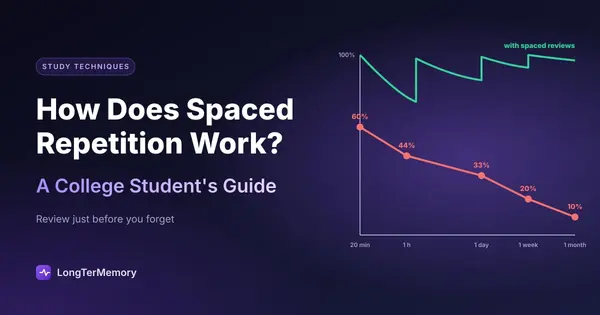
In the 1880s, a German psychologist named Hermann Ebbinghaus did something obsessive and scientifically valuable: he spent years memorizing thousands of meaningless syllable combinations, then tracked exactly how quickly he forgot them. What he found became one of the most replicated findings in all of learning science , the forgetting curve.
Here’s what it looks like in practice:
| Time after a single study session | Approximate retention |
|---|---|
| 20 minutes | ~60% |
| 1 hour | ~44% |
| 1 day | ~33% |
| 1 week | ~20% |
| 1 month | ~10% |
That’s not pessimism , that’s the baseline human memory architecture operating as designed. Your brain isn’t broken. It’s just ruthlessly efficient at discarding information it doesn’t think you’ll need again.
And cramming , studying everything in one marathon session the night before , is almost perfectly designed to exploit the worst properties of this curve. You load information in, it feels present and accessible when you go to sleep, and then it drains away before the test even starts.
Why Your Brain Treats a Cram Session as Low Priority
Here’s the thing your brain is doing that you’re not aware of. When you encounter a piece of information once , even if you study it for three hours straight , your brain essentially files it as a single event. Something you needed once. Not necessarily something worth keeping.
But when you encounter the same information repeatedly over time, with gaps in between, your brain starts to read that differently. It registers: this keeps coming back up, it must be relevant, I should hold on to this. That’s the biological signal that tells your neurons to strengthen the connections between them , a process called long-term potentiation.
Cramming bypasses this signal entirely. You’re essentially telling your brain the same thing once, very loudly, instead of the same thing multiple times at the right moments.
The Spacing Effect: The Finding That Changed Everything
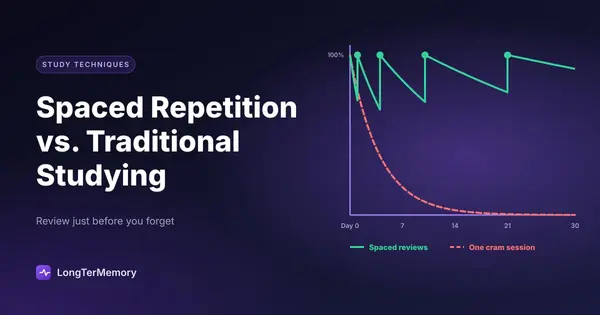
Ebbinghaus also found the solution in his own data. When he reviewed material at spaced intervals , a bit today, more tomorrow, a review next week , the forgetting curve for each subsequent review got dramatically shallower. The memory became more durable. More resistant to decay.
This is the spacing effect, and it’s about as well-established as findings get in cognitive psychology. A 2013 meta-analysis covering 254 studies found that spaced practice outperforms massed practice (cramming) across virtually every subject, age group, and type of material tested.
The mechanism is elegant: every time you retrieve a memory that’s just started to fade , not so fresh you barely have to try, not so faded it’s completely gone , you rebuild it slightly stronger and with a longer decay rate. You’re not just refreshing. You’re restructurally upgrading the memory each time.
How to Schedule Review Sessions for Maximum Long-Term Retention
Understanding the science is one thing. Actually scheduling your reviews in a way that works with real college life is another.
The Core Principle: Review Just Before You Forget
The sweet spot for a review session isn’t random. It’s timed to hit just as the memory is beginning to fade , not so soon that the review feels trivially easy (low benefit), and not so late that the memory is already gone (forcing full relearning from scratch).
In practice, for most learners and most material, a rough schedule looks something like this:
| Review session | Timing |
|---|---|
| First review | 1 day after initial study |
| Second review | 3–4 days later |
| Third review | 1 week later |
| Fourth review | 2–3 weeks later |
| Fifth review | 1–2 months later |
After the fifth review, most material is stable enough to require only occasional refreshes , perhaps once every few months. This is what’s meant by long-term retention: you’re not just keeping things alive through constant drilling. You’re building a memory that genuinely persists.
How to Apply This to a Real Exam Calendar
Let’s say you have a final exam in six weeks. Here’s how to translate spaced repetition scheduling into a workable college study plan.
Week 1: Go through the material actively (make notes, create questions from each lecture). Don’t try to memorize everything , focus on understanding.
Week 2: First reviews. Revisit week 1 material. Create flashcards or question sets from whatever you just studied. The goal is to test yourself, not re-read.
Weeks 3–4: Second and third reviews of earlier material, interleaved with new content from recent lectures. This is where most students start feeling the compound benefit , you’re covering new ground while simultaneously consolidating what came before.
Weeks 5–6: Final review passes. By now, the material from week 1 should feel genuinely solid. The review time per topic drops significantly. You’re reinforcing, not relearning.
The Power of Small, Daily Review Sessions
One of the most counterintuitive findings in spaced repetition research is that frequency matters more than duration. Twenty minutes of distributed review daily produces dramatically better retention than three hours once a week, even when the total time invested is the same.
This is good news for busy college students. You don’t need to carve out enormous blocks of time. You need to make reviewing a daily habit , something you do for 15–30 minutes every morning, or while commuting, or between classes.
Consistency is the actual mechanism. The spacing effect requires the gaps. Without the gaps, you’re just cramming in slow motion.
Dealing With Large Amounts of Material
One of the real challenges of college is scale. You’re not memorizing 50 flashcards , you might be managing 500 across five subjects simultaneously. A few strategies that actually help:
- Prioritize by exam weight. Not all material is equally likely to appear on an exam. Focus your review budget on high-yield content.
- Create meaningful question units. Instead of “what is osmosis?” try “What would happen to a red blood cell placed in a hypotonic solution, and why?” Deeper questions reinforce deeper understanding, not just surface recall.
- Accept that forgetting is part of the process. If you get a flashcard wrong during a review, that’s not failure , that’s the mechanism working. The struggle to retrieve a fading memory, and then the correction, produces stronger retention than reviewing something you already know cold.
Digital Tools vs. Traditional Methods: Making the Right Choice for Your Learning Style
The technique is platform-agnostic , but your choice of tool will significantly affect whether you actually stick with it long-term.
Traditional Methods: Paper Flashcards and Review Sheets
There’s still a strong argument for paper-based studying, especially for certain types of material.
Advantages:
- Writing by hand improves encoding. The physical act of writing a question and answer creates an additional memory trace.
- No digital distractions during study sessions.
- Works for visual learners who benefit from spatial arrangement (mind maps, annotated diagrams).
Limitations:
- Scheduling is entirely manual. You need to track when to review what, which most students do badly or not at all.
- Cards accumulate fast. 500 paper flashcards are genuinely cumbersome to manage.
- No data on your own performance over time.
Paper works best as a creation tool , writing your own question sets forces deep processing of the material. The weakness is in the scheduling, where paper-based systems nearly always break down.
Anki: The Gold Standard (With a Learning Curve)
Anki is the most well-known dedicated spaced repetition software, and it’s free for desktop. It uses an algorithm called SM-2 that calculates optimal review intervals based on how confidently you rated each card.
What it does well:
- Review scheduling is automatic and genuinely well-calibrated.
- Huge library of pre-made decks for medical, legal, and language studies.
- Extremely customizable for advanced users.
Where it struggles:
- The interface is dated and not beginner-friendly.
- Creating quality cards requires real time investment upfront.
- Converting lecture slides or PDF notes into Anki cards is a manual, time-consuming process.
For students who put in the setup work, Anki produces outstanding results. For students who don’t , which is a lot of students , the deck never gets built properly and the whole system collapses within two weeks.
Quizlet: Easy to Use, Imperfect Spaced Repetition
Quizlet has a much better onboarding experience than Anki. Cards can be created quickly, and there’s an enormous database of shared study sets. The “Learn” mode incorporates some spaced repetition principles.
The tradeoff: Quizlet’s algorithm is less rigorous than Anki’s, and many of its study modes (Match, Gravity) are closer to gamified recognition tasks than true retrieval practice. Fun , but not as effective per minute as actual flashcard review.
Best use case: quick vocabulary drilling, collaborative study sharing, getting started fast.
AI-Powered Tools: The New Generation
This is where things have gotten genuinely interesting in the last few years. AI-powered study platforms , including LongTerMemory , can take a PDF of your lecture slides or textbook chapter and automatically generate a complete question-and-answer set optimized for spaced repetition review.
What this changes is the bottleneck. The hardest part of running a spaced repetition system isn’t the reviewing , it’s the card creation. Most students who try Anki give up at this stage. AI-generated flashcards remove that barrier entirely.
| Feature | Paper | Anki | Quizlet | AI-Powered |
|---|---|---|---|---|
| Setup time | High | High | Low | Very Low |
| Scheduling | Manual | Automatic | Partial | Automatic |
| Card quality | You control | You control | Variable | AI-generated |
| Cost | Low | Free | Freemium | Freemium |
| Mobile use | Poor | Good | Excellent | Excellent |
The right choice depends on your current situation:
- Starting from scratch with limited time? Try an AI-powered tool. Let it handle the card creation and get straight to reviewing.
- Deep into a subject like medicine or law? Anki’s extensive community decks are worth the learning curve.
- Studying with a group? Quizlet’s sharing features are genuinely useful.
Building Your Spaced Repetition Practice From Scratch
Theory is only useful if it changes behavior. Here’s what an actual starting week looks like.
Day 1: Build Your First Question Set
After your first lecture or reading session, don’t re-read your notes. Instead, convert them into questions. For every major concept, write a question that would require you to retrieve that concept from memory.
Aim for 20–40 questions per study session. If you’re using an AI tool, upload the PDF and let it generate the questions , then spend 10 minutes reviewing and editing any that feel too vague or too detailed.
Days 2–3: First Review Pass
Work through your question set. When you get something wrong, mark it and move on , don’t peek ahead, don’t skip the uncomfortable ones. The difficulty is the point.
Rate your confidence on each card honestly. “I knew it instantly” is different from “I kind of got there eventually.” Most systems use this rating to calculate your next review date. Gaming it only hurts yourself.
Day 4 Onward: The Compound Effect Begins
By the end of week two , if you’re reviewing daily, even briefly , you’ll notice something: material from earlier in the week is sticking in a way it didn’t before. You’re not having to relearn things from scratch. You’re just refreshing them quickly and moving on.
That sensation , of material actually accumulating rather than constantly draining away , is what studying smart feels like. It’s qualitatively different from cramming. Less panic, more confidence, better outcomes.
The Things Nobody Tells You About Spaced Repetition
It Feels Harder Than Cramming (At First)
Struggling to retrieve a fading memory is cognitively effortful in a way that re-reading notes is not. This is called desirable difficulty in cognitive science, and it’s a feature, not a bug , the struggle is precisely what makes the memory stick. But it doesn’t feel satisfying the way highlighting does. Expect the first couple of weeks to feel genuinely uncomfortable.
You Don’t Need to Memorize Everything
Spaced repetition is most powerful for material that requires recall under exam conditions: definitions, formulas, processes, historical events, anatomical structures. For conceptual understanding , how economic systems work, why a literary argument holds together , it’s better combined with other techniques like the Feynman method or practice problems.
Use spaced repetition for the foundation. Build your conceptual understanding on top.
Review Quality Beats Review Quantity
Thirty focused minutes of genuine retrieval practice , really trying to produce the answer before you check , beats two hours of half-attentive card-flipping while you have Netflix on in the background. The research on this is unambiguous. Active retrieval requires actual attention. If you’re just going through the motions, you’re not getting the benefit.
FAQ: How Does Spaced Repetition Work?
How does spaced repetition work in simple terms?
You review information at increasing intervals, such as 1 day, 3 days, 1 week, then 3 weeks. Each review happens just before you would forget, which makes the memory stronger and the next gap longer.
How long does it take for spaced repetition to work?
Most students notice better recall within one to two weeks of daily five to fifteen minute sessions. The biggest gains show up over a full semester, when early material is still sharp at exam time.
Is spaced repetition better than cramming?
For anything you need to remember beyond the next day, yes. Cramming gives short-term familiarity, while spacing reviews across days and weeks builds durable long-term memory.
Do you need an app to use spaced repetition?
No. Paper flashcards and a simple calendar work. Apps such as Anki or LongTerMemory automate the scheduling so you only decide what to learn, not when to review it.
The Bottom Line
Spaced repetition is not a productivity hack or a study app trend. It’s a direct application of how human memory actually works , how information moves from fragile short-term impressions into durable long-term knowledge.
Cramming exploits a bug in our cognitive system: you can load information into working memory fast, it feels like learning, and then it disappears. Spaced repetition patches that bug. It works with your brain’s natural consolidation processes instead of against them.
The formula is simple even if it requires real commitment: study actively, review at the right intervals, and do a little every day instead of a lot all at once. That’s it. The science behind it is deep and well-established, but the practice itself is accessible to any student willing to change their habits.
If you’ve been grinding through exams and feeling like it’s never quite enough , like you study hard but don’t retain what you study , the problem almost certainly isn’t intelligence or effort. It’s timing. You’re doing the right work at the wrong intervals.
So, how does spaced repetition work? It changes when you review, not how hard you study. Change the intervals. Everything else follows.
Want to put this into practice without spending hours building flashcard decks from scratch? LongTerMemory automatically generates spaced repetition flashcards from your PDFs and study materials , so you can spend your time reviewing instead of reformatting. Try it free.