How to Build Resilience Into Your Study Schedule
Life will interrupt your study plan. Here's how to build a resilient, flexible schedule that absorbs disruptions and keeps your learning on track.
Table of Contents
- Why Rigid Study Plans Break So Quickly
- The Core Principle: Plan for 70 Percent, Not 110 Percent
- Buffer Days and Light Weeks: Building Slack Into Your Study Plan
- A Sample Weekly Template With Built-In Buffers
- How to Respond to Disruptions Without Abandoning the Whole Plan
- The Recovery Protocol
- Common Disruptions and Specific Responses
- The Mindset of a Resilient Learner vs. a Perfectionist Learner
- How to Shift From Perfectionist to Resilient Thinking
- Building Your Resilient Study Schedule: A Step-by-Step Process
- Step 1: Define Your Realistic Weekly Capacity
- Step 2: Identify Your Non-Negotiable Sessions
- Step 3: Build in Buffer Days and Light Weeks
- Step 4: Decide Your Minimum Viable Session
- Step 5: Create a Written Recovery Protocol
- Step 6: Review and Adjust Weekly
- Tools That Make Resilient Schedules Easier to Maintain
- Final Thoughts: Resilience Is a Skill, Not a Trait
Most study schedules fail for the same reason. They look perfect on paper, color-coded and ambitious, but they have no room for real life. Then a meeting runs late, you get sick, a family obligation appears, or you simply have one low-energy day, and the whole plan starts to crumble.
The problem usually isn’t the interruption. The problem is that the schedule was built as if interruptions would never happen. A truly useful study schedule is not a fragile blueprint. It is a flexible system designed to bend without breaking.
Building resilience into your study schedule means planning for disruption in advance, designing responses that are simple instead of dramatic, and adopting a mindset that treats consistency as more important than perfection. Here’s how to do it.
Why Rigid Study Plans Break So Quickly
A rigid plan breaks the first time reality disagrees with it. If your schedule assumes you will study exactly two hours every single evening, seven days a week, with no exceptions, then one missed evening creates a gap, two missed evenings create guilt, and three missed evenings make the whole thing feel pointless.
This pattern is incredibly common. Students and professionals preparing for big exams often build schedules that would only work in a perfectly controlled environment. Then, when the inevitable disruption arrives, they interpret the deviation as personal failure rather than a predictable feature of real life.
The truth is simpler. Life is variable. Your study schedule should be variable too. That does not mean studying less. It means distributing your effort across the week in a way that acknowledges some days will be harder than others. A resilient schedule has built-in slack, so a bad day does not become a bad week, and a bad week does not become a abandoned plan.
The Core Principle: Plan for 70 Percent, Not 110 Percent
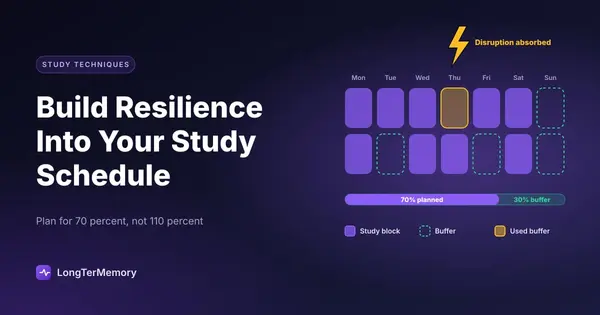
The most resilient study schedules are built around a realistic baseline, not an ideal one. If you plan to study at 70 percent of your maximum capacity, you leave room for the unexpected. If you plan at 110 percent, you are already behind before you begin.
This principle shows up in every durable study system. High performers do not fill every hour. They protect the hours that matter and leave open space around them. That open space is what absorbs the shocks.
Think of your weekly study capacity as a budget. If your absolute maximum is ten focused hours per week, plan for seven. Those three extra hours become your flexibility reserve. On a normal week, you can use them for extra review, deeper practice, or rest. On a disrupted week, they prevent you from falling behind.
| Planning Approach | Weekly Hours Scheduled | Flexibility Reserve | What Happens When Disruption Hits |
|---|---|---|---|
| Maximum effort plan | 10 hours | 0 hours | One missed day derails the week |
| Realistic resilient plan | 7 hours | 3 hours | Disruption absorbed by reserve |
| Minimal maintenance plan | 4 hours | 6 hours | Keeps continuity during hard weeks |
The realistic resilient plan is the sweet spot for most people. It is ambitious enough to produce real progress and conservative enough to survive reality.
Buffer Days and Light Weeks: Building Slack Into Your Study Plan
Slack is not wasted time. Slack is the secret ingredient that makes ambitious schedules actually work. Without it, every session is a high-stakes performance. With it, a missed session is just a missed session.
There are three main types of slack you want to build into a resilient study schedule:
Buffer days are specific days in the week when you schedule lighter study or no study at all. Many people find that reserving one weekday evening as a buffer, plus one weekend day, gives them enough breathing room without losing momentum.
Light weeks are entire weeks, or partial weeks, where you intentionally reduce your study load. These are useful before and after intense periods, such as work deadlines, travel, family events, or exam sprints. A light week might mean 50 percent of your normal load, or it might mean doing only review and no new material.
Micro-buffers are short pockets of time built around each session. If you schedule a 90-minute block, plan for the possibility that only 60 minutes will happen. Make the first 30 minutes the most important part of the session, so even a shortened block still produces value.
A Sample Weekly Template With Built-In Buffers
Here is what a resilient weekly study schedule might look like for someone preparing for a professional exam while working full time.
| Day | Primary Study Block | Type of Work | Buffer Zone |
|---|---|---|---|
| Monday | 60 minutes | New material | 15-minute optional extension |
| Tuesday | 60 minutes | Active recall and flashcards | 15-minute optional extension |
| Wednesday | 45 minutes | Review and consolidation | No extension, light day |
| Thursday | 60 minutes | Practice questions | 15-minute optional extension |
| Friday | 30 minutes | Light review only | Buffer day |
| Saturday | 90 minutes | Mixed practice and weak topics | 30-minute optional extension |
| Sunday | Rest or 20-minute review | Recovery and planning | Full buffer day |
Notice a few things about this template. The total committed load is about five and a half hours, which is manageable for most working professionals. The optional extensions add another hour and a half for good weeks. Friday is intentionally light, Sunday is a full buffer, and every session has a priority structure so shortened sessions still deliver value.
This is what study plan flexibility looks like in practice. It is not chaos. It is intentional structure with intentional breathing room.
How to Respond to Disruptions Without Abandoning the Whole Plan
When something interrupts your schedule, the most important response is a small one. The second most common mistake, after building a too-rigid plan, is overcorrecting when the plan breaks.
You do not need to double your study time the next day. You do not need to rewrite the entire schedule. You do not need to abandon the plan because you missed two sessions. What you need is a simple, pre-decided recovery protocol.
The Recovery Protocol
Use this three-step response whenever your study schedule gets disrupted.
-
Acknowledge without dramatizing. Missing one session is a normal event, not a catastrophe. Say to yourself, “That session didn’t happen,” and move on. Avoid sentences like “I always mess this up” or “I’ll never be ready in time.”
-
Do the minimum viable session next. Your next study session should be short and easy to start. The goal is to re-establish continuity, not to catch up on everything you missed. A 20-minute review is enough to restart the habit.
-
Decide what, if anything, needs to be cut. If the disruption was minor, you may not need to change anything. If it was major, such as a week lost to illness or a work crisis, trim the schedule rather than compressing it. Drop one topic, delay one module, or reduce one week to review-only. Do not try to squeeze ten hours of work into four.
This protocol works because it separates continuity from volume. Continuity is the habit of returning to the work. Volume is how much you get done in any single session. A resilient schedule protects continuity above all else, because continuity is what produces long-term learning.
Common Disruptions and Specific Responses
Different disruptions call for slightly different responses. Here is a quick reference table you can adapt to your own situation.
| Disruption | First Response | Recovery Session | Schedule Adjustment |
|---|---|---|---|
| One busy evening | Skip without guilt | 20-minute review the next day | None |
| Two missed days | Acknowledge the break | 30-minute light review | Consider a buffer day that week |
| Sick day or low energy | Rest fully | 15-minute passive review when recovered | Light week if needed |
| Work deadline week | Reduce to minimum | 20-minute flashcard review each day | Cut one topic, do not compress |
| Family emergency | Pause studying | Resume with a single short session | Trim the next two weeks |
| Travel day | Plan a mobile session | Audio review or flashcards on the go | Lower expectations for that day |
The pattern across every row is the same. Protect the habit, reduce the load, and resist the urge to overcompensate. A resilient study schedule is one you can return to easily, not one that punishes you for being human.
The Mindset of a Resilient Learner vs. a Perfectionist Learner
The practical strategies above only work if they are supported by the right mindset. There is a real difference between a resilient learner and a perfectionist learner, and that difference shows up most clearly when things go wrong.
A perfectionist learner sees the schedule as a contract. Any deviation is a breach. The perfectionist interprets a missed session as evidence of poor discipline, poor time management, or poor character. This interpretation produces shame, and shame produces avoidance. The more the perfectionist deviates, the harder it becomes to return.
A resilient learner sees the schedule as a guide. The resilient learner expects disruption, plans for it, and treats recovery as part of the process. A missed session is information, not indictment. The resilient learner asks, “What do I do next?” instead of “What is wrong with me?”
Here is how the two mindsets compare across common study situations.
| Situation | Perfectionist Learner | Resilient Learner |
|---|---|---|
| Missed one session | ”I’ve ruined everything." | "One session is one session. I’ll do the next one.” |
| Fell behind schedule | ”I need to study for six hours this weekend." | "I’ll trim one topic and protect my recovery time.” |
| Low-energy day | ”If I can’t do a full session, there’s no point." | "I’ll do 15 minutes and call it continuity.” |
| Unexpected work trip | ”My whole week is wasted." | "I’ll plan mobile review and lower this week’s target.” |
| Practice test score drops | ”I’m not cut out for this." | "This shows me where to focus next.” |
The resilient mindset is not lower standards. It is better standards. A perfectionist standard asks, “Did I follow the exact plan?” A resilient standard asks, “Did I keep moving forward in a sustainable way?” The second standard is the one that gets you to exam day prepared and sane.
How to Shift From Perfectionist to Resilient Thinking
Mindset shifts do not happen from a single decision. They happen from repeated, deliberate reframes. Try these when you notice perfectionist thinking creeping in.
- Replace “I have to” with “I get to.” This small language change reduces the sense of coercion and increases ownership.
- Replace “falling behind” with “adjusting pace.” Progress is not always linear, and pacing changes are normal.
- Replace “all or nothing” with “something is better than nothing.” A 15-minute session still reinforces memory and protects the habit.
- Replace “I should have” with “next time I will.” The former punishes the past. The latter plans the future.
Over time, these reframes become automatic. You stop seeing disruptions as threats to your identity and start seeing them as part of the terrain.
Building Your Resilient Study Schedule: A Step-by-Step Process
Now that you understand the principles, here is a concrete process for building your own resilient schedule.
Step 1: Define Your Realistic Weekly Capacity
Look at your actual calendar, not your ideal one. Count the hours you can genuinely protect for focused study in a normal week. Then multiply by 0.7. That is your committed baseline.
For example, if you think you can realistically do ten hours in a good week, commit to seven. Those three extra hours are your flexibility reserve for harder weeks and deeper review on easier weeks.
Step 2: Identify Your Non-Negotiable Sessions
Choose two or three sessions per week that are sacred. These are your anchor sessions. They happen at the same time, in the same place, with the same routine. Anchor sessions create stability, and stability makes everything else easier.
For most people, early morning or immediately after work are the best anchor slots, because they are less likely to be hijacked by other obligations.
Step 3: Build in Buffer Days and Light Weeks
Mark at least one buffer day per week. Mark at least one light week per month. Use these as recovery, not catch-up. If you end up using buffer time to recover from a disrupted week, that is exactly what it is for.
Also mark any known high-stress periods in advance, such as work deadlines, travel, holidays, or family events. Plan around them rather than pretending they will not affect you.
Step 4: Decide Your Minimum Viable Session
Your minimum viable session is the smallest version of studying that still counts. For most people, this is 15 to 20 minutes of active review. On hard days, you do the minimum. On good days, you do more.
The minimum viable session is your insurance policy against total derailment. It keeps the identity intact, maintains the streak, and often leads to longer sessions once you have started.
Step 5: Create a Written Recovery Protocol
Write down exactly what you will do when you miss a session, a day, or a week. Having a pre-decided protocol prevents you from making emotional decisions in the moment. It also reduces the mental load of deciding how to recover.
Keep your recovery protocol somewhere visible, such as the first page of your notebook or a note attached to your study space.
Step 6: Review and Adjust Weekly
Every week, spend five minutes reviewing how the schedule went. Did you use your buffers? Were your estimates realistic? Did any disruptions reveal weak points in the plan?
Adjust the schedule based on what you learn. A resilient schedule is a living document, not a stone tablet.
Tools That Make Resilient Schedules Easier to Maintain
A resilient schedule is easier to maintain when the administrative work is minimized. If every study session requires you to spend fifteen minutes deciding what to review, finding your materials, and reorganizing your notes, then disruptions become even more damaging. The friction adds up.
This is where spaced repetition tools become especially valuable. When your review material is already organized, scheduled, and prioritized automatically, you can sit down and start studying immediately, even if you only have 20 minutes. You do not need to rebuild your plan every time life interrupts it.
LongTerMemory is built for exactly this kind of resilient learning. You upload your study materials once, and the platform generates flashcards and manages the review schedule for you. On a normal day, you study what the algorithm says you need to review. On a disrupted day, you can do a short session and still move the needle. On a good day, you can go deeper without having to reorganize anything.
Over weeks and months, this kind of automatic structure protects your momentum better than any manual system. It turns your study schedule into something that supports you, instead of something you have to constantly rescue.
If you are building a resilient study schedule for a certification, an exam, or a long-term learning goal, consider letting LongTerMemory handle the review logistics so you can focus on showing up consistently. Visit LongTerMemory to see how automatic flashcards and spaced repetition can keep your momentum alive through every disruption.
Final Thoughts: Resilience Is a Skill, Not a Trait
The most important thing to remember is that schedule resilience is something you build, not something you either have or lack. The first version of your schedule will not be perfect. You will underestimate some weeks and overestimate others. You will forget to buffer for certain kinds of disruptions and then learn from them.
That is normal. That is the process.
A resilient study schedule is not one that never breaks. It is one that is designed to be repaired quickly. It is built on realistic capacity, protected anchor sessions, intentional buffer time, and a mindset that values continuity over perfection.
When you study with this kind of structure, disruptions stop being emergencies. They become weather. Some days are sunny, some days are rainy, and your job is not to control the weather. Your job is to have a good enough umbrella that you can keep walking either way.
So build the slack in. Lower the stakes of individual sessions. Protect the habit above all else. And trust that steady, flexible effort will take you much further than a perfect plan that falls apart the first time life gets complicated.
Because it will. And when it does, you will be ready.
Want a study system that keeps working even when your schedule doesn’t? LongTerMemory turns your notes and materials into automatic flashcards with spaced repetition built in, so you can maintain momentum with just a few minutes a day.