How to Study When You Have No Motivation
Motivation isn't a prerequisite for studying , it's a byproduct. Discover behavioral strategies to start studying even when you feel completely unmotivated.
Table of Contents
- The Motivation Myth
- Why You're Not Motivated (And What That Tells You)
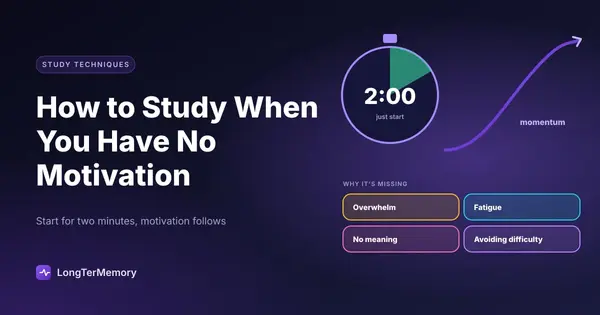
- Overwhelm and Vagueness
- Fatigue and Depletion
- Disconnection from Meaning
- Avoidance of Difficulty
- The Strategies That Actually Work
- The Two-Minute Rule
- Environmental Design
- Implementation Intentions
- The Pomodoro Technique (Adapted for Low-Motivation Days)
- Identity-Based Motivation
- What to Do With a Truly Zero-Energy Day
- Building a System That Reduces Motivation Dependency
- Tools That Make Starting Easier
- The Bottom Line
You’ve been sitting at your desk for twenty minutes. The textbook is open. The tab with your lecture notes is open. Your phone is face-down. You’ve done everything right, on paper.
And you still can’t start.
This isn’t a willpower problem. It’s not laziness, and it’s not a sign that you’re wrong for your field or your goal. It’s an extremely common experience that most students, professionals, and learners go through , especially during long preparation cycles, after setbacks, or when the thing you’re supposed to study has stopped feeling meaningful.
Here’s the thing almost nobody tells you: waiting for motivation before you study is the wrong strategy. Motivation, as it turns out, isn’t a prerequisite for starting. It’s often a byproduct of having already started.
The Motivation Myth
We tend to think of motivation as a spark that triggers action. You feel motivated, so you study. You don’t feel motivated, so you can’t study. The motivation comes first, and the behavior follows.
Behavioral psychology, and the experience of millions of students and professionals, suggests this model is backwards.
Action generates motivation, not the other way around. When you start a task , even without wanting to , your brain often generates a sense of engagement and interest after a few minutes of work. The doing creates the wanting. But if you wait for the wanting before you do, you can wait indefinitely.
This is the core insight behind behavioral activation, a technique developed in cognitive behavioral therapy (CBT) for depression but with clear applications for anyone stuck in a motivation-action deadlock. The theory: when you’re in a low-motivation state, the path out isn’t to fix the feeling first and then act. It’s to act first, and let the feeling follow.
The 20-minute problem described at the top of this article is almost always a starting problem, not a sustaining one. Most people who make it past the first five minutes of actual studying find that something shifts , it doesn’t always feel great, but it feels workable. The resistance lives at the edge, not in the middle.
Why You’re Not Motivated (And What That Tells You)
Before jumping to strategies, it’s worth spending a moment on diagnosis. Low motivation to study is almost never just one thing, and different causes call for different responses.
Overwhelm and Vagueness
One of the most common causes of study paralysis is a study task that’s too large and too vague. “Study for my exam” isn’t a task , it’s a category. It has no clear starting point, no clear ending point, and the gap between where you are and where you need to be feels infinite.
The response to this cause isn’t motivational , it’s task clarification. Reduce the scope to something concrete and small enough to complete. “Study for my exam” becomes “write out everything I know about protein synthesis from memory.” That has a start, a middle, and an end.
Fatigue and Depletion
Low motivation sometimes isn’t psychological at all , it’s physical. If you’ve been studying heavily, sleeping poorly, skipping exercise, or under chronic stress, your brain genuinely doesn’t have the metabolic resources to engage well. Pushing through depletion doesn’t produce good learning; it produces the illusion of studying while your retention approaches zero.
In this case, the right intervention might be a genuine break , not guilt-laden avoidance, but intentional recovery. A 20-minute walk, a nap, or a hard stop for the day, scheduled and guilt-free, often produces better outcomes than white-knuckling through a session that isn’t working.
Disconnection from Meaning
Long study cycles, especially for professional certifications or graduate-level preparation, can produce a gradual disconnection from why the material matters. The subject becomes a pile of content to get through rather than something with meaning and purpose.
When motivation drops for this reason, the intervention is reconnecting with purpose rather than optimizing study technique. Why did you start this? What does the credential or the knowledge make possible? A genuine few minutes spent on this question , not as a pep talk, but as a real reflection , can restore enough forward momentum to break through the inertia.
Avoidance of Difficulty
Sometimes low motivation is actually avoidance of material that feels genuinely hard. The hard chapter, the concept that keeps not clicking, the topic that makes you feel stupid , your brain, which is very good at protecting your ego, will manufacture endless other things to do.
This cause requires acknowledging it for what it is: fear of difficulty or failure, dressed up as lack of motivation. The resolution is usually to engage directly with the hard thing, but gently , start with a single small piece of the difficult material, rather than trying to conquer all of it at once.
The Strategies That Actually Work
The Two-Minute Rule
Set a timer for two minutes. Tell yourself you only have to study for two minutes. When the timer goes off, you can stop.
This sounds almost insultingly simple, and you’ll still feel resistance before starting. But the strategy works because it addresses the real problem: the barrier to beginning. Once you’re actually doing the thing for a couple of minutes, the two-minute rule has already done its job. Most people continue past it.
The two-minute rule only works if you take it seriously , you genuinely must allow yourself to stop when the timer goes off if you want to. Otherwise it’s just a trick you’ve seen through, and tricks you’ve seen through stop working.
Environmental Design
Your environment shapes your behavior more than your intentions do. A messy desk, a phone in arm’s reach, a laptop with notification badges , these are not neutral features of your study space. They are active impediments to sustained attention.
Design your environment for the behavior you want:
- Clear the surface of everything except what you need for the session
- Put your phone in another room, not just face-down
- Use a browser extension to block distracting sites for defined periods
- Establish a specific physical location you associate only with studying , your brain will eventually treat entering that space as a behavioral cue
The goal isn’t willpower , it’s to make studying the path of least resistance in your environment rather than the path of most resistance.
Implementation Intentions
Research by psychologist Peter Gollwitzer on implementation intentions shows that people who specify exactly when, where, and how they will perform a task are dramatically more likely to follow through than people who just set a goal.
The format is simple: “When [situation X], I will do [behavior Y].”
- “When I sit down at my desk at 7:00 PM, I will open my notes and write a recall outline for Chapter 4.”
- “When I’ve made my coffee in the morning, I will do 15 flashcard reviews before checking email.”
The specificity is the point. A vague commitment to “study tonight” is easy to defer. A specific implementation intention anchors the behavior to a context that will definitely occur, reducing the moment-of-decision friction to almost zero.
The Pomodoro Technique (Adapted for Low-Motivation Days)
The standard Pomodoro technique , 25 minutes of focused work, 5-minute break, repeat , is well-known and genuinely useful. On low-motivation days, adapt the ratio:
Start with shorter work intervals. 15 or even 10 minutes of focused study, followed by a 5-minute break, is still useful learning. The standard 25-minute block can feel impossibly long when you’re running on empty. Reducing the interval reduces the resistance to starting.
As you warm up , and you usually do , you can extend the intervals. Many people find that they naturally shift from 10-minute blocks to 25-minute blocks within a single session, once the initial inertia is overcome.
Identity-Based Motivation
This strategy operates at a deeper level than the others and has longer-term effects.
Motivation that depends on external rewards or punishments (I have to study or I’ll fail) is fragile. It works under pressure but evaporates when the pressure is temporarily reduced. Motivation that connects to identity (“I’m a person who shows up for my goals even when it’s hard”) is more durable.
Asking yourself “what would a person who takes their development seriously do right now?” shifts the decision away from “do I feel like it?” (often no) toward “is this consistent with who I am?” (often yes, if you’ve cultivated that identity).
This isn’t a shortcut , building an identity as someone who studies consistently requires consistently studying. But starting to narrate your behavior as identity-consistent, even before it fully is, tends to create the behavior that validates the narrative over time.
What to Do With a Truly Zero-Energy Day
There are days when none of the above works. You’re exhausted, emotionally depleted, or overwhelmed in ways that genuinely make sustained study impossible.
On those days, the right approach isn’t forcing a session that will produce zero retention and maximum resentment. It’s damage minimization: doing the smallest possible thing that keeps your streak alive and maintains some connection to your material.
That might look like:
- Reviewing 10 flashcards (not 100)
- Reading a single page
- Listening to an audio summary while doing dishes
- Spending 5 minutes looking at your notes without any expectation of intensive engagement
This isn’t productive studying in any meaningful sense. But it serves two important purposes: it keeps the psychological streak of “I’m someone who works on this daily” intact, and it prevents the accumulation of avoidance behavior that makes resumption harder.
The worst outcome isn’t a day of light engagement. It’s a day that starts a week-long slide, where the gap between you and your material grows large enough that resuming feels overwhelming.
Building a System That Reduces Motivation Dependency
The deeper goal , the one worth working toward beyond any single low-motivation day , is to build a study system that doesn’t require motivation to activate.
Habits don’t require motivation in the way that decisions do. When a behavior is sufficiently routine, contextual cues trigger it automatically, the way brushing your teeth in the morning happens without a motivational speech. The design goal for study habits is the same: create enough repetition, in a consistent enough context, that the decision to study stops requiring active motivation.
This typically takes 8–12 weeks of fairly consistent behavior before it begins to feel automatic. The early weeks are the hardest, because you’re relying on motivation and willpower that aren’t fully available. Use the tactics above to get through those early weeks. After that, the habit carries more of the load.
Keystone habits help here too: identifying the behaviors that reliably precede your best study sessions and protecting those. For many people, a specific pre-study ritual , making a particular drink, changing into certain clothes, clearing the desk to a specific state , functions as a behavioral on-ramp that reduces friction. The ritual signals to your brain that the next thing is studying, and your brain obligingly shifts into that mode.
Tools That Make Starting Easier
Anything that reduces the friction of beginning helps. LongTerMemory is designed with this in mind: rather than facing a blank page or deciding what to study, you get a queue of material that the system has already prioritized based on what you’re most likely to forget. You open the app, and there’s already a concrete task in front of you.
That kind of pre-built structure is underrated as a motivation aid. A lot of study paralysis isn’t really about the studying itself , it’s about the meta-decisions that precede it. What should I study? In what order? For how long? When those decisions are already made, starting gets dramatically easier.
The Bottom Line
Waiting to feel motivated is waiting for permission that may never come. The research, the behavioral science, and the experience of anyone who has maintained a long-term study practice all point to the same conclusion: you act your way into motivation, not the other way around.
This doesn’t mean forcing yourself through miserable sessions that produce nothing. It means understanding that the resistance you feel before starting is usually larger than the resistance you’ll feel once you’re in the middle of it , and designing your approach to minimize the friction of crossing that threshold.
Start small. Start now. Let the motivation catch up when it will.