
How to Prepare for the CMA Exam (Institute of Management Accountants)
A practical CMA exam study plan covering both parts, content weighting, essay prep, and how to actually retain the material long enough to pass.
Table of Contents
- What the CMA Exam Actually Covers
- Part 1: Financial Planning, Performance, and Analytics
- Part 2: Strategic Financial Management
- How Long Should You Actually Study?
- The Essay Section: Where CMA Candidates Actually Lose Points
- Building a Study System That Actually Retains the Material
- Practice Questions: How Many Is Enough?
- Choosing a Review Course (And Whether You Even Need One)
- Common Mistakes That Extend Your Timeline
- Final Two Weeks: What to Actually Do
If you’ve started looking into the Certified Management Accountant (CMA) exam, you’ve probably already noticed the two things that make people nervous about it: it’s split into two dense parts, and roughly a quarter of your score comes from essays that can’t be gamed with memorized multiple-choice tricks. That combination scares a lot of otherwise capable accountants.
Here’s the good news. The CMA exam is entirely learnable with the right structure. It’s not testing obscure trivia, it’s testing whether you can apply a defined body of management accounting knowledge under time pressure. That’s a study problem, not a talent problem, and study problems have solutions.
What the CMA Exam Actually Covers
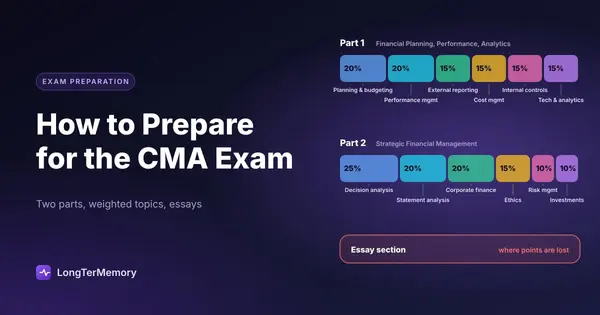
The CMA, administered by the Institute of Management Accountants (IMA), is built around two exam parts, each with its own content weighting. Knowing exactly how much of your study time to allocate to each topic is the single highest-leverage thing you can do before you open a single practice question.
Part 1: Financial Planning, Performance, and Analytics
| Content Area | Weighting |
|---|---|
| External Financial Reporting Decisions | 15% |
| Planning, Budgeting, and Forecasting | 20% |
| Performance Management | 20% |
| Cost Management | 15% |
| Internal Controls | 15% |
| Technology and Analytics | 15% |
Part 2: Strategic Financial Management
| Content Area | Weighting |
|---|---|
| Financial Statement Analysis | 20% |
| Corporate Finance | 20% |
| Decision Analysis | 25% |
| Risk Management | 10% |
| Investment Decisions | 10% |
| Professional Ethics | 15% |
Notice that no single content area in either part dominates the exam. This means you cannot cherry-pick two or three topics and skip the rest, a strategy that sometimes works on exams with one or two heavyweight sections. The CMA rewards broad, even coverage far more than it rewards deep expertise in a narrow slice.
How Long Should You Actually Study?
Most successful CMA candidates report somewhere between 150 and 170 hours per part, spread across 10 to 14 weeks. That’s a wide range, and where you fall in it depends heavily on your background.
If you’re coming from a role that already touches budgeting, variance analysis, or cost accounting, you’ll move faster through Part 1’s overlapping content. If your day-to-day work is closer to financial reporting or tax, Part 2’s decision analysis and corporate finance sections will likely take longer, since those topics (net present value, capital budgeting, hedging strategies) may be genuinely new territory.
A realistic weekly structure for a 12-week timeline looks like this:
- Weeks 1-8: First pass through content, one major topic area per week, mixing video or textbook review with immediate practice questions on that topic
- Weeks 9-10: Full practice exams under timed conditions, followed by targeted review of weak areas
- Weeks 11-12: Essay practice, final review of formulas and frameworks, light review only in the final 48 hours
The biggest mistake candidates make here isn’t underestimating total hours, it’s front-loading content review and leaving almost no time for practice under exam conditions. You need at least two to three weeks of dedicated practice-exam time before your test date, not tacked on as an afterthought.
The Essay Section: Where CMA Candidates Actually Lose Points
Both parts end with two essay scenarios worth 25% of your total score combined. This is the part of the exam that trips up candidates who otherwise crush the multiple-choice section, and it deserves its own strategy.
The essays aren’t asking you to write beautifully. They’re asking you to apply specific calculations and concepts to a business scenario, show your work, and communicate your reasoning clearly enough that a grader can follow it. For a broader guide on essay exam strategy, see our complete walkthrough on how to study for an essay exam. A correct final number with no visible work earns partial credit at best. A clearly labeled, step-by-step calculation with the correct approach but a small arithmetic slip often earns more.
A few things that consistently help:
- Practice writing under time pressure, not just solving. Doing a practice essay in your head and checking the answer key is not the same as typing out a full response in 30 minutes, which is roughly what you’ll have per essay on exam day.
- Label everything. Write “Step 1: Calculate contribution margin” before you show the calculation. Graders are scanning for evidence of correct process, and labels make that process visible at a glance.
- Don’t skip the writing-skills component. A small portion of the essay grade evaluates written communication independently of the accounting content. Clear, organized paragraphs matter, even in a technical response.
- Answer every essay prompt, even partially. Blank responses earn zero. A partially correct, clearly labeled attempt earns something. There is no penalty for a wrong guess here, only upside for showing your reasoning.
Building a Study System That Actually Retains the Material
Here’s the uncomfortable truth about CMA prep: most candidates study the content once, feel confident after the first pass, and then discover on exam day that concepts from Week 2 have quietly evaporated. This isn’t a discipline problem, it’s how memory naturally works without reinforcement.
Spaced repetition directly counters this. Instead of reading a chapter on variance analysis once and moving on, you review key formulas and concepts again a few days later, then again a week after that, then again closer to the exam. Each review interval is timed to hit right as the memory would otherwise start fading, which is dramatically more efficient than re-reading an entire chapter from scratch when you realize you’ve forgotten it.
This matters enormously for the CMA specifically because the exam draws from two parts covering roughly a dozen content areas each with heavy formula dependence. Trying to hold all of that in working memory through pure repetition of full review sessions is exhausting and inefficient. A tool like LongTerMemory can take your CMA study materials, whether that’s a review course PDF, your own notes, or practice question explanations, and automatically generate spaced-repetition flashcards from them. Instead of manually deciding what to review and when, you get a daily queue that prioritizes the formulas and concepts you’re most at risk of forgetting, which is exactly the kind of systematic coverage the CMA’s broad weighting demands.
Practice Questions: How Many Is Enough?
Plan to work through at least 1,000-1,500 multiple-choice questions per part before test day, not as a one-time pass but with review of every wrong answer and, ideally, a second pass on questions you missed. The point isn’t just exposure, it’s identifying the specific pattern behind each mistake. Did you misread the question? Misapply a formula? Confuse two similar concepts? Each of those has a different fix, and lumping them all together as “I need more practice” wastes time you don’t have.
Track your practice-question accuracy by content area, not just overall. A candidate scoring 85% overall but 55% on Internal Controls has a clear, specific gap to close, information that a single blended percentage would hide completely.
Choosing a Review Course (And Whether You Even Need One)
Most CMA candidates use a commercial review course rather than studying purely from the IMA’s own outline, and for good reason: a structured course organizes the exam’s content areas into a sequence, provides practice questions mapped to specific weighting, and typically includes essay-grading guidance that’s hard to replicate on your own.
That said, a review course is a resource, not a guarantee. Simply watching video lectures start to finish without doing the accompanying practice questions produces the same shallow familiarity that re-reading a textbook does: you’ll recognize concepts when you see them explained again, but struggle to produce the correct approach cold on exam day. Whichever course you choose, treat the video or reading content as the input phase and budget at least as much time, ideally more, for the practice-question and essay-writing phase that follows.
If you’re deciding between courses, prioritize ones with a large, well-explained practice question bank over ones with the flashiest video production. The questions and their explanations are where the actual exam-relevant learning happens.
Common Mistakes That Extend Your Timeline
A few patterns show up repeatedly among candidates who end up needing a retake, and they’re almost all avoidable with a bit of foresight:
- Treating the two parts as symmetrical in difficulty. Many candidates find Part 2 noticeably harder, particularly the corporate finance and decision analysis sections, because it involves more quantitative reasoning under time pressure. Don’t assume your Part 1 timeline will transfer directly to Part 2.
- Under-practicing the essay format until the final week. Essay writing is a distinct skill from multiple-choice recognition, and cramming your first few practice essays into the last few days doesn’t give you enough repetitions to build genuine comfort with the format.
- Skipping the professional ethics content because it feels like common sense. Ethics carries real weight on Part 2, and the exam’s specific framework for evaluating ethical scenarios doesn’t always match casual intuition. It rewards knowing the IMA’s actual ethical standards, not just having good instincts.
- Studying content in isolation from a timer. Practicing questions without time pressure builds knowledge but not exam-day speed. By your second pass through practice questions, always work under realistic timed conditions.
Final Two Weeks: What to Actually Do
In the last stretch before your exam, resist the urge to cram new material. At this point, new content competes with material you’ve already partially learned for the same limited working memory, and it usually loses that competition badly.
Instead:
- Do one full timed practice exam per part, reviewing every miss in detail
- Run through formula sheets daily using active recall, not passive re-reading
- Do at least three full essay practice attempts per part under real time constraints
- Sleep normally. Cutting sleep in the final week to cram costs you more in exam-day cognitive performance than the extra study hours could possibly gain you
The CMA is a marathon exam that rewards consistent, structured preparation over last-minute heroics. Build the plan, trust the spacing, and walk in on exam day having already seen the hardest version of every question type the real exam can throw at you.