How to Compress Your Notes into One-Page Study Summaries
Learn how to compress your notes into powerful one-page study summaries that boost retention and make last-minute review fast and effective.
Table of Contents
- Why One-Page Summaries Are More Powerful Than They Look
- The Art of Selecting What Makes the Final Summary Page
- Start With the Exam's Structure, Not Your Notes
- Apply the 80/20 Rule to Your Notes
- Use the Right Format for Each Type of Content
- Using One-Page Summaries as the Last Review Before an Exam
- The Rapid Scan Method
- Use the Summary to Triage, Not to Cram
- Keep It Somewhere Accessible
- Building the Summary From Memory Rather Than From Notes
- The Blank Page First Approach
- Test the Summary Before You Keep It
- Revise and Compress Over Multiple Sessions
- Making This a Habit Across All Your Subjects
- The Bottom Line
There is a moment most students know well. You are sitting with a stack of notebooks, a folder of printed slides, and a digital document that is somehow already thirty-seven pages long, and the exam is in two days. Everything feels equally important. You do not know what to review first. You do not know what you can safely skip. You just know you cannot read all of it again.
A one-page study summary is the answer to that problem. Not just as a last-minute rescue tool, but as a study technique in its own right. The process of compressing your notes into a single page is one of the most effective learning activities you can do, and the finished page is one of the most useful revision tools you will ever have.
This is how to do it well.
Why One-Page Summaries Are More Powerful Than They Look
The instinct when studying is to accumulate. More notes, more highlights, more pages. It feels like thoroughness. But accumulation is the opposite of learning. Memory is built not by storing more information but by repeatedly retrieving and organising it.
When you compress your notes into one page, you are not just making a convenient cheat sheet. You are forcing your brain to do something far more demanding: decide what actually matters. Every sentence you include requires you to evaluate it against everything else you know about the subject. Every decision to leave something out is a judgment call that requires understanding.
Research in cognitive science backs this up. The process of summarising activates what is called generative processing, where you produce something new from existing material rather than just re-reading it. Generative processing produces stronger memory traces than passive review, consistently and significantly.
And then there is the practical benefit. A one-page summary gives you a single artifact that contains the essential shape of everything you need to know. You can review it in five minutes. You can keep it in your pocket. You can glance at it on the morning of the exam without triggering the panic that comes from opening a full set of notes.
The Art of Selecting What Makes the Final Summary Page
The hardest part of building a one-page summary is not the writing. It is the selection. Deciding what deserves a place on that single page is where most of the learning actually happens.
Start With the Exam’s Structure, Not Your Notes
Before you look at anything you have written, ask yourself: what does this exam actually test? If there is a syllabus, a learning objectives list, or past exam papers available, that is your starting point. Work out what the top-level categories of testable content are. These categories will become the skeleton of your one-page summary.
For a biology exam, those categories might be cell biology, genetics, evolution, and ecology. For a business ethics course, they might be the major ethical frameworks, landmark cases, and key distinctions. For a project management certification, they might be the knowledge areas or process groups.
Your page starts as an outline of those categories. Everything that goes into the summary must earn its place by fitting into that structure.
Apply the 80/20 Rule to Your Notes
In almost every subject, a relatively small portion of the content accounts for the vast majority of exam questions and real-world applications. Your job is to find that portion.
Look for concepts that appear in multiple places across your notes. If something comes up in the lecture slides, the textbook, and the practice questions, it is almost certainly high-yield. Look for the things your instructor emphasised repeatedly. Look for the definitions that everything else seems to depend on.
What you are looking for is the structural knowledge that makes other things make sense, rather than isolated facts that only matter in one narrow context. A formula that unlocks ten different problem types earns a place on your summary page. A specific example that illustrates a concept you already know well probably does not.
Use the Right Format for Each Type of Content
A one-page summary does not have to be a wall of prose. In fact, it should not be. Different types of content deserve different formats.
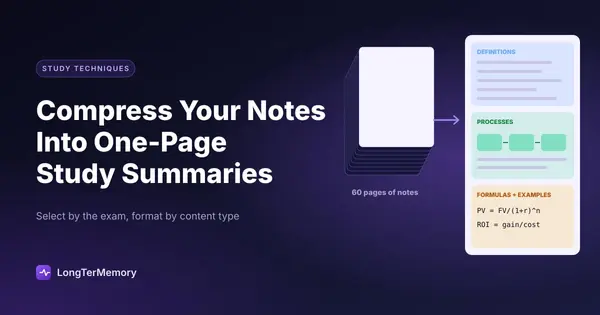
Definitions and key terms work well as a small, dense glossary in one corner. Keep them extremely brief, just enough to trigger the full concept in your mind.
Processes and sequences work best as numbered lists or small flowcharts. If a process has five steps, a tiny numbered list takes less space and is easier to retrieve than a paragraph.
Comparisons and contrasts benefit enormously from a simple two-column table. If you need to compare two frameworks, two historical periods, or two types of anything, a table of five rows and two columns can convey in a fraction of an inch what a paragraph would need three inches to say.
Formulas, equations, or rules should be written exactly as you will need to recall them, with a one-word label so you can locate them instantly.
Here is a rough template for how a well-structured one-page summary might be organised:
| Section | Content Type | Format |
|---|---|---|
| Top third | Core concepts and definitions | Short glossary or bullets |
| Middle third | Processes, models, frameworks | Flowcharts, numbered steps, tables |
| Bottom third | Formulas, exceptions, common traps | Compact notations, brief flags |
Obviously, adapt this to your subject. A history summary will look completely different from a pharmacology summary. The principle is to use the format that communicates the information in the least space with the highest retrievability.
Using One-Page Summaries as the Last Review Before an Exam
A finished one-page summary is not just a record of what you know. It is a precision revision tool that becomes especially powerful in the final hours before an exam.
The Rapid Scan Method
In the last twenty to thirty minutes before you enter an exam, your brain cannot absorb new information effectively. What it can do is prime existing memories for fast retrieval. This is where your one-page summary earns its value.
Do not read the summary passively, as if it were a novel. Instead, scan it section by section and mentally reconstruct what each item represents. When you see a term, test yourself silently: what does this mean, and what connects to it? When you see a formula, mentally run through what it does. When you see a process, briefly play it forward in your mind.
This kind of rapid active scanning takes about five minutes and has been shown to significantly improve performance compared to sitting quietly or attempting new learning in the pre-exam window. You are warming up the retrieval pathways without overloading yourself.
Use the Summary to Triage, Not to Cram
A common mistake is to use a pre-exam summary review as a cramming session, frantically trying to memorise things you do not feel confident about. This is counterproductive and tends to increase anxiety while delivering minimal retention gains.
Instead, use your summary scan to identify two or three things you want to focus on, and then spend the remaining time actively recalling those specific items, testing yourself out loud or on a scrap of paper. Targeted retrieval practice on your weakest areas is far more useful than passive re-reading of everything.
Keep It Somewhere Accessible
If your exam has a waiting room or a brief window before you sit down, having your one-page summary with you means you can use that time effectively. A folded piece of paper beats a phone screen for this, partly because there are no distractions and partly because the physical act of carrying your own handwritten summary has a small but real psychological benefit. It is yours. You made it. That gives it authority.
Building the Summary From Memory Rather Than From Notes
Here is the technique that separates genuinely powerful one-page summaries from mediocre ones: build the summary from memory first, and only then check your notes.
Most students do this backwards. They open their notes, flip through them, pick out things that look important, and write those down. The result is a summary that their notes made, not one that their understanding made. The process requires almost no thinking, which means almost no learning happens.
The Blank Page First Approach
Set your notes aside. Open a blank document or get a fresh piece of paper. Now try to write down everything you can remember about the subject without looking at anything. No cheating.
This is going to feel uncomfortable. There will be gaps. Things you thought you knew will refuse to come to mind. Whole sections might be missing. This is exactly what you want. Those gaps are your learning agenda.
Once you have written everything you can, check your notes and fill in what was missing. But now you are filling in real gaps in your memory, not just copying text. That difference is enormous for retention.
Test the Summary Before You Keep It
Before you finalise your one-page summary, put it away and try to reproduce it from memory on a blank page. Not word for word, but the structure, the key points, the essential content.
If you can do that, your summary is doing its job. The information is genuinely in your head. If you cannot reproduce it, that tells you that you understand the structure but have not yet internalised the content, and you know exactly where to focus your remaining study time.
Revise and Compress Over Multiple Sessions
The best one-page summaries are not built in one sitting. They are iterative.
In an early study session, your first draft might run to two pages. That is fine. Come back the next day, review what you have, and see what you can cut without losing anything essential. The process of each compression is itself a retrieval and evaluation exercise.
By the time you reach your final summary, it should feel like every word has been earned. Every item on it should be something you could not in good conscience leave off.
Making This a Habit Across All Your Subjects
Once you build one effective one-page summary, you will want to do it for everything. The technique works across every subject and at every level of study, from undergraduate coursework to professional certification exams.
The habit that produces the best results is simple: end every major study unit by building a summary from memory. When you finish a chapter, a module, a topic cluster, rather than moving straight on, spend twenty minutes doing a blank-page recall and then compressing what you get into the most concise possible version.
These summaries accumulate over a semester or a course, and when exam time comes you do not have to compress hundreds of pages of notes from scratch. You have already done the work, incrementally, as you went. Your final review is just a review of summaries you already know.
If you are looking for a system that automates part of this process, LongTerMemory lets you upload your study materials and generates question-and-answer pairs from them automatically, which you can then review through built-in spaced repetition. It is a different format from a one-page summary, but it solves the same problem: turning passive accumulated notes into active retrievable knowledge.
The Bottom Line
The goal of a one-page study summary is not to have less to read. It is to have more deeply processed what you know.
Every time you select what belongs on that page, you are making a judgment about importance, connection, and structure. Every time you compress a paragraph into a phrase, you are encoding the information more deeply than you would by re-reading it. Every time you build the summary from memory rather than from notes, you are doing retrieval practice, which is the single most evidence-backed study technique available.
The page itself is useful. But the person you become by building it is more prepared for any exam than the person who never tried.