How to Create a Cheat Sheet for Open-Book Exams
Learn how to build a powerful one-page cheat sheet for open-book exams, and why the process of making it is itself the best study technique.
Table of Contents
- What to Include on a One-Page Exam Cheat Sheet
- High-Stakes Formulas, Definitions, and Rules
- Frameworks and Structures
- Connections and Comparisons You Keep Confusing
- What Does NOT Belong
- How Building the Cheat Sheet Is Itself a Powerful Study Technique
- The Compression Effect
- It Forces You to Confront Gaps
- Using Your Cheat Sheet in Practice Before the Real Exam
- Simulate Actual Exam Conditions
- Annotate After Practice Runs
- When to Stop Adding Things
- Common Mistakes to Avoid
- The Bigger Picture
Open-book exams have a reputation for being the easy ones. You get to bring your notes, your textbook, maybe a carefully assembled reference sheet, and suddenly the whole thing feels a lot less terrifying. Except, here is the thing most students find out the hard way: open-book exams are almost never easy. They are just hard in a different way.
The professors who set them know you have access to your materials. That is why they design questions that cannot be answered by simply looking something up. They want you to apply, synthesize, analyze. To do that well, you do not just need your notes in front of you. You need to have actually learned the material well enough that you can navigate it fast, connect ideas under pressure, and retrieve specific details without spending ten minutes flipping through a folder.
A well-built cheat sheet (or reference sheet, if you want to sound more academic about it) is one of the most underrated tools in exam preparation. Not because you will stare at it for most of the test, but because building it forces you to do the hard cognitive work that actually prepares you for the exam.
Let us break down exactly how to do it right.
What to Include on a One-Page Exam Cheat Sheet
The first instinct is to cram in as much as possible. Tiny font, both sides of the page, every definition you can find. Resist this. A cheat sheet stuffed with everything is actually close to useless, for two reasons. First, you will not be able to find what you need under time pressure. Second, if you tried to write down everything, you probably did not do the cognitive work of deciding what actually matters, which is the most valuable part of the exercise.
A great cheat sheet is a distillation of your understanding, not a photocopy of your notes.
Here is what actually belongs on it:
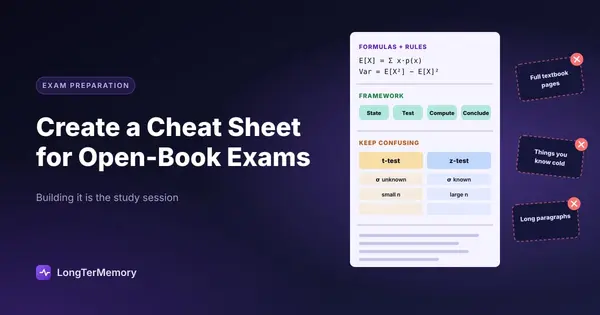
High-Stakes Formulas, Definitions, and Rules
These are the things that are both hard to remember and high-cost to get wrong. In a statistics exam, that might be specific formulas you cannot derive under pressure. In a law exam, it might be the elements of a particular doctrine you keep mixing up. In an economics exam, it might be a comparison table of models that all look similar.
The test: would getting this wrong cost you significant marks? Is it something you cannot reconstruct from first principles in the exam? If both answers are yes, it goes on the sheet.
Frameworks and Structures
If your subject involves applying a consistent analytical framework, having it visually mapped on the sheet is enormously helpful. An essay structure for argument-based exams. A decision tree for problem-solving questions. A process diagram for a multi-step methodology.
These take up a bit of space, but they are genuinely useful because they keep you oriented when stress makes your thinking sluggish.
Connections and Comparisons You Keep Confusing
Make a small table comparing concepts you consistently muddle. Perfectly and clearly laid out. In biology, that might be mitosis vs. meiosis. In history, two political movements that overlap. In accounting, different depreciation methods.
| Concept A | Concept B |
|---|---|
| Key trait 1 | Key trait 1 |
| Key trait 2 | Key trait 2 |
| Key distinction | Key distinction |
Seeing them side by side in your own words, built by you, is much more useful than re-reading someone else’s comparison.
What Does NOT Belong
Everything that you could figure out in thirty seconds if you needed to. Material you already know cold. Definitions that are so fundamental they are second nature. Lengthy quotes or passages. Vague general statements like “remember the key differences” that give you no actual information.
The goal is a high-density, low-redundancy artifact that points you exactly to what you need.
How Building the Cheat Sheet Is Itself a Powerful Study Technique
Here is the thing that surprises most students when they first hear it: the actual test-day value of the cheat sheet is often secondary to the value of creating it.
When you sit down to build a one-page reference sheet, you are forced to do something most students never do deliberately: prioritize. You cannot put everything on one page. You have to make decisions about what matters most. That decision-making process is itself a form of deep engagement with the material that passive review almost never produces.
Think about what happens cognitively. You go through your notes or textbook and you have to ask: “Is this important enough to include? Do I already know it well enough not to need it on the sheet? Where does this fit in relation to everything else?” Those questions force you to think structurally about the subject, to build a mental hierarchy of importance. That is exactly what high-performing students do naturally, and now you are doing it deliberately.
The Compression Effect
When you compress a full course or a large body of material into a single page, you are doing something cognitively powerful called chunking. You are grouping related information, finding the patterns, and building a compressed representation in your brain that mirrors the compressed representation on the page.
This is not just about what ends up written down. The act of writing, physically, encodes information more deeply than typing or reading. When you write out a formula or a framework by hand while deciding it belongs on your sheet, you are processing it at a deeper level than you would if you highlighted it.
It Forces You to Confront Gaps
One of the most uncomfortable but useful things that happens while building a cheat sheet is discovering you do not actually understand something you thought you understood.
You go to write down a definition and realize you can only produce a vague paraphrase. You try to include a formula and cannot quite reconstruct how the variables relate. You attempt to summarize a framework and discover the steps are fuzzy in your head.
These moments of confusion are your study agenda. They tell you exactly what needs more attention before the exam. That is information you might never have gotten from passive re-reading, which gives you the illusion of knowing without testing whether you actually do.
If you are using a tool like LongTerMemory to generate AI-powered Q&A cards from your study materials, you can use those cards alongside your cheat sheet building process. Where the flashcards test retrieval, the cheat sheet forces synthesis. The two work beautifully together.
Using Your Cheat Sheet in Practice Before the Real Exam
A cheat sheet that has never been used under realistic conditions is only half-valuable. The other half comes from integrating it into your practice sessions.
Simulate Actual Exam Conditions
Take a practice test or work through past exam questions with your cheat sheet available, under a time limit, the same way you will use it in the real exam. This does several things.
First, you learn how to navigate the sheet quickly. You discover whether your layout makes it easy to scan or whether you have to hunt for things. You may realize you put a formula in the wrong section, or that a table needs to be larger, or that a piece of information you left off is actually critical.
Second, you train yourself not to over-rely on it. Students who use their cheat sheet heavily in practice often realize that they reach for it constantly in situations where they actually do know the answer, just slowly. That dependency can kill your time management in the real exam. Practice makes you faster and more confident, so the sheet becomes a confirmation tool rather than a crutch.
Annotate After Practice Runs
Each time you finish a practice session with your sheet, annotate it. What did you look up and then realize you already knew? That item might be less important than you thought, and something you are missing might be more important. What did you need and could not find quickly? Fix the layout. What came up in questions that is not on your sheet at all? Decide whether it belongs there.
This iterative process, building, testing, revising, mirrors how professionals maintain reference tools in real working environments. Lawyers keep updated case indexes. Engineers maintain their reference tables. Your cheat sheet should get better every time you use it, not just sit static from the moment you finish making it.
When to Stop Adding Things
The sheet is done when you have tested it in enough practice sessions that you are no longer finding things to add or reorganize. At that point, stop. Final tinkering the night before an exam is usually driven by anxiety, not genuine improvement. Trust the process you have done and sleep instead.
Common Mistakes to Avoid
Making it too dense. If you need a magnifying glass, it is too small. You will be under exam pressure, scanning quickly. Legibility matters more than coverage.
Copying verbatim from your notes. Your cheat sheet should be in your words, structured by you. Copying creates an illusion that you have processed the material when you have only transcribed it.
Building it the night before. The cheat sheet should be built across your study period, not all at once. Early versions built while you are still learning help you identify gaps. A version built the night before is too compressed in time to give you the cognitive benefits.
Not testing it. A sheet you have never used under realistic conditions has unknown failure modes. You do not know whether you can navigate it fast enough, whether the layout works, whether you left out something important. Test it.
Relying on it instead of actually learning. This is the most important one. The goal is not to have a magic piece of paper that saves you from learning. It is to have a final-reference artifact built through a learning process that genuinely prepares you for the exam. If you are counting on the sheet to do all the heavy lifting, you will run out of time looking things up while everyone else is applying knowledge they have actually learned.
The Bigger Picture
Open-book exams reward preparation differently than closed-book exams. Closed-book exams reward retrieval. Open-book exams reward organization, application, and speed of navigation through prior learning.
The cheat sheet is the tool that connects your preparation to your performance. Built thoughtfully, it serves as both a study artifact and a test-day resource. But its most important function is the one that happens before you ever walk into the exam room: the process of deciding what matters, wrestling with what you do not fully understand, and compressing a whole subject into something you can hold in one hand.
That process is studying at its most efficient. Everything else is just turning pages.
Start building your cheat sheet early, test it often, and revise it without mercy. Walk into that open-book exam with something you made, not just something you copied. That difference in ownership is what separates students who scramble through their notes for an hour from students who finish with time to check their work.