How to Use Debate as a Study Technique for Humanities
Discover how using debate as a study technique deepens understanding in humanities subjects and helps you ace exams through argumentation.
Table of Contents
- Why Arguing Makes You Learn Better
- Arguing Both Sides of a Position to Deepen Understanding
- How to Practice the Both-Sides Technique
- Structured Debate With a Study Partner for Humanities Exam Prep
- The Structured Study Debate Format
- What to Do If You Don't Have a Study Partner
- Using Devil's Advocate Thinking to Test Your Understanding of Arguments
- The Devil's Advocate Loop
- Applying Devil's Advocate to Different Humanities Subjects
- Turning Debate Practice Into Active Recall
- The Kind of Understanding Debate Builds
If you’ve ever sat in a philosophy seminar, a history class, or a literature tutorial and felt your brain come alive in a way that reading textbooks just doesn’t produce, you already know something important. Debate and argumentation are among the most powerful learning tools available, especially for humanities subjects. The question is how to harness that power deliberately, outside the classroom, and turn it into genuine exam preparation.
This post is about doing exactly that. We’re going to dig into why debating ideas works so well for memory and understanding, and then get practical about how to actually use it as a regular study technique.
Why Arguing Makes You Learn Better
Before getting into the how, it’s worth understanding the why, because once you see what’s happening in your brain during a debate, you’ll never want to go back to passive reading.
When you argue a position, you’re forced to do something that passive studying never demands: you have to defend your understanding in real time. Reading a passage about Marxist theory feels like learning. But try explaining it to someone who keeps asking “but why?” and “how does that actually work?” and you’ll discover very quickly which parts you understood and which parts you were just recognizing from having read the words.
This connects to a well-established concept in educational psychology called the generation effect. Information you actively produce, through speaking, writing, explaining, or arguing, sticks dramatically better than information you passively consume. Every time you construct an argument, you’re encoding ideas in a richer, more connected way than re-reading ever produces.
There’s also something specific to debate that goes beyond general active learning. When you argue, you’re working with ideas relationally, figuring out how they connect, where they conflict, and which positions are stronger under pressure. Humanities subjects, from philosophy to political theory to literary criticism, are fundamentally built on this kind of relational thinking. Exam questions in these subjects almost always ask you to compare, evaluate, argue, or apply. Debate practice builds exactly those muscles.
Arguing Both Sides of a Position to Deepen Understanding
Here’s the single most valuable debate technique for studying humanities: argue both sides of every major position you encounter.
This sounds counterintuitive at first. Shouldn’t you figure out what you actually think and defend that? Maybe. But for exam preparation, the goal isn’t to have the right opinion. The goal is to understand a topic so thoroughly that you can engage with it from any angle. And nothing builds that kind of thorough understanding faster than genuinely trying to argue a position you personally disagree with.
Take a classic example from political philosophy: the debate between individual liberty and collective welfare. If you naturally lean libertarian, your instinct will be to study arguments for limited government and individual rights. That might get you through some questions. But the exam question that asks you to “critically evaluate Rawls’s theory of justice” is going to expose you badly if you’ve never really engaged with why Rawls is compelling on his own terms, before launching into critique.
How to Practice the Both-Sides Technique
The mechanics are simple:
- Choose a position from your syllabus - a philosophical argument, a historical interpretation, a literary critical stance, an ethical claim.
- Write a brief argument for the position - not from your own view, but from the strongest version of that view. Steelman it. Make it as compelling as possible.
- Then write an equally strong argument against it - engaging with the real weaknesses, not strawmen.
- Finally, write two or three sentences on where the weight of evidence and argument actually sits - this is your synthesis, and it’s exactly what essay questions in humanities exams are looking for.
This three-step loop takes maybe fifteen minutes per topic. Run it across your entire syllabus and you’ll have done more substantive exam preparation than someone who read the same material five times.
A useful variation: pick one position and argue for it out loud for three minutes, then switch and argue the opposite for three more minutes. The switch is where the real learning happens. You’ll find ideas you didn’t know you had, and gaps you didn’t realize existed.
Structured Debate With a Study Partner for Humanities Exam Prep
Solo debate practice is valuable. Structured debate with a partner is transformative.
The reason is that another person asks questions you wouldn’t ask yourself. They probe weaknesses you’re blind to because you’ve been living inside your own understanding for too long. They force you to articulate things you thought were obvious. And they give you immediate feedback on whether what you’re saying actually makes sense to an outside listener.
Here’s a format that works really well for exam prep:
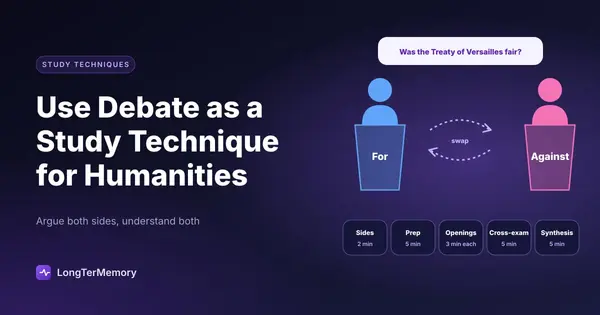
The Structured Study Debate Format
| Step | Time | What Happens |
|---|---|---|
| Topic assignment | 2 min | Each person picks a position (or you flip a coin for sides) |
| Prep time | 5 min | Each person notes their main arguments silently |
| Opening statements | 3 min each | Each person presents their core argument |
| Cross-examination | 5 min | Each person questions the other |
| Rebuttal | 2 min each | Each person addresses the critiques raised |
| Synthesis | 5 min | Both people together identify the strongest points on each side |
The whole thing takes about 25 minutes and covers a topic more thoroughly than an hour of solo reading. And the synthesis at the end is crucial, that’s where you’re jointly building the kind of balanced, nuanced understanding that gets high marks in humanities essays.
You don’t need to be formal about this. You don’t need a timer or a scorecard. What you do need is the commitment to actually argue opposite sides rather than just having a conversation where you both agree. The productive friction is the point.
What to Do If You Don’t Have a Study Partner
Not everyone has a willing debate partner. But you can approximate it in a few ways:
Write a dialogue. Create a short written dialogue between two fictional people arguing opposite sides of a position. This forces you to construct both arguments rigorously rather than just nodding at them as you read.
Use an AI tool for Socratic dialogue. You can prompt an AI to argue a position against you and probe your responses. It’s not quite the same as a real human, but it creates enough friction to expose gaps in your understanding. Tools like LongTerMemory can help you generate practice questions from your study materials, giving you the questioning framework even when no partner is available.
Record yourself. Argue a position out loud for three to five minutes and play it back. Listening to your own argument from the outside is uncomfortable, and that discomfort is informative. You’ll hear exactly where your logic gets fuzzy.
Using Devil’s Advocate Thinking to Test Your Understanding of Arguments
Devil’s advocate thinking is a specific technique where you deliberately generate the strongest possible objection to whatever position you’re studying. It’s slightly different from arguing both sides, because it’s not about giving fair time to the opposition. It’s about stress-testing your own understanding by throwing the hardest possible challenge at it.
This is incredibly useful for humanities exam prep because humanities questions are almost never looking for you to simply describe a position. They want you to evaluate it, and evaluation means knowing where the weaknesses are.
Here’s how to apply it systematically:
The Devil’s Advocate Loop
Take any theory, argument, or interpretation from your syllabus. State it clearly in one or two sentences. Then ask:
- What is the single strongest objection to this? Not a weak critique, the most devastating one you can imagine.
- What would a defender of this position say in response? This is where understanding gets deep.
- Does the response actually work, or does the objection still stand?
For example: if you’re studying Kant’s categorical imperative, the devil’s advocate objection might be that it produces absurd results in certain edge cases. How would a Kantian respond? What does that response reveal about the limits and strengths of the framework? Working through this loop once is worth more than re-reading the Critique of Pure Reason twice.
The reason this works so well in exams is that examiners in humanities subjects almost always write questions from the devil’s advocate position. “Critically evaluate…” and “To what extent do you agree…” are devil’s advocate prompts. They’re inviting you to stress-test the idea. If you’ve already done that stress-testing in your study sessions, the exam question feels like familiar territory rather than a surprise.
Applying Devil’s Advocate to Different Humanities Subjects
The technique adapts well across different subject areas:
History: For any major historical interpretation, ask what the revisionist view would be. What evidence would challenge the standard account? How would a historian from a different tradition read the same events?
Literature: For any critical reading of a text, ask what a resistant reader would say. What does the text resist doing that the interpretation claims it does? What counter-evidence exists within the text itself?
Philosophy: For any argument, apply Kant’s own test, ask whether it survives when universalized. Or ask what empirical data would refute it, if it’s the kind of claim that can be empirically tested.
Political theory: For any normative position, ask what it implies in practice and whether those implications are defensible. Most political theories sound reasonable in abstract form and run into trouble in application.
Turning Debate Practice Into Active Recall
One thing worth noting is that debate works best when combined with active recall, not as a replacement for it.
Before you can argue a position, you need to know the material well enough to work with it. That means doing your reading, making notes, and probably doing some initial retrieval practice to lock in the key concepts and names. Debate comes into its own once you have that foundation, because it forces you to do something with the knowledge rather than just storing it.
A good study rhythm for humanities subjects looks something like this:
- Read the material with genuine attention
- Close everything and write down what you remember (blank page recall)
- Check what you missed and fill gaps
- Use the debate techniques in this post to stress-test your understanding
- Schedule a spaced review session to revisit the material in a few days
This isn’t a quick shortcut. It takes real effort and engagement. But it’s also the kind of studying that means you actually know the material rather than just recognizing it when you see it.
LongTerMemory is built precisely for steps 2 through 5. It can transform your reading notes and uploaded materials into question-answer pairs and schedule those cards through spaced repetition so you’re reviewing at exactly the right intervals. Combined with debate practice for the higher-order critical thinking, it’s a complete system for humanities exam preparation.
The Kind of Understanding Debate Builds
Here’s what debate practice actually produces, in terms of the kind of knowledge you’ll have when you sit down in that exam room.
You’ll know why positions exist, not just what they are. You’ll know the strongest versions of arguments you personally disagree with. You’ll be able to move between positions fluidly, which is what “critically evaluate” questions demand. And you’ll be able to do that under time pressure, because you’ve practiced doing it under the social pressure of a debate.
That’s a fundamentally different kind of readiness than someone who has read the same texts repeatedly. They might be able to describe the positions. You’ll be able to argue with them.
Humanities subjects reward this. The students who consistently get the highest marks in history, philosophy, political theory, literature, and related fields are almost always the ones who engage with ideas actively, who read and argue and interrogate rather than just absorbing. Debate practice is the most direct way to build that capacity deliberately.
It doesn’t require special resources or elaborate setups. It requires a topic, a willingness to argue both sides, and ideally a partner who’ll push back. If you have those three things, you have one of the most effective study techniques available.
Start with whatever position you’re most certain about in your current syllabus. Then argue against it. See what you find.