How to Prepare for an Exam in 2 Weeks: A Science-Based Action Plan
Behind on studying? This 2-week exam prep plan uses the 3-phase input-elaboration-consolidation method to help you retain more in less time.
Table of Contents
- Why Most Last-Minute Study Plans Fail
- The 3-Phase Method: Input, Elaboration, and Consolidation
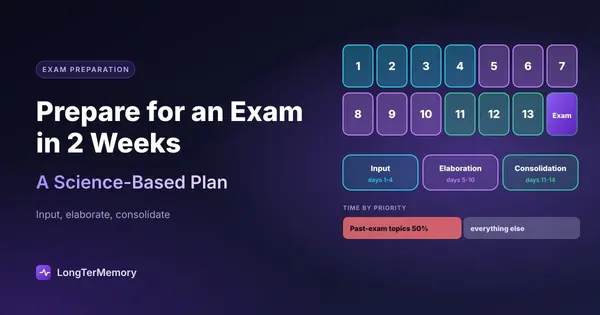
- Phase 1: Input (Days 1–4)
- Phase 2: Elaboration (Days 5–10)
- Phase 3: Consolidation (Days 11–14)
- How to Transform 200 Pages of Textbook into Effective Flashcards
- The Question-First Approach
- How to Process a Chapter Without Getting Overwhelmed
- Prioritizing at Scale
- Common Mistakes to Avoid During Your Final Pre-Exam Sprint
- Mistake 1: Switching to Passive Review When Stressed
- Mistake 2: Ignoring the Material You Find Most Difficult
- Mistake 3: All-Nighters Before the Exam
- Mistake 4: Treating All Study Sessions as Equal
- Mistake 5: Skipping Self-Assessment Until It's Too Late
- Putting It All Together: Your Day-by-Day Snapshot
- One Tool That Changes Everything
- The Bottom Line
Two weeks. That’s what you’ve got. Maybe you knew the exam was coming and kept telling yourself you’d start tomorrow. Maybe life just happened. Either way, you’re here now, staring at a pile of material that would make a reasonable person sweat, and you need a plan that actually works.
Here’s the thing: two weeks is not a lot of time, but it’s also not nothing. Used correctly, two weeks of focused, structured study can accomplish more than two months of half-hearted re-reading. The key word there is “correctly.” Most people default to the least effective study habits precisely when the pressure is highest , and that’s exactly what we’re going to prevent.
This is a science-based plan. Everything in here is grounded in what cognitive research actually shows about how the brain encodes, retains, and retrieves information. No motivational fluff, no productivity theater. Just a method that works, broken down into something you can actually follow.
Why Most Last-Minute Study Plans Fail
Before we get to the action plan, it’s worth understanding why the typical panic-study approach produces such poor results. Because if you understand the failure mode, you’ll be far less tempted to fall back into it.
The classic approach goes something like this: re-read the textbook chapter, review your notes, maybe make a summary document, repeat until the exam. It feels like studying. It produces the comforting sensation of engagement. And it barely works at all.
The problem is something psychologists call the fluency illusion , when you re-read material, it starts to feel familiar, and your brain interprets familiarity as understanding. But recognition and recall are completely different cognitive processes. The exam doesn’t show you information and ask if you recognize it. It gives you a blank page and asks you to produce it.
There’s also the spacing problem. Even students who study the right material often compress it all into massive sessions right before the exam. Long study sessions without breaks overwhelm working memory, trigger fatigue, and fail to trigger the memory consolidation that happens during sleep. The research on this is extremely consistent: distributed practice dramatically outperforms massed practice, even when the total study time is identical.
The two-week plan below is specifically designed to avoid both of these traps.
The 3-Phase Method: Input, Elaboration, and Consolidation
The most useful framework for a compressed exam prep window is a three-phase approach, each with a distinct cognitive goal. Think of it as moving material through a pipeline , from the outside world into your head, from your head into a deeper network of understanding, and from that network into stable long-term memory.
Phase 1: Input (Days 1–4)
The first phase is about getting oriented. You’re not trying to memorize anything yet , you’re mapping the territory.
Day 1: Triage your materials. Gather everything. Lecture slides, textbook chapters, past assignments, old exams if you can find them. Then do something most people skip: figure out what actually matters. Check the syllabus, look at past exam formats, ask yourself which topics appear repeatedly. Not all material carries equal weight, and you don’t have time to treat it all the same.
Make a list of topics in rough priority order. This is your study agenda.
Days 2–4: Active first pass through the material. Here’s the key distinction from passive re-reading: as you go through each section, your job is not to understand everything , it’s to extract questions. For every concept, definition, or process, write down a question that would test it. This does two things simultaneously: it forces you to engage with the material at a deeper level, and it starts building the flashcard deck you’ll use in Phase 2.
Some people find it easier to do this on paper. Others prefer digital tools. Either works. What matters is that you’re generating something, not just consuming.
By the end of Day 4, you should have:
- A rough map of the whole syllabus
- A set of questions covering the most important content
- A realistic sense of where your knowledge gaps are
Phase 2: Elaboration (Days 5–10)
This is the core of the plan. Phase 2 is where the actual learning happens, and it’s built around two techniques that have the strongest evidence base in cognitive science: active recall and spaced repetition.
Active recall means testing yourself , answering questions from memory , rather than re-reading. Every time you successfully retrieve a piece of information, you strengthen the neural pathway associated with it. Every time you try and fail, you create a gap that gets filled more effectively when you check the correct answer. Either way, you’re learning more efficiently than passive review allows.
Spaced repetition means reviewing material at increasing intervals based on how well you know it. The principle is backed by decades of research on spaced practice, first formalized by Hermann Ebbinghaus in the 1880s: memory decays exponentially after learning, but each successful retrieval resets the clock and slows future decay. By reviewing items just before you’d normally forget them, you maximize retention per unit of time.
The practical routine for Phase 2 looks like this:
Each day (Days 5–10), do two things:
-
New material session (45–60 minutes): Pick one topic cluster from your priority list and go through it using active recall. Attempt to answer each question you generated in Phase 1 before checking. When you get one wrong, note it , it goes into the “struggling” pile.
-
Review session (30–45 minutes): Go back through questions from previous days, focusing heavily on the ones you got wrong or found difficult. Skim the ones you consistently nail , they don’t need as much attention.
This might sound simple, and it is. The simplicity is the point. You’re not looking for complex systems , you’re looking for a sustainable rhythm that compounds over six days.
Phase 3: Consolidation (Days 11–14)
By Day 11, you should have covered all the major material at least once through active recall, and you should have a much clearer picture of where your gaps are. The final phase is about closing those gaps and locking in what you’ve learned.
Days 11–12: Targeted drilling. Focus almost entirely on the material you’ve identified as weak. Pull out your “struggling” flashcard pile. Work through practice problems in the areas where you’re least confident. If you have old exams, use them now , under realistic conditions, with the answers hidden.
Day 13: Integration. Rather than drilling specific facts, spend this day doing higher-level synthesis. Can you explain the relationship between different concepts? Can you outline the major themes without notes? Can you teach the core ideas out loud? This kind of integration work helps your brain connect what it knows into a more accessible network.
Day 14: Light review and rest. This is not the day for cramming. Your brain needs sleep to consolidate what you’ve built over the past two weeks. Do a final light pass through your most difficult areas, then stop. Get a full night’s sleep. The research on sleep and memory consolidation is clear: the hours you spend sleeping before an exam are not wasted hours , they are the hours when your brain actually does the filing.
How to Transform 200 Pages of Textbook into Effective Flashcards
One of the most practical challenges in any compressed study window is turning a huge volume of material into something you can actually test yourself on. Here’s a method that works at scale.
The Question-First Approach
Most people make flashcards by writing facts on one side and answers on the other. That works, but there’s a better version: write a question on the front that could actually appear on your exam. This forces you to think about what the examiners care about, not just what you happen to find interesting.
Compare these two flashcards:
| Version | Front | Back |
|---|---|---|
| Fact-based | Mitochondria | Produces ATP via cellular respiration |
| Question-based | What is the role of mitochondria in energy production? | They generate ATP through cellular respiration, using oxygen to convert nutrients into usable energy |
The second version is better for three reasons: it mirrors exam format, it requires a more complete response, and it includes enough context that reviewing it tells you whether you actually understand the concept or just recognize the word.
How to Process a Chapter Without Getting Overwhelmed
Here’s a process for working through a dense chapter efficiently:
-
Skim first (10 minutes). Read headings, subheadings, summary boxes, and any highlighted terms. Don’t read the full text yet. Build a skeleton.
-
Identify testable content. What are the definitions, processes, dates, mechanisms, arguments, or formulas? These are your flashcard candidates. Mark them or list them , don’t write the cards yet.
-
Write questions, not facts. For each testable item, write a question a professor might actually ask. “What causes X?” beats “X” every time.
-
Back-fill your answers. Now read the relevant section properly and write the answer. Keep it concise but complete.
-
Add one example or application. The best flashcards include a concrete example. Concepts connected to examples are significantly easier to retrieve under pressure.
If your exam is much sooner than two weeks away, you can compress this same process into a single day. See our guide on how to read 100 pages in a day for a step-by-step emergency plan.
Prioritizing at Scale
If you’re genuinely looking at 200 pages with two weeks on the clock, you cannot treat all of it equally. Use this rough framework:
| Priority | Content type | Time allocation |
|---|---|---|
| High | Topics from past exams or practice tests | 50% |
| Medium | Core concepts repeated in lectures and readings | 35% |
| Low | Peripheral detail, single-mention material | 15% |
This isn’t about skipping material , it’s about being honest that your time is a finite resource and allocating it intelligently.
Common Mistakes to Avoid During Your Final Pre-Exam Sprint
Even with the right framework, a few consistent errors can undermine two weeks of solid work. These are the ones that show up most often.
Mistake 1: Switching to Passive Review When Stressed
Stress makes passive review feel safe. Re-reading is easy, familiar, and produces the sensation of productivity. When anxiety spikes , usually in the last few days , there’s a powerful pull toward going back over your notes one more time rather than testing yourself.
Resist this. The discomfort of active recall is not a sign that you’re doing it wrong. It’s the sign that you’re doing it right. The struggle of trying to retrieve something and failing is more learning than successfully recognizing it in your notes.
Mistake 2: Ignoring the Material You Find Most Difficult
Here’s a counterintuitive truth: the flashcards you hate are the most valuable ones. Most people gravitate toward drilling the content they’re already comfortable with, because getting answers right feels good. But you are not spending your study time to feel good , you’re spending it to pass an exam.
If you consistently get a card right, you can review it less frequently. If you’re consistently getting something wrong, that’s where your time should go. Force yourself to sit with the uncomfortable material.
Mistake 3: All-Nighters Before the Exam
This one is worth stating plainly because the temptation is real: an all-nighter before an exam is almost always counterproductive. Sleep is not optional for memory. It’s when your hippocampus replays and consolidates the day’s learning into longer-term storage. Cutting that process short for an extra four hours of studying is a poor trade-off in virtually every scenario.
If you’ve followed the two-week plan, you don’t need an all-nighter. If you haven’t, an all-nighter won’t save you , it’ll just make you more cognitively impaired during the exam itself.
Mistake 4: Treating All Study Sessions as Equal
A 90-minute session with focused active recall and genuine effort is not equivalent to 90 minutes of distracted, phone-interrupted, passive reading. The research on deliberate practice consistently shows that quality of engagement matters more than raw time.
This means: close other tabs. Put the phone in another room. Treat each study block as a finite, focused resource. Shorter sessions with real intensity beat longer sessions with constant context-switching.
Mistake 5: Skipping Self-Assessment Until It’s Too Late
One of the most valuable things you can do in the first few days of a two-week plan is figure out exactly how bad the situation is. Take a practice test. Try to recall the major topics from memory. See what actually sticks.
Most people avoid this because it’s uncomfortable to confront what they don’t know. But discovering a gap on Day 3 gives you 11 days to close it. Discovering it on Day 13 gives you almost nothing.
Putting It All Together: Your Day-by-Day Snapshot
Here’s a simplified overview of the full two-week plan:
| Days | Phase | Focus |
|---|---|---|
| 1 | Input | Triage materials, identify priorities |
| 2–4 | Input | Active first pass, generate questions/flashcards |
| 5–10 | Elaboration | Daily new material + spaced review sessions |
| 11–12 | Consolidation | Targeted drilling on weak areas |
| 13 | Consolidation | Integration and synthesis |
| 14 | Consolidation | Light review, sleep |
If you only have one day left instead of two weeks, use our guide on how to memorise chapters for an exam in one day instead.
This is not a rigid script , real life will require adjustments. But the structure matters. Each phase serves a distinct cognitive purpose, and skipping from input directly to consolidation misses the elaboration step where deep learning actually happens.
One Tool That Changes Everything
The single biggest friction in this plan is the logistics of spaced repetition. Manually tracking which cards to review, when, and how frequently is genuinely cumbersome if you’re doing it by hand.
This is where AI-powered flashcard tools become genuinely useful , not as a shortcut, but as a logistics solution. Platforms like LongTerMemory can automatically generate question-answer pairs from your PDFs and notes, and handle the scheduling of reviews so you’re always seeing the right card at the right time. You don’t have to spend cognitive energy managing the system. You just study.
The method still requires your effort and attention. But removing the overhead of building and scheduling hundreds of flashcards manually means you can spend more of your two weeks on the thing that actually matters: retrieval practice.
The Bottom Line
Two weeks is not ideal. But it’s workable if you’re willing to study the right way rather than the easy way.
The three-phase method gives you a structure that respects how memory actually functions: you can’t cram elaboration and consolidation into the last 48 hours and expect it to stick. You need the full arc , input, elaboration, consolidation , even if each phase is compressed.
The most important mindset shift is this: discomfort during studying is a feature, not a bug. If your review sessions feel hard , if you’re struggling to pull answers out of your head, if you’re getting flashcards wrong , that’s evidence that real learning is happening. Passive review that feels easy is the thing to worry about.
You have two weeks. Use them.