
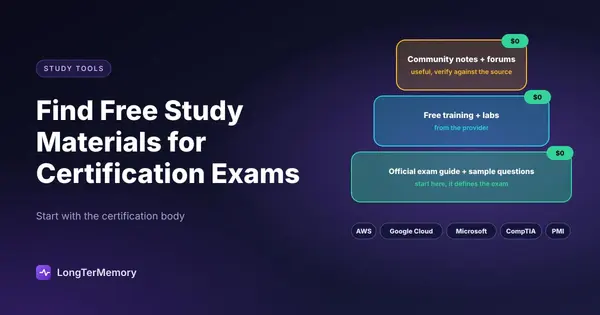
How to Find Free Study Materials for Certification Exams
Discover official free resources from certification bodies, the best community decks and guides, and how to evaluate free materials before trusting them.
Table of Contents
- Official Free Resources From Certification Bodies Themselves
- Why Start With the Source
- AWS Certifications
- Google Cloud Certifications
- Microsoft Azure and Microsoft Certifications
- CompTIA Certifications (A+, Network+, Security+, etc.)
- PMI (PMP, CAPM, etc.)
- Medical and Legal Certifications
- Community-Shared Decks, Guides, and Notes for Major Certifications
- Anki Decks From the Community
- Reddit Communities
- GitHub Repositories
- YouTube Channels
- Free Textbooks and Open Educational Resources
- How to Assess the Quality of Free Certification Study Materials
- Check the Exam Version and Date
- Triangulate Against Official Materials
- Look for Pass Rate Reports
- Check the Depth and Coverage
- For Anki Decks: Review a Sample Before Committing
- Combining Free Resources Into a Study System
- The Bigger Picture
Certification exams can cost hundreds of dollars just to sit for. Add prep courses, practice test subscriptions, and textbooks, and the total price of earning a professional certification can easily climb past a thousand dollars before you’ve answered your first exam question.
But here’s something the prep industry doesn’t exactly shout from the rooftops: there are genuinely high-quality free resources for almost every major certification exam. You don’t always need the expensive course to pass. What you need is to know where to look and how to evaluate what you find.
This guide covers exactly that.
Official Free Resources From Certification Bodies Themselves
This is the most underused category of free study material, and it’s often the most reliable.
Why Start With the Source
Certification bodies design the exams. That means their own published materials, even when free, are authoritative in a way that third-party content can’t match. When there’s a discrepancy between what AWS says in its official documentation and what a prep course says, the official documentation is right.
Many organizations publish surprisingly generous free resources because it’s in their interest for candidates to be prepared and to pass. A certification with a reputation for being fair and achievable attracts more candidates. Certification bodies don’t benefit from trick questions or obscure materials.
AWS Certifications
AWS provides an extensive free study ecosystem:
- AWS Skill Builder: AWS’s own learning platform offers free digital courses for every certification, including exam-specific preparation paths. The free tier provides hundreds of hours of video content and some practice question sets.
- AWS Whitepapers: freely available at the AWS documentation site. For specialty certifications, the relevant architecture and best-practice whitepapers are essentially required reading and contain more depth than most paid courses.
- AWS FAQs: the FAQ pages for each service are unexpectedly useful for exam prep. They’re written to answer the exact “why would you use this instead of that” questions that AWS exams test.
- AWS Sample Questions: every certification page includes sample questions that reflect the style and difficulty of actual exam items. These are small in number but worth careful analysis.
- AWS Re:Post and re:Invent sessions: community Q&A and recorded conference talks are excellent for understanding how services are actually used in production scenarios.
Google Cloud Certifications
Google Cloud’s learning platform includes free study content for its certification tracks:
- Google Cloud Skills Boost: offers free learning paths for each certification, with hands-on labs available through a free credits program.
- Google Cloud documentation: like AWS, the official docs are thorough and exam-relevant. The “best practices” and “concepts” sections of service documentation are particularly useful.
- YouTube: Google Cloud’s official YouTube channel publishes exam prep videos and technical deep-dives freely.
Microsoft Azure and Microsoft Certifications
Microsoft has one of the more generous free learning ecosystems:
- Microsoft Learn: the free official learning platform covers all Azure and Microsoft 365 certifications with structured learning paths, sandbox environments for hands-on practice, and knowledge checks.
- Microsoft documentation: comprehensive and continuously updated. For Azure certifications, the documentation is often more useful than any paid course for understanding service behavior and limits.
- Practice assessments on Microsoft Learn: Microsoft now offers free practice assessments directly on the Learn platform for many certifications. These are legitimately useful for gauging readiness.
CompTIA Certifications (A+, Network+, Security+, etc.)
CompTIA publishes:
- Exam objectives documents: freely downloadable PDFs that list every topic covered on each exam. Use these as the table of contents for your study plan.
- Sample questions: available on the CompTIA website for each certification.
- CertMaster Learn trial: CompTIA offers limited free access to its CertMaster platform.
Community resources are particularly strong for CompTIA certifications, with active subreddits, free Professor Messer video courses for A+ and Security+, and extensive free content on YouTube.
PMI (PMP, CAPM, etc.)
PMI publishes:
- PMBOK Guide: officially, PMP candidates need a copy of the PMBOK Guide. PMI members get it free as part of membership. Student membership is significantly cheaper than a full professional membership and includes PMBOK access.
- Exam content outlines (ECOs): free PDF documents that define what each exam tests. Essential for structuring your study.
- PMI Learning: PMI’s online platform has some free introductory content.
For PMP specifically, the PMI membership cost is typically worth it given the PMBOK access and the discount on the exam itself.
Medical and Legal Certifications
For USMLE, NCLEX, bar exam, and similar high-stakes professional exams, official free resources are more limited, but they exist:
- NBME: publishes free sample USMLE Step questions and offers some free practice materials on its website.
- NCLEX: NCSBN (the organization that administers NCLEX) provides a free practice exam and study resources on its website.
- Bar exam: the NCBE provides free practice MBE questions on its website. Many individual state bars publish past essay questions with model answers.
Community-Shared Decks, Guides, and Notes for Major Certifications
The certification prep community is remarkably generous. For virtually every major certification, candidates who’ve passed share what worked for them.
Anki Decks From the Community
AnkiWeb hosts a public shared deck repository where thousands of exam-specific decks are available for free download. Quality varies significantly, which is why the evaluation section below matters, but the best community decks are genuinely excellent.
Particularly well-regarded freely available decks include:
- Anking for USMLE: considered one of the best resources for medical board prep, created and maintained by a community of medical students
- Various AWS certification decks: search AnkiWeb by certification name to find current decks
- Zanki and derivative decks for various medical school topics
For most certifications, searching “[exam name] Anki deck Reddit” will surface current community recommendations faster than browsing AnkiWeb directly.
Reddit Communities
Reddit hosts active communities for virtually every certification:
- r/AWSCertifications, r/aws
- r/CompTIA, r/ccna
- r/PMP
- r/medicalschool, r/Step1, r/Step2
- r/barexam
How to use Reddit for exam prep: search for “[certification name] passing score” or “[certification name] study plan” to find detailed post-mortems from candidates who’ve recently passed. These often contain specific resource recommendations, timeline guidance, and honest assessments of what was and wasn’t worth the time. They’re more up-to-date than any book and more honest than any course sales page.
GitHub Repositories
For technology certifications (AWS, Azure, GCP, Kubernetes, etc.), GitHub hosts free study guides, cheat sheets, and practice question collections. Searching “[certification name] study guide site:github.com” often turns up high-quality repositories with substantial content.
The awesome-aws and similar awesome-list repositories compile curated links to free resources across AWS services and are useful for building a comprehensive study resource list.
YouTube Channels
For many certifications, high-quality free video courses are available on YouTube:
- Professor Messer: free CompTIA A+, Network+, and Security+ video courses
- FreeCodeCamp: certification prep courses for various technology certifications
- Andrew Brown (ExamPro): extensive free AWS certification content
- John Savill’s Technical Training: deep Azure and Microsoft certification content
- Simplilearn and Edureka: various certification prep series, though quality varies
For non-technology certifications, PMP, SHRM, CFA, and similar credentials have active YouTube communities producing free content.
Free Textbooks and Open Educational Resources
- OpenStax: free peer-reviewed textbooks for subjects like accounting, economics, and statistics that underpin many professional certifications
- MIT OpenCourseWare: free lecture notes and materials from MIT courses on subjects relevant to many technical certifications
- Khan Academy: genuinely useful for shoring up foundational knowledge in quantitative areas (finance, statistics, mathematics) that underpin professional certifications
How to Assess the Quality of Free Certification Study Materials
The abundance of free materials creates its own problem: some are excellent, some are outdated, some are just wrong. Using bad study materials is worse than using no materials, because you may confidently learn incorrect information.
Here’s how to evaluate what you find:
Check the Exam Version and Date
Certification exams are updated regularly. AWS updates exam content annually. CompTIA certifications have versioned editions. PMI revamped the PMP exam significantly in 2021. A study guide that was excellent in 2022 may be substantially wrong for the current exam.
Before committing to any free resource, check:
- Which exam version it covers (look for this explicitly in the resource)
- When it was last updated (GitHub commit history, Reddit post date, YouTube upload date)
- Whether the certification organization has updated the exam since the resource was created
Triangulate Against Official Materials
For any fact, framework, or guidance from a free community resource, check it against the official documentation or exam objectives. If a free deck says “DynamoDB GSIs support strongly consistent reads,” verify this against AWS documentation (it’s actually false, they don’t). Using official sources to verify community materials keeps you from learning exam-wrong information.
Look for Pass Rate Reports
On Reddit and other communities, candidates who use a resource and pass often credit it in their post-mortems. Conversely, candidates who felt unprepared will often note what was missing. A resource with multiple recent positive reports from successful candidates is far more trustworthy than one with limited community validation.
Check the Depth and Coverage
Compare the resource against the official exam objectives or content outline. Does it cover all the domains? Are the explanations superficial or genuinely explanatory? A good study resource explains why answers are right or wrong, not just which answer is correct.
Flashcard decks that just list definitions without context are less valuable than those with scenario-based questions and explanatory notes.
For Anki Decks: Review a Sample Before Committing
Before adding a 2,000-card community Anki deck to your review queue, browse through 50 to 100 cards manually. Look for:
- Current and accurate content
- Well-formed questions (not ambiguous or testing trivia)
- Appropriate card complexity (not so brief they’re useless, not so long they’re unmanageable)
- Evidence the deck has been recently maintained (notes section, creation date)
A poor-quality deck will waste weeks of daily review time. Spend 20 minutes evaluating before you commit.
Combining Free Resources Into a Study System
The most effective approach for most certifications is to layer free resources:
- Official documentation and exam objectives as the authoritative content source
- Community-recommended Anki deck or free course for structured learning
- Reddit post-mortems from recent successful candidates for strategy and prioritization
- YouTube lectures for concepts that benefit from visual explanation or demonstration
- Practice questions from free official samples plus community-contributed question sets
This combination covers the full range of learning modes, from conceptual understanding to active recall practice, without spending money on a single prep course.
If you want to incorporate your own notes and materials into a spaced repetition system, LongTerMemory can take your PDFs, highlights, and study notes and automatically convert them into a flashcard deck with optimized review scheduling. This is particularly useful when you’re pulling content from multiple free sources and want a unified review system rather than juggling five different tools.
The Bigger Picture
The certification prep industry is built on the assumption that candidates need expensive courses to pass. Many don’t. The community of people who’ve already earned the certification you’re pursuing has collectively documented what works, what doesn’t, and where to find the best free materials.
Your job is to find those resources, evaluate them honestly, combine them into a coherent study system, and show up consistently to review and practice.
The certification you’re working toward is achievable without breaking the bank. The free resources are out there. Now you know how to find them.