How to Memorize Everything You Read Quickly
Discover the encode-retrieve loop and a 3-step system to actually memorize everything you read, not just skim it.
Table of Contents
- Why Reading Once Is Never Enough to Memorize
- The Illusion of Understanding
- How Your Brain Actually Stores What You Read
- The Encode-Retrieve Loop: Turning Reading Into Lasting Memory
- What Encoding Actually Means
- The Role of Retrieval in Cementing Memories
- How the Loop Works in Practice
- A 3-Step System for Memorizing Everything You Read
- Step 1: Read With Intent (The Pre-Question Method)
- Step 2: Retrieve Before You Move On
- Step 3: Schedule Your Reviews
- Why Most People Don't Do This (And Why You Should Anyway)
- How to Apply This to Different Types of Material
- Textbooks and Academic Papers
- Professional Reports and Non-Fiction Books
- Technical Documentation and Manuals
- Dense Scientific Literature
- Building the Habit: Making This Automatic
- The Bottom Line
You’ve been there. You read an entire chapter, reach the last line, and realize you couldn’t summarize what you just read to save your life. Not a single concept stuck. You flip back to the beginning and try again, maybe with a highlighter this time, and the same thing happens. The words pass through your eyes and straight out the other side without leaving a mark.
This isn’t a sign that you’re bad at studying or that the material is too hard. It’s a sign that you’re using the wrong process entirely. Reading and memorizing are not the same thing, and treating them as if they are is the most common mistake students and professionals make.
The good news is that once you understand how memory actually works , and build a reading system around it , you can dramatically change how much you retain from everything you read. Not someday, but starting with your next session.
Why Reading Once Is Never Enough to Memorize
Let’s start with the uncomfortable truth: the human brain was not designed to remember text. It was designed to remember experiences, patterns, threats, rewards, and social information. When you sit down and read a textbook or a report, you’re asking your brain to do something fundamentally unnatural , convert a stream of abstract symbols into long-term memories.
The Illusion of Understanding
Here’s what actually happens when you read. Your brain processes the words as a stream of meaning, generating something that feels like understanding in real time. You read a sentence, you get it, you move on. The problem is that this sense of understanding is extremely shallow.
Cognitive psychologists call this the fluency illusion. The more familiar text becomes , after a second reading, or during a slow, careful first reading , the more confident you feel that you’ve learned it. But familiarity and memory are two completely different things. You can recognize something perfectly and still be completely unable to recall it when there’s nothing in front of you.
This is why re-reading is such an ineffective study strategy. You read something, it starts to feel familiar, your confidence goes up , and then you sit down for a test with no notes in front of you and the information is simply gone. It was never encoded in the first place. It just felt like it was.
How Your Brain Actually Stores What You Read
For information to become a long-term memory, it has to go through a process called encoding. This isn’t passive , it requires mental effort, and it requires you to do something with the information, not just consume it.
Research on the levels of processing effect shows that the depth at which you process information directly predicts how well you’ll remember it. Shallow processing (reading the words, noting how they look or sound) produces weak, short-lived memories. Deep processing (connecting ideas, generating examples, asking questions, paraphrasing) produces strong, lasting memories.
Reading once, even carefully, is almost always shallow processing. You’re following the author’s logic, not generating your own. And your brain stores what you generate far better than what you passively receive.
The solution, then, is to build retrieval into your reading process , which brings us to the core concept behind memorizing everything you read.
The Encode-Retrieve Loop: Turning Reading Into Lasting Memory
The single most important shift you can make is understanding that reading and memorizing need to be two separate activities, and both need to happen during the same session.
What Encoding Actually Means
Encoding happens when your brain takes incoming information and connects it to something it already knows. The richer the connection, the stronger the memory.
There are a few ways to trigger deep encoding while reading:
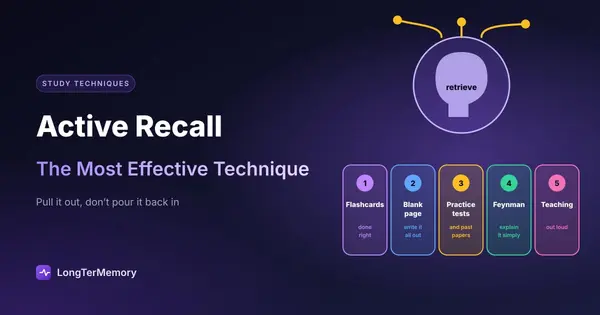
- Paraphrase in your own words: After each section, close the book and summarize what you just read without looking. The struggle to find your own words forces your brain to actually process the information.
- Ask why and so what: Don’t just accept what the text says. Ask yourself why it matters, how it connects to other things you know, what it changes about your understanding.
- Generate examples: For every concept, come up with your own example , ideally something from your life or field. This creates a personal hook that makes the memory concrete.
- Make predictions: Before reading a new section, predict what it will say based on the heading. This creates a mental framework the information fits into.
None of these take much time. But each one transforms passive reading into active encoding.
The Role of Retrieval in Cementing Memories
Here’s the key insight that most people miss: encoding is not enough on its own. Even well-encoded information fades quickly if you never retrieve it.
Retrieval practice , the act of pulling information out of your memory , doesn’t just test what you know. It actually strengthens the memory itself. Every time you successfully retrieve something, your brain marks it as important and consolidates it more deeply. Every time you fail to retrieve it and then look it up, that “desirable difficulty” also creates a stronger trace than if you’d just re-read the material.
So the process isn’t just read → encode. It’s read → encode → retrieve → encode more deeply. That loop is what separates people who remember what they read from people who don’t.
How the Loop Works in Practice
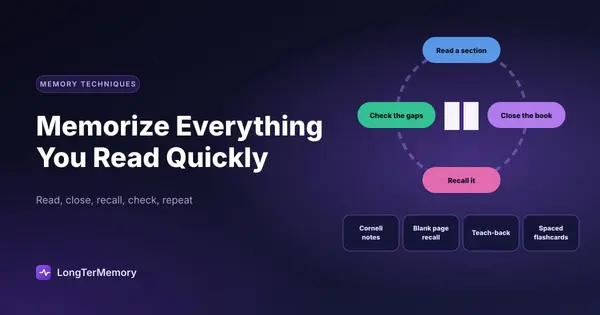
In a practical reading session, the encode-retrieve loop looks like this:
- Read a section (not the whole chapter , a coherent chunk of a page or two)
- Close the book / look away from the screen
- Write or say aloud everything you can recall from that section
- Check what you missed
- Pay extra attention to the gaps on your next read-through
- Before moving to the next section, do one more quick recall check on the previous one
That’s it. This process takes maybe 20–30% longer than just reading straight through , but it produces results that passive reading simply cannot achieve.
A 3-Step System for Memorizing Everything You Read
The encode-retrieve loop is the core mechanism, but let’s turn it into a complete, repeatable system you can use for any material.
Step 1: Read With Intent (The Pre-Question Method)
Before you read a single word of a section, generate questions. Look at the heading and turn it into a question. If the heading is “The Role of Dopamine in Motivation,” your question becomes: What role does dopamine play in motivation? If there’s no heading, skim the first sentence or two and ask: What is this section going to explain?
These pre-questions do something powerful: they give your brain a target. Instead of processing text passively, your brain is now actively looking for the answer to a specific question. This improves comprehension and triggers deeper encoding almost automatically.
Write your pre-questions in a notebook before each section. You’ll use them again in Step 2.
Quick tip: If you’re working with a textbook, the discussion questions or review questions at the end of each chapter are gold for this step. Use them before you read, not after.
Step 2: Retrieve Before You Move On
After each section, before you turn the page or scroll down, close the material and answer your pre-questions from memory. Don’t just think the answer , write it. Writing forces you to be more precise and complete than mentally confirming “yeah, I know this.”
This is the moment where most of the real learning happens. The act of trying to recall the answer, finding partial information, filling gaps , this is active encoding. Your brain is forced to construct the knowledge rather than just recognize it.
A few variations that work well:
| Method | How it works | Best for |
|---|---|---|
| Cornell Notes | Divide page into questions/answers columns | Lecture-style material |
| Blank Page Recall | Write everything you remember on a blank page | Dense conceptual reading |
| Teach-Back | Explain the section out loud as if to someone else | Procedural or scientific content |
| Spaced Flashcards | Convert key points into flashcard Q&A | Terminology-heavy material |
Choose the method that fits your material. The important thing is that retrieval happens before you continue reading.
Step 3: Schedule Your Reviews
The most memorized information in the world is forgotten if you don’t revisit it. Your brain follows a predictable forgetting curve , within 24 hours of reading, most of the details fade dramatically unless you intervene.
The intervention is simple: schedule review sessions. The first one should happen within 24 hours of the original reading. Then again after 3 days. Then after a week. Then after two weeks. Each review should be active retrieval , test yourself before you look anything up.
This pattern is based on spaced repetition, which is the most evidence-backed approach to long-term retention that exists. You’re reviewing information just before you’d naturally forget it, which forces another retrieval and extends the memory’s lifespan significantly.
If you want this automated, tools like LongTerMemory can do the scheduling for you , you upload your PDF or notes, it generates flashcards automatically, and then the app handles the spaced review schedule so you never miss an optimal review window. This is especially useful if you’re covering large volumes of material across multiple subjects.
Why Most People Don’t Do This (And Why You Should Anyway)
The system above isn’t complicated. But it’s also not how most people read, and there are a few reasons for that.
It’s slower in the short term. Sitting down to actively recall takes more time than just moving through pages. For students under time pressure, this feels counterproductive. But it’s a classic case of false efficiency , reading faster and retaining nothing is actually slower in the long run, because you end up reading the same material three or four times anyway.
It’s uncomfortable. Closing the book and trying to recall something you just read is frustrating, especially when your mind goes blank. Most people interpret this blankness as evidence they didn’t understand the material and immediately re-read. But the blankness is actually the point , sitting with it and working through it is exactly where learning happens.
It feels less productive. Flipping pages feels like progress. Staring at a blank notebook trying to reconstruct a concept you read five minutes ago feels like struggling. But research is clear: struggle during learning is a feature, not a failure. It’s called desirable difficulty, and the outcomes it produces are dramatically better than smooth, fluent re-reading.
How to Apply This to Different Types of Material
The encode-retrieve loop is universal, but how you apply it varies by material type.
Textbooks and Academic Papers
These typically have defined sections with clear structure. Pre-questions map perfectly onto headings and subheadings. After each section, do a blank-page recall. After each chapter, generate 10–15 questions from the material and answer them the next day without notes.
For biology textbooks specifically, combine this encode-retrieve approach with visual techniques like blank diagram reproduction. See our guide on how to memorize biology fast for a subject-specific workflow.
For material that must be recalled in a specific order, such as speeches, processes, or numbered lists, combine the encode-retrieve loop with the memory palace technique to anchor each item to a familiar spatial path.
Professional Reports and Non-Fiction Books
For narrative non-fiction or business content, the structure is less predictable. Focus on main arguments rather than details. After each chapter, summarize the central argument in one sentence and list three supporting points. If you can’t do that without looking, you haven’t encoded it yet.
Technical Documentation and Manuals
For code documentation, legal text, or medical material, the details matter enormously. Flashcards work well here. After reading a section, convert each key fact or procedure into a card with a question on one side and the answer on the other. Then drill those cards using spaced repetition.
Dense Scientific Literature
For journal articles or highly technical content, apply the “annotate and retrieve” method. As you read, write brief marginal questions in pencil. When you finish a section, answer each question without looking. For particularly dense material, don’t expect to encode everything in one session , plan for two or three passes with retrieval practice between each one.
Building the Habit: Making This Automatic
The best study system is one you actually use. Consistency beats intensity almost every time, and that means building this process into your daily routine rather than relying on willpower to apply it.
A few things that help:
- Start small: Don’t overhaul your entire reading process at once. Pick one subject or one reading session and apply the retrieve-before-continuing rule. Get comfortable with it before expanding.
- Use a timer: Set a timer for each read-and-recall cycle. Fifteen minutes of reading, then five minutes of retrieval. The time pressure keeps you focused and prevents passive drifting.
- Keep a retrieval notebook: Dedicate one notebook (or one document) specifically to your recall attempts. This creates a written record of what you could and couldn’t retrieve, which is incredibly useful for identifying where to focus your reviews.
- Pair with LongTerMemory or another spaced repetition tool: Manual review scheduling is hard to maintain. An app that handles the timing means you spend your mental energy on the actual learning, not on logistics.
The goal isn’t perfection. The goal is to make active encoding and retrieval the default way you read, rather than the exception.
The Bottom Line
If you want to memorize everything you read, the answer isn’t to read more carefully, read slower, or highlight more aggressively. The answer is to stop treating reading as learning and start treating it as the first step in a process that requires retrieval.
Read a chunk. Close the book. Recall it. Check what you missed. Schedule a review. That loop, applied consistently, transforms reading from a passive activity where information washes over you into an active one where memories are built deliberately.
You already have everything you need to start. The next time you sit down with a book, a paper, or a set of notes, try it for one section. Notice how it feels different. Notice how much more you can recall. And then ask yourself why you ever read any other way.