How to Memorize Things You Don't Understand
Learn when and how to memorize first and understand later, using surface anchors, context clues, and review strategies to build comprehension over time.
Table of Contents
- When Memorizing Without Understanding Is Actually Fine
- Surface Anchors: Building a Memory Hook Without Deep Understanding
- The Sound-Alike Method
- The Structural Bracket
- Positional Memory
- First-Pass Memorization: How to Do It
- Read for Structure, Not Meaning
- Convert to Minimal Units
- Use Maximum Sensory Encoding
- Flagging Confusion: The Confusion Log
- Using Review Sessions to Convert Surface Memory to Understanding
- The "Why?" Challenge
- The Connection Drill
- The Application Test
- Honest Limitations: What Surface Memorization Can't Do
- When to Give Up and Go Back to Basics
- The Bottom Line
Conventional wisdom says you should always understand something before you memorize it. Understanding creates meaning, meaning creates connections, connections make memories durable. All of that is true.
But conventional wisdom isn’t terribly helpful when you’re looking at a biochemistry pathway that reads like a foreign language, or a legal statute packed with references to other statutes that reference other statutes, or a piece of advanced mathematics where you genuinely can’t tell what anything means yet. Sometimes you simply don’t understand something , and you still need to remember it for the exam next week.
This is a real situation that real students face, and “go back and understand it first” isn’t always a practical answer. Sometimes the course moves too fast. Sometimes the prerequisite knowledge is shaky. Sometimes the concept is genuinely complex and understanding will develop over weeks of exposure , but the exam is in days.
So here’s the honest guide to memorizing things you don’t understand. When to do it, how to do it, and how to use the memorization itself as a bridge toward eventual understanding.
When Memorizing Without Understanding Is Actually Fine
Before getting into the how, let’s be clear about the when , because this strategy has real limits, and applying it indiscriminately will create more problems than it solves.
Memorizing without understanding is appropriate when:
- The material is definitional or terminological , you need the names, labels, and categories before you can understand the system they describe
- Understanding requires more exposure time than you currently have
- The exam tests recall of specific facts rather than application
- The content is foundational, and memorizing it now will allow understanding to develop as you encounter it repeatedly
- You’re in an early stage of learning a new subject where concepts are genuinely opaque before the bigger picture clicks
Memorizing without understanding is not appropriate when:
- The exam requires applying, analyzing, or reasoning with the material (you can’t fake this through rote memorization)
- The material is a stepping stone and you’ll be building on it for months
- You have enough time to develop genuine understanding
The key insight from cognitive science is that understanding and memorization are not sequential , they’re iterative. You don’t always understand first and then memorize. Sometimes you memorize the form of something, and understanding emerges through repeated exposure. Metacognition , your awareness of your own understanding , is what allows you to monitor this process and know when surface memorization is serving you and when it’s a dead end.
Surface Anchors: Building a Memory Hook Without Deep Understanding
A surface anchor is a memorization technique that doesn’t require understanding the content , it just requires finding a hook that the memory can attach to.
The Sound-Alike Method
When you encounter an unfamiliar term or formula that means nothing to you, find something it sounds like and build an image around that sound.
For example, if you’re memorizing that the Krebs cycle produces NADH, FADH₂, and ATP, and you don’t yet understand the biochemistry:
- “Krebs” sounds like “crabs”
- Picture crabs carrying three types of treasure (NADH, FADH₂, ATP) on their backs
- The image is bizarre and visual, which makes it memorable even without understanding what NADH actually is
Later, when you study the Krebs cycle more deeply and understand what NADH does in the electron transport chain, the memory you already have will absorb that understanding. The anchor gets upgraded rather than replaced.
The Structural Bracket
For complex content where you don’t understand the pieces but you can see the structure, memorize the structure as a scaffold and treat the pieces as labels.
For example, if you’re memorizing a complex legal statute and don’t understand the legal concepts:
Structure:
- Who it applies to (the subject)
- What they must or must not do (the obligation)
- Under what conditions (the trigger)
- What happens if they don’t (the consequence)
You memorize this four-part bracket for each statute, filling in the slots even if you don’t fully grasp what the legal terms mean. The structure itself is memorable because it’s logical. The specific content inside each bracket becomes your retrieval target.
Positional Memory
When you genuinely have no hook at all, positional memorization , remembering where something appears in a list or structure , can serve as a temporary anchor.
If you know that point #3 in a five-point list is the one about catalysis, and you remember the number even if the content is fuzzy, you can often reconstruct “what was #3 about” by thinking about the surrounding points you do remember. Position in a sequence is surprisingly memorable, and it can guide retrieval of content you’ve only partially stored.
First-Pass Memorization: How to Do It
When you’re committing to learning something you don’t understand, the approach looks slightly different from normal memorization. Here’s a first-pass protocol:
Read for Structure, Not Meaning
On your first pass through incomprehensible material, don’t try to understand it. That effort creates frustration and burns time. Instead, read for structure:
- How many main parts does this have?
- What are the key terms (even if you don’t know what they mean)?
- What are the input and output states? (What precedes this? What follows it?)
- Is there a visual representation , a diagram, a chart, a formula?
This structural reading takes 10-15 minutes for dense material and gives you a framework to attach specific content to.
Convert to Minimal Units
Break the incomprehensible material into the smallest possible units and memorize those units individually, without trying to understand how they connect.
For a biochemical pathway you don’t understand:
- Card 1: “What precedes the Krebs cycle?” → “Pyruvate oxidation” (even if you don’t know what pyruvate is)
- Card 2: “What does the Krebs cycle produce per turn?” → “3 NADH, 1 FADH₂, 1 ATP, 1 CO₂”
- Card 3: “How many turns does the Krebs cycle complete per glucose molecule?” → “2”
You’re memorizing facts in isolation, without understanding the system. This is genuinely suboptimal for deep learning. But it’s also genuinely better than nothing, and it gives you a foundation that understanding can later be built on.
Use Maximum Sensory Encoding
When you don’t have meaning to help you remember, sensory richness compensates. Make your memory hooks as vivid, strange, and multi-sensory as possible:
- Assign a color to each category of information
- Draw (badly) diagrams of things you can’t visualize clearly
- Say terms out loud in a silly voice while writing them
- Associate each unfamiliar term with a physical gesture or movement
The more senses involved in encoding, the more retrieval paths your brain has, even without semantic understanding.
Flagging Confusion: The Confusion Log
One of the biggest risks of memorizing without understanding is that you can lose track of what you’ve actually learned versus what you’ve just memorized superficially. If you go into an exam thinking you understand something you’ve only surface-memorized, you’ll be in trouble the moment the question requires application.
The solution: keep a confusion log.
A confusion log is a running list of everything you’ve memorized without understanding, with a brief note of what specifically confuses you. It serves three purposes:
- Clarity: You know exactly what you don’t understand, rather than having vague anxiety about everything
- Priority: You can return to the confusion log specifically when you have time to dig deeper
- Testing: Before the exam, you can go through the log and test whether each item has moved from “surface-memorized” to “understood” over time
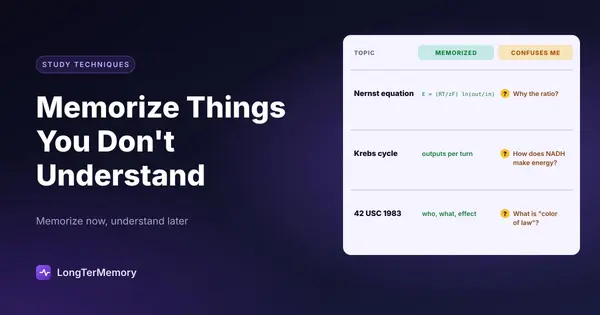
The log might look like this:
| Topic | What I memorized | What confuses me |
|---|---|---|
| Krebs cycle | Outputs per turn | How does NADH actually produce energy? |
| Statute 42 USC 1983 | Who, what, when, consequence | What’s “color of law” mean exactly? |
| Nernst equation | Formula E = (RT/zF)ln([X]out/[X]in) | Why does the ratio of concentrations matter? |
This table is your understanding roadmap. As you study more and re-encounter each confusing topic, your understanding grows , and you can mark items as resolved.
Using Review Sessions to Convert Surface Memory to Understanding
The goal isn’t to memorize without understanding permanently , it’s to memorize now and understand later. Review sessions are where that conversion happens.
The “Why?” Challenge
In every review session, pick 2-3 items from your confusion log and try to answer one question: “Why?”
Why does the Krebs cycle happen twice per glucose? (Because one glucose → two pyruvates → two acetyl-CoA units.) Why does Statute 1983 require action “under color of law”? (Because it only applies to government action, not private individuals.)
You don’t need to answer every “why” in one session. But consistently asking the question during review means your understanding grows incrementally alongside your memory. By the time the exam arrives, many of your surface memories will have acquired real depth.
The Connection Drill
As your understanding develops, do a connection drill: take each memorized item and try to link it to at least two other things you know. If something stands entirely alone in your memory , connected to nothing , it’s fragile. The more connections you can draw, the more retrieval paths exist.
“Krebs cycle → connects to: pyruvate oxidation (precedes it), electron transport chain (uses its NADH output), ATP synthesis (the whole point), cellular respiration (the broader context it belongs to)”
A memory with four connections is dramatically more durable than a memory with none.
The Application Test
The ultimate test of whether surface memorization has converted to genuine understanding: can you apply it to a novel scenario?
Write a practice exam question that uses the concept in a scenario you haven’t studied specifically. Try to answer it. If you can , if the memorized information actually guides your reasoning in a new situation , you’ve crossed the threshold from surface memory to usable knowledge.
Honest Limitations: What Surface Memorization Can’t Do
It’s worth being direct about where this approach breaks down:
It cannot substitute for understanding on application-based exams. If the exam asks you to diagnose a patient using your understanding of biochemical pathways, or to analyze a legal situation using the statute’s logic, surface memorization will fail. You need real understanding for these tasks.
It can create false confidence. The feeling of fluency , being able to produce the right answer on a flashcard , can trick you into thinking you understand something you don’t. Test yourself regularly with application questions to check whether your knowledge is genuine.
It requires follow-through. Surface memorization only works as a bridge strategy if you actually return to the confusion log and develop understanding over time. If you surface-memorize and never revisit, you end up with fragile, easily-confused knowledge that falls apart under exam pressure.
When to Give Up and Go Back to Basics
Sometimes material is incomprehensible because you’re missing foundational knowledge that should have come first. In this case, surface memorization won’t bridge the gap , you need to go back.
Signs you need to go back to basics:
- You’re surface-memorizing more than 70% of the material in a section
- Your confusion log keeps expanding faster than it resolves
- Practice questions reveal that you can’t even recognize when your memorized facts are relevant
When this happens, the most efficient path forward is often to spend time with introductory sources , a YouTube explanation, a simplified textbook, a tutor , to build the conceptual foundation that will make the dense material suddenly legible.
Whether you are memorizing first or understanding first, regular review is what makes it stick. LongTerMemory generates question and answer flashcards from your notes and PDFs and schedules them with spaced repetition, so you keep coming back to the material while your understanding catches up.
The Bottom Line
Memorizing without understanding isn’t ideal. But it isn’t cheating, and it isn’t futile. Used strategically , with a clear eye on what you know versus what you’ve only surface-stored, with a plan to develop understanding over time, and with realistic expectations about what kind of exam questions you can handle , it’s a legitimate tool in a student’s arsenal.
Memorize the form when you must. Flag the confusion. Keep asking why. Build the connections. The understanding will come , often faster than you expect, once the vocabulary and structure are already in place.