How to Memorize Fast in 30 Minutes: A Practical Guide
Learn how to memorize fast in 30 minutes using focus, chunking, and retrieval practice that compress study time without sacrificing retention.
Table of Contents
- How to Memorize Fast in 30 Minutes: The Big Picture
- The Focus Conditions That Make 30 Minutes Equal 3 Hours
- The Cognitive Load Problem
- The Optimal Study Environment
- The First Three Minutes: Activating Prior Knowledge
- Chunking and Association for Rapid Encoding
- How Chunking Works
- Building Chunks from New Material
- Association Techniques for Fast Encoding
- How to Use Retrieval Practice in Compressed Sessions
- The Compressed Study Cycle
- Why the Retrieval Attempts Must Be Genuine
- What to Do With What You Can't Recall
- The Post-Session Schedule
- The Compounding Effect of Efficient Sessions
If you’ve ever watched someone else absorb material in what seems like half the time it takes you, it can feel like they have some kind of natural advantage , better memory, higher IQ, or some secret technique they’re not sharing. The reality is usually more mundane and more useful: they’ve figured out how to memorize fast in 30 minutes by making their study time dense with actual learning rather than the illusion of learning.
Thirty minutes of genuine, well-structured study produces more lasting retention than two hours of diffuse, distracted, mostly-passive reviewing. This isn’t a bold claim , it’s a predictable outcome of how memory actually works. And once you understand the mechanics, you can replicate those results yourself.
This guide is about what makes those thirty minutes work: the conditions, the techniques, and the structure that turn a short session into something that actually sticks.
How to Memorize Fast in 30 Minutes: The Big Picture
Learning how to memorize fast in 30 minutes is not about cramming more facts into your head. It is about aligning the way you study with how your brain actually encodes information. The framework below combines three evidence-backed elements: focused attention, chunking, and retrieval practice. Each one multiplies the others, so the session as a whole becomes far more efficient than the sum of its parts.
The Focus Conditions That Make 30 Minutes Equal 3 Hours
Before any technique matters, the environment does. Thirty minutes of genuine focus is a different experience , and a different neurological state , than thirty minutes of superficially studying while half-distracted.
The Cognitive Load Problem
Your brain has limited cognitive resources at any given moment. When you split attention between studying and other inputs , a phone notification, background TV, a conversation nearby, or an open social media tab , your brain has to constantly reallocate resources. This doesn’t just reduce the quality of your studying; it fundamentally changes what kind of processing is happening. Deep encoding requires sustained, focused attention. Divided attention produces surface processing at best.
Research on cognitive psychology research on attention and memory consistently shows that information processed under conditions of full attention is retained longer and recalled more accurately than information processed under divided attention , even when total study time is identical.
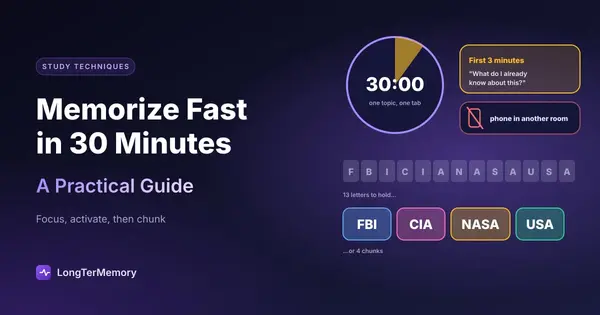
This means: one of the most high-leverage things you can do is simply remove distractions before you start. Phone in another room. Notifications off. Browser tabs closed. Noise-canceling headphones if needed. Door shut if possible.
The Optimal Study Environment
The conditions that produce maximum encoding efficiency:
Physical state: Alert, not exhausted. If you’re fighting to stay awake, your hippocampus , the brain structure primarily responsible for converting short-term experience into long-term memory , is operating below capacity. A twenty-minute nap before a study session can genuinely improve retention by a meaningful amount.
Mental state: Clear and primed. Spend the first two minutes of your session writing down anything that’s currently competing for mental space , to-do lists, worries, things you’re waiting to hear about. This simple brain-dump reduces cognitive interference and frees up working memory for the material in front of you.
Physical environment: Consistent and dedicated if possible. Studying in the same place repeatedly creates context-dependent memory , cues in the environment become associated with the material studied there, which can help during later recall. (This is less critical than the other factors but worth noting.)
Session structure: Use a timer. The Pomodoro technique , 25 minutes of focused work, 5 minutes of break , has good research support and works well for study sessions. Knowing a break is coming in a finite number of minutes makes it easier to resist distractions during the work period.
The First Three Minutes: Activating Prior Knowledge
Don’t start by opening your notes. Spend the first two to three minutes actively recalling what you already know about the topic. Write it down, say it out loud, or just mentally run through it.
This does two important things: it primes your brain for incoming information by activating related knowledge, and it shows you exactly what you already have solid so you don’t waste time on it. The blank areas in your recall are your study priorities for the session.
Chunking and Association for Rapid Encoding
Once your environment and mental state are optimized, the most powerful technique for how to memorize fast in 30 minutes is chunking , the process of grouping individual pieces of information into meaningful units.
How Chunking Works
Your working memory , the mental workspace where active thinking happens , can hold approximately four to seven items at once. But those “items” can be small (individual digits or letters) or large (complex concepts with multiple components), as long as each item is stored as a unified chunk.
The number 1776 is four separate digits to a stranger, but a single meaningful chunk (American Independence) to anyone who knows American history. The difference in cognitive load is enormous. When you encode information as meaningful chunks rather than isolated facts, you can hold more, process more, and retain more.
Building Chunks from New Material
Here’s how to chunk effectively while studying:
Step 1: Find the structure first. Before drilling details, understand how the material is organized. What are the main categories? What’s the hierarchy? What connects to what? This structural overview becomes the skeleton onto which you hang individual facts, making each one easier to encode and retrieve.
Step 2: Group related items. Instead of learning facts in the order they appear in a textbook, reorganize them into logical groups. Facts within a group reinforce each other, reducing the total cognitive load.
Step 3: Label each group. Give each cluster a short, memorable label. This label becomes the retrieval cue , when you need to recall the cluster, the label brings the whole group to mind.
Step 4: Find or create connections between chunks. Isolated chunks are harder to retrieve than connected ones. How does this group of facts relate to that group? What’s the overarching principle that explains both? The more a piece of information is connected to other things you know, the more routes you have to retrieve it.
Association Techniques for Fast Encoding
For individual facts that don’t naturally fit into larger structures, association techniques dramatically speed up encoding.
The Story Method: Chain items together into a narrative. Your brain is extraordinarily good at remembering stories , they’re one of the oldest and most natural memory formats. If you need to remember five historical events, don’t memorize them as a list; turn them into a brief story where each event causes or leads to the next.
Visualization: Create a vivid mental image for each piece of information. The more sensory detail, the more memorable. Pair the image with something you already know , hang the new image on a familiar hook.
Analogies: When you encounter a new concept, immediately look for an analogy to something you already understand. Even an imperfect analogy gives your brain a pre-existing structure to map the new concept onto, which dramatically speeds up encoding.
Emotional hooks: Attach something emotional or personally meaningful to the information. Surprising connections, funny analogies, or material you genuinely care about are remembered longer without extra effort.
How to Use Retrieval Practice in Compressed Sessions
The third element , after focus conditions and chunking , is using retrieval practice correctly within a short session. This is where most people either get it right and see dramatic results, or get it wrong and wonder why thirty minutes of “active studying” isn’t performing better than passive review.
The Compressed Study Cycle
In a thirty-minute session, the optimal structure looks like this:
Minutes 0–2: Brain dump and environment setup (as described above) Minutes 2–7: Learn one chunk , read, understand, and connect it Minutes 7–10: Retrieve , close everything and test yourself on that chunk Minutes 10–15: Learn second chunk Minutes 15–18: Retrieve second chunk; also quickly test the first chunk again Minutes 18–23: Learn third chunk (or continue on second if needed) Minutes 23–27: Retrieve third chunk; briefly test all three Minutes 27–30: Final review , what gaps remain? Schedule follow-up accordingly.
The rhythm is learn → retrieve → learn → retrieve, with brief re-tests on earlier material mixed in. This interleaving , revisiting earlier material while adding new content , is one of the most evidence-backed approaches for maximizing learning per unit of time.
Why the Retrieval Attempts Must Be Genuine
There’s a specific failure mode to avoid here: fake retrieval. Fake retrieval looks like this: you say “let me test myself,” glance at the material for three seconds “just to get started,” and then find you can recall most of it , because it’s right in front of you. That’s recognition, not recall.
Real retrieval means looking away fully, committing to an answer, and only then checking. The discomfort of not being able to immediately recall something is the signal that encoding is actually happening. If retrieval feels totally comfortable and easy, either you already know the material (great , move on) or you’re not really retrieving (fix this , it’s slowing your actual learning).
What to Do With What You Can’t Recall
When you find a gap , something you encoded five minutes ago that you can’t retrieve , this is useful information, not failure. Note it specifically, then return to the source material and re-encode with more depth:
- Generate an additional connection (can you find an analogy?)
- Add a vivid image
- State it out loud rather than just thinking it
- Create a flashcard for this item specifically
The item that stumps you in retrieval practice is the item that most deserves your attention. Don’t gloss over gaps in the interest of covering more material. Cover fewer things better.
The Post-Session Schedule
Thirty minutes of excellent study with no follow-up produces far less long-term retention than thirty minutes of excellent study with planned review sessions. Before you close your books, spend the final two minutes of your session writing:
- What you covered
- What you’re confident about
- What you’re shaky on
- When you’ll review it next (tomorrow? in three days?)
This small act of planning dramatically increases follow-through on review, because the decision has already been made. You don’t have to remember to review , it’s already scheduled.
If you’re using a spaced repetition system like LongTerMemory, the review scheduling happens automatically. You upload your notes or PDF, the system generates flashcards from your material, and it tells you exactly what to review each day based on your performance history. For students managing multiple subjects, this kind of automation removes a significant amount of cognitive overhead from the study process.
The Compounding Effect of Efficient Sessions
Here’s the bigger picture argument for thirty-minute, high-intensity sessions over marathon studying: efficiency compounds.
A student who consistently does thirty-minute focused sessions with chunking and retrieval practice builds a larger store of well-encoded knowledge than a student who does three-hour sessions of passive review , even if the total time is the same.
This is because well-encoded knowledge accelerates future learning. When you deeply understand a concept, related concepts are faster to encode because you have more hooks to hang them on. The student who’s built solid foundations learns new material faster. The compounding advantage grows over time.
The student who crams passively has shallower foundations. Each new topic requires more work to encode because there’s less pre-existing structure to connect it to. The inefficiency compounds in the wrong direction.
Thirty focused minutes a day, done consistently, is a genuinely powerful study strategy , not as a shortcut, but as a sustainable investment with compounding returns. Most people who “don’t have time to study” actually have more than enough time once they stop counting passive reviewing as studying and start counting only what produces actual encoding.
These principles apply across subjects. If you want to memorize biology fast specifically, combine the 30-minute focus framework with biology-specific techniques like blank diagrams and disease case studies. See our guide on how to memorize biology fast.
If you have a full hour instead of thirty minutes, the same framework scales up into a complete one-hour sprint. See our guide on how to memorize fast in 1 hour for the extended version with a minute-by-minute plan.
Try it for two weeks. Track what you cover and do your retrieval checks. You’ll find that thirty genuine minutes accomplishes more than you expected, and that learning how to memorize fast in 30 minutes becomes easier the longer you practice it.
For a broader framework on choosing and retaining any material deliberately, see our guide on how to memorize what you want.