How to Memorize a Textbook Quickly, One Chapter at a Time
Learn how to memorize a textbook with a proven chapter-by-chapter system: pre-reading surveys, testable content extraction, and post-chapter recall.
Table of Contents
- The Pre-Reading Survey: Cut Memorization Time in Half
- Read the Learning Objectives
- Scan the Headings and Subheadings
- Read Chapter Summaries First
- Formulate Your Questions
- Extracting Testable Content: Read Like an Examiner
- What Is Testable Content?
- The Margin Note System
- Look for Signpost Language
- Post-Chapter Recall: Your Most Important Step
- Close Everything and Dump
- Check and Fill the Gaps
- Re-read Only the Gaps
- Generate Your Flashcard Deck
- How to Memorize a Textbook: The Complete Workflow
- Handling Difficult or Dense Chapters
- Break It Into Sections
- Draw the Concept Map
- Use the Chapter's Diagrams and Tables Actively
- Memorizing Chapters Across Multiple Subjects
- The Weekly Chapter Review Rotation
- How to Memorize a Textbook FAQ
- How do you memorize a textbook quickly?
- Is re-reading a textbook an effective way to memorize it?
- How long does it take to memorize a textbook chapter?
- The Bottom Line
There’s a particular kind of despair that sets in when you’re staring at a forty-page textbook chapter the night before an exam. Where do you even start? You can’t memorize all of it. Even if you had time to read every word carefully, most of it would evaporate overnight. And yet somehow, the chapter is going to be on the test.
Most students approach textbook chapters the same way: start at page one, read to the end, maybe highlight a few things, and call it studying. This approach is comfortable, orderly, and almost completely ineffective for actual memorization. By the time you reach page forty, you’ve forgotten most of what was on page five.
The good news is that textbook chapters have a specific structure that you can exploit. They’re designed to be taught, which means the key information is organized and flagged , you just need to learn how to find it before you read, extract it while you read, and lock it in after you read. This guide shows you how to memorize a textbook by mastering one chapter at a time.
The Pre-Reading Survey: Cut Memorization Time in Half
Before reading a single word of the chapter’s actual content, spend 10 minutes doing a structured survey. This one step will change everything about how well you remember the chapter afterward.
Here’s what to do:
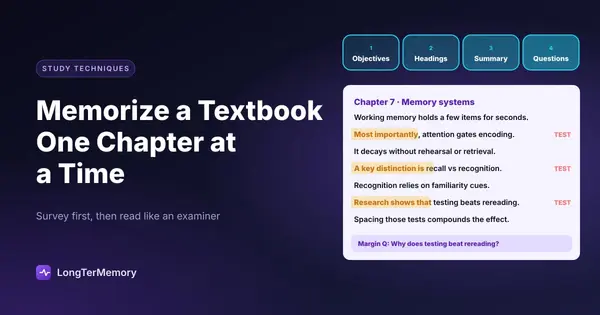
Read the Learning Objectives
Almost every textbook chapter begins with learning objectives , bullet points stating what you should know or be able to do by the end. These are not filler. They are a direct preview of the exam. Every learning objective is something the instructor considered important enough to state explicitly, which means it’s likely to appear on a test.
Write each learning objective as a question. “Explain the causes of the French Revolution” becomes “What caused the French Revolution?” You now have a reading agenda instead of just a passive text to absorb.
Scan the Headings and Subheadings
Skim through all the headings and subheadings before reading. In 3-4 minutes you get the entire architecture of the chapter: how many major topics it covers, how they’re organized, and how they relate to each other.
This matters more than it sounds. When you read text, your brain is building a mental model of the information. If you have a sense of the structure before you start, your brain can place each new piece of information into the correct location in that model as you read. Without pre-reading structure, each page feels disconnected from the others, and nothing sticks properly.
Read Chapter Summaries First
If the chapter has a summary or review section at the end, read it before reading the chapter itself. This tells you the key takeaways in advance.
This feels backwards, but it’s backed by solid memory research. Knowing the destination before you start the journey allows your brain to recognize important information when you encounter it in the full text , instead of having to figure out what matters as you go. The summary also creates a set of expectancy gaps: things the summary mentioned that you now want to understand in more depth.
Formulate Your Questions
Based on the objectives, headings, and summary, write down 5-10 questions you expect the chapter to answer. These questions prime your brain to actively search for answers as you read, rather than passively processing words.
The SQ3R method , Survey, Question, Read, Recite, Review , has been used in academic settings for decades precisely because this question-before-reading structure so dramatically improves comprehension and retention. The survey step you just did, combined with formulating questions, is the SQ in SQ3R.
Extracting Testable Content: Read Like an Examiner
Most of what’s in a textbook chapter won’t appear on your exam. A lot of it is context, narrative, explanation, and illustration , useful for understanding, but not the stuff that gets tested directly. Your job while reading is to separate testable content from background content.
What Is Testable Content?
- Definitions , bolded terms and their meanings
- Frameworks and models , numbered steps, named theories, named effects
- Cause-and-effect relationships , what causes what, what leads to what
- Comparisons and contrasts , how two concepts differ
- Exceptions and edge cases , textbooks often test these specifically because they’re surprising
- Specific facts with numbers , dates, statistics, named researchers and their findings
Everything else , the historical context, the extended analogies, the transition paragraphs , is support material. You read it for understanding, but you don’t try to memorize it.
The Margin Note System
As you read, keep a running list of questions in the margins or in a separate notebook. For every key concept you encounter, immediately write it as a question. You’re not taking notes , you’re building your exam questions as you go.
When you finish the chapter, you have a complete question set ready for active review. You’ve also thought about the material more actively while reading, which improves encoding.
Look for Signpost Language
Textbook authors use consistent language to flag important content:
| Signpost phrase | What it signals |
|---|---|
| ”Most importantly…” | This will be on the test |
| ”A key distinction is…” | Expect a compare/contrast question |
| ”This is an example of…” | Memorize the principle, not just the example |
| ”In summary…” | The core of this section |
| ”Research shows that…” | A specific finding worth memorizing |
| ”There are X types/steps/phases…” | Memorize the list |
Training yourself to notice these phrases turns passive reading into active extraction.
Post-Chapter Recall: Your Most Important Step
Most students stop studying after they’ve read the chapter. This is exactly backwards. The reading is preparation for the real work: getting the information out of the chapter and into your long-term memory.
The most powerful thing you can do after reading any textbook chapter is a full post-chapter recall exercise. Here’s the process:
Close Everything and Dump
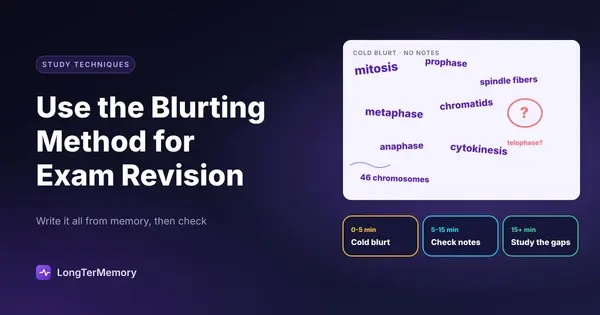
Close the textbook. Close your notes. Sit with a blank page and write down everything you remember from the chapter. Everything , key terms, definitions, frameworks, names, numbers, relationships, examples. Don’t organize it. Don’t filter it. Just produce.
This should feel uncomfortable. You’ll blank on things. That discomfort is not a sign that studying isn’t working , it’s the sign that actual learning is happening. Every time you successfully pull something from memory, you strengthen that memory. Every time you try to pull something and fail, you identify a gap.
Check and Fill the Gaps
Now open your materials and compare your recall with the actual chapter. What did you get right? What did you miss? What did you get wrong?
The things you missed are your study agenda for the next session. The things you got wrong deserve extra attention , misconceptions are harder to correct than gaps, because your brain has already filed an incorrect answer and will need to override it.
Re-read Only the Gaps
Don’t re-read the whole chapter. Only go back to the specific sections where your recall failed. Re-reading everything feels thorough but wastes time on content you already know. Focused, targeted re-reading of gaps is dramatically more efficient than a full second pass.
Generate Your Flashcard Deck
From your recall exercise, convert every gap into a flashcard. These are the specific facts, definitions, and relationships your brain didn’t retain from the first read. They’re your personalized study set , much more efficient than pre-made cards, because they target exactly your weak spots, not someone else’s.
How to Memorize a Textbook: The Complete Workflow
Here’s the complete system assembled into a single workflow:
Before reading (10 minutes):
- Read learning objectives , convert each to a question
- Scan headings and subheadings , build a mental map
- Read the summary , know the destination before the journey
- Write 5-10 anticipatory questions
During reading (variable): 5. Read actively , annotate textable content, not everything 6. Write questions in margins for every key concept 7. Notice signpost language , prioritize those sections
After reading (15-20 minutes): 8. Close everything , blank page recall 9. Check your recall against the chapter 10. Re-read only the sections that correspond to gaps 11. Convert gaps into flashcards
Next day: 12. Review flashcards before looking at any new material 13. Try to explain the chapter’s main ideas out loud from memory
This workflow takes more conscious effort than just reading. But it typically takes less total time than the read-then-reread-then-skim approach because you’re replacing passive passes with a single active pass plus targeted gap-filling.
Handling Difficult or Dense Chapters
Not every chapter is created equal. Some are straightforward narratives. Others are packed with technical terminology, complex diagrams, and dense causal chains. If you want to know how to memorize a textbook full of dense technical material, a few extra strategies help.
Break It Into Sections
Don’t try to read and recall an entire 50-page chapter in one sitting. Break it into 10-15 page sections, doing a mini-recall exercise after each section before moving on. This gives your brain a chance to consolidate small chunks before adding more on top.
Draw the Concept Map
After reading a section, draw a concept map from memory , a diagram showing how the key ideas connect to each other. Don’t copy from the book. Build it yourself based on what you remember. Then compare with the textbook.
Concept maps are powerful because they make relationships visible. Understanding how ideas relate to each other provides multiple retrieval paths , if you can’t access an idea directly, you can often reach it by following the connections you’ve memorized.
Use the Chapter’s Diagrams and Tables Actively
Textbooks invest heavily in diagrams, charts, and tables because visual organization aids comprehension and memory. But most students just look at these visuals passively. Instead:
- Cover the labels and try to recall them from memory
- Reproduce diagrams from scratch on a blank page , the process of drawing forces you to recall structural relationships
- Test yourself on tables , cover one column and try to fill it in
The act of reconstructing a visual forces much deeper processing than just looking at it.
Memorizing Chapters Across Multiple Subjects
If you’re managing multiple textbook-heavy courses simultaneously, the challenge is dividing your review time without letting any subject go stale.
The Weekly Chapter Review Rotation
Set up a rotation where every chapter gets revisited at least once per week:
| Day | Activity |
|---|---|
| Day of reading | Full post-chapter recall |
| 3 days later | Flashcard review + mini recall |
| 1 week later | Attempt to explain chapter from memory |
| 2 weeks later | Practice questions covering chapter content |
| Before exam | Final walkthrough of flashcard deck |
This schedule ensures each chapter stays active in your memory across the entire term, rather than fading the week after you read it.
If the exam is tomorrow and you cannot follow the full weekly rotation, see our guide on how to memorise chapters for an exam in one day for a triage-first, 24-hour version of this chapter system.
Turning every chapter into questions is the slowest step in this process. LongTerMemory can do it for you: upload a chapter PDF and it generates question and answer flashcards automatically, then schedules them with spaced repetition so earlier chapters stay fresh while you move on to new ones.
How to Memorize a Textbook FAQ
How do you memorize a textbook quickly?
The fastest way is to use an active extraction system: survey the chapter first, extract only testable content while reading, and do a full blank-page recall immediately after. This replaces passive reading with targeted memory building.
Is re-reading a textbook an effective way to memorize it?
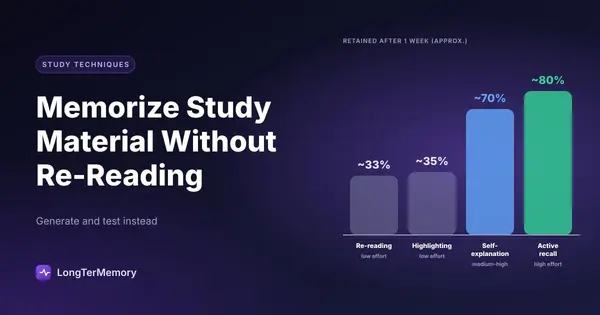
No. Re-reading creates familiarity without durable memory. The most effective approach is active recall: close the book and try to reproduce what you learned, then review only the gaps.
How long does it take to memorize a textbook chapter?
With the system above, a single chapter can be encoded in one focused session of 45-60 minutes, plus 15-20 minutes for post-chapter recall. Retention is then maintained with spaced review over the following days.
The Bottom Line
If you want to learn how to memorize a textbook, you must stop thinking of each chapter as a document to be read. It’s a body of knowledge to be extracted, processed, and transferred into your long-term memory. Those are completely different tasks requiring completely different strategies.
Survey before you read to build a mental scaffold. Extract testable content while you read, not everything. Recall actively after you read, before the information has a chance to fade. And review the gaps with targeted flashcards instead of passive re-reading.
Do this consistently across all your textbook chapters and you’ll find yourself remembering far more with less total study time , because you spent that time building real memory, not just accumulating a feeling of familiarity.