How to Memorize Things in 5 Minutes: A Practical Guide
Learn what you can realistically memorize in 5 minutes, the micro-session method for intense encoding, and how to build a daily habit around it.
Table of Contents
- What You Can Realistically Memorize in 5 Minutes
- The Myth of Multitasking During Short Sessions
- The Micro-Session Method: High-Intensity Encoding in 5 Minutes
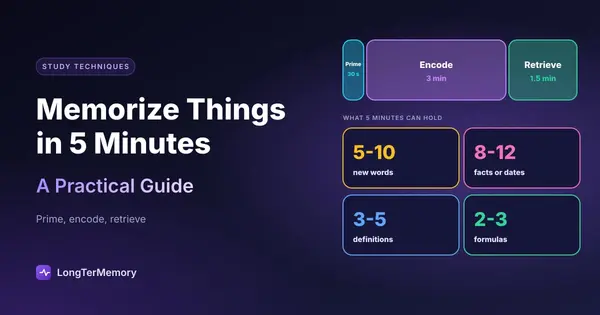
- Phase 1: Prime (30 seconds)
- Phase 2: Encode (3 minutes)
- Phase 3: Retrieve (1.5 minutes)
- Making 5-Minute Windows a Daily Habit
- Where to Find Your 5-Minute Windows
- Setting Up Your Micro-Session System
- The Compound Effect of Daily Micro-Sessions
- Specific Techniques for Different Material Types
- Vocabulary and Terminology
- Numbers and Dates
- Sequences and Processes
- Key Concepts and Arguments
- When 5 Minutes Isn't Enough (And What to Do Instead)
- The 5-Minute Review: Your Most Underused Tool
- Start Today
Five minutes. You have five minutes before a meeting, between classes, in a waiting room, on a train platform. Most people spend those five minutes scrolling through their phones. But what if you could use them to actually cement something into your long-term memory?
The idea sounds almost too good to be true, and honestly, there’s a version of this that is too good to be true. You cannot read 50 pages and remember them in five minutes. You cannot replace a four-hour study session with a five-minute sprint. But what you can do , with the right technique , is use five focused minutes to encode a surprising amount of material in a way that sticks.
This guide is about doing exactly that. No hype, no magic promises , just a realistic, science-based approach to making short study windows genuinely productive.
What You Can Realistically Memorize in 5 Minutes
Let’s be honest about expectations first. Five minutes is a constraint, not a magic wand. What you accomplish in that window depends entirely on what you’re trying to learn and how you spend the time.
Here’s a realistic breakdown:
| Material Type | What 5 minutes can accomplish |
|---|---|
| Vocabulary words | 5–10 new words with strong encoding |
| Dates and facts | 8–12 isolated facts |
| Definitions | 3–5 technical definitions |
| Formulas | 2–3 formulas with context |
| Key arguments | Main point + 2 supporting details |
| Speech/poem lines | 3–5 lines with rehearsal |
| Process steps | One procedure with 4–6 steps |
The common thread: five minutes is great for discrete, bounded pieces of information. It’s not suited for deep conceptual understanding or long narratives. Use it for facts, terms, sequences, and short structures.
What makes five minutes powerful is not the volume , it’s the intensity and the repetition. Five minutes of focused, active retrieval beats thirty minutes of passive reading for locking in specific pieces of information.
The Myth of Multitasking During Short Sessions
Before going further: five-minute sessions only work if those five minutes are actually focused. Checking your phone twice, responding to a notification, and half-watching a video while you “study” produces essentially zero benefit. Your brain needs to be fully present.
Research on memory encoding and attention research shows that attention is the gatekeeper to long-term memory. Information that isn’t fully attended to doesn’t make it past working memory into long-term storage. So the first rule of five-minute memorization is: phone face down, notifications off, nothing else open. Five real minutes beats thirty distracted ones every time.
The Micro-Session Method: High-Intensity Encoding in 5 Minutes
The micro-session method is a structured approach to squeezing maximum learning out of minimum time. It works in three phases.
Phase 1: Prime (30 seconds)
Before you look at any material, ask yourself: what do I already know about this topic? Spend thirty seconds retrieving whatever you can from memory , even if it’s almost nothing. This primes your brain for the new information, creating mental “hooks” that new content can attach to.
If you’re completely new to the material, spend this time looking at just the headings or key terms so your brain has a basic structure to work with.
Phase 2: Encode (3 minutes)
This is the core of the session. Cover the material , but not passively. Here’s the process:
- Read one item (a definition, a fact, a vocabulary word)
- Look away immediately
- Repeat it to yourself , out loud if possible, in your head if not
- Generate a connection , link it to something you already know, create an image, make up an example
- Read the next item
The key is read → look away → retrieve → connect. This is the encode cycle, and running it repeatedly in three minutes is what distinguishes the micro-session from passive skimming.
For vocabulary or isolated facts, you can cycle through this quickly , ten to fifteen seconds per item. For more complex material (definitions, formulas), slow down and spend twenty to thirty seconds per item making sure the connection is real.
Phase 3: Retrieve (1.5 minutes)
After encoding, immediately test yourself. Cover the material and try to recall everything you just learned. This can be:
- Saying items aloud from memory
- Writing them on a scrap of paper
- Flipping through flashcards without looking at the answer side first
Don’t skip this phase even if it’s uncomfortable. The retrieval attempt , including the struggle when your mind goes blank , is what converts short-term exposure into something with a chance of lasting. Without this step, most of what you just encoded will be gone within the hour.
Making 5-Minute Windows a Daily Habit
The power of this approach isn’t in any single five-minute session. It’s in consistency across many sessions. Five minutes once does almost nothing. Five minutes daily compounds into something remarkable.
The secret is to attach your micro-sessions to existing habits , a technique behavioral scientists call habit stacking. You’re not adding a new time slot to your day; you’re piggybacking on moments that already exist.
Where to Find Your 5-Minute Windows
Most people have more five-minute pockets than they realize. Here are the most commonly underused ones:
- Morning coffee or tea: While it’s brewing or cooling down
- Commute segments: Walking to the bus, waiting at a stop, short subway rides
- Meal waiting time: The few minutes between ordering and receiving food
- Between meetings: The ten-minute buffer before a call starts
- Exercise transitions: Stretching before a run, cooling down after
- Evening wind-down: The fifteen minutes before you actually fall asleep (though see the note below on timing)
The evening window is worth highlighting separately. Research on sleep and memory consolidation shows that information learned just before sleep is often consolidated more effectively during the night’s sleep cycles. A five-minute review session right before bed , even just going through flashcards , can meaningfully improve retention.
Setting Up Your Micro-Session System
For micro-sessions to actually happen, everything needs to be immediately accessible. If your study materials are in a folder on your laptop that takes ninety seconds to find and open, you won’t do it in a five-minute window. The friction has to be zero.
Here’s a practical setup:
Physical materials: Keep a set of flashcards in your pocket or bag. A small card box organized by subject lets you pull and drill any time. Nothing to open, nothing to load.
Digital materials: Use a flashcard app (Anki, LongTerMemory, or similar) that’s on your phone’s home screen and opens directly to your current study deck. One tap, immediate access. LongTerMemory also auto-generates flashcards from your uploaded notes or PDFs, so you always have relevant material ready without having to create cards manually.
The Review Queue: Before bed each night, set up your study queue for the next day , which deck you’ll drill at which times, what material you’re encoding versus reviewing. This decision is made in advance so the session itself is pure execution.
The Compound Effect of Daily Micro-Sessions
Let’s run the numbers. If you do two five-minute micro-sessions per day , one in the morning, one in the evening , that’s ten minutes of daily study. Over a month, that’s approximately five hours of focused, active retrieval. Over a semester, it’s around thirty hours.
For context, thirty hours of distributed, active retrieval is significantly more effective than thirty hours of massed study done in long cramming sessions. The distribution itself is the feature. Each short session triggers memory consolidation, and the spacing between sessions mimics the spacing effect , the principle that memories become stronger when review is spread out over time.
Year of daily micro-sessions: If you spend just ten minutes a day on spaced micro-sessions, properly structured, you can maintain and expand mastery of more material than most people accumulate from weeks of traditional studying.
Specific Techniques for Different Material Types
The basic micro-session framework works for almost anything, but here are refinements for specific categories of material.
Vocabulary and Terminology
For language vocabulary, technical terms, medical terminology, or legal definitions, the keyword method is the fastest encoding technique for short sessions:
- Take the new word
- Find a sound-alike or related word you already know
- Create a vivid mental image connecting the two
- When you see the new word, the image triggers the meaning
Example: Learning the word seraph (a type of angel). It sounds like “Sarah” plus “-aph.” Visualize Sarah , someone you know , with enormous wings. Ridiculous? Yes. Memorable? Extremely.
The more vivid, emotional, or absurd the image, the better it encodes. Your brain prioritizes memorable things, and strange imagery is inherently memorable.
Numbers and Dates
Numbers are intrinsically boring to the brain, which makes them hard to encode. The solution is to convert numbers into meaningful content.
For important dates: make a story. If something happened in 1787, connect it to something personal about those numbers , maybe your house number contains some of those digits, or you can picture 17 people from 1787 doing something vivid.
For formulas and equations: break them into components and understand what each part represents physically or conceptually. A formula you understand is a formula you can reconstruct. A formula you’ve only memorized by rote will vanish under pressure.
Sequences and Processes
For step-by-step processes , clinical procedures, legal processes, technical workflows , the link method works well:
- Visualize the first step as a vivid scene
- Connect the second step to the first through a dynamic interaction (the first step does something to the second)
- Continue chaining each step to the previous one
When you need to recall the sequence, you walk through the chain mentally. Each scene leads you to the next.
A simpler approach for shorter sequences: make an acronym from the first letters. If the steps are Assess, Plan, Implement, Evaluate, Document , that’s APIED. Weird enough to remember, simple enough to reconstruct.
Key Concepts and Arguments
For conceptual material where the relationships matter more than the isolated facts, five-minute sessions work best as retrieval reviews rather than initial learning. Use them to quiz yourself on material you’ve previously studied at depth, asking questions like:
- What is the central argument here?
- What are the two or three main supporting points?
- What would challenge or complicate this view?
- How does this connect to what I learned last week?
When 5 Minutes Isn’t Enough (And What to Do Instead)
Being honest about the limits of micro-sessions is important. Five-minute windows are powerful for maintenance, reinforcement, and discrete facts. They are not a replacement for:
- Deep conceptual work: Understanding a complex framework, building intuition for a subject, synthesizing across multiple texts , this requires longer, uninterrupted sessions
- Initial learning of new material: Micro-sessions work best when reviewing or reinforcing something you’ve had at least one longer encounter with; cold-starting entirely new concepts in five minutes rarely works well
- Problem-solving skills: Math, coding, case analysis , these require sustained practice on realistic problems, not just recall of facts
The ideal study approach combines deep sessions for initial learning and complex work with daily micro-sessions for maintenance and retention. They’re complementary, not competing. For a focused 30-minute deep session, see our guide on how to memorize fast in 30 minutes. And if you have a full hour before an exam, our guide on how to memorize fast in 1 hour gives you a complete one-hour sprint protocol.
The 5-Minute Review: Your Most Underused Tool
If there’s one application of the five-minute session that’s almost universally underused, it’s the post-learning review. After any longer study session , a lecture, a two-hour reading block, a tutorial , spend the last five minutes before you stop testing yourself on what you just covered.
No notes. No looking back. Just write or say everything you can remember from the session.
This single habit dramatically increases how much of the session you retain. It’s also the best diagnostic for what actually stuck versus what just flowed past. Whatever you can’t recall in this five-minute wrap-up is what you need to focus on in your next session.
Start Today
You don’t need to overhaul your schedule or buy any special tools. You just need to use the pockets of time you already have , and use them differently.
Start tomorrow morning. While your coffee brews, open your flashcard app or pull out your cards and run through five minutes of active recall. Do the same thing after dinner. That’s it. See how it feels after a week. See what’s different about the material you’ve been drilling.
The five-minute session isn’t a shortcut. It’s a different kind of investment , small, frequent, and compounded over time. And that kind of investment, practiced consistently, beats any amount of passive studying every single time.
For a complete system that works for any material you choose, see our guide on how to memorize what you want.