How to Use Spaced Repetition for Immunology and Microbiology
Master immunology and microbiology with spaced repetition. Build high-yield flashcard decks, organize pathogens, and combine SRS with clinical reasoning.
Table of Contents
- High-Yield Immunology and Microbiology Content for SRS Decks
- High-Yield Immunology Content
- High-Yield Microbiology Content
- Organizing Pathogen Flashcards by Type, Virulence, and Clinical Presentation
- The Pathogen Framework Card
- Organizing Your Deck by Category
- Image Cards for Microbiology
- Combining SRS with Clinical Case Reasoning for Medical Students
- The SRS Foundation
- Clinical Vignette Practice as the Second Layer
- Adding Explanations to Your Cards
- Spacing Review Cycles Around Your Curriculum
- The Review Habit That Makes This All Work
- Building Your Deck Over a Full Course
- The Bottom Line
If you’ve ever opened an immunology textbook and felt your brain quietly rebel, you’re in good company. Immunology and microbiology are among the most information-dense subjects in medicine. You’re dealing with hundreds of cell types, receptors, cytokines, signaling pathways, bacteria, viruses, fungi, and parasites, all of which interact in complex ways and carry clinical implications you need to be able to recall instantly on exam day.
The volume problem is real. And the traditional approach of reading through textbooks, highlighting, and hoping things stick? It doesn’t scale to this volume of material. Not even close.
Spaced repetition is the method that actually scales. It’s the system underlying Anki, the reason top USMLE scorers swear by it, and the reason medical students who use it consistently outperform those who don’t on retention-heavy exams. But using spaced repetition for immunology and microbiology requires some deliberate setup. This is your guide to doing it right.
High-Yield Immunology and Microbiology Content for SRS Decks
Before you build a single flashcard, you need to make a strategic decision about what to put in your deck. Because the biggest mistake medical students make with Anki and similar tools is trying to capture everything. When your deck has 30,000 cards, daily review becomes a 5-hour nightmare, and the system breaks down.
High-yield selection is the first discipline.
High-Yield Immunology Content
For most medical exams, and especially for USMLE Step 1, the immunology content that earns the most marks clusters around a few core areas:
Cells of the immune system and their functions:
- T cells: helper (CD4), cytotoxic (CD8), regulatory (Treg), the major subtypes (Th1, Th2, Th17)
- B cells: their activation, class switching, and the role of plasma cells and memory cells
- NK cells, macrophages, dendritic cells, neutrophils, mast cells, basophils, eosinophils
Cytokines, their sources, and their targets:
- IL-1, IL-2, IL-4, IL-5, IL-6, IL-8, IL-10, IL-12, IL-17, TNF-alpha, IFN-gamma, TGF-beta
- For each cytokine: which cell produces it, which cell it acts on, what it does
MHC molecules:
- MHC I: presents to CD8 T cells, expressed on all nucleated cells, presents intracellular antigens
- MHC II: presents to CD4 T cells, expressed on professional APCs, presents extracellular antigens
Complement system:
- Classical, lectin, and alternative pathways
- Key complement proteins and their functions: C3a, C5a, MAC (C5-9), C3b (opsonization)
Hypersensitivity reactions:
- Type I (IgE-mediated), Type II (antibody-mediated cytotoxicity), Type III (immune complex), Type IV (delayed, T-cell mediated)
Immunodeficiency syndromes:
- SCID, DiGeorge, Bruton’s, CVID, Wiskott-Aldrich, CGD, Chediak-Higashi
High-Yield Microbiology Content
Microbiology high-yield content is a bit more organism-specific:
- Gram-positive vs. gram-negative bacteria and their clinical significance
- Bacterial virulence factors: toxins, capsules, pili, biofilm formation
- Specific organisms with classic presentations: S. aureus (TSST-1), S. pyogenes (M protein), C. difficile (toxins A and B), N. meningitidis (petechial rash, polysaccharide capsule)
- Viral characteristics: DNA vs. RNA, enveloped vs. non-enveloped, their clinical syndromes
- Antimicrobial mechanisms of action and resistance for major antibiotic classes
- Parasites and fungi relevant to the exam: Plasmodium, Trypanosoma, Candida, Aspergillus, Cryptococcus
The key principle: you want cards that test clinically testable facts, not encyclopedic descriptions. Every card should answer a question you could realistically be asked in a vignette.
Organizing Pathogen Flashcards by Type, Virulence, and Clinical Presentation
The structure of your pathogen flashcards matters enormously. A poorly designed deck will have you drilling isolated facts that you can’t connect to clinical scenarios. A well-designed deck builds the pattern recognition that lets you identify organisms from vignette clues.
The Pathogen Framework Card
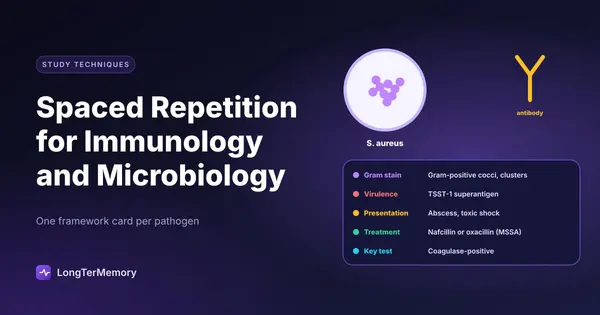
For each major pathogen, build a small cluster of related cards organized around this framework:
| Card Type | Example Front | Example Back |
|---|---|---|
| Gram stain + morphology | ”Gram stain and shape of S. aureus?” | Gram-positive cocci in clusters |
| Key virulence factor | ”Which toxin causes S. aureus toxic shock?” | TSST-1 (superantigen, activates many T cells at once) |
| Classic clinical presentation | ”S. aureus in a diabetic with a hot, fluctuant skin lesion?” | Skin abscess, think MRSA, treat with I&D +/- TMP-SMX |
| Treatment | ”First-line for MSSA bacteremia?” | Nafcillin or oxacillin (anti-staphylococcal penicillins) |
| Distinguishing feature | ”What separates S. aureus from S. epidermidis?” | Coagulase-positive (aureus), coagulase-negative (epidermidis) |
This framework means you’re not memorizing one fact about an organism. You’re building a small network of related facts that reinforce each other.
Organizing Your Deck by Category
Rather than one massive deck with all your immunology and microbiology cards mixed together, use a hierarchical organization:
- Immunology
- Cell types and markers
- Cytokines
- Complement
- MHC
- Hypersensitivity
- Immunodeficiency
- Microbiology
- Gram-positive bacteria
- Gram-negative bacteria
- Anaerobes
- Mycobacteria
- Spirochetes
- DNA viruses
- RNA viruses
- Fungi
- Parasites
- Antimicrobials
- Mechanism by drug class
- Resistance mechanisms
- Toxicities
This organization lets you study strategically. If you have a dedicated block on gram-negative bacteria coming up, you can suspend everything else and focus on that subdeck.
Image Cards for Microbiology
Some microbiology content is inherently visual: gram stains, colony morphology, electron microscope images of viruses, histopathology of infected tissue. These are not optional in a serious deck.
For visual content, build cards with the image on the front and the identification or interpretation on the back. Being able to say “beta-hemolytic colonies on blood agar with lancet-shaped gram-positive diplococci” from an image is the same skill the exam tests. Train that skill explicitly.
Combining SRS with Clinical Case Reasoning for Medical Students
Here’s where a lot of students’ microbiology preparation falls short. They build excellent factual recall decks and then freeze on vignettes because they’ve learned isolated facts without building the pattern recognition that connects facts to clinical situations.
The fix is to use SRS as one component of a two-part system, with clinical case reasoning as the other.
The SRS Foundation
Spaced repetition builds your fact base. It ensures that when you encounter “gram-positive diplococci in a blood culture from an elderly man with lobar pneumonia,” you don’t have to think hard. The pattern is automatic: S. pneumoniae.
This automaticity is what frees up cognitive bandwidth for higher-order reasoning. If you’re burning working memory trying to recall basic organism characteristics, you have no capacity left to think through the vignette.
Achieve automaticity first with SRS. That’s the foundation.
Clinical Vignette Practice as the Second Layer
Once your SRS deck is running and you’re reviewing consistently, layer in clinical vignette practice. This is where you take the organism identification skills you’ve built and apply them under realistic conditions.
For every vignette you encounter in practice:
- Identify the organism from the clinical clues before reading the answer choices
- Recall the virulence factors relevant to the presentation
- Predict the treatment before seeing options
- Understand why wrong answers are wrong, not just why the right answer is right
This two-step process, SRS for factual automaticity plus vignette practice for application, is the combination that produces consistently high scores on microbiology and immunology questions.
Adding Explanations to Your Cards
A powerful hybrid technique: when you encounter a vignette that teaches you something new about an organism, add a card to your deck that captures the clinical reasoning, not just the fact.
Front: “An IV drug user presents with fever, back pain, and an MRI showing disc space narrowing and vertebral endplate erosion. Organism?” Back: Staphylococcus aureus (most common cause of vertebral osteomyelitis in IV drug users; hematogenous seeding of vertebral bodies)
This card now tests both the organism and the clinical context. When you review it, you’re rehearsing the entire reasoning chain, not just the name of a bug.
Spacing Review Cycles Around Your Curriculum
One underutilized strategy: align your SRS review intensity with your curriculum schedule.
When you’re in your microbiology block, accelerate new card introduction and front-load review time on that subdeck. When you move to other systems, let the mature cards tick over in their natural spaced schedule while you add new content.
This means you’re always building on fresh material while maintaining everything you’ve already learned. The spaced repetition system handles the maintenance automatically. You just need to keep introducing new cards and completing your daily reviews.
The Review Habit That Makes This All Work
None of this works without a consistent daily review habit. And daily is not an exaggeration. The intervals in spaced repetition are calibrated to the point where skipping days compresses reviews and creates a backlog that quickly becomes demotivating.
Fifteen to thirty minutes of daily review, every day, is dramatically more effective than three-hour marathon sessions on weekends. Treat your daily review as non-negotiable, at the same time, with the same priority as any class or lab.
If you’re using a tool like LongTerMemory, you can upload your immunology and microbiology PDFs and lecture notes and let the AI generate initial card sets automatically. This saves hours of manual card creation and gets you to reviewing faster. You’ll still want to edit and refine the generated cards to match your learning goals, but the heavy lifting of conversion is done for you.
Building Your Deck Over a Full Course
Here’s a practical timeline for using SRS across an immunology and microbiology course:
Weeks 1-2: Focus on deck architecture. Set up your category structure. Build out the immunology foundational cards (cells, cytokines, complement). Aim for 20-30 new cards per day, not more.
Weeks 3-5: Shift focus to gram-positive and gram-negative bacteria. For each organism you cover in class, add the framework cards within 24 hours of learning it. This takes 10 minutes per organism and dramatically improves encoding.
Weeks 6-8: Add viruses, fungi, and parasites. Start layering in vignette cards alongside factual cards. The ratio should be roughly 60% factual, 40% clinical application by this point.
Exam week: Suspend new card introduction. Review only mature cards that are due. Add a targeted review session on your weakest categories based on your practice question data.
After the exam: Don’t delete your deck. Suspend it. You’ll use it again when microbiology and immunology content returns in clinical courses, USMLE Step 1 prep, shelf exams, and ultimately Step 3.
The Bottom Line
Immunology and microbiology are manageable if, and only if, you have a systematic approach to the volume. Spaced repetition is that system.
Build a high-yield deck structured around the pathogen framework. Review daily without exception. Layer clinical vignette practice on top of your factual foundation. And let the algorithm handle the scheduling so you can focus all your cognitive energy on learning, not logistics.
The students who come out of these courses with lasting knowledge aren’t the ones who read the most. They’re the ones who built the best review systems and maintained them.