
How to Build a Knowledge Architecture for a New Field
Learn how to create a structured mental map when entering a new field, so you learn faster, retain more, and connect ideas like an expert from day one.
Table of Contents
- What Is a Knowledge Architecture?
- Why Most People Learn Backwards
- Step 1: Create a High-Level Map Before You Dive In
- Step 2: Identify the Foundational Concepts
- Step 3: Learn the Language of the Field
- Step 4: Find the Fault Lines
- Step 5: Build Bridges to What You Already Know
- Step 6: Update Your Architecture as You Learn
- A Practical Template for Building Your Architecture
- How Long Does This Take?
- The Compounding Effect of Good Architecture
There’s a particular kind of frustration that comes with starting something completely new. You open the first textbook, read three chapters, and finish with a mild sense of panic: you technically processed the words, but nothing connected. The concepts feel like puzzle pieces scattered across a table. Individually, you can see them, but you can’t see the picture they’re supposed to make.
This experience is universal, but it’s not inevitable. The reason it happens isn’t that the material is too hard or that you’re not smart enough. It’s that you’re trying to learn content before you have anywhere to put it. You’re adding rooms to a house before the foundations are in.
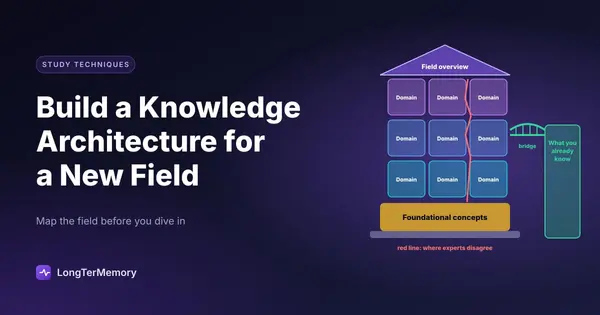
Building a knowledge architecture solves this problem. It’s the process of deliberately constructing a mental structure for a new field before, or at least alongside, trying to absorb its details. Once you have that structure, everything you learn has a place to land, a relationship to other things you know, and a reason to stick around in memory.
This guide walks through exactly how to do it.
What Is a Knowledge Architecture?
A knowledge architecture is, essentially, your mental map of a field. It’s the high-level structure of what the field is about, what its major domains are, how those domains relate to each other, and what the foundational concepts are that everything else builds on.
Think of it like the table of contents of an expert’s mind. When you ask a senior doctor about cardiology, they don’t dump random facts at you. They organize their answer: here’s how the heart works, here’s what can go wrong, here’s how we diagnose problems, here’s how we treat them. That organizational structure isn’t an accident. It’s something they built over years, and it’s what allows them to learn new information quickly because they know exactly where to file it.
When you enter a new field as a beginner, you don’t have that structure yet. Building one intentionally, before getting lost in the weeds, dramatically changes your learning trajectory.
Why Most People Learn Backwards
The natural instinct when learning something new is to start at the beginning: chapter one, lecture one, concept one. This feels logical, but it creates a structural problem. You’re consuming details without a framework to organize them.
It’s like being handed the stones to build a wall before anyone shows you what the wall is supposed to look like. You can pick up the stones and move them around, but you don’t know where they go.
Most educational content is designed around depth rather than orientation. Textbooks begin with foundational concepts and build upward. Courses move chronologically through material. This works reasonably well if you stay engaged from beginning to end, but it means you spend the first significant chunk of your learning time disoriented, unsure of what matters and why.
The approach here inverts that. You build the overview first, then fill it in.
Step 1: Create a High-Level Map Before You Dive In
Before you read a single chapter, before you start a course, spend a couple of hours building a rough map of the field you’re entering.
This map doesn’t need to be accurate. In fact, it can’t be, because you don’t know the field yet. The point is to create a preliminary structure that will sharpen as you learn.
Here’s how to build it:
Search for field overviews. Look for “intro to X” content that takes a bird’s-eye view. Wikipedia’s main article on a field is often surprisingly good for this. Look for encyclopedic summaries, not tutorials or courses. You want structure, not depth.
Find the major domains. Every significant field has 4-10 major subfields or domains. In medicine: anatomy, physiology, pathology, pharmacology, etc. In machine learning: supervised learning, unsupervised learning, reinforcement learning, deep learning, etc. In law: contracts, torts, constitutional law, criminal law, etc. Find those top-level categories.
Sketch a rough diagram. Draw a simple map. Put the field name in the center. Attach the major domains. For each domain, note 2-3 key concepts you’ve encountered. This doesn’t need to be pretty. It just needs to exist as a visible structure.
Identify the relationships. Some domains depend on others. Some concepts underlie entire branches of the field. Even a rough sense of which things come “first” or “underneath” others gives your map a hierarchy that pure lists don’t have.
After this initial session, you have something to navigate by. It will be wrong in places, and that’s fine. The goal is orientation, not accuracy.
Step 2: Identify the Foundational Concepts
Every field has a small set of ideas that almost everything else builds on. In economics, concepts like supply and demand, marginal utility, and opportunity cost underlie most of the rest of the field. In programming, data structures, control flow, and abstraction are foundational. In music theory, it’s rhythm, harmony, and melody.
These foundational concepts deserve disproportionate attention early on.
Why? Because once you genuinely understand a foundational concept, a huge portion of the field becomes easier to learn. The investment pays compound returns. Conversely, if you try to skip foundations and jump to advanced material, you’ll be building on a shaky structure, and the more you learn on top of it, the more fragile the whole edifice becomes.
To identify foundational concepts:
- Ask the question: “If I didn’t understand X, what else would I fail to understand?” The things that appear in the answer most often are foundational.
- Look at what every textbook and course covers in its early chapters. Universally repeated concepts are almost always foundational.
- Find an expert and ask: “What are the 5-10 concepts someone absolutely must understand to make sense of this field?” Most experts can answer this fairly quickly.
Once you’ve identified the foundations, spend real time on them. Don’t rush through to get to the “interesting” advanced material. The foundations are what make the advanced material interesting.
Step 3: Learn the Language of the Field
Every discipline has its own vocabulary, and that vocabulary exists for a reason. It’s not gatekeeping. It’s compression: a single technical term often captures a precise concept that would take a paragraph to explain in plain language.
Building fluency in the field’s language should happen early, alongside your architectural work. Here’s why: once you know the terms, you can read primary sources, research papers, advanced texts, and expert discussions. Before you know them, those sources are nearly impenetrable, and you’re limited to beginner-level material.
How to build field vocabulary efficiently:
- Create a personal glossary as you encounter new terms. Keep it short: one-sentence definitions in your own words.
- Use active recall to learn definitions. Don’t just read them once. Test yourself. Use flashcards. A tool like LongTerMemory can automatically generate Q&A pairs from your notes and study materials, turning your glossary into a spaced repetition review deck without the manual work.
- Notice when the same term appears in different contexts. This is how you build a rich, multi-dimensional understanding of a concept rather than a thin, definitional one.
The goal isn’t to become a vocabulary collector. It’s to get to the point where you can read expert-level material in the field without constantly stopping to look things up.
Step 4: Find the Fault Lines
Every mature field has genuine disagreements, ongoing debates, and unresolved questions. These aren’t just interesting trivia. They’re some of the most important structural elements of a field’s architecture.
Understanding where experts disagree tells you:
- Which questions the field has definitively answered (and can be treated as established knowledge)
- Which questions are still open (and should be held with appropriate uncertainty)
- What the major schools of thought are and what assumptions they make
For example, in nutrition science, the debate around dietary fat and cardiovascular disease is a fault line. In economics, the debate around fiscal stimulus and government intervention is a fault line. In psychology, debates around the replication crisis and what findings can be trusted are fault lines.
Learning about these fault lines early prevents a common beginner mistake: treating everything in a field as equally settled and equally reliable. It also makes the field more intellectually interesting, because you start to see it as a living body of knowledge rather than a fixed set of facts.
You don’t need to resolve these debates. You just need to know they exist and roughly what they’re about.
Step 5: Build Bridges to What You Already Know
One of the most powerful things you can do when entering a new field is to actively look for connections to knowledge you already have. This is how experts learn new things quickly: they’re not starting from zero. They’re finding where the new field overlaps with, extends, or contradicts things they already understand.
As a beginner, you have more existing knowledge than you probably give yourself credit for. Think about:
- Analogous structures. Does this field organize itself similarly to one you already know? The concept of feedback loops applies in engineering, economics, biology, and psychology. The concept of marginal returns shows up in physics, finance, and learning science.
- Shared vocabulary. Do terms you know from other domains show up here with similar or different meanings? Understanding the similarities and differences is itself valuable knowledge.
- Contrasting approaches. Does this field solve a problem you’re familiar with in a completely different way? That contrast is memorable and illuminating.
Actively building these bridges isn’t just a memory trick. It’s how genuine understanding develops. A concept you understand in multiple contexts, from multiple angles, is a concept you actually own.
Step 6: Update Your Architecture as You Learn
The knowledge architecture you build at the beginning will be rough and partially wrong. That’s expected and fine. What matters is that you update it as you go.
As you learn more, you’ll discover:
- Concepts that are more central than you initially thought
- Relationships between domains you didn’t see at first
- Foundational ideas that your early map missed entirely
- Simplifications in your early model that need to be corrected
Treat your knowledge map as a living document. Return to it regularly. Every few weeks, look at what you’ve drawn and ask: is this still accurate? What needs to be added or corrected? What connections have I discovered that weren’t there before?
This process of returning and revising isn’t just helpful for accuracy. It’s also one of the most powerful memory techniques available. Revisiting your high-level structure forces you to retrieve and reorganize everything underneath it, which strengthens the entire architecture.
A Practical Template for Building Your Architecture
Here’s a simple framework you can use for any new field:
| Element | Questions to Answer |
|---|---|
| Field overview | What is this field about? What problems does it solve? |
| Major domains | What are the 5-8 main subfields or areas? |
| Foundational concepts | What must I understand before anything else makes sense? |
| Key vocabulary | What terms do experts use that I need to know? |
| Fault lines | Where do experts disagree? What’s unresolved? |
| Connections | How does this relate to what I already know? |
Go through this framework before starting any serious learning in a new area. Spend a few hours on it. The time you invest upfront will pay back many times over in the speed and depth of your subsequent learning.
How Long Does This Take?
Depending on the complexity of the field, building a first-pass knowledge architecture takes roughly 3-8 hours. That might sound like a lot when you’re eager to dive into the content, but consider: this investment typically saves 10-20 times as much time later, by preventing the confusion and rework that happens when you learn without structure.
For a professional certification or graduate-level subject, you might refine your architecture over several weeks as your understanding deepens. For a narrower topic (a specific programming framework, a particular area of law, a functional discipline within a larger field), you might build a solid architecture in a single focused session.
The density of the field determines the investment required. The return is always worth it.
The Compounding Effect of Good Architecture
Here’s what happens when you have a solid knowledge architecture in place: every new thing you learn has somewhere to go. New concepts connect to existing ones. Your understanding deepens rather than just expanding. You start to see the field the way experts see it, as an organized system rather than a collection of facts.
And perhaps most importantly, learning becomes faster over time rather than staying the same speed or slowing down. The more your architecture develops, the more hooks you have for new information, and the less effort it takes to learn each additional thing.
This is how experts can pick up advanced material in their field at astonishing speed. It’s not that they’re smarter than beginners. It’s that they have a rich architecture that makes new information easy to place, understand, and remember.
You can build that architecture intentionally, starting from your very first day in a new field. You don’t have to wait years for it to develop organically through accumulated experience.
Start with the map. Then fill it in. The content will stick far better when it has somewhere to land.