How to Memorize Fast in 1 Hour for Any Exam
Learn how to memorize fast in 1 hour: triage high-yield material, drill with active recall, and lock everything in during the final 10 minutes.
Table of Contents
- How to Memorize Fast in 1 Hour: The Plan at a Glance
- How to Triage 1 Hour of Material for Maximum Exam Impact
- The Priority Sorting System
- Narrowing Within Tier 1
- High-Density Active Recall: Covering More in Less Time
- The Read-Cover-Recall Cycle
- The Question-First Method
- Rapid-Fire Drilling for Fact-Heavy Material
- Using <a href="https://en.wikipedia.org/wiki/Distributed_practice" target="_blank">distributed practice</a> Even Within One Hour
- What to Do in the Final 10 Minutes Before You Stop
- The Rapid-Fire Synthesis (5 minutes)
- Identify Your Most Fragile Memories (3 minutes)
- The Pre-Exam Mental Anchor (2 minutes)
- Making This Hour Worth More Than Three Hours of Passive Study
- FAQ: How to Memorize Fast in 1 Hour
- How much can you memorize in 1 hour?
- What is the best way to memorize fast in 1 hour?
- Should you re-read your notes when you only have an hour?
- What should you do in the last 10 minutes?
One hour. That’s what you have. Maybe it’s one hour before an exam starts and you’ve just realized there are three topics you haven’t touched. Maybe you’re cramming for a morning exam and it’s already 11 PM. Maybe you have exactly one hour between your afternoon job and evening class. Whatever brought you here, you want to know how to memorize fast in 1 hour, and you want a method that actually works.
Whatever the situation, one hour of focused, structured studying is not nothing. It’s not ideal , you’d rather have a week , but one hour done right can do real work. The key word is “right.” One hour of passive reading will get you almost nowhere. One hour of intelligent, active work can solidify a surprising amount.
This guide is about making that hour count as much as possible.
How to Memorize Fast in 1 Hour: The Plan at a Glance
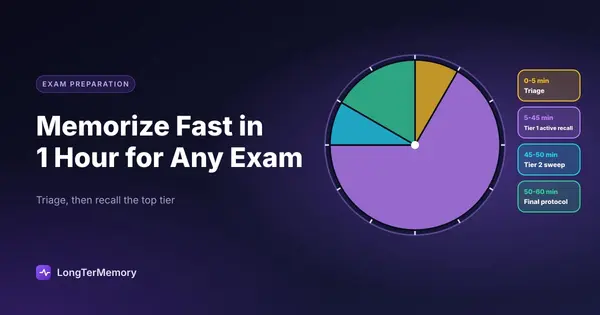
Here is the one-hour framework before we get into the details:
| Time | What to Do |
|---|---|
| 0-5 min | Triage: sort all material into Tier 1, 2, and 3 |
| 5-45 min | High-density active recall on Tier 1 topics |
| 45-50 min | Tier 2 sweep, plus quick recall checks on earlier topics |
| 50-60 min | Final protocol: synthesis, fragile-memory retrieval, pre-exam anchor |
The rest of this guide walks through each step in detail.
How to Triage 1 Hour of Material for Maximum Exam Impact
The biggest mistake people make in a time-crunched situation is trying to cover everything. The second biggest mistake is covering things in the order they appear in their notes without any strategic thought. Both approaches waste the limited resource you have , which is time and cognitive capacity.
Before you open a single book or note, spend five minutes on triage.
The Priority Sorting System
Quickly go through your material , a topic list, a syllabus, your notes , and sort everything into three categories:
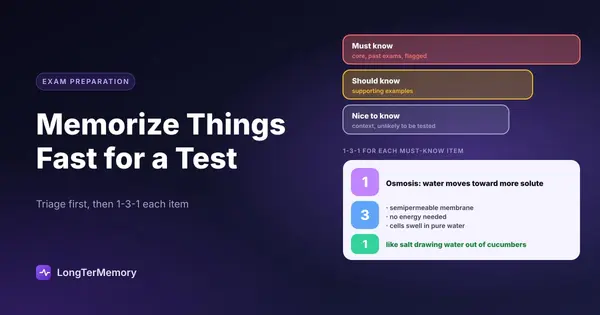
Tier 1 , High return on time: Core concepts, definitions that appear everywhere, processes or frameworks that underlie multiple other topics, anything your instructor explicitly emphasized or that appeared on practice tests. These are your first priority.
Tier 2 , Moderate return: Supporting examples, secondary theories, contextual information that adds depth to Tier 1 content. If time permits, you’ll get to these.
Tier 3 , Low return: Tangential details, one-off facts, material that seems unlikely to appear given the scope of the exam. Set this aside entirely for now.
With an hour available, you should spend roughly 40 minutes on Tier 1 and 15 minutes on Tier 2. Save the last five minutes for the specific end-of-session protocol described later. Don’t touch Tier 3 unless you’ve finished Tier 1 and Tier 2 with time to spare , which is unlikely.
Narrowing Within Tier 1
Even within Tier 1, there may be too much for an hour. If that’s the case, further sort by:
- Foundational vs. advanced: Master the foundational content first. Advanced content often makes more sense once the fundamentals are solid, and foundational content is more likely to appear in basic exam questions.
- What you already know vs. what you don’t: Do a quick mental scan. What can you already articulate reasonably well? What’s genuinely blank? Focus on what’s blank. You’re not doing a full review , you’re filling specific gaps.
- High-frequency terms and concepts: For most exams, some content appears everywhere (in multiple questions, in different contexts) and some content appears once. High-frequency content is worth more per unit of study time.
The five minutes you spend on triage will save you twenty minutes of wasted effort on the wrong material. Don’t skip it.
High-Density Active Recall: Covering More in Less Time
The most important decision you’ll make for your one-hour session is to study actively, not passively. In a time-crunched situation, the gap between passive and active study is especially important , you simply can’t afford to spend an hour re-reading and hoping something sticks.
High-density active recall means maximizing the number of retrieval attempts , actual tests of your memory , per unit of time.
The Read-Cover-Recall Cycle
For each topic you study, apply this cycle:
- Read the relevant section once , just once, but attentively. Identify the key concepts and terms.
- Cover your notes or close the book.
- Recall out loud or in writing: What were the key points? What were the definitions? What’s the process or framework?
- Check what you missed. Spend twenty seconds re-reading only the gaps.
- One more retrieval , cover again, verify you can now recall what you missed.
- Move on.
This cycle, done efficiently, takes roughly four to six minutes per topic. In one hour (minus the five-minute triage and five-minute closing protocol), you have fifty minutes for active study , which means roughly eight to twelve topics covered with genuine retrieval, not just surface exposure.
The quality of those eight to twelve retrieval cycles will far exceed the quality of reading through thirty topics passively.
The Question-First Method
An even faster encoding approach for individual facts and definitions: instead of reading to learn and then testing yourself, convert the material into questions before you read the explanation.
Look at the heading or term. Ask: What do I expect this to mean? What do I already know about this? Then read the explanation to confirm or correct your prediction.
This predictive reading approach engages deeper processing because your brain is actively looking for specific information rather than passively receiving it. The confirmation or correction of your prediction is a retrieval-like event that boosts encoding.
Rapid-Fire Drilling for Fact-Heavy Material
For subjects requiring you to memorize many discrete facts , dates, vocabulary, steps in a process, names, formulas , rapid-fire drilling is the most time-efficient approach:
- Write the item on a scrap card or sticky note (front: question, back: answer)
- Drill through the stack quickly, sorting into “got it” and “need more work”
- Set aside the “got it” pile
- Drill the “need more work” pile again immediately
- Repeat until the “need more work” pile is empty or time is up
The benefit of physical card sorting is that you get immediate visual feedback on your progress and the physical act of sorting keeps you engaged. If you’re working digitally, LongTerMemory or a similar flashcard app can replicate this with its built-in difficulty rating.
Using distributed practice Even Within One Hour
Even within a single hour, you can apply a mini version of distributed practice by coming back to earlier material rather than moving through your notes linearly.
Study Topic A for five minutes. Move to Topic B. After five minutes on B, do a thirty-second recall check on A. Move to Topic C. After five minutes on C, check A and B again briefly.
This cycling ensures that earlier material is being retrieved , and therefore consolidated , even while you’re learning new content. It also mimics the interleaving effect, which strengthens both individual memories and the connections between them.
What to Do in the Final 10 Minutes Before You Stop
How you end your study session matters almost as much as how you conduct it. The final ten minutes are a specific opportunity to lock in what you’ve learned and set yourself up for successful recall during the exam.
The Rapid-Fire Synthesis (5 minutes)
With five minutes remaining, stop studying new material. Instead, do one final sweep of everything you covered , rapidly, without notes.
Mentally run through each topic: What’s the one-sentence summary? What are the two or three most important points? What’s a detail that I found hard to remember?
You don’t need to write this down (though you can). The goal is to activate all the material you encoded in the last hour one more time, so that each retrieval attempt re-consolidates the memory just before you stop.
This final sweep is particularly effective because it mirrors the “testing effect” under compressed conditions , each successful recall during this sweep strengthens the memory for the actual exam.
Identify Your Most Fragile Memories (3 minutes)
As you do the final sweep, notice which items feel shaky , things where your one-sentence summary is fuzzy, where you can recall the topic exists but not the content.
Write down a list of these fragile items , five to ten of them. These are the things most at risk of not being retrievable under exam pressure.
Spend the last two minutes doing one final, focused retrieval attempt on each item in this list. Not re-reading , retrieving. Try to state the answer before you check. Each successful retrieval here is worth several re-readings.
The Pre-Exam Mental Anchor (2 minutes)
Before you finish, do a brief mental organization exercise:
- Imagine you’re in the exam room, looking at the first question
- Recall the main categories or topics you studied
- Identify which category that question would come from
- Practice this mental filing system with two or three hypothetical questions
This exercise builds a mental structure for exam retrieval. Under exam pressure, people often struggle less because they don’t know the material and more because they can’t locate it quickly. Building a retrieval structure in advance , knowing where your knowledge lives, not just that it exists , improves exam performance. For speeches, ordered lists, or any material you need to walk through sequentially, the memory palace technique is one of the strongest retrieval structures you can build.
Making This Hour Worth More Than Three Hours of Passive Study
The structure above is designed to do in one hour what many students don’t accomplish in three hours of passive, unfocused reviewing. Here’s why it works:
Every minute includes a retrieval attempt: You’re not reading for an hour and hoping something sticks. You’re actively pulling information out of memory, which is where encoding actually happens.
You’re working on the right material: The triage step ensures your cognitive resources go toward high-value content, not a balanced distribution across everything.
You’re managing cognitive load deliberately: The final ten minutes specifically address the items most at risk of forgetting, rather than hoping for the best.
You’re leaving with a clear map: The final synthesis and structure-building gives you a retrieval framework for the exam, not just a stack of isolated facts.
One genuine, well-structured hour is not a replacement for a week of spaced practice. But it is a real, meaningful intervention , and it’s vastly more effective than a panicked, unfocused hour of re-reading.
If you have more than an hour and need to memorise chapters for an exam in one day, the same principles scale up into a full-day sprint. See our guide on how to memorise chapters for an exam in one day for the complete 24-hour plan. For a realistic estimate of how far a full day can take you, read our guide on how many pages can you memorize in a day.
If you need to memorize biology fast, the same one-hour techniques work even better when paired with biology-specific methods like blank diagrams and disease case studies. See our complete guide on how to memorize biology fast.
If you find yourself relying on hour-long crunch sessions regularly, the underlying issue is probably the lack of a daily review system. Tools like LongTerMemory are designed for exactly this: instead of building everything the day before, you spend five to ten minutes a day on spaced flashcard review, so that when the exam approaches, the knowledge is already solid and the hour before is just a calm, confident refresh rather than an emergency intervention.
FAQ: How to Memorize Fast in 1 Hour
How much can you memorize in 1 hour?
With triage and active recall, most people can solidly learn eight to twelve focused topics or one to two dense chapters’ worth of key ideas. Trying to cover everything in the hour leaves you with shallow recall everywhere.
What is the best way to memorize fast in 1 hour?
Spend five minutes sorting material into tiers, then use the read-cover-recall cycle on Tier 1 topics. Retrieval attempts beat re-reading, and the final ten minutes should lock in your most fragile items.
Should you re-read your notes when you only have an hour?
No. Read each section once, then close the notes and recall it. Re-reading feels productive but creates familiarity, not memory.
What should you do in the last 10 minutes?
Stop learning new material. Do a rapid synthesis of every topic without notes, list your five to ten shakiest items, and retrieve each one once more.
But for right now, with the hour you have: triage, retrieve actively, and finish with a focused synthesis. That’s how to memorize fast in 1 hour, and it’s the best version of one-hour exam prep that exists. Learn the method once and you can repeat it before every exam where time is short.
If you only have half the time, the same principles still apply. See our guide on how to memorize fast in 30 minutes for a shorter version of this framework.
For a general approach to memorizing any material you choose, see our guide on how to memorize what you want.