How to Learn from Your Mistakes on Practice Tests
Turn every wrong answer into a learning opportunity. Learn how to analyze practice test mistakes and build an error log that improves your exam score.
Table of Contents
- Why Wrong Answers Are More Valuable Than Right Ones
- Categorizing Errors: Content Gaps vs. Reasoning Errors vs. Careless Mistakes
- Type 1: Content Gaps
- Type 2: Reasoning Errors
- Type 3: Careless Mistakes
- Tracking the Categories Over Time
- Deep Error Analysis: Spending More Time on Wrong Answers Than Right Ones
- The Five-Question Error Analysis
- Writing It Out Forces Depth
- Building an Error Log That Informs Your Next Study Sessions
- What to Track in Your Error Log
- Using Your Error Log to Drive Study Decisions
- Closing the Loop: Re-Testing on Error Content
- The Mindset Shift That Makes Error Review Work
- Don't Skip the Review When You're Short on Time
- A Sample Error Review Workflow
Most students treat a practice test as a measuring stick. They complete it, check their score, feel good or bad about the number, and then move on to reading more material. What they’ve missed is the actual value, the thing that makes practice testing one of the most powerful study techniques available.
The score tells you where you are. The wrong answers tell you how to get better. And if you’re not systematically mining those wrong answers for information, you’re leaving the most useful part of every practice test on the table.
This post is about how to change that.
Why Wrong Answers Are More Valuable Than Right Ones
Here’s a counterintuitive fact: on a well-designed practice test, the questions you got right are mostly giving you confirmation that you already know something. That’s pleasant, but it doesn’t move you forward. The questions you got wrong are actively pointing you toward the gaps between your current knowledge and what you need to know for the real exam.
Every wrong answer is a signal. Your job is to figure out what it’s signaling.
The research on this is consistent: retrieval failure followed by correction produces stronger long-term memory than successful retrieval. When you get something wrong and then find out the right answer, the contrast creates a stronger memory trace than simply getting it right would have. That’s why error review, done properly, is one of the highest-leverage activities in any exam preparation program.
But this only works if the review is active and analytical, not passive. Reading through the correct answer and moving on is close to useless. What produces the learning is understanding why you got it wrong, which requires a different kind of engagement.
Categorizing Errors: Content Gaps vs. Reasoning Errors vs. Careless Mistakes
Before you can learn from a wrong answer, you need to know what kind of wrong answer it was. These are meaningfully different problems with meaningfully different solutions.
Type 1: Content Gaps
You got this wrong because you simply didn’t know the information required to answer it correctly. The concept was unfamiliar, you hadn’t encountered it, or you confused it with something else.
How to identify it: When you read the correct answer explanation, your reaction is “oh, I didn’t know that” or “I’ve never really understood that properly.”
How to fix it: Go back to the source material. Read or re-read the relevant section. Make a flashcard or spaced repetition card on the specific piece of knowledge you were missing. Schedule a review of it.
Content gaps are the most straightforward category to address: find the gap, fill it, verify it.
Type 2: Reasoning Errors
You knew the relevant information, but you applied it incorrectly. You misunderstood what the question was asking, used the right knowledge in the wrong context, or reasoned from correct premises to an incorrect conclusion.
How to identify it: When you read the correct answer explanation, your reaction is “I knew that, but I thought the question was asking something different” or “I can see how the right answer follows, but I chose X because I was thinking about Y.”
How to fix it: This is trickier than filling a content gap. Reasoning errors often indicate a conceptual misunderstanding, not just a missing fact. You need to work out specifically where your reasoning went wrong. Ask yourself: at what step did my logic diverge from the correct path? What was I assuming that turned out to be wrong?
Reasoning errors often benefit from writing out your reasoning process explicitly, then comparing it step by step to the explanation provided. The specific divergence point is the thing to address.
Type 3: Careless Mistakes
You knew the answer and your reasoning was correct, but you got it wrong anyway. You misread “EXCEPT” as just a regular qualifier, you made an arithmetic error, you selected the wrong bubble, or you changed a right answer to a wrong one in the last five minutes.
How to identify it: When you review, you immediately see that you knew the right answer and there’s no content or reasoning gap.
How to fix it: The fix isn’t more studying. It’s slowing down during the exam. Careless mistakes are usually a symptom of rushing, anxiety, or both. If you’re seeing a pattern of careless mistakes, the solution is exam technique work, practice reading carefully, checking your work before moving on, managing time so you’re not rushing.
Tracking the Categories Over Time
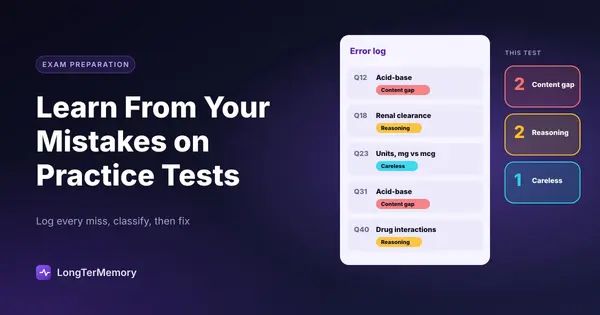
The most useful thing you can do is track which type of error you’re making most. If 80 percent of your errors are content gaps, you need more content review. If they’re mostly reasoning errors, you need to work on how you apply your knowledge to scenarios. If they’re mostly careless, you need exam technique and anxiety management.
This categorization gives you a study strategy based on data rather than intuition.
Deep Error Analysis: Spending More Time on Wrong Answers Than Right Ones
Let’s be specific about what “deep error analysis” actually looks like in practice.
When you’ve completed a practice test block (say, 40 questions), resist the temptation to immediately check your overall score. Instead, work through each question you got wrong individually.
The Five-Question Error Analysis
For each wrong answer, ask yourself these five questions:
- What category of error was this? (Content gap, reasoning error, or careless mistake)
- What did I think when I chose my answer? Try to reconstruct your reasoning at the time of answering.
- At what specific point did my reasoning or knowledge go wrong? Be precise. Not “I didn’t know pulmonary stuff” but “I confused the mechanism of hypoxia with the mechanism of hypercapnia.”
- What would I need to know or do differently to answer this correctly in the future? This is the action step.
- Is this an isolated gap or part of a pattern? If this is the third time you’ve gotten a question on this concept wrong, it deserves significantly more attention than a first-time miss.
This analysis takes two to four minutes per question. If you got 12 questions wrong, that’s 24 to 48 minutes of error review, which is longer than the time many students spend. But the payoff is substantially greater than the same amount of time spent re-reading content.
Writing It Out Forces Depth
There’s a meaningful difference between thinking through your error analysis and writing it out. Writing requires more precision and exposes the gaps in your reasoning more clearly.
Keep a brief written record for each significant error: the concept involved, the type of error, and the specific thing you need to review or change. This creates a reference document that captures your learning from every practice session, and it becomes the foundation of your error log.
Building an Error Log That Informs Your Next Study Sessions
An error log is a systematic record of your practice test mistakes that you actually use to guide your future study. Not a pile of reviewed tests sitting on your desk, but an active document that tells you, at any point, what your current knowledge gaps are.
The simplest version is a spreadsheet, but even a notebook works. What matters is that you’re recording patterns, not just individual mistakes.
What to Track in Your Error Log
| Field | What to Record |
|---|---|
| Date | When you did this practice test |
| Topic/Concept | The specific subject matter of the question |
| Error Type | Content gap, reasoning error, or careless |
| What I Got Wrong | Brief note on your error |
| Correct Concept | The knowledge needed for the right answer |
| Review Status | Whether you’ve since reviewed and retested this |
You don’t need all of these fields for every error. But tracking topic, error type, and review status gives you the most important information: what am I getting wrong, and have I fixed it?
Using Your Error Log to Drive Study Decisions
The log becomes most powerful when you review it before study sessions. Before opening a textbook or starting a new practice set, look at your error log. What are the top three content areas you’ve been getting wrong most often? Start there.
This turns your study sessions from “I’ll work through chapter 7 because that’s next” into “I’m getting questions about Chapter 4’s core concepts wrong repeatedly, so that’s where my time goes today.” It makes your study time responsive to actual data about your performance rather than a predetermined sequence.
Closing the Loop: Re-Testing on Error Content
The log is only useful if you close the feedback loop. For every content gap you identify, you need to revisit that content, then test yourself on it again to verify that you’ve actually fixed the gap.
The best way to do this is through spaced repetition. Tools like LongTerMemory are built exactly for this, letting you create question-answer pairs from your study material, flag items you’ve gotten wrong, and schedule them for review at intervals that progressively move the content into long-term memory. Your error log directly feeds your flashcard system, so every identified gap becomes a card that you’ll see again, repeatedly, until you know it cold.
Without closing the loop, error analysis is just a confession of what you don’t know. With it, every error becomes a discrete problem that you can solve and verify.
The Mindset Shift That Makes Error Review Work
There’s a psychological dimension to this that’s worth naming directly. Most people find error review uncomfortable, because it means spending time looking at your mistakes rather than confirming what you already know. There’s a natural desire to move on, to get back to the flow of studying rather than sitting with your failures.
The mindset shift required is simple but not easy: stop treating wrong answers as evidence of your inadequacy and start treating them as data about your current state of preparation. They’re not a report card. They’re a diagnostic. You’re not looking at your failures. You’re looking at your opportunities.
This shift is easier when you see actual improvement. After a few weeks of rigorous error analysis, most candidates notice that their practice scores are improving faster than they did when they just read and re-read content. That improvement is concrete evidence that the discomfort of error review is producing results.
Don’t Skip the Review When You’re Short on Time
Here’s where most candidates go wrong. When they’re feeling time pressure, the thing they cut from their study session is usually the review piece. “I’ll just do more questions to cover more ground.”
This is exactly backwards. More questions with no review produces modest gains in performance. Fewer questions with deep review produces larger gains. If you have two hours and you had to choose between 80 questions with no review and 40 questions with thorough analysis, choose the 40.
The review is the learning. The questions themselves are just a vehicle for identifying what to review.
A Sample Error Review Workflow
Here’s a concrete workflow you can implement immediately:
Immediately after a practice set:
- Check your answers and mark every wrong one.
- For each wrong answer, write the question number and topic in your error log.
- Categorize the error type quickly (content / reasoning / careless).
During your error review session (within 24 hours):
- For each content gap error: look up the correct information, read the explanation thoroughly, create a review card.
- For each reasoning error: reconstruct your reasoning, find the specific divergence point, write out why the correct answer is correct.
- For careless mistakes: note the pattern. If it’s a reading error, flag it. If it’s arithmetic, note that.
Before your next practice session:
- Review your open error log items.
- Do a quick active recall test on the content gaps you identified last session. Can you answer the question now?
- Add any unresolved items to your spaced repetition queue.
This isn’t a complex system. But it is a consistent one, and consistency over time is what produces the compounding improvement that makes a 10- or 15-point score jump possible over a few weeks of preparation.
Practice tests are the most valuable study tool most candidates have. But only if you use the wrong answers, not just the score.