How to Manage Exam Anxiety With CBT Techniques
Learn practical CBT techniques to manage exam anxiety, reframe anxious thoughts, and build confidence through gradual exposure before test day.
Table of Contents
- Cognitive Restructuring for Exam-Related Anxious Thoughts
- What Anxious Thoughts Look Like Under Pressure
- The ABCDE Method for Exam Anxiety
- Common Cognitive Distortions During Test Prep
- Behavioral Experiments That Reduce Exam Anxiety Through Gradual Exposure
- Why Avoidance Feeds Anxiety
- The Fear Ladder for Test Situations
- Simulated Exam Practice as Exposure
- Tracking Your Anxiety Ratings Over Time
- When Self-Directed CBT Is Enough vs. When Professional Support Is Needed
- Signs You Can Manage It Yourself
- Red Flags That Mean It Is Time for a Therapist
- What Professional CBT for Exam Anxiety Looks Like
- Quick CBT Techniques You Can Use in the Exam Room
- Building Long-Term Study Habits That Reduce Anxiety
- Conclusion
How to Manage Exam Anxiety With CBT Techniques
Your heart pounds, your palms sweat, and your mind goes blank right when you need it most. If that sounds familiar, you are not alone. Exam anxiety affects up to 40% of students worldwide, and roughly 10% experience it at a clinical level that significantly impacts their grades and wellbeing. The good news is that cognitive behavioral therapy, or CBT, offers some of the most effective, evidence-based tools for managing test stress. Unlike generic advice to just relax, CBT techniques target the specific thoughts and behaviors that keep anxiety alive. In this guide, you will learn how to reframe catastrophic thinking, use gradual exposure to build confidence, and know exactly when to handle it yourself or reach out to a professional.
Cognitive Restructuring for Exam-Related Anxious Thoughts
The core idea behind cognitive restructuring is simple: your thoughts shape your feelings, not the other way around. When you believe “I am going to fail and ruin my future,” your body reacts with a full-blown stress response. CBT teaches you to catch those thoughts, challenge them, and replace them with more accurate alternatives.
What Anxious Thoughts Look Like Under Pressure
Anxious thoughts during exam season rarely sound rational when you say them out loud, but in the moment they feel completely believable. Common examples include:
- “If I do not get an A, I am a total failure.”
- “Everyone else understands this except me.”
- “My mind always goes blank during exams.”
- “One bad grade means I will never get into graduate school.”
These thoughts are not harmless. A 2020 meta-analysis in Medical Education found that students who engaged in high levels of catastrophic thinking before exams scored significantly lower than peers with similar preparation but more balanced self-talk. Your brain’s threat detection system, the amygdala, does not distinguish between a literal tiger and a looming final exam. It floods your system with cortisol and adrenaline, which impairs the exact prefrontal cortex functions you need for reasoning and memory retrieval.
The ABCDE Method for Exam Anxiety
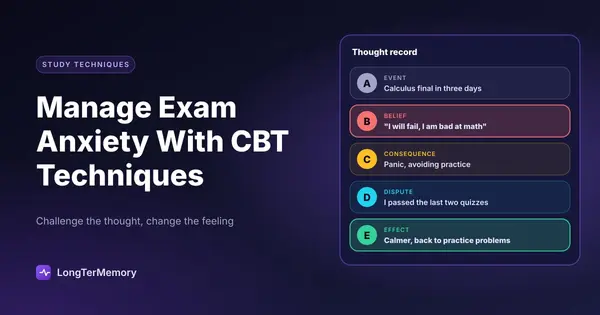
One of the most practical CBT frameworks for restructuring anxious thoughts is the ABCDE model, originally developed by psychologist Albert Ellis. You can use it in a notebook or even in your head during a study break. Here is how it works:
| Step | What to Do | Example |
|---|---|---|
| A - Activating Event | Identify the situation that triggered anxiety. | ”I have a calculus final in three days.” |
| B - Belief | Write down the automatic thought that followed. | ”I am going to fail because I am bad at math.” |
| C - Consequence | Note the emotional and physical result. | Heart racing, avoidance, inability to focus on practice problems. |
| D - Disputation | Challenge the belief with evidence. | ”I passed the midterm with a B+. I have completed 80% of the practice problems correctly this week.” |
| E - Effective New Belief | Form a more balanced thought. | ”I am prepared enough to pass, and one exam does not define my abilities.” |
The magic of this method is not toxic positivity. You are not forcing yourself to believe you will ace the exam. You are training your brain to tolerate uncertainty without spiraling into worst-case scenarios. A 2022 study published in Behaviour Research and Therapy showed that students who practiced thought records like this for just two weeks before exams reported a 34% reduction in self-reported anxiety scores compared to a control group.
Common Cognitive Distortions During Test Prep
To get faster at cognitive restructuring, it helps to learn the specific categories of distorted thinking that show up around exams. Here are the most common ones:
- All-or-nothing thinking: Viewing any outcome short of perfection as a complete failure. One wrong answer does not erase ten correct ones.
- Mind reading: Assuming your classmates are all confident and prepared, when in reality many are probably just as anxious.
- Fortune telling: Predicting you will fail before you even sit down, which then becomes a self-fulfilling prophecy.
- Emotional reasoning: Believing that because you feel unprepared, you must actually be unprepared. Feelings are not facts.
- Mental filtering: Fixating on the one topic you do not understand while ignoring the nine chapters you have mastered.
The next time a worry pops up, label it. Simply naming the distortion, “Ah, that is fortune telling,” reduces its power. Research from UCLA shows that affect labeling, the act of putting feelings and thoughts into words, dampens amygdala activity and helps your prefrontal cortex regain control.
Behavioral Experiments That Reduce Exam Anxiety Through Gradual Exposure
Cognitive work is only half the battle. If you spend months avoiding practice tests, your brain never gets the chance to learn that exams are survivable. Behavioral experiments in CBT are structured activities designed to test your anxious predictions and gradually build tolerance to the situations you fear.
Why Avoidance Feeds Anxiety
Anxiety operates on a cruel feedback loop. You feel nervous about an exam, so you avoid taking a practice test under timed conditions. Your anxiety drops temporarily, which reinforces the avoidance. But the next time you face a timed assessment, your brain treats it as a novel threat and ramps up the panic. The only way to break the cycle is through gradual exposure, which teaches your nervous system that predicted catastrophes do not actually occur.
A landmark study by Lang and colleagues demonstrated that repeated, controlled exposure to feared stimuli is one of the most effective interventions for performance anxiety. The key word is gradual. You do not start by simulating a four-hour bar exam in a crowded lecture hall. You start small and build up.
The Fear Ladder for Test Situations
A fear ladder is a CBT tool that breaks your exam-related fears into manageable steps. You rank situations from least anxiety-provoking to most, then systematically confront each one. Here is an example ladder for someone with severe exam anxiety:
| Rank | Situation | Target Anxiety Level (0-10) |
|---|---|---|
| 1 | Reviewing notes at home with no timer. | 2 |
| 2 | Doing five practice questions alone. | 3 |
| 3 | Doing 20 practice questions with a 30-minute timer. | 5 |
| 4 | Taking a full practice test alone in a quiet room. | 6 |
| 5 | Taking a practice test in a library or coffee shop with background noise. | 7 |
| 6 | Taking a practice test with a friend acting as a proctor. | 8 |
| 7 | Sitting for the actual exam. | 9 |
You only move up the ladder when your anxiety in the current step drops to a 3 or below for two consecutive attempts. This prevents you from jumping too far ahead and reinforcing the belief that you cannot handle it. Each successful exposure is proof that your catastrophic predictions were wrong.
Simulated Exam Practice as Exposure
One of the most powerful behavioral experiments is the mock exam. But to make it count as true exposure, it needs to mimic the real thing as closely as possible. That means:
- Using the exact same time limits.
- Working in a similar environment, quiet or noisy depending on the real setting.
- Wearing the same clothes you plan to wear on test day.
- Using the same materials allowed during the real exam.
- Refraining from checking your phone or getting up except during scheduled breaks.
After each mock exam, rate your peak anxiety and your actual performance. Most students discover two things: first, their anxiety peaks within the first ten minutes and then naturally declines. Second, they perform better than they predicted. Tracking this data gives you concrete evidence to use during cognitive restructuring. A 2019 randomized controlled trial found that students who completed at least three full mock exams under realistic conditions reduced their exam-day cortisol levels by an average of 22% compared to peers who studied traditionally.
Tracking Your Anxiety Ratings Over Time
Behavioral experiments work best when you collect data. Before and after each exposure task, record:
- Your predicted anxiety level (0-10).
- Your actual peak anxiety level (0-10).
- Your predicted performance, such as expected score or number of mistakes.
- Your actual performance.
Over time, you will likely notice a gap between prediction and reality. Your anxiety is consistently lower than you feared, and your performance is consistently better than you expected. That gap is your cognitive armor. The next time your brain screams that you are doomed, you will have a spreadsheet full of proof that it is wrong.
When Self-Directed CBT Is Enough vs. When Professional Support Is Needed
CBT techniques are powerful, but they are not a magic wand for everyone. There is a real difference between manageable pre-exam jitters and a clinical anxiety disorder that requires professional intervention. Knowing where you fall on that spectrum can save you months of unnecessary suffering.
Signs You Can Manage It Yourself
Self-directed CBT, using workbooks or structured online programs, is often sufficient if your anxiety meets these criteria:
- It is situation-specific. The anxiety shows up around exams but does not dominate your daily life.
- You can still study, even if it is uncomfortable. Avoidance is occasional, not habitual.
- Your physical symptoms are manageable. You might feel nauseated or tense, but you do not experience full panic attacks.
- You have good insight. You can recognize that your fears are exaggerated, even if you struggle to shake them.
- You are motivated to practice the techniques consistently, ideally for 15 to 20 minutes per day.
If this sounds like you, tools like The Anxiety and Worry Workbook by Clark and Beck, or free CBT worksheets from reputable university counseling centers, can be excellent starting points. Many students see meaningful improvement within four to six weeks of regular practice.
Red Flags That Mean It Is Time for a Therapist
There is no shame in needing professional help. In fact, seeking therapy is often the smartest strategic move a student can make. Consider reaching out to a licensed CBT therapist if you experience any of the following:
- Panic attacks: Sudden episodes of intense fear with chest pain, shortness of breath, or dizziness that feel like medical emergencies.
- Chronic avoidance: You have dropped classes, skipped exams, or considered leaving school to escape test situations.
- Sleep disruption: Insomnia or nightmares related to exams that persist for weeks and impair your functioning.
- Physical health decline: Unexplained headaches, gastrointestinal issues, or weight changes tied to academic stress.
- Comorbid depression: Loss of interest in activities, persistent sadness, or thoughts of self-harm alongside your anxiety.
- No improvement after six weeks: You have diligently practiced self-directed CBT and see no change in your symptoms.
A 2021 review in The Lancet Psychiatry found that CBT delivered by a trained clinician produces effect sizes nearly double those of self-help interventions for moderate to severe anxiety. A therapist can also rule out related conditions, such as ADHD or generalized anxiety disorder, that might be fueling your exam stress.
What Professional CBT for Exam Anxiety Looks Like
If you do see a therapist, the structure will likely feel familiar because it builds on the same principles in this article. A typical course of CBT for test stress lasts 8 to 12 sessions and includes:
- Psychoeducation: Learning how anxiety works in the brain and body.
- Cognitive restructuring: Identifying and challenging distorted thoughts with therapist guidance.
- Exposure hierarchy: Gradually facing feared test situations in and out of sessions.
- Skills training: Breathing techniques, progressive muscle relaxation, and mindfulness practices.
- Relapse prevention: Creating a plan for future high-stakes exams so you do not slide back into old patterns.
Some universities offer free or low-cost CBT through their counseling centers. If that is not available, look for therapists certified by the Academy of Cognitive and Behavioral Therapies or equivalent organizations in your country. Telehealth options have also expanded dramatically, making it easier to find a specialist even if you live in a rural area.
Quick CBT Techniques You Can Use in the Exam Room
Even with thorough preparation, some anxiety on test day is normal. Here are three CBT-informed techniques you can use discreetly at your desk:
- The 5-4-3-2-1 Grounding Technique: Name five things you see, four you can touch, three you hear, two you smell, and one you taste. This pulls your brain out of catastrophic future-thinking and into the present moment.
- Box Breathing: Inhale for four counts, hold for four, exhale for four, hold for four. Repeat for one to two minutes. This activates your parasympathetic nervous system and lowers physiological arousal without drawing attention.
- Evidence Check: If your mind says, “I am failing this,” ask yourself, “What evidence supports that? What evidence contradicts it?” Usually, the mere act of questioning disrupts the panic spiral.
These techniques work best when you practice them during your mock exams, not for the first time on test day.
Building Long-Term Study Habits That Reduce Anxiety
Here is the truth no one tells you: the most effective antidote to exam anxiety is genuine preparation paired with efficient systems. CBT helps you manage the mental noise, but you still need a study strategy that builds real confidence. That is where spaced repetition comes in.
Students who use spaced repetition retain information significantly better than those who cram. A famous 2006 study by Cepeda and colleagues found that spacing study sessions over time improved long-term retention by up to 200% compared to massed practice. When you actually know the material, your brain has fewer openings for catastrophic thoughts to take hold.
If you are tired of spending hours manually organizing flashcards and review schedules, LongTerMemory can help. It automatically handles the scheduling for you, so you review each concept at the optimal interval for your memory. You can import content directly from PDFs and web articles, which means you spend less time copy-pasting and more time actually learning. The platform tracks your progress and surfaces the material you are most likely to forget, turning vague anxiety into concrete, manageable review sessions.
You can start a free trial today and see how much calmer you feel heading into your next exam when your study system is actually working for you, not against you.
Conclusion
Exam anxiety is real, common, and highly treatable. Cognitive behavioral therapy gives you a practical framework for dismantling the thoughts and avoidance patterns that keep test stress alive. Start by catching and challenging your catastrophic predictions with cognitive restructuring. Then, use gradual exposure and behavioral experiments to teach your nervous system that exams are survivable. Know your limits, too. Self-directed CBT is a great starting point, but if your symptoms are severe or persistent, a licensed CBT therapist can offer targeted support that changes outcomes. Combine these psychological tools with smart, spaced study habits, and you will walk into your next exam room with something better than false confidence. You will have evidence-based proof that you can handle it.