How to Prepare for Oral Exams and Viva Voce Assessments
Understand what examiners score in a viva voce, how to train for thinking under pressure, and how retrieval practice prepares you for unpredictable questions.
Table of Contents
- What Examiners Are Actually Looking For
- Depth of Understanding, Not Breadth of Recitation
- Intellectual Honesty Under Pressure
- Coherent Structure, Even When Improvising
- Practice Techniques for Thinking and Speaking Under Pressure
- Why Silent Review Doesn't Transfer
- Mock Vivas With Real Follow-Up Questions
- Training the Pause
- Using Retrieval Practice to Prepare for Unpredictable Questions
- Build a Question Bank From Your Own Material, Then Answer It Out Loud
- Space Your Practice Rather Than Cramming It
- The Week Before: A Realistic Taper
- The Bottom Line
Most exam anxiety research focuses on written tests, but a viva voce creates a specific kind of pressure that written exams simply do not. There is no blank page to hide behind, no crossing out a wrong answer before anyone sees it. Someone is watching your face while you think, and the silence between a question and your answer feels a lot longer than it actually is.
As a neuroscientist who studies memory under stress, I want to reframe how you think about viva preparation, because most students prepare for the wrong thing. They prepare to know the material. What actually gets tested in a viva is whether you can access that knowledge, coherently, out loud, while a stranger is evaluating you in real time. Those are related skills, but they are not the same skill, and treating them as interchangeable is where most viva anxiety actually comes from.
What Examiners Are Actually Looking For
If you only remember one thing from this article, make it this: examiners are almost never trying to catch you out. They are trying to answer a fairly specific question, does this candidate genuinely understand their material well enough to defend, extend, and critique it, or have they memorized a script.
Depth of Understanding, Not Breadth of Recitation
A candidate who can recite their thesis abstract flawlessly but freezes the moment a question deviates from the expected script has demonstrated memorization, not understanding. Examiners deliberately probe for this distinction. Expect follow-up questions that push slightly beyond what you prepared, that is not a sign you are failing, it is a sign the examiner is doing their job.
The practical implication: your prep should not be “memorize answers to expected questions.” It should be “build a deep enough model of my own work that I can reason about questions I have not specifically rehearsed.”
Intellectual Honesty Under Pressure
Examiners consistently rate candidates more favorably when they respond to a hard question with genuine, transparent reasoning, including openly saying “I’m not certain, but here’s how I’d think through it,” rather than bluffing or over-claiming certainty. A confident-sounding wrong answer tends to read worse to an experienced examiner than an honest, well-reasoned uncertain one. This is worth internalizing early, because a lot of viva anxiety comes from an unspoken fear that not knowing something instantly equals failure. It doesn’t. Poor reasoning under uncertainty is what actually costs marks.
Coherent Structure, Even When Improvising
Examiners are also implicitly scoring how well you organize an answer on the fly. A rambling, unstructured response to a good question reads worse than a shorter, clearly structured one, even if the rambling answer technically contains more correct information. Before you answer a tricky question, it is worth taking a breath and briefly signposting your structure out loud (“There are really two parts to this, let me start with…”) rather than launching straight into unstructured thinking. It buys you processing time and it makes your reasoning easier for the examiner to follow and credit.
Practice Techniques for Thinking and Speaking Under Pressure
Understanding is necessary but not sufficient. You also need to train the specific skill of producing coherent spoken reasoning while your stress response is active, because that is a genuinely different cognitive demand than producing the same reasoning calmly at your desk.
Why Silent Review Doesn’t Transfer
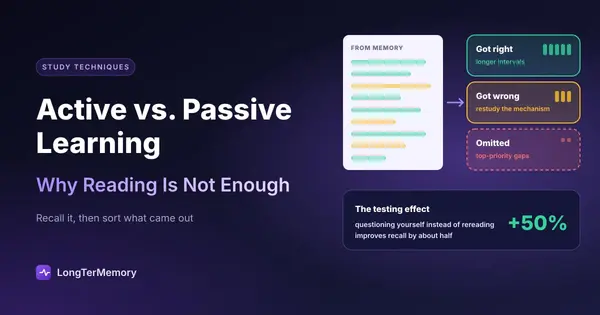
Here is the neuroscience piece that matters most: acute stress narrows working memory and makes retrieval feel harder, even when the underlying knowledge is intact. If all your preparation happens in a low-pressure, silent environment, you are training a skill (calm, unhurried recall) that does not fully transfer to the actual test condition (recall under social and evaluative pressure). This is the same principle behind why athletes practice under game-like conditions rather than only in isolated drills.
The fix is to deliberately practice under conditions that approximate at least some of the real pressure: speaking your answers out loud, to another person, in real time, without notes.
Mock Vivas With Real Follow-Up Questions
The single most effective preparation technique is a genuine mock viva with someone who will ask real follow-up questions rather than simply letting you deliver a rehearsed monologue. Ask your mock examiner specifically to interrupt you, to push back on claims, and to ask “why” a second and third time after your first answer. This is uncomfortable, and that discomfort is exactly the point. You want your first experience of being pushed on a weak point to happen in a low-stakes mock session, not in the actual exam.
Training the Pause
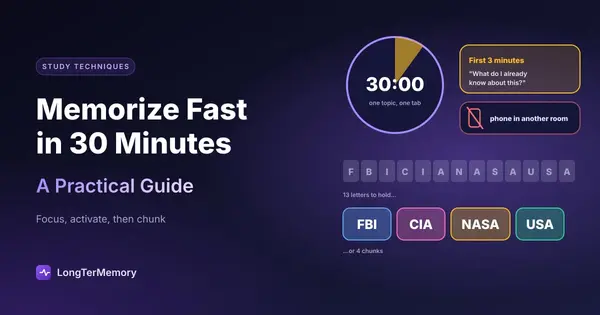
One small, high-impact technique: practice pausing for two to three full seconds before answering a hard question, instead of filling the silence immediately with whatever comes to mind first. Most candidates find silence excruciating and rush to fill it, which produces worse-organized answers. A brief pause signals composure to an examiner, and it gives your prefrontal cortex, the part of your brain responsible for organized reasoning, a moment to actually structure the answer before your mouth starts moving. This is a trainable habit, not a fixed personality trait, and it improves quickly with deliberate practice.
Using Retrieval Practice to Prepare for Unpredictable Questions
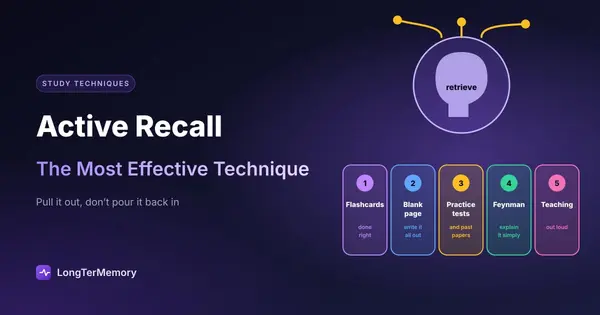
Because you cannot script every question an examiner might ask, the highest-value preparation is building a flexible, well-retrieved knowledge base rather than a fixed set of rehearsed answers. This is where retrieval practice, the same principle behind effective flashcard study, becomes directly useful for oral exam prep specifically.
Build a Question Bank From Your Own Material, Then Answer It Out Loud
Go through your thesis, dissertation, or subject material and generate a wide net of possible questions, not just the obvious ones, but questions that probe assumptions, alternative interpretations, and limitations of your work or argument. Then answer each one out loud, from memory, without reading from notes. This does two things simultaneously: it strengthens your ability to retrieve the content under mildly artificial pressure, and it surfaces the specific gaps in your reasoning before an examiner finds them for you.
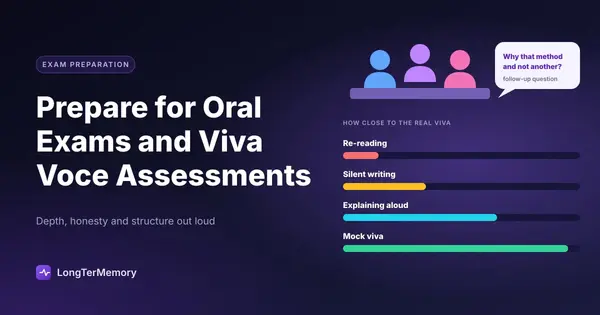
| Preparation method | What it trains | How close to real viva conditions |
|---|---|---|
| Re-reading your written work | Familiarity | Low |
| Writing out answers silently | Recall organization | Low to moderate |
| Speaking answers out loud alone | Verbal retrieval | Moderate |
| Mock viva with real follow-ups | Retrieval under social pressure | High |
Notice the progression: each step gets you closer to the actual demands of the exam. Most students stop at the first or second row. The candidates who walk in calm and coherent are almost always the ones who pushed through to the third and fourth.
Space Your Practice Rather Than Cramming It
Retrieval practice is significantly more effective when spaced over multiple sessions rather than crammed into one long practice marathon the day before. The same forgetting curve that governs flashcard-based studying applies here: a question you answered well once, three weeks ago, needs to be revisited to stay reliably accessible, not assumed to be permanently secured after a single successful attempt. Building your likely viva questions into a spaced review system, the same way you would with exam flashcards, keeps your answers sharp across the weeks leading up to the exam instead of only being fresh right after a single cramming session. This is exactly the kind of scheduling problem a tool like LongTerMemory is built to solve, turning your question bank into a recurring review rotation rather than a one-time practice session you have to remember to repeat yourself.
The Week Before: A Realistic Taper
Heavy new-question generation should stop about a week out. In the final days, focus on:
- Reviewing the specific gaps your mock viva sessions exposed, not starting new material
- One more full mock viva, ideally with a different questioner than your earlier sessions, to avoid over-familiarity with one person’s question style
- Rehearsing your opening explanation of your work so you have a confident, well-organized answer ready for whatever the first question turns out to be
- Sleep, since working memory and verbal fluency both suffer measurably under sleep deprivation, which is the last thing you want during an evaluative, high-pressure conversation
The Bottom Line
A viva voce is not testing whether you memorized your material. It is testing whether you can think with it, out loud, under mild social pressure, in front of someone actively probing for the edges of your understanding. That is a specific, trainable skill, separate from simply knowing your content well.
Understand what examiners are actually scoring, practice retrieving your knowledge out loud under conditions that resemble the real pressure, and build your preparation around a wide, well-rehearsed set of retrieval-practiced questions rather than a narrow script. Do that consistently, and the silence after a hard question stops feeling like a threat. It starts feeling like exactly what it is, a moment to think clearly before you speak.