
How to Study Management Theory for a Professional Exam
A practical guide to mastering management theory for professional exams, from classical frameworks to situational questions and effective retention strategies.
Table of Contents
- Understanding What Management Theory Exams Actually Test
- Classical vs. Contemporary Management Theories: A Study Framework
- Classical Theories
- Contemporary Theories
- How to Study Management Theory: A Practical Approach
- Build a Theory Comparison Matrix
- Learn Through Scenarios
- Apply Theories to Real Organizations
- Use Active Recall with Spaced Repetition
- Practice with Situational Questions
- Organizational Behavior Concepts That Recur in Exams
- Managing Your Study Schedule for Management Theory
- The Key Mindset Shift
Management theory is one of those subjects that feels deceptively approachable until you actually sit down to study it. The concepts seem familiar, almost common-sense, until you realize that exams don’t just ask you to recognize the ideas. They ask you to apply them, compare them, and select the right framework for a specific scenario under time pressure.
If you’re preparing for a professional exam that covers management theory, whether that’s the PMP, SHRM, a management MBA program, or a civil service leadership exam, this guide will help you study the material in a way that actually prepares you for exam conditions. Not just recognition. Genuine flexible knowledge.
Understanding What Management Theory Exams Actually Test
Before diving into study strategies, it’s worth being specific about what professional management exams are assessing. Most students assume these exams test whether you “know the theories.” That’s partly true, but it’s incomplete.
What most management theory exams actually test:
- Whether you can identify which theory applies to a given scenario
- Whether you understand the assumptions and limits of each framework
- Whether you can compare competing theories and articulate their differences
- Whether you can apply concepts to workplace situations you haven’t seen before
This has an important implication for how you study. Memorizing definitions without understanding application is insufficient. You might be able to tell an examiner what Herzberg’s Two-Factor Theory says, but if you can’t recognize a scenario where it applies and distinguish it from Maslow’s hierarchy, you’ll miss situational questions.
The goal is flexible, applicable knowledge. Not rote recall.
Classical vs. Contemporary Management Theories: A Study Framework
Most management exams draw from two broad eras of management thinking: classical theories (developed primarily in the 20th century) and contemporary theories (more recent frameworks that address modern organizational complexity). Understanding both, and understanding the historical arc connecting them, is valuable context that makes the material stick better.
Classical Theories
These are the foundational frameworks that almost every management exam covers. You need to know them well.
Scientific Management (Taylor) Focus: Efficiency, standardization, task analysis, time-and-motion studies. Core idea: Work can be optimized through systematic analysis, and workers should be matched to tasks based on ability and trained rigorously. Exam watch: Questions about factory settings, production efficiency, and the role of financial incentives for performance.
Administrative Theory (Fayol) Focus: Management principles applicable at the organizational level. Core idea: 14 principles of management (division of work, authority, discipline, unity of command, etc.). The manager’s role is to plan, organize, command, coordinate, and control. Exam watch: Fayol’s 14 principles are frequently tested. Know them and be able to identify scenarios where specific principles are violated or upheld.
Bureaucratic Theory (Weber) Focus: Organizational structure, formal authority, rules-based systems. Core idea: The ideal organization is rational, rule-based, and impersonal. Authority derives from position, not personality. Exam watch: Questions about organizational hierarchy, formal procedures, and the advantages and disadvantages of bureaucratic structures.
Human Relations Movement (Mayo, Maslow, Herzberg, McGregor) Focus: Motivation, social needs, worker psychology. Core ideas:
- Mayo: Social factors (group dynamics, recognition) affect productivity more than physical conditions.
- Maslow: Hierarchy of needs from physiological to self-actualization.
- Herzberg: Hygiene factors (prevent dissatisfaction) vs. motivators (drive satisfaction).
- McGregor: Theory X (workers are lazy, need control) vs. Theory Y (workers are motivated, seek responsibility).
Exam watch: These are heavily tested. Scenario questions will describe workplace situations and ask which theory or which manager type is illustrated. Know the distinctions between hygiene factors and motivators (Herzberg) and Theory X vs. Y assumptions.
Contemporary Theories
Contingency Theory Core idea: There is no single best way to manage. The optimal approach depends on the situation. Variables like organizational size, environment, technology, and workforce characteristics determine what works. Exam watch: Questions presenting a specific organizational context and asking what management approach is most appropriate. The answer usually involves identifying the contingent variable that changes the answer.
Systems Theory Core idea: Organizations are open systems that interact with their environment. Inputs, transformation processes, outputs, and feedback loops are all interconnected. Exam watch: Questions about organizational interdependency, environmental influences on organizational performance, and the consequences of changes in one part of the system on others.
Transformational Leadership Core idea: Leaders who inspire and motivate through vision, charisma, and intellectual stimulation produce better outcomes than transactional leaders who rely on reward/punishment exchanges. Exam watch: Compare transformational vs. transactional leadership. Recognize scenarios illustrating each type.
Situational Leadership (Hersey and Blanchard) Core idea: Effective leaders adapt their style to the development level of each follower. Four styles (directing, coaching, supporting, delegating) are matched to four follower readiness levels. Exam watch: Heavily tested in management and project management exams. Be able to identify follower readiness level and select the corresponding leadership style.
How to Study Management Theory: A Practical Approach
With this landscape in mind, here’s how to structure your study so the material becomes flexible and usable, not just recognizable.
Build a Theory Comparison Matrix
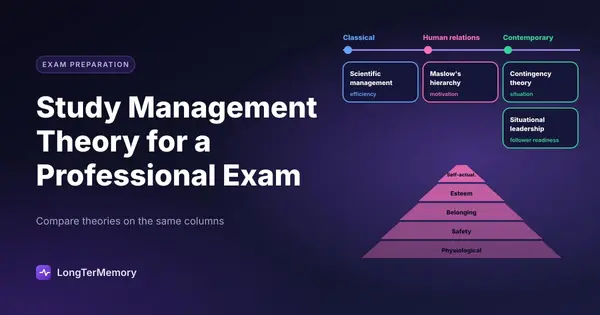
The single most useful study tool for management theory is a comparison matrix. Create a table with each theory as a row and key attributes as columns.
| Theory | Era | Focus | Key Assumption | Main Critique |
|---|---|---|---|---|
| Scientific Management | Classical | Efficiency | Workers respond to financial incentives | Dehumanizing, ignores social needs |
| Maslow’s Hierarchy | Human Relations | Motivation | Needs are hierarchical | Evidence for strict hierarchy is weak |
| Contingency Theory | Contemporary | Situation | Context determines best approach | ”It depends” can be frustratingly vague |
| Situational Leadership | Contemporary | Leader style | Adapt to follower readiness | Readiness assessment is subjective |
Building this matrix is itself a study activity, not just a reference to read passively. The act of deciding what goes in each cell forces you to understand each theory rather than just recognizing its name.
Once you’ve built it, use it for active recall. Cover the right side of the table and try to fill in the attributes from memory. Then check. Then redo the ones you got wrong.
Learn Through Scenarios
This is where most students fall short. They learn the theories in abstract and then struggle with exam questions that present concrete workplace situations.
Practice reverse engineering. Take a work scenario (you can find these in old exam questions, case studies, or even just workplace stories you’ve read) and ask: which theory does this illustrate? What would each major theory say about how to handle this?
Example scenario: A manager notices that her team’s productivity has been declining despite recent pay raises. She decides to reorganize workstations to increase social interaction between team members.
Which theory does this reflect? The Human Relations movement. Which specific insight? Mayo’s Hawthorne studies, which found that social conditions affect productivity more than physical or financial factors alone.
Practice writing scenario explanations. After identifying the theory, write a two-sentence explanation of why that theory applies. This level of active engagement with the material is what makes it usable in exam conditions.
Apply Theories to Real Organizations
One of the most effective ways to make management theory stick is to connect it to organizations you know. Think about companies you’ve worked for, studied, or read about, and ask: which theories describe how they operate?
- A company with strict hierarchy, lots of formal rules, and standardized processes: Bureaucratic theory, possibly with a Theory X underpinning.
- A startup where the CEO inspires employees with a mission vision, talks about changing the world, and gives teams broad autonomy: Transformational leadership, Theory Y assumptions.
- A consulting firm where client engagement strategies are heavily adapted to each client’s specific context: Contingency theory in practice.
Real-world anchors make abstract theories memorable. They also give you a rich set of examples to draw on if exam questions ask you to illustrate a concept.
Use Active Recall with Spaced Repetition
Management theory has a lot of named frameworks, theorists, and specific concepts that require reliable recall. For this component of the content, flashcards with spaced repetition are the right tool.
Create cards for:
- Key definitions (what is Herzberg’s Two-Factor Theory?)
- Theorist-to-theory pairings (which theorist developed Theory X and Theory Y?)
- Core distinctions (what is the difference between hygiene factors and motivators?)
- Historical context (which theory was a reaction against Scientific Management’s dehumanizing aspects?)
If you’re uploading your management theory notes or textbook chapters into a tool like LongTerMemory, it can automatically generate these question-answer pairs for you, saving hours of manual flashcard creation and letting you focus on the actual review.
Review these cards using spaced repetition: more frequently when you’re getting them wrong, less frequently as you master them. This ensures that your weakest knowledge areas get the most reinforcement.
Practice with Situational Questions
The hardest part of management theory exams is the situational question format. You’re given a scenario and asked what a good manager should do, or which theory best explains what’s happening, or what the likely outcome of a given management approach would be.
To prepare for these:
- Work through past exam questions in situational format. Most professional exams publish sample questions. Get as many as you can find.
- Analyze why wrong answers are wrong. On situational questions, wrong answers are usually wrong because they apply the right theory to the wrong context, or the wrong theory to a recognizable context. Understanding the errors is as important as getting the right answer.
- Write your own situational questions. Take a theory you’re studying and write three scenarios: one where the theory clearly applies, one where it doesn’t, and one where it’s ambiguous. This forces a level of understanding that simply reading about a theory never produces.
Organizational Behavior Concepts That Recur in Exams
Beyond the big-name theories, professional management exams frequently test a cluster of organizational behavior concepts. These come up in situational questions regularly.
Group dynamics and team performance. Tuckman’s stages (forming, storming, norming, performing, adjourning) appear in PMP and management exams constantly. Know the stages and what a leader should do at each one.
Conflict management styles. Collaborating, competing, avoiding, accommodating, compromising. Know when each is appropriate and what its costs are.
Communication channels and organizational structure. Formal vs. informal communication, tall vs. flat hierarchies, matrix vs. functional structures. Know the tradeoffs of each.
Change management. Kotter’s 8-step model and Lewin’s unfreeze-change-refreeze model appear in management exams regularly. Know the steps and the reasoning behind the sequence.
Decision-making models. Rational decision-making vs. bounded rationality vs. intuitive decision-making. Know the assumptions and limitations of each.
Managing Your Study Schedule for Management Theory
Management theory is a broad subject that rewards spread-out studying more than cramming. Here’s a rough study schedule structure:
| Phase | Focus |
|---|---|
| Weeks 1-2 | Survey all major theories; build comparison matrix |
| Weeks 3-4 | Deep study of each theory; create flashcard decks |
| Weeks 5-6 | Scenario practice; past exam questions |
| Week 7 | OB concepts (group dynamics, conflict, change) |
| Week 8 | Full practice exams; targeted review of weak areas |
Adjust this timeline based on your exam date and the weight management theory carries in your specific exam’s content outline.
The Key Mindset Shift
The biggest thing that separates students who do well on management theory exams from those who struggle is a mindset shift: from learning what theories say to understanding what problems they were designed to solve.
Every management theory emerged because someone noticed a real problem in how organizations work and tried to address it. Scientific management was a response to inefficiency and inconsistency in industrial production. The Human Relations movement was a response to the dehumanizing effects of pure efficiency thinking. Contingency theory was a response to the failure of universal management prescriptions.
When you understand what problem each theory is solving, you understand why it makes the assumptions it does, when it’s useful, and when it breaks down. That understanding is what makes situational questions answerable, because you can reason from first principles rather than having to match a scenario to a memorized description.
Know the theories. More importantly, know the problems they solve. Then applying them becomes intuitive.