How to Memorize Formulas Fast for Math and Science
Master math and science formulas with proven memorization techniques including derivation practice, visual encoding, and smart flashcard strategies.
Table of Contents
- Understanding vs. Memorizing: Why You Need Both
- The Derivation Practice Method
- How to Practice Derivations
- Visual Encoding: Making Formulas Stick Through Images
- Color-Coded Variables
- The Shape Method
- Story Formulas
- Flashcard Design for Equations and Variables
- Card Type 1: Definition Cards
- Card Type 2: Variable Isolation Cards
- Card Type 3: Application Cards
- Card Type 4: Reverse Engineering Cards
- The Review Schedule
- The Grouping Strategy
- Example: Kinematic Equations Family
- Example: Trigonometric Identities
- The Practice Problem Method
- The Problem Set Approach
- Mnemonics That Actually Work for Formulas
- Acronym Mnemonics
- Sentence Mnemonics
- The Key to Good Formula Mnemonics
- Common Mistakes That Sabotage Formula Memorization
- Mistake 1: Memorizing Without Understanding Units
- Mistake 2: Only Memorizing the "Standard" Form
- Mistake 3: Trying to Memorize Everything at Once
- Mistake 4: Neglecting the Conditions
- Building a Formula Memorization Routine
- The Bottom Line
There’s a special kind of panic that hits when you sit down for a math or science exam, turn over the paper, and realize that the formula you drilled last night has completely vanished from your brain. You stared at it for an hour. You copied it out five times. You could picture the page it was on. And now? Nothing. Just a blank space where the quadratic formula or the ideal gas law should be.
If this has happened to you, the problem isn’t your memory. The problem is how you’re trying to memorize. Copying formulas, staring at formula sheets, and hoping they’ll stick through sheer repetition is one of the weakest approaches to memorization. It treats formulas like arbitrary strings of symbols , and your brain is terrible at remembering arbitrary strings.
The good news? Formulas aren’t arbitrary. They have logic, structure, and meaning. And when you tap into that meaning, memorization goes from grinding repetition to something that actually works.
Understanding vs. Memorizing: Why You Need Both
Let’s clear something up right away: understanding a formula and memorizing it are two different things, and you need both.
Understanding means you know why the formula works. You can explain what each variable represents, how the pieces connect to each other, and what the formula is actually saying about the world. Understanding is deep and powerful, but it’s not always fast , you can understand the derivation of a formula and still blank on the exact form when you need it under pressure.
Memorizing means you can produce the formula from memory, quickly and accurately, without needing to derive it from scratch. Memorization is fast and reliable, but without understanding, it’s fragile , one misremembered sign or variable and the whole thing falls apart.
The best approach combines both. Understand first, then memorize the result. When you understand the logic behind a formula, your memorization has a scaffold to attach to. Each symbol has meaning. Each relationship makes sense. And meaningful information is dramatically easier to remember than meaningless symbols.
The Derivation Practice Method
This is the single most powerful technique for memorizing formulas, and it’s the one most students skip because it feels like extra work.
Here’s the idea: instead of memorizing the final formula, learn to derive it from simpler principles you already know. Then practice the derivation until you can do it quickly and reliably.
Take the quadratic formula as an example. Most students try to memorize:
x = (-b ± √(b² - 4ac)) / 2a
That’s a lot of symbols to hold in your head. But if you understand completing the square, you can derive this formula from scratch in about 90 seconds. And once you can derive it, you never need to worry about whether you’ve got the sign right or whether it’s 2a or 4a in the denominator , you can just work it out.
How to Practice Derivations
- Start with the source material. Work through the derivation with your textbook open, understanding each step.
- Close the book and reproduce it. This is the key step. Can you get from the starting point to the final formula on your own?
- Check your work. Where did you get stuck? Where did you make an error? Those are the specific steps you need to reinforce.
- Repeat until fluent. You should be able to write out the derivation smoothly, without hesitation, in under two minutes.
This method works for a huge range of formulas across math, physics, chemistry, and engineering. The kinematic equations come from integrating basic acceleration definitions. The compound interest formula comes from repeated multiplication. Many statistical formulas derive from fundamental probability rules.
Not every formula can be easily derived from simpler principles , some really are just definitions you need to memorize directly. But for any formula that has a derivation, learning that derivation is the most robust memorization strategy available.
Visual Encoding: Making Formulas Stick Through Images
Your brain is extraordinarily good at remembering images , far better than it is at remembering text or symbols. Visual encoding takes advantage of this by turning formulas into something your visual memory can grab onto.
Color-Coded Variables
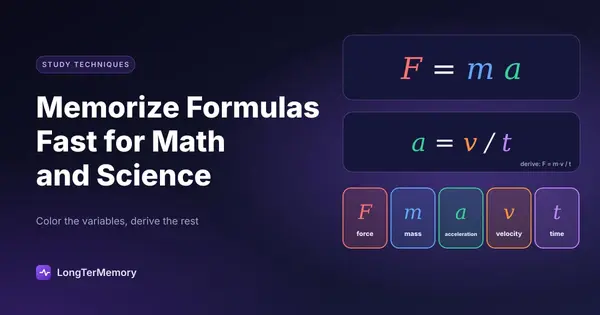
Assign a consistent color to each variable across all your formulas. For physics, you might use:
| Variable | Color | Meaning |
|---|---|---|
| F | Red | Force |
| m | Blue | Mass |
| a | Green | Acceleration |
| v | Orange | Velocity |
| t | Purple | Time |
When you write out F = ma, it becomes a pattern of colors: red equals blue times green. That visual pattern is surprisingly sticky. When you later encounter F = mv/t, the color pattern immediately tells you it’s force equals mass times velocity over time.
The Shape Method
Some formulas have spatial relationships that you can exploit visually. The classic example is Ohm’s Law triangle:
    V
   ───
  I × R
Cover the variable you want to solve for, and the remaining variables show you the formula. Want V? It’s I × R. Want I? It’s V/R. Want R? It’s V/I.
You can create similar visual arrangements for many formula families. The key is that spatial relationships are easier to remember than symbolic ones. Your brain evolved to navigate three-dimensional space, not to parse algebraic notation.
Story Formulas
For formulas with multiple terms, create a story or scenario that walks through the formula left to right. For the elaborative encoding to work, the story should be vivid and slightly absurd , boring stories don’t stick.
For example, the kinematic equation d = v₀t + ½at² could become: “The distance to the pizza place equals your starting speed times time walking, plus half the acceleration times time squared because you keep speeding up when you smell the pizza.” Silly? Yes. Memorable? Absolutely.
Flashcard Design for Equations and Variables
Generic flashcards with a formula on one side and its name on the other are almost useless. Here’s how to design flashcards that actually work for mathematical and scientific formulas:
Card Type 1: Definition Cards
- Front: “What formula relates force, mass, and acceleration?”
- Back: “F = ma (Newton’s Second Law)”
These test whether you can produce the formula from a conceptual prompt.
Card Type 2: Variable Isolation Cards
- Front: “Solve F = ma for acceleration”
- Back: “a = F/m”
These test whether you understand the formula well enough to manipulate it. This is critical because exams rarely ask you to just write down a formula , they ask you to use it.
Card Type 3: Application Cards
- Front: “A 5kg object accelerates at 3 m/s². What force is applied?”
- Back: “F = ma = 5 × 3 = 15 N”
These test whether you can select the right formula and apply it correctly. Application cards are the closest you can get to simulating exam conditions on a flashcard.
Card Type 4: Reverse Engineering Cards
- Front: “The units of the answer are kg·m/s². Which formula gives this result?”
- Back: “F = ma (force in Newtons)”
These train dimensional analysis skills and help you cross-check your work on exams.
The Review Schedule
For formula flashcards, follow this spacing pattern:
- Day 1: Learn new cards, review all
- Day 2: Review only cards you got wrong yesterday, plus new cards
- Day 4: Review all cards
- Day 7: Review all cards
- Day 14: Review only the ones you’re still missing
This schedule front-loads your review when memories are freshest and gradually spaces out as the formulas become more stable in your long-term memory.
The Grouping Strategy
Formulas don’t exist in isolation. They belong to families, and learning them as families makes each individual formula easier to remember because you can see how they relate.
Example: Kinematic Equations Family
| Equation | Variables Used | Missing Variable |
|---|---|---|
| v = v₀ + at | v, v₀, a, t | d |
| d = v₀t + ½at² | d, v₀, a, t | v |
| v² = v₀² + 2ad | v, v₀, a, d | t |
| d = ½(v + v₀)t | d, v, v₀, t | a |
When you see these four equations together, patterns emerge. Each equation is missing exactly one variable. If you know which variable you don’t have, you know which equation to use. That structural understanding makes it almost impossible to forget any individual equation because they’re all connected.
Example: Trigonometric Identities
Instead of memorizing sin²θ + cos²θ = 1, tan²θ + 1 = sec²θ, and 1 + cot²θ = csc²θ as three separate facts, recognize that the second and third are just the first one divided by cos²θ and sin²θ respectively. One formula becomes three.
The principle: whenever you can reduce the number of things you need to memorize by seeing connections between formulas, do it. Fewer items to memorize means less confusion and less forgetting.
The Practice Problem Method
Here’s a truth about formula memorization that most study guides won’t tell you: the best way to memorize formulas is to use them repeatedly in problems. Not to stare at them. Not to copy them out. To actually use them.
When you work through 20 problems that all require F = ma, you’ll never forget that formula. It becomes automatic , like how you don’t need to think about the formula for addition when someone asks you what 7 + 5 is.
The key is to work problems without a formula sheet. If you have the formulas written on a card next to you, your brain has no reason to remember them , it can just look. Put the formula sheet away. When you need a formula and can’t remember it, struggle with it for at least 30 seconds before checking. That struggle is where the memorization happens.
The Problem Set Approach
- First pass: Work through problems with your formula sheet available. Focus on understanding when and how to apply each formula.
- Second pass: Same problems, no formula sheet. Note which formulas you couldn’t remember.
- Third pass: New problems, no formula sheet. This tests both memorization and application with unfamiliar scenarios.
By the third pass, most formulas will be locked in. The ones that aren’t are the ones you need to apply the other techniques to , derivation practice, visual encoding, or targeted flashcard drilling.
Mnemonics That Actually Work for Formulas
Some formulas resist all the elegant approaches above. They’re definitions, not derivations. They don’t group neatly. They just need to be brute-force memorized. For these, mnemonics can help.
Acronym Mnemonics
SOH-CAH-TOA for trigonometry is the classic example:
- Sine = Opposite / Hypotenuse
- Cosine = Adjacent / Hypotenuse
- Tangent = Opposite / Adjacent
Sentence Mnemonics
For the order of operations (PEMDAS): Please Excuse My Dear Aunt Sally.
For the electromagnetic spectrum (radio, microwave, infrared, visible, ultraviolet, X-ray, gamma): Real Men In Vegas Use X-ray Glasses.
The Key to Good Formula Mnemonics
The mnemonic should encode the structure of the formula, not just its name. A mnemonic that helps you remember “the quadratic formula” is useless , you already know it’s called that. You need to remember what it actually says.
For the quadratic formula, a common approach: “Negative boy couldn’t decide (±) whether to go to the radical party. But the boy was square enough to miss out on four awesome chicks. The party was over at 2 am.”
This maps to: x = (-b ± √(b² - 4ac)) / 2a
Is it goofy? Extremely. Does it work? For many students, it’s the thing that finally makes the formula stick.
Common Mistakes That Sabotage Formula Memorization
Mistake 1: Memorizing Without Understanding Units
If you don’t know the units of each variable, you can’t sanity-check your work. Always memorize what each variable represents and what units it carries. When your answer comes out in the wrong units, that’s an immediate signal that you’ve used the wrong formula or made an algebraic error.
Mistake 2: Only Memorizing the “Standard” Form
Exams often require rearranged formulas. If you only know F = ma, you’ll waste valuable time solving for a or m under pressure. Practice algebraically rearranging every formula you memorize. Each rearrangement should feel as natural as the original.
Mistake 3: Trying to Memorize Everything at Once
Your working memory can handle about 4-7 new items at a time. If you’re trying to memorize 30 formulas the night before an exam, you’re going to mix them up. Instead, learn formulas in groups of 3-5, get those solid, then add more.
Mistake 4: Neglecting the Conditions
Many formulas only apply under specific conditions. The ideal gas law (PV = nRT) only works for ideal gases. The kinematic equations only work with constant acceleration. Memorize the conditions alongside the formula. On exams, knowing when a formula applies is often worth as many points as the calculation itself.
Building a Formula Memorization Routine
Here’s a practical weekly schedule for a student who needs to learn a set of formulas for an upcoming course or exam:
Monday: Learn 3-5 new formulas. Understand what they mean, practice derivations if applicable, create flashcards.
Tuesday: Review Monday’s formulas from memory. Work 5-10 practice problems using only those formulas, without a formula sheet.
Wednesday: Learn 3-5 more formulas. Review Monday’s formulas briefly. Create flashcards for the new batch.
Thursday: Work mixed practice problems requiring formulas from both Monday and Wednesday. No formula sheet.
Friday: Full review of all formulas from the week. Identify the ones that aren’t sticking and apply targeted techniques (mnemonics, extra derivation practice, visual encoding).
Weekend: Rest or light review. Your brain needs consolidation time to move formulas from short-term to long-term memory.
This schedule might look like a lot, but the daily time commitment is modest , about 20-30 minutes of focused formula work on top of your regular study time. The key is consistency, not marathon sessions.
To keep formulas fresh across a whole semester, LongTerMemory can generate flashcards from your formula sheets, lecture notes, or textbook PDFs and schedule them with spaced repetition, so each formula comes back for review right before it starts to fade.
The Bottom Line
Formulas aren’t random strings of symbols to be memorized through brute repetition. They’re expressions of real relationships between real quantities, and the more you engage with their meaning, the easier they are to remember.
Derive them. Visualize them. Group them into families. Use them in problems. Design smart flashcards that test application, not just recall. And when all else fails, create a ridiculous mnemonic that makes the structure unforgettable.
The students who never forget their formulas aren’t the ones with naturally good memories. They’re the ones who stopped staring at formula sheets and started actively engaging with what those formulas mean. That’s the difference.