
How to Memorize Information Overnight
Discover how to maximize overnight retention using sleep science, strategic pre-sleep review, and morning consolidation techniques for exam success.
Table of Contents
- What Your Brain Does With New Information While You Sleep
- The Pre-Sleep Study Window
- Why the Last Study Session Matters Most
- What to Study in the Pre-Sleep Window
- The Specific Pre-Sleep Protocol
- Maximizing Overnight Retention: Environmental Factors
- The Sleep Hygiene Essentials
- The Minimum Effective Sleep Dose
- Morning Review: The Consolidation Booster
- The Morning Review Protocol
- What to Eat and Drink in the Morning
- When You Have More Than One Night
- The Most Common Overnight Mistakes
- Pulling an All-Nighter
- Cramming New Material Right Before Sleep
- Using Re-Reading as Your Primary Strategy
- Checking Your Phone in the Night
- The Bottom Line
It’s 10 PM. The exam is at 9 AM. You have more material than you can realistically cover, and a creeping anxiety that no amount of coffee is going to fix. Sound familiar? If you are wondering what “realistically cover” actually means, our guide on how many pages can you memorize in a day breaks down the real limits of daily memorization.
Most students in this situation make the same mistake: they keep studying until 2 or 3 AM, accumulating more and more information through exhausted eyes, and then collapse into a few hours of broken sleep. What they don’t realize is that those final cramming hours are doing remarkably little , while the sleep they’re sacrificing is doing the most important work of all.
The science of overnight memory is both fascinating and immediately useful. Once you understand what your sleeping brain actually does with new information, you can structure your evening study session to maximize what gets retained by morning. And yes, the right approach can make a genuinely significant difference in a single night.
What Your Brain Does With New Information While You Sleep
Here’s something that surprises most students: sleep isn’t just passive rest. During sleep , particularly during slow-wave sleep and REM phases , your brain is actively processing and consolidating everything you learned that day.
The mechanism goes roughly like this: while you’re awake and studying, your hippocampus (the brain’s short-term memory hub) temporarily stores new information. But the hippocampus has limited capacity. During sleep, it replays the day’s experiences to the neocortex, where long-term memories are formed and stored. This transfer process , called memory consolidation , is why a concept you study the night before an exam can feel surprisingly solid the next morning, even if you were exhausted when you studied it.
As the research on sleep and memory consistently shows, different sleep stages consolidate different types of information. Slow-wave sleep (the deep early-night stages) primarily consolidates factual and conceptual knowledge , the kind you need for most academic exams. REM sleep (the later stages of the night, more prominent in the second half of your sleep) consolidates procedural skills and emotional memories, and is especially important for creative insight and problem-solving.
This has a crucial practical implication: if you cut your sleep short, you lose disproportionately from REM. That 6-hour night instead of 8 doesn’t cut off the last hour of sleep , it cuts off the richest phase of memory consolidation.
The Pre-Sleep Study Window
Knowing how sleep consolidation works, you can engineer what you study before bed to take maximum advantage of overnight processing.
Why the Last Study Session Matters Most
Research on the temporal gradient of consolidation shows that the memories most recently formed before sleep are the ones most actively consolidated during the night. Your brain hasn’t gotten around to fully “filing” them yet, which means it will do more work on them while you sleep.
This is excellent news for your cramming session. What you study last gets processed most intensively overnight. The catch: it has to be studied actively enough to form a real memory trace in the first place. Passively reading your notes at midnight creates a very faint trace that sleep can only do so much with.
What to Study in the Pre-Sleep Window
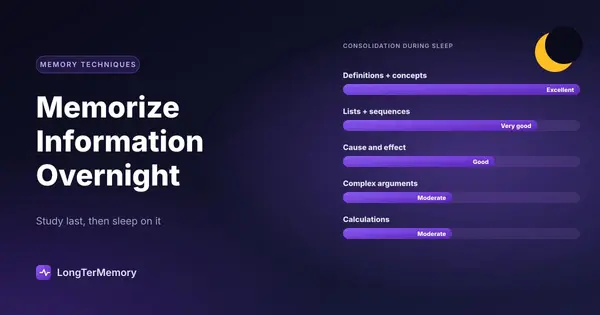
Not all information is equally suited to overnight consolidation. Here’s a rough ranking by consolidation effectiveness:
| Information type | Consolidation during sleep | Study strategy |
|---|---|---|
| Factual definitions and concepts | Excellent | Active recall before sleep |
| Structured lists and sequences | Very good | Repeated recall until fluent |
| Cause-and-effect relationships | Good | Explain from memory |
| Complex arguments and essays | Moderate | Outline from memory |
| Calculations and procedures | Moderate | Work through examples |
| Fine motor skills | Excellent (but different mechanism) | Not exam-relevant for most students |
Definitions, facts, and structured sequences are the sweet spot for overnight memorization. They consolidate well during slow-wave sleep, and active recall during your evening session gives them a solid enough trace to work with. For structured lists and sequences, the memory palace technique is especially effective because it stores each item along a familiar spatial route that sleep can reinforce.
The Specific Pre-Sleep Protocol
Here’s what to do in the 60-90 minutes before bed:
Step 1: Triage your material (10 minutes) Write a list of everything you need to know. Then mark each item with a priority: High (definitely on the exam, don’t know it solidly), Medium (likely on the exam, somewhat know it), Low (unlikely or already solid). Your study time goes to High first.
Step 2: Active recall drill (40-50 minutes) Work through your High-priority items using active recall only , no re-reading. Cover the answer and try to produce it. For definitions: say the definition out loud without looking. For concepts: explain what it is in one or two sentences. For sequences: recite the list from start to finish.
When you get something wrong or blank, look at the correct answer, then immediately cover it and try again. Don’t spend time re-reading , spend time attempting retrieval.
Step 3: Decay review (10 minutes) Go back through everything you got wrong during Step 2. Do a final pass on just those items. The goal isn’t to master them , it’s to give your brain a fresh, recent trace on the most difficult material so sleep consolidation has something to work with.
Step 4: Quiet mental review (5-10 minutes) In bed, before falling asleep: mentally run through the key concepts in your head. Don’t look at your phone or notes. Just rehearse quietly. This low-intensity consolidation activity as you drift toward sleep may help prime overnight processing , and more practically, it keeps your final waking thoughts on the material rather than on Netflix.
Maximizing Overnight Retention: Environmental Factors
The quality of your sleep determines how effective overnight consolidation is. A restless, interrupted night does far less work than a deep, continuous one.
The Sleep Hygiene Essentials
Stop looking at screens 30 minutes before bed. Blue light from phones and laptops suppresses melatonin production and delays sleep onset. Even reading your notes on a bright screen in the final 30 minutes before bed may actually interfere with the sleep quality that consolidates those notes overnight. Use physical notes or books for your pre-sleep review.
Keep the room cool. Your body temperature naturally drops as you fall asleep, and a cool room supports this process. Studies consistently find that slightly cool sleeping environments correlate with better sleep quality than warm ones.
Avoid alcohol. Many students use alcohol to “wind down” after a stressful study day. This is a serious memory mistake. Alcohol disrupts REM sleep , it’s one of the most reliable REM suppressors known to science. A drink before sleep will directly reduce the quality of overnight memory consolidation.
Sleep in your own bed if possible. “First night effect” is a real phenomenon: when you sleep somewhere unfamiliar, one brain hemisphere stays on partial alert, reducing deep sleep. If you’re preparing for an important exam, this is not the week to crash somewhere else.
The Minimum Effective Sleep Dose
There’s a myth that elite students sleep less. In reality, sleep restriction consistently impairs memory, attention, and problem-solving , the core skills of any exam. But if a full 8 hours isn’t realistic the night before an exam, aim for at least 6-7 hours, and focus on quality. A complete 6-hour sleep with deep slow-wave cycles does more for memory than a fragmented 8-hour night of light sleep.
If you absolutely must sacrifice sleep for study time, cut from the beginning of the night (study late, sleep full) rather than the end (sleep early, wake up early). You preserve REM-rich late sleep and still study the most recent material , which gets processed most intensively overnight.
Morning Review: The Consolidation Booster
Sleep consolidates your memories, but it doesn’t lock them in permanently. The hours immediately after waking are a critical window: newly consolidated memories are briefly more accessible and easier to reinforce.
Most students waste this window by skipping morning review entirely. That’s a significant missed opportunity, especially the morning of an exam.
The Morning Review Protocol
10-15 minutes immediately after waking , before eating, before your phone, before anything else:
- Don’t look at your notes first. Start by trying to recall everything from last night’s study session from memory. Write it down or say it out loud.
- Then check. Go through your High-priority items and test yourself with brief active recall.
- Flag any gaps. Anything that still isn’t solid gets one more focused pass , read it carefully, then immediately close and recall.
This brief morning session does something specific and valuable: it tests whether overnight consolidation worked, catches anything that didn’t consolidate properly, and re-activates everything you studied before you need to use it in a few hours.
What to Eat and Drink in the Morning
Hydration significantly affects cognitive performance. Your brain is roughly 73% water, and even mild dehydration of 1-2% body weight impairs working memory, attention, and processing speed. Drink a large glass of water as soon as you wake up , before coffee, before food. You’ve been slightly dehydrated all night.
Breakfast before an exam isn’t just a nice idea , it’s cognitive fuel. Studies on exam performance consistently find that students who eat breakfast perform better than those who don’t, with protein and complex carbohydrates (eggs, oatmeal, yogurt) providing more stable cognitive energy than sugar-heavy options that cause a mid-exam crash.
When You Have More Than One Night
One night is what it is. But if you have two or three nights before an exam, the overnight approach becomes dramatically more powerful , because each night of sleep consolidates what you studied the previous day, and each morning review reinforces those consolidated memories before you add new ones.
The optimal two-night approach:
Night 1: Study your most important and most difficult material. Active recall drill before sleep. Full sleep.
Morning 1: Quick review of night 1 material. Note anything that didn’t consolidate.
Day 1: Study medium-priority material. Review morning 1 gaps.
Night 2 (night before exam): Review everything , starting with gaps from morning 1, then night 1 material, then day 1 material. Active recall throughout. Full sleep.
Morning of exam: 15-minute recall walkthrough. Light review. No new material.
This two-night approach leverages sleep consolidation twice, which can produce significantly better retention than the same total study hours concentrated into a single session.
The Most Common Overnight Mistakes
Pulling an All-Nighter
An all-nighter produces temporary alertness through stress hormones and caffeine, but it skips consolidation entirely. You’re walking into the exam with fatigued working memory, impaired attention, and information that exists in a vulnerable temporary state rather than consolidated long-term storage. Studies on academic performance show that all-nighters don’t just fail to help , they often produce worse results than sleeping with a shorter study session.
Cramming New Material Right Before Sleep
The pre-sleep window should be for reviewing and recalling material you’ve already studied , giving your brain strong recent memory traces to consolidate. Encountering completely new material right before sleep isn’t efficient: the hippocampus needs to do initial encoding work before consolidation can begin, and you don’t have time for that at 11 PM.
Using Re-Reading as Your Primary Strategy
Re-reading before bed feels productive but produces very little benefit for overnight consolidation. For sleep to consolidate a memory effectively, that memory needs to exist with enough strength to begin with. Passive re-reading barely encodes information at all. Active recall , even if imperfect , creates a much stronger trace for your sleeping brain to work with.
Checking Your Phone in the Night
Looking at your phone if you wake up during the night , even briefly , disrupts the sleep architecture that makes consolidation effective. Blue light aside, the mental activation from even a short scroll interrupts the rest cycles your brain uses to replay and consolidate memories. Put your phone across the room.
If you need a full plan rather than just memory techniques, see our guide on how to study for exams in one night, which covers triage, active recall, and how much sleep to protect.
Next time you have more than one night, give yourself a head start. LongTerMemory turns your notes and PDFs into question and answer flashcards in minutes and schedules them with spaced repetition, so the material is already well consolidated before the night before the exam.
The Bottom Line
You can’t fully compensate for weeks of missed study with a single night. But you can absolutely optimize that single night to get significantly more out of the study time you have.
If you have a full day before the exam rather than just one night, you can build a more complete plan around the same principles. Our guide on how to memorise chapters for an exam in one day walks through a full 24-hour study sprint with triage, deep-study blocks, and active recall.
Study the most important material last. Use active recall, not passive reading. Get enough sleep , this isn’t optional, it’s the mechanism. Do a morning review to catch what didn’t consolidate and reinforce what did.
If you want to make the most of the time before sleep, use our guide on how to memorize fast in 30 minutes to structure your pre-sleep study window.
Your sleeping brain is your study partner. The students who understand that treat sleep as part of their study strategy, not as something that competes with it. Use those eight hours well.